


There are an estimated 18.1 million goats in Ethiopia and the newly independent state of Eritrea (FAO 1992a). They are kept in a wide range of production systems reflecting the diversity of the Ethiopian and Eritrean environments. Approximately half the goat population is kept by pastoralists in the lowlands of the south, east and west, while the remaining 50% are found in small flocks on mixed highland farms. To their owners goats are a valuable source of milk, meat, cash and security against the vagaries of the environment. Yet despite their economic importance to many of Ethiopia's and Eritrea's most vulnerable groups, little attention has been paid to their development through research and extension.
In 1988 the British non-governmental organisation (NGO) FARM-Africa initiated a Dairy Goat Development Programme in collaboration with the Ministry of Agriculture, Alemaya University of Agriculture, Awassa College of Agriculture and several international and indigenous NGOs. The programme aimed to redress the past neglect of goats through an-extension programme in the highlands of south and east Ethiopia, a cross-breeding programme and through supporting research on goats.
It was clear at the start of the programme that a comprehensive description of the diverse goat types found in Ethiopia and Eritrea had never been made. Descriptions of localised goat types had been attempted during the colonial era in Eritrea and Somaliland. Marchi (1929 cited in Mason and Maule 1960) and Gadola (1947 cited in Mason and Maule 1960) described the variety of small goats kept by various Eritrean tribes such as the Beni-Amer, Assorta and Bilena. Salerno (1939 cited in Mason and Maule 1960) described a short-haired goat of the Danakil desert, and the white and variegated coloured goats of the Hararghe highlands and lowlands. Girardon (1939 cited in Mason and Maule 1960) mentions the Bati goat of Wollo valued for its skin, the Arusi goat and the goats of the western lowlands of Ethiopia. Drake-Brockman (1912 cited in Mason and Maule 1960) described the Somali goats he encountered in Somaliland. In all, 17 goat types were described during the period 1920-50.
A systematic description of the goat types and management systems should be considered a prerequisite for planning the rational use of the national goat resources. In addition, breed characterisation is the first step in the urgent task of genetic resource conservation (Baker 1992; FAO 1992b).
In order to make a first attempt at identifying the goat types of Ethiopia FARM-Africa began a National Goat Breed Survey of Ethiopia and Eritrea in 1990. The objectives of the survey were to:
· identify and characterise the indigenous goats types in Ethiopia and Eritrea
· describe the traditional goat husbandry practices in different production systems
· develop and test a method for the rapid survey of indigenous livestock.
Ethiopia has the largest livestock population of any country in Africa. The majority of the cattle population, estimated at 28 million, is found in the highlands (Table 1) where the animals supply draft power for cultivation and milk for home consumption and sale. The bulk of the sheep population, estimated at 23 million, is also found in the highlands. Sheep are readily traded, providing a useful source of cash and store of wealth. It was formerly believed that the majority of the goat population is found in large flocks in the lowlands where they are kept by pastoralists for milk production, for slaughter and for sale. However, a recent survey of agriculture in the highlands of Ethiopia found that 9.6 million goats are reported to be kept in the highlands (CSA 1995). This represents about 50% of the estimated total goat population. Evidence is accumulating that there has been an underestimate of the importance of goats kept in small flocks on mixed farms in the highlands. The distribution of goats in Ethiopia and Eritrea is presented in Figure 1.
Figure 1. Map of goat distribution. - Reprinted with permission from the Ethiopian Mapping Authority.
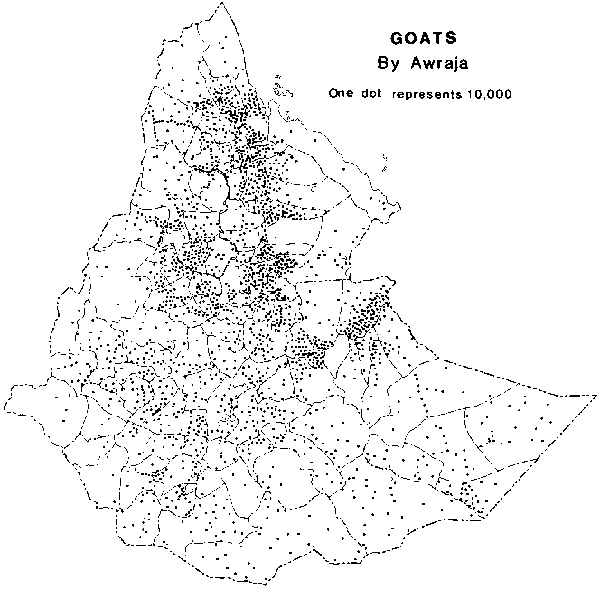
Source: EMA (1988).
Table 1. Distribution of Ethiopian and Eritrean livestock by agro-ecological zone.
|
Zone |
Land area % |
Cattle (%) |
Sheep (%) |
Goats (%) |
Ruminant TLU % |
Human population % |
|
Arid |
44.5 |
14.0 |
10.0 |
38.0 |
19.0 |
5.6 |
|
Semi-arid |
10.1 |
14.0 |
16.0 |
22.0 |
14.2 |
43.4 |
|
Subhumid |
7.7 |
14.0 |
8.0 |
5.0 |
12.2 |
4.9 |
|
Highland |
37.7 |
58.0 |
66.0 |
35.0 |
54.4 |
46.1 |
Source: Jahnke (1982).
The agroclimatic zonation commonly used in Ethiopia is presented in Table 2. Climate is predominantly determined by altitude which in Ethiopia may range from below sea level in the Danakil desert to above 4000 metres in the Simien mountains. This huge altitude range creates a wide variety of environments which may be classified into the 12 zones defined in Table 2.
Table 2. The agroclimatic zones of Ethiopia.
|
Altitude (m) |
Annual rainfall (mm) |
||
|
Less than 900 |
900-1400 |
More than 1400 |
|
|
Above 3700 m |
|
|
High Wurch |
|
|
|
|
(Afro-alpine steppe, meadow) |
|
|
|
|
A: None, frost limit |
|
3200-3700 m |
|
Moist Wurch |
Wet Wurch |
|
|
|
(Subalpine) |
(Subalpine) |
|
|
|
A: Only barley, one crop per year |
A: Only barley, two crops per year |
|
2300-3200 m |
|
Moist Dega |
Wet Dega |
|
|
|
(Afro-montane forest woodland) |
(Afro-montane forest-bamboo) |
|
|
|
A: Barley, wheat and pulses; one crop per year |
A: Barley, wheat, noug, pulses; 2 crops per year |
|
1500-2300 m |
Dry Weyna Dega |
Moist Weyna dega |
Wet Weyna dega |
|
|
(Savanna) |
|
|
|
|
A: Wheat, teff, rarely maize |
A: Maize, sorghum, teff, enset (rare), wheat, noug, finger millet,
barley |
A: Teff, maize, enset (in western parts), noug, barley |
|
500-1500 m |
Dry Kolla |
Moist Kolla |
Wet Kolla |
|
|
A: Sorghum (rare), teff |
A: Sorghum, rarely teff, noug, finger millet, peanuts |
A: Mango, taro, sugar cane, maize, coffee, oranges |
|
Below 500 m |
Bereha |
|
|
|
|
(Acacia-Commiphora bushland) |
|
|
|
|
A: Crops only with irrigation |
|
|
A: main crops; S: soils; T: natural trees; L: main livestock species.
