5.3.1 Perfect competition
5.3.2 Imperfect competition: monopolies and oligopolies
5.3.3 Horizontal and vertical integration
5.3.4 Separation of markets
5.3.5 Product differentiation
5.3.6 Price movement due to seasonal and cyclic variations
Module 3 showed how market supply and demand curves were derived from aggregated individual supply and demand. The intersection of the two curves gave us equilibrium market prices and quantities. We also saw how supply and demand elasticities could be used to make market price forecasts. We will now look a little more closely at how the marketing system and its structure can influence the determination of price. In this context, six main characteristics of the marketing system which influence price will be discussed:
· perfect competition
· imperfect competition: monopolies and oligopolies
· horizontal and vertical integration
· separation of markets
· product differentiation
· seasonal and cyclic variations.
For supply and demand to determine price, a competitive situation must exist in the market. Competition is an ingredient in most markets which are not centrally-planned. Competition, by definition, exists when no single economic agent, whether buyer or seller, can control the price in the market. This will occur when each agent's activities in the market make up only a small part of total market activity; because many other agents are carrying out the same roles. New agents can enter the market at will if they feel there are profits to be made. Price is thus determined by the market as a whole. In theory, each agent must simply accept that price. Ideally, the market would also be large enough to absorb whatever quantity of goods is traded by any single agent at the ruling price. Since, in perfect competition, it is up to the agent to decide the quantity traded, sellers and buyers are all quantity-fixers and price-takers. Each agent chooses to trade that quantity which will maximise his or her profits and which he or she has the resources to handle.
In such a market, no agent is earning more than a normal profit level, comparable to the profits of all others in the market. Any occurrence of unusually high profits will cause new agents to enter that activity, driving down the price until profits return to normal. Market prices thus act as a signal to participants, informing them where best to expand their efforts and resources in order to achieve the greatest returns. High prices to sellers in one market sector will result in greater efforts to supply that sector. Similarly, low prices to buyers will cause greater demand for those goods, again shifting resources appropriately. Traders will move their resources to those goods where the margin, or difference between the price they pay and the price they receive, is the greatest.
The movement of resources in response to price signals occurring in a competitive market results in one of the most important and desirable aspects of such a marketing system: the optimal allocation of resources. The producer is able to respond, through market signals, to the changing needs of the consumer. A well-operating market provides for the most efficient use of resources, thus providing the potential for greater wealth creation and economic development.
The ingredients for such a competitive system are thus:
· A large number of economic agents in every market activity, with unhindered entry and exit.· A rapid and extensive flow of information, especially relating to prices, quality and quantity, between consumers, traders and producers.
· Institutional and physical infrastructures which support the movement of goods and which enable the above two requirements to be met.
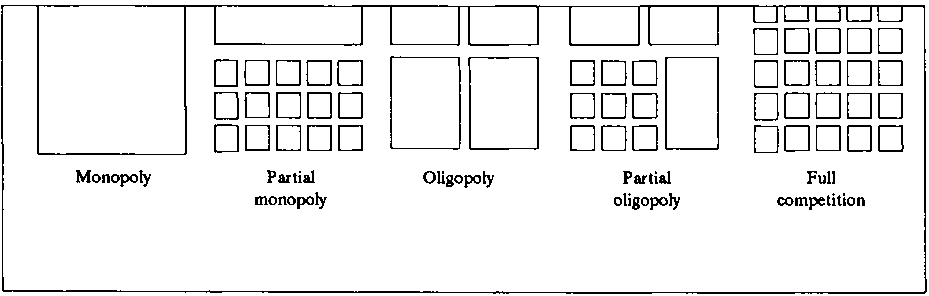
A system of perfect competition is often difficult to find. Many marketing systems are characterised by some degree of imperfect competition, where some agents have the ability to influence directly or indirectly, if not control, market prices. Imperfect competition occurs when one of the above requirements is not met and is usually seen in two general forms: monopoly and oligopoly. A monopoly exists when a single large supplier can dictate the market price because buyers have no alternative suppliers. (Monopsony is the case of a single buyer). An oligopoly occurs when there are only a few large actors in the market. This reduces competition and allows these actors (whether deliberately in concert or not), to influence market prices to their benefit. Both of these situations result in increased costs for other market actors and inefficient use of market resources as a whole. Inefficient resource use results when monopolists receive greater returns than they "deserve" (i.e. greater than "normal" profits). Those resources cannot then be used elsewhere. Figure 2 illustrates the concepts of complete and partial monopolies and oligopoly.
Figure 5.2. Levels of competition between buyers and/or sellers.
Source: Abbot (1979: p. 213.
Market integration refers to the expansion of some firms to the point that they begin to occupy larger portions of the market, in terms of either activities or market share. Horizontal integration occurs when some firms grow so large within one trade that they are able to dominate that trade. Vertical integration is the expansion of activities of a firm until it controls its raw materials at one end and its markets at the other. Contract farming is a form of quasi-integration where the buyer assumes some of the risks and also has some control over production decisions.
Agents with some degree of monopoly power may be able to separate markets. If agents can control the movement between markets, they can control not only the total quantity sold but the price in each market. Under this form of discriminatory pricing, sellers take advantage of differences in demand in each market. This is done by charging a higher price in a high-income or inelastic demand market and a lower price in a low-income, elastic demand market. A micro-level example is the pricing arrived at by individual bargaining. If each buyer is unaware of what the other buyers paid, the seller can charge what the buyer can, and is willing, to pay. In a traditional livestock market, buyers are, however, aware of existing prices. A tourist buying souvenirs, on the other hand, may not be, and thus may be subject to price discrimination. On a larger scale, separation of markets might take place regionally. Separation of markets can also result from official restrictions on product movement.
Product differentiation, which can also lead to market separation, occurs when otherwise similar products are differentiated by quality or presentation (i.e. packaging, brand name etc). An example is the urban red meat market, where prices in the elite market, sold by licensed butchers and supermarkets catering largely to higher-income consumers, may be much higher than those in shops selling to the larger community.
As with all agricultural markets, livestock markets are susceptible to seasonal variation. Fresh milk prices fluctuate in the same way as food crop prices - moving inversely with supply on the market as supply diminishes in the dry season. Meat prices move in a slightly different manner with natural shocks. While food prices are likely to rise during bad years when crop production falls, meat prices will fall during the same years as producers attempt to sell livestock they can no longer maintain for lack of feed or water. The bad year price rise in food causes demand to fall and sellers to hoard supplies, contributing to reduced consumption. This lengthens the period during which food supplies will last. The consequences of a bad year on the livestock market, however, are the opposite. The perishability of livestock during such a year causes supplies to be consumed more quickly than normal. The effects may be felt for years as producers attempt to rebuild their herds.
Cyclical price variation is not due to natural shocks, but is based on the reactions of supply to changing market conditions. Because sustained increases in livestock production, in response to some increase in demand, may take some years to bring about, during the lag prices may be sustained at a high level, and fall later.