


Chapter 3 ECONOMIC AND DEMOGRAPHIC BACKGROUND
This chapter presents, in quantitative and qualitative terms, the scenarios for population development, economic growth and the construction sector, which underlie other parts of the study, especially the econometric analysis of supply and demand for forest products in chapter 6.
Wherever possible, the scenarios presented are authoritative official scenarios prepared by international agencies specialised in the topic under consideration, as the authors of ETTS V have no particular expertise in these fields. However, where no such scenarios exist or are not specific enough for the purposes of ETTS V, the authors have not hesitated to make their own estimates. This has often been necessary for the long-term future, as few other analysts (except demographers) find it possible or useful to make forecasts 30 years into the future. This chapter will also draw attention, where appropriate, to major areas of uncertainty, which might be the subject of sensitivity analysis at a later stage in the study.
This chapter draws heavily on the work done by Messrs. Peck and Descargues on the policy context, discussed in chapter 2 and issued in an ETTS V working paper.
World population in the mid 1990s stands at over 5.3 billion people, of which over 75 per cent are in developing countries. The rapid growth which seemed to have started in the eighteenth or nineteenth century, is expected to continue into the twenty first: the planet will have about 8.5 billion people in 2025. The rate of growth is, however, expected to slow down, from around 2 per cent a year in the 1970s, to about 1.3 per cent a year in the 2020s; nevertheless, this slower rate of growth still implies an annual increase of 90 million people (more than the total 1995 population of Europe's largest country, Germany). The reasons for the decline in the fertility rate are expected to be greater material prosperity, better education, especially of women, and governmental policy, driven by fears of the consequences of overpopulation.
In Europe however, the picture is very different, with fertility rates at or below the replacement level and very stable populations, increasing only marginally (in many cases, through net immigration, not natural replacement). As a result, Europe's share of world population is expected to fall further, from 9.4 per cent in 1990 to 6.1 per cent in 2025. There is one exception to this general picture: Turkey, with a present population of 56 million is expected to reach 93 million people in 2025, thus becoming Europe's most populous country by far.
The main demographic issues of interest to the forest and forest products sector are:
- will the enormous expansion of world population, which is certain to occur in the next quarter century, place unsustainable pressure on natural resources, including forests and wood?, and
- how will Europe adapt to the changes in demographic structure, notably the aging of the population, reducing the ratio of "productive" to "dependent" people (or people of working age to the total of the elderly and the young)? This question is highly relevant to strategic planning for social security systems, employment conditions (retirement age), and the housing stock (special housing for retired people).
ETTS V assumes that there will be no catastrophic demographic or social change, unforeseen by the official demographic scenarios. There is not expected to be any major war, health disasters or mass migration. If any of these occurred at a significant level, scenarios for the forest and forest products sector would become meaningless.
The most important influence on the demand for forest products is the overall growth of the economy. It is extraordinarily difficult to forecast long-term macroeconomic trends with any degree of certainty, given the many important factors which interact in complex ways, and the importance of public policy in determining trends. However, as a base scenario for economic development is necessary for any rational strategic planning, a number of official and unofficial agencies make regular efforts to create such scenarios, the results of which are widely used for national and sectoral policy making.
FIGURE 3.2.1
Europe: scenarios for GDP growth
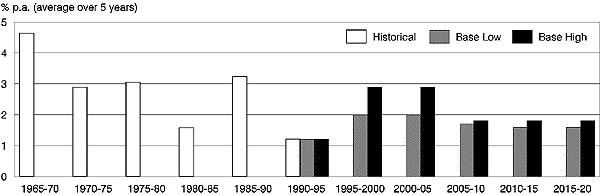
Work carried out by the ECE secretariat presents a synopsis of the available medium- and long-term global perspectives (EC.AD/R.69, R.76 and R.83). This shows a high degree of consensus on medium-term trends between the models considered, which are the United Nations LINK Project, the projections prepared by the national experts of the World Bank, the International Monetary Fund, and the OECD.
The consensus view of the major models listed above, as articulated by the ECE secretariat, is that the base line scenarios foresee that the depressed climate of recent years (the early 1990s) will give way to a gradual and durable recovery. The growth rate for all industrialised economies should be between 2.4 and 3.0 per cent per year until the beginning of the next century. For the European Union a rate between 2.5 and 3.2 per cent per year is forecast.
In all the base line scenarios, the return to growth is linked to the implementation of strict policies both at the national and international level. Budgetary rationalisation in countries with excessive deficits, strict monetary policy and the maintenance of an open international environment are all prerequisites for achieving the targets set by the various scenarios. Only after these conditions have been met can growth in the industrialised countries gradually approach its potential medium-term level.
However, while the application of the base-line scenarios makes it possible to lay the foundations for more sustained long-term growth, it is insufficient to meet the challenges facing a large number of industrialised countries, such as unemployment. In the scenarios, unemployment remains close to 10 per cent in western Europe. Similarly, according to most of the scenarios, the budgetary and current account imbalances would only be corrected gradually, while the risk of tension on the monetary and financial markets, should the climate of international cooperation deteriorate, would remain.
Several transition economies have only just resumed growth towards the middle of the 1990s, and output is still falling in a few others. In several countries, it will be necessary to wait until the beginning of the next century for the decline in production resulting from industrial restructuring to be offset by the emergence of new activities better suited to the requirements of the market economy and of international competition.
The next ten years should see a return to more sustained growth in the developing countries as a whole. In the 1980s and 1990s, this group recorded GDP growth of about 5 per cent per year, with forecasts for medium-term (1995-2002) growth of 5.6 per cent per year. In Africa, Latin America, and the Middle East, medium-term growth would be around 4 per cent, while it would be nearly 7 per cent for East Asia.
All of the base-line scenarios considered point to a yearly progression of world trade of about 6-7 per cent.
These consensus growth rates, of over 2.5 per cent per year average over the medium term (e.g. 1997-2002) are, however, roughly equivalent to those of the most expansive post war years, the 1960s and early 1970s, and much higher than those of more recent years, especially the depressed period in the early 1990s. These rates may well be achieved until the early years of the twenty-first century, as governments give priority to employment and growth. However, it must be considered unlikely that these rates of growth could be maintained for 25 years. One or more negative factors, such as overheating, economic imbalance, policy errors or resource shortages, would interrupt or slow down this long period of sustained and balanced growth. In the very long term, furthermore, economic growth is constrained essentially by population growth and by productivity gains due to technological progress. We have seen that population growth will be small: can technological progress alone drive growth of nearly 3 per cent per year for 25 years? In the absence of any official forecasts of very long-term economic growth, ETTS V therefore proposes long-term growth rates, which are somewhat below the consensus for the medium term, as a basis for the econometric projections. This judgement is supported by the weaker-than-expected performance of the market economies in 1995 (i.e. after the consensus forecasts for medium-term growth were prepared).
FIGURE 3.2.2
ETTS V scenarios for GDP of European market economies
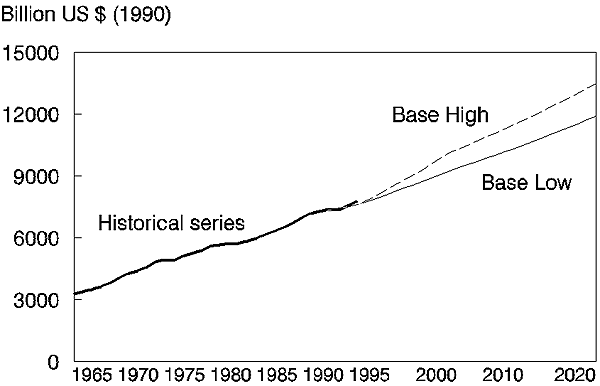
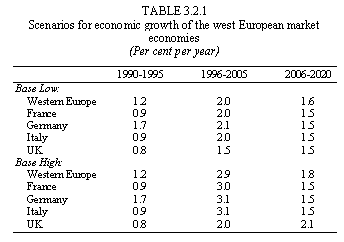
For the econometric projections in chapter 6, ETTS V has prepared two scenarios for economic growth: Base Low and Base High. The latter is based, up to 20051, on the FAO compendium of macroeconomic indicators, itself based on World Bank data, which do not differ significantly from the consensus scenarios described above. The Base Low scenario is rather lower. Both scenarios show slower growth rates for the period after 2005, in recognition of the unlikelihood of sustained strong growth over a 25-year period. The scenarios for economic growth for the European market economies as a whole and for the four largest economies are shown in table 3.2.1.
Construction, and, in particular, gross fixed capital formation in dwellings, has the most direct influence on the level of consumption of sawnwood and wood-based panels. It is affected by many factors, including disposable income, interest rates, construction and land costs (themselves influenced by land-use planning policy), the state of the existing housing stock (e.g. the presence of large numbers of post-war dwellings, many rapidly and shoddily built and now needing replacement or major renovation), and social and demographic changes (proportion of elderly, number of households, influenced by trends for marriage, divorce and age of leaving home for young people), government policy (mortgage subsidies), etc. There are major differences in many of these areas between countries, even those which appear similar in other respects.
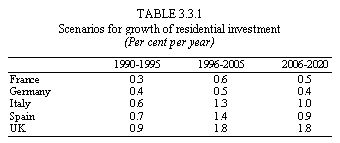
Residential investment does not follow the same trend as GDP. EUROCONSTRUCT, a consortium of specialised research institutes which prepare medium-term (five-year) outlooks by sector for the major market economies, expects moderate growth to 1998, especially in the crucial sector of repairs and maintenance, which is already the largest part of construction in many countries. However, like the macroeconomic scenarios, this time span is not long enough for the purposes of ETTS V. Therefore, the relationship between residential investment and GDP over the period 1964-92 has been modelled and the elasticities obtained applied to the GDP scenarios.2
The estimated growth rates for residential investment in the five largest economies are shown in table 3.3.1 (residential investment scenarios were only prepared for the nine countries for which detailed modelling was undertaken).
1
For the period 1990-95, complete data are not yet available, but data for the years prior to 1994 have been supplemented by official short-term forecasts for 1995, so that the "scenario" for the first half of the 1990s is essentially reliable historical data.2
The same procedure was followed for the other components of the end-use index, manufacturing production and furniture production. All three series are clearly interlinked, especially residential investment and furniture manufacture.
