Abstract
Introduction
Methods and materials
Results
Conclusions
Acknowledgements
Résumé
References
J. Betker*
(* Institute for Agricultural Engineering, Hohenheim University, Stuttgart, F.R. Germany)
Weeding is a major labour bottleneck in traditional agricultural systems in semi-arid Western Africa that can be overcome by the introduction of animal-drawn implements. The performance of 5 weeding implements (flexible harrow, Arara, houe asine, HATA and Hiler) was analyzed comparing efficiency and labour time. Labour time decreased from 40.6 in/ha for the traditional hand tool to 9.0 - 11.9 in/ha for the animal-drawn implements. Efficiency of mechanized weeding reached up to 56.8% compared to 92.8% for manual weeding. The efficiency of weeding with animal-drawn implements can be improved by increasing the number of passages per row. The newly developed low-cost implement HATA ('Hiler a traction asine') achieved similar values for efficiency and labour time to other animal-drawn equipment and showed a potential for wider adoption due to traditional manufacturing. Experiments will be continued under on-farm conditions.
In the semi-arid zone in Western Africa mechanical weed control is one of the major labour bottlenecks in traditional agriculture (Delgado and McIntire 1982). The use of animal-drawn implements can reduce labour demand considerably. In Niger, however, their use remains limited in rainfed agriculture (Starkey 1988) due to various factors (lack of trained animals, high costs of equipment, problems in distribution, repair and maintenance of implements, training of the farmers). This research was undertaken to compare the traditional hand tool for weeding on sandy soils to animal-drawn implements with regard to labour time requirements and efficiency. In addition to existing models a low-cost implement, which integrated traditional parts and was manufactured locally, was developed and included in the experiments.
Implements
Five implements-two oxen-drawn, two donkey-drawn and one hand tool - were examined in the experiments (Table 1). The development of a new model was based on several criteria:
· local manufacturing by village blacksmiths (no welding, only forging and riveting) to ensure maintenance and repair and to reduce costs,· integration of traditional elements to facilitate the adoption by and the training of farmers,
· light construction for donkey traction and for easy transport from the village to the field.
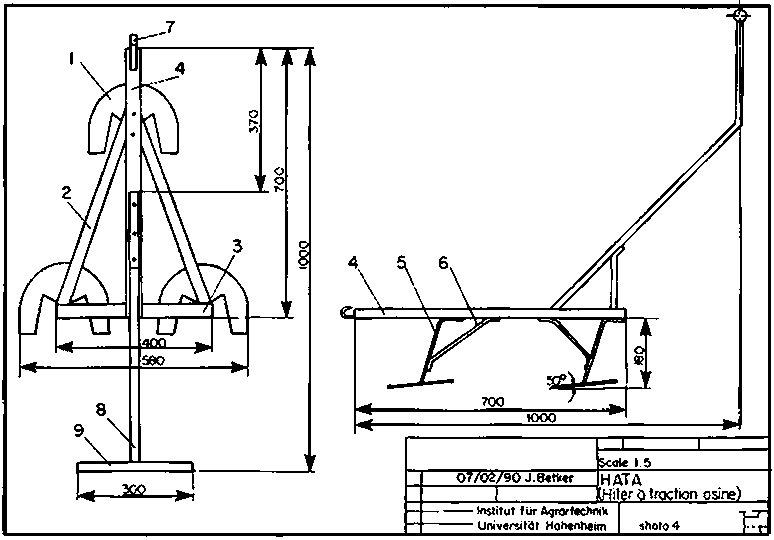
Fig 1. Schematic drawing of HATA ('Hiler a traction asine')
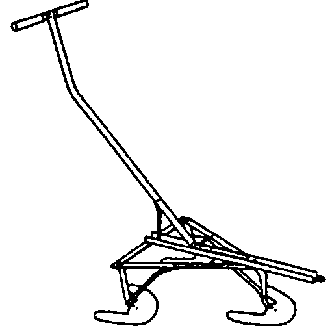
Table 1. Description of weeding implements.
|
Implement |
Characteristics |
|
flexible harrow |
a model widely used in Europe for weed control on sandy soils. The flexible structure curves the surface of the ground and therefore can work on ridges. The oxen-drawn equipment is 1600 × 1550 mm wide and weighs 37 kg. Imported model. |
|
Arara |
an oxen-drawn toolcarrier equipped with 3 goose-feet; its weight is 32.5 kg with a working width of 600 mm. Cost: 25,000 FCFA. Manufactured in modern workshop. |
|
'Houe asine' |
a light donkey drawn hoe with 3 goose-feet and an adjustable working width from 250-500 mm and a weight of 11 kg. Cost 18,000 FCFA Manufactured in modern workshop. |
|
HATA |
a prototype development of a donkey-drawn hoe ('Hiler a traction asine') with 2 Hiler blades. Weight of 9.0 kg. Cost: 6,000 FCFA. Manufactured by local blacksmith (See Figs. 1 and 2). |
|
Hiler |
a traditional hand tool for weeding consisting of a metal blade, a wooden beam and handle. Cost: 1,500 FCFA. Manufactured by local blacksmith. |
Note: 1000 FCFA =3.30 US$
Measuring Methods
The five implements were compared according to efficiency and labour time. For the animal-drawn models draught forces and working depth were also measured. Efficiency 'e' was determined by collecting weed samples before and after the treatment (sample size 1m2, 4 repetitions per plot). Sample were dried and e was calculated by the relative difference between total dry matter of weeds before (m1) and after (m2) the weeding treatment
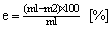 (1)
(1)
Relating efficiency (= productive output) to power input the ratio h p is determined.
h p = e/P [% /W] (2)
Labour time 't' is determined by stop-watch and recorded separately for working, turning and preparation time for animal- drawn equipment. Calculation of labour time for these implements takes into account that two persons are normally needed for weeding operations, one to guide the animal and one to handle the implement. A labour time related ratio rt, calculated by
h t =e/ttot [% /h] (3)
allows the comparison of labour time efficiency for different models.
Mechanical parameters (draft force F [N], working depth d [cm]) are measured by load cell and ultra-sonic sensor and recorded continuously.
Experiments were conducted on sandy soils (93.8% sand, 2.9% loam, 3.3% clay) in millet crop (Pennisetum americanum), laid out as a randomized bloc design with four replications (plot size 4m × 30m).
The efficiency of weeding was lowest for the flexible harrow (e =27%); it scratched the ground at a low depth and therefore was not able to uproot a high percentage of weeds. The second oxen- drawn equipment, the Arara, reached peak efficiency (e = 56%) while working at a depth of d =10 cm. The reversible tines of the 'Houe asine' uprooted the weed at a working depth d =7.5 cm with e =30.1%. Weeds were cut with an efficiency of e =35.1% by the HATA prototype equipment although working only at a low depth of d =2.5 cm. The best efficiency was realised by the hand tool where almost all weeds were eliminated (e =92.8%).
Average caught forces for the oxen-drawn equipment were measured to be F =420 N for the flexible harrow and F = 960 N for the Arara Therefore the Arara needed to be purled by a pair of oxen whereas the harrow is also suitable for single-oxen traction. Forces measured for the donkey-drawn equipment did not exceed the working capacity of the animals (F =260 N for houe asine and F =200 N for HATA).
The efficiency-power-ratio rp was found to be significantly higher for donkey-drawn models (Table 2). Large reductions in labour time requirements were determined for the animal-drawn implements (ttot = 9.0 -11.1 in/ha) compared to the manual tool (ttot = 40.6 h/ha). Turning and preparation time were found to be slightly lower for donkeys than for oxen because of easier handling of the former (Table 3).
Table 2. Efficiency, draught force, working depth and power efficiency1 for different weeding implements .
|
Implement |
e |
F |
d |
h p |
|
Harrow |
27.00 |
420.00 |
2.10 |
0.10 |
|
Arara |
56.80 |
960.00 |
10.00 |
0.10 |
|
Houe asine |
30.10 |
260.00 |
7.50 |
0.15 |
|
HATA |
35.10 |
200.00 |
2.50 |
0.24 |
|
Hiler |
92.80 |
- |
2.00 |
- |
|
S.E. |
3.90 |
77.00 |
0.90 |
- |
|
C.V.(%) |
52.10 |
7.90 |
8.30 |
- |
1 average working speed: 0.64, 0.58, 0.77 and 0.73 [m/s]
2 pearl millet field with an average weed population of 74.6 kg/ha and Jacquemontia tamnifolia and Ceratotheca sesamoides as dominating species.
Relating efficiency to total labour time the ratio is best for the oxen-drawn Arara (h t = 4.8% h) and lowest for the manual Hiler (h t = 2.3%/h).
The efficiency of animal-drawn equipment can be increased when passing several times over the same row. This effect was shown for the HATA implement where efficiency rose up to e = 81% for four passages per row. Linearly labour time requirements increased reaching maximum values of 22.5 in/ha (Table 4).
Weeding with animal-drawn implements reduced labour time significantly, whereas hand weeding reaches the best efficiency in weed control. An efficient method (as examined by Klaij 1988) would be to weed manually in the rows and to use animal-drawn implements for inter-row weeding. The prototype developed in this study (HATA-Hiler a traction asine) can be manufactured by local blacksmiths, and achieved the same efficiency as existing implements (see Appendix for parts list and detailed machine drawing of the HATA).
In the 1990 rainy season the prototype will be tested under on-farm conditions in nine villages in the northern part of the department of Niamey, Niger. During the preparation of the on- farm experiments, farmers liked the light construction of the implement, the donkey as draught animal and the traditional Hiler blades. The quality of the blacksmiths' work will highly influence the results of the experiments.
The author would like to thank the scientists at ICRISAT Sahelian Center, Sadore, Niger, for their collaboration in conducting the experimental work.
Table 3. Labour times1 and labour time efficiency for different weeding implements (in h/ha)2
|
Implement |
tp |
tt |
tw |
ttot |
h t |
|
Harrow |
1.00 |
1.40 |
8.70 |
11.10 |
2.40 |
|
Arara |
1.00 |
1.40 |
9.50 |
11.90 |
4.80 |
|
Houe asine |
0.70 |
1.10 |
7.20 |
9.00 |
3.30 |
|
HATA |
0.70 |
1.00 |
7.60 |
9.30 |
3.80 |
|
Hiler |
- |
- |
40.60 |
40.60 |
2.30 |
|
S.E. |
- |
0.20 |
0.36 |
0.35 |
- |
|
C.V.(%) |
- |
40.60 |
25.80 |
25.20 |
- |
1 tp - preparation time, tt- turning time, tw working time, ttot - total time
2 same field as in Table 2
Table 4. Effects the number of passages on efficiency and labour time of weeding1
|
No. of Passages |
e(%) |
ttot |
|
1 |
48.90 |
6.50 |
|
2 |
68.10 |
11.10 |
|
3 |
75.10 |
16.90 |
|
4 |
80.90 |
22.50 |
|
S.E. |
4.17 |
2.03 |
|
CV(%) |
46.60 |
5.90 |
1 HATA implement, pearl millet field with an average weed population of 51.9 kg/ha and Jacquemontia tamnifolia as dominating weed species
Table 5. List of materials for HATA (dimensions in mm)
|
No.1 |
Number |
Description |
|
1 |
3 |
Hiler blades |
|
2 |
2 |
flat steel 35 × 3, l = 500 |
|
3 |
1 |
flat steel 35 × 3, l = 400 |
|
4 |
1 |
rolled steel section, u-shape, 40 ×25 × 2, l = 600 |
|
5 |
3 |
flat steel 15 × 5, 1 = 250 |
|
6 |
3 |
reinforcing bar dia. = 12, l = 150 |
|
6 |
3 |
reinforcing bar dia. = 12, l = 150 |
|
7 |
1 |
hook |
|
8 |
1 |
tube dia. = 34, thickness = 4, l = 1150 |
|
9 |
1 |
tube dia. = 34. thickness = 4. l = 350 |
1 Referring to Fig 2 below.
L'équipement en culture attelée devrait permettre de résoudre le goulôt d'étranglement que constitue le sarclage dans les systèmes de production traditionnels de la zone semi-aride de l'Afrique de l'Ouest. Une étude comparative des performances de cinq ouais de sarclage (herse articulée, Arara, houe asine, HATA et hiler) sur le plan de leur efficacité et du temps de labour a été effectuée. Le temps de labour est tombé de 40,6 h/ha avec des outils simples à 9-11,9 h/ha avec du matériel à traction animale. L'efficacité du sarclage mécanique s'établissait à 56,8%, contre 92,8% pour le désherbage manuel. Une augmentation du nombre de passages par ligne améliore l'efficacité du sarclage mécanique. Les résultats obtenus avec l'HATA (hiler à traction asine), outil peu coûteux récemment mis au point, sont comparables à ceux obtenus avec les autres matériels de culture attelée. Du fait de sa fabrication traditionnelle, l'adoption sur une grande échelle de l'HATA apparaît possible. L'expérimentation en milieu paysan se poursuit.
Delgado, Ch. J. and McIntire, J. 1982. Constraints on Oxen Cultivation in the Sahel. American Agricultural Economic Association 64, 2. 188-196.
Klaij, M.C. and Serafini, P.G. 1988. The potential impact of the use of animal traction on millet based cropping system in the Sahel. In Starkey, Goe, M. and Faye, A. (ed) Animal traction for agricultural development. Proceedings of a workshop held 7-12 July 1988 in Saly, Senegal. International Livestock Centre for Africa (ILCA), Addis Ababa, Ethiopia.
Starkey, P. 1988. Animal Traction Directory: Africa. Braunschweig, Wiesbaden, Federal Rep. of Germany, Vieweg Verlag. 151p.