


A distinction may be made between biological collapse and the economic collapse resulting from it.
There has been for a long time a tendency to consider that a rapid and large-scale decrease in the biomass was abnormal and represented a collapse (Fig. 18A). Measures to be taken therefore aimed at reconstituting the stock. The examples given in Paragraph 2.1 show that the biological reality is rather the existence of “eruptions” of the biomass (regular or not) followed by a return to normal in the absence of intensive exploitation or an earlier return to a level below normal in the opposite case (Fig. 18B).
Figure 19 analyses the evolution of such a biological eruption, represented schematically by an evolution of the biomass (B) following a normal curve. Figure 19A shows the theoretical evolution of B with or without exploitation over a cycle of several years in decades. Figure 19B shows that “eruptive biological production” is positive in the growth phase and then negative, passing through a maximum during the growth phase. Figure 19C gives a theoretical representation of the development of fishing effort (and land capacities) parallel to the biological eruption, in the absence of regulation. Experience shows that this effort continues to grow after the biomass has passed the maximum, reaching its peak when the eruptive biological production is already strongly negative.
This simplified approach implies:
that no management is in a position to force the stock to any given equilibrium at the high levels of biomass observed during eruption, or to stabilize the fishery when the collapse has started.
that intensive fishing, above the maximum of eruptive biological production, adds a factor of decrease of the spawning stock at a particularly critical moment in its evolution. It leads to far lower levels of biomass than those to which the stock would have descended for exclusively natural reasons. It therefore endangers the dynamic equilibria established by the species during its evolution. It is important in this connection to note the difference between the consequences of natural variations in abundance of stock and those due to fishing. In particular, the age structures will be different. A stock reduced for natural reasons (drop in recruitment) will be composed of individuals that are old and therefore of comparatively high fertility, whereas an overfished stock (drop in life expectancy) will be composed of young and not very fertile individuals. It should therefore be admitted that the reconstitution capacities of a stock, constituted in the course of evolution by adaptation to the environment, will be adversely modified by fishing.
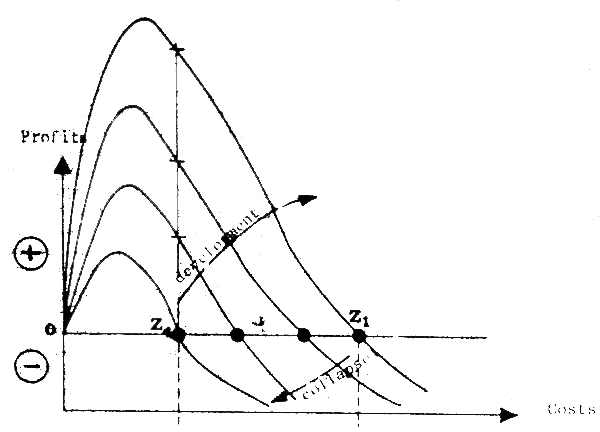
Fig. 17 Evolution of profits depending on costs (investments) and under the action of the environment. The 4 curves correspon to the 4 parabolas of Fig. 16B. The arrows indicate the course of an uncontrolled fishery when the biomass (and the profits) increase and then decrease. The equilibrium points Z1 to Z4 (profits = 0) correspond to those of Fig. 16B
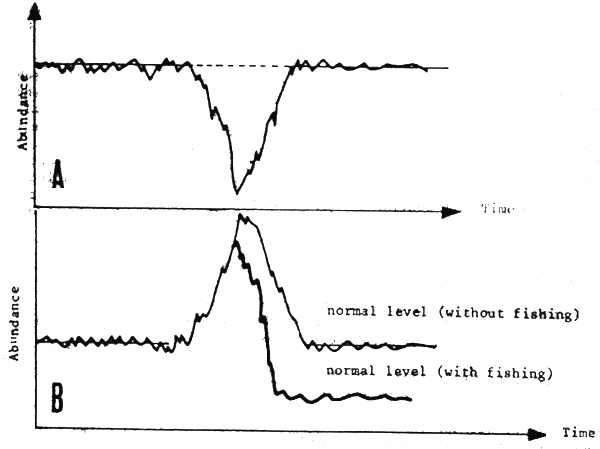
Fig. 18 A: Collapse and return of stock to normal
B: Biological eruption and return to normal with fishing (lower curve) and without fishing (higher curve)
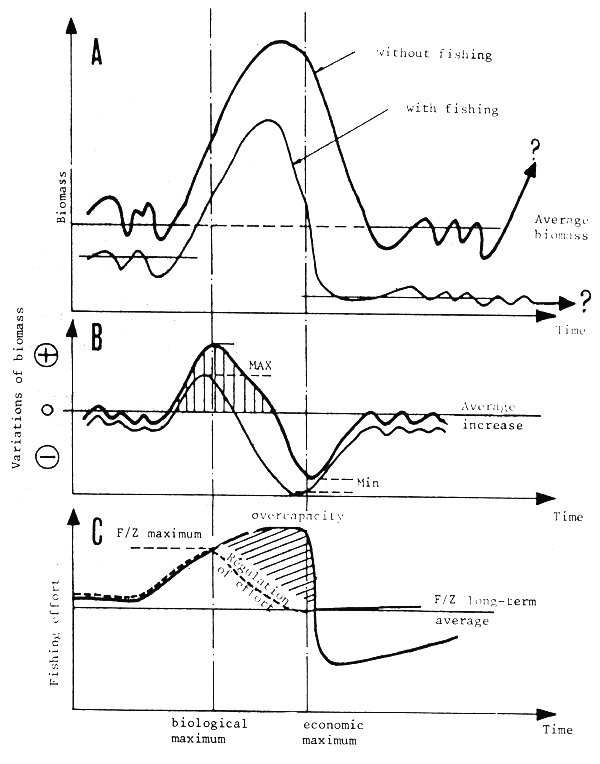
Fig. 19 Theoretical schematic representation of the evolution of biomass, additional eruptive production and fishing effort when a biological eruption occurs
The appearance of a biological eruption is a major signal in the ecosystem exploited, which industry detects rapidly and to which it replies immediately if the market is ready for it. It has been seen in Paragraph 3.5 that the profit increases rapidly. The search for larger, short-term profits leads the fishery system to hypertrophy. Fishery administrations submitted to strong pressure often help rapid development by establishing favourable investment codes and national or international development banks. The resulting decrease of the biomass will be partly compensated for by improved techniques (sonar, sounder, “pack” fishing, use of aeroplanes, etc.) increasing still further the catch overcapacity, and leading to levels of mortality due to fishing several times higher than the natural mortality to which the stock is adapted. Markets will also be changed. For example, a big market for fish meal could be developed, making it possible to process the exceptional quantities caught, and leading to a change in processing factories on land.
Figure 17 clearly shows the non-reversibility of the process when the eruption is over and the biomass decreases sharply. The profits become negative and bankruptcies quickly follow. The reduction of fixed costs is slower than that of current costs. The gregarious behaviour of pelagic stocks involves high mortality even when the fleet is reduced.
Management measures discussed in a climate of crisis are taken too late and not properly enforced. Favourable fluctuations in markets as a result of the reduction in supply can perpetuate for some time the adverse effects of the system, until demand is directed toward a replacement product (soya, for example).
In the end there is a total collapse of a hypertrophied economic activity, with disastrous financial consequences (boats withdrawn from fishing, factories closed, staff out of jobs, serious economic crisis). The drop in supply over a long period can involve a loss of markets which is difficult to reverse.
Economic collapse raises serious problems of reconversion of the whole sector and implies enormous State expenditure (subsidies, nationalizations, various set-offs, high social costs).
The consequences of economic collapse are felt outside the country in the markets, but even more so through large-scale transfers of ships and factories available at low prices. The development policies of countries with resources still underexploited can in turn be seriously affected by this international situation, in an insidious way (cf. the chain of collapses in California, Peru, South Africa/Namibia).
