


Session guide - Principles of research planning
Reading note - Long-term planning of a national agricultural research system in the third world: a new method
|
DATE |
|
|
TIME |
|
|
FORMAT |
Plenary participatory lecture |
|
TRAINER |
|
OBJECTIVES
At the end of this session participants should:
1. Know another definition for planning2. Be aware of the nature of the information base needed for planning
3. Understand the planning steps
4. Know the interrelationships of planning with other major management functions and the organizational goals
5. Understand how plans provide a foundation for management
6. Know major dimensions to be considered when developing a research plan
7. Be aware of the environment within which research is planned.
|
INSTRUCTIONAL MATERIALS | ||
|
Exhibit 1 |
Planning | |
|
Exhibit 2 |
Information base needed for planning | |
|
Exhibit 3 |
Planning in diagrammatic form | |
|
Exhibit 4 |
Planning example | |
|
Exhibit 5 |
Planning considerations | |
|
Exhibit 6 |
The value of planning | |
|
Exhibit 7 |
Interrelationships of the four functions of management to attain organizational goals | |
|
Exhibit 8 |
Plans as the foundation of management | |
|
Exhibit 9 |
Four major dimensions to consider when developing a plan | |
|
Exhibit 10 |
The planning environment | |
|
RECOMMENDED READING | ||
|
Casas, J. 1990. |
Long-term planning of a national agricultural research system in the Third World: a new method. FAO AGR Working Paper Series, 11. | |
|
HAND-OUT | ||
|
Ewing, D.W. Some Laws of Planning, from The Human Side of Planning. | ||
|
SPECIAL EQUIPMENT AND AIDS | ||
|
Overhead projector and chalkboard | ||
Initiate the session by showing EXHIBIT 1 and reading the definition of planning. Ask participants to give examples of planning exercises in which they have been involved. Ask them to describe the information base used in the examples provided.
Show EXHIBIT 2 and discuss the information base needed for planning. The trainer should be prepared to provide examples as to why the indicated information is needed. For example, under Item 1, he or she might note that it would be hard to plan a trip without knowing where one wished to go. Similarly, it would be difficult to plan a research project without knowing one's goals. Under Item 2, the trainer might note that in connection with planning a trip it would be important to know whether one had a car, an aeroplane or an ox. Similarly, while planning a research project, it would be important to know whether one had a set of test tubes and chemicals or an electron microscope. After discussing the items in this exhibit, the trainer could ask the participants for suggestions of other categories of information that would be needed as part of the basis for research planning.
Discuss planning in diagrammatic form (EXHIBIT 3). Goals should normally be expressed in terms of where one would like some segment of the economy or society to be at some future date. Constraints and opportunities should be expressed as basically as possible. This will allow the planner to develop objectives aimed at overcoming the constraints or taking advantage of opportunities in order to reach stated goals. Programmes are a set of functional activities aimed at achieving the planned objectives. Tactics are described as concrete steps which are required to implement the identified programmes. This includes going into sufficient detail to determine schedules, budgets and logistics.
To illustrate the planning steps described in EXHIBIT 3, show exhibit 4. The trainer may wish to develop other examples to illustrate the process. It may help participants understand the process better by having them suggest an example, which the trainer writes on the chalkboard.
Show EXHIBIT 5 and discuss planning considerations. Each of the considerations noted in this exhibit is important. The trainer may wish to stress each by giving an example, by asking participants to give an example, or by asking a question concerning the planning considerations. This will give participants sufficient time to absorb the importance of these considerations.
Show EXHIBIT 6 and discuss each of the nine points.
Show EXHIBIT 7 on the interrelationships of the four functions of management in attaining organizational goals. Note that, without goals, the four management functions become meaningless. One cannot plan without knowing where one is going; one cannot control without having a plan of how one is going to reach one's goals. With no goals or plan, there is no rational way to establish an organization. If one does not know where one is going, it is impossible to know whether one has arrived or not.
Show EXHIBIT 8 and discuss plans as the foundation of management. With plans, one has a rational basis for establishing an organizational structure and determining the type of people needed and when. It provides us with a basis for assessing how to lead effectively and direct. It further provides us with a basis for setting control standards.
Four major dimensions to consider when developing a plan are discussed in EXHIBIT 9. Discuss the exhibit, with examples and questions to participants so as to increase their understanding of the nature of the four dimensions of a plan. Conclude the discussion of the exhibit by asking participants if they can suggest other dimensions.
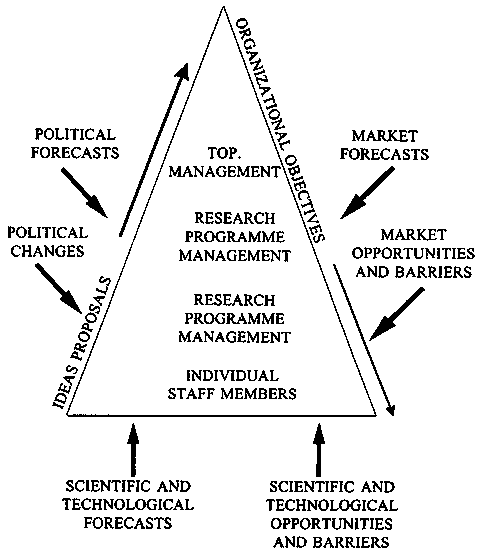
The planning environment provides a framework for discussing some of the major external forces which affect an institute's plan (EXHIBIT 10). It would be useful for the trainer to provide examples which are relevant to participants' experiences. The exhibit also suggests that ideas, proposals and organizational objectives should flow both up and down the management chain. It is useful to engage participants in a discussion as to whether or not such flows occur within their organizations, and also whether or not they should occur.
EXHIBIT 1 - PLANNING IS THINKING NOW - FROM A BASE OF INFORMATION - ABOUT WHAT YOU SHOULD DO IN THE FUTURE
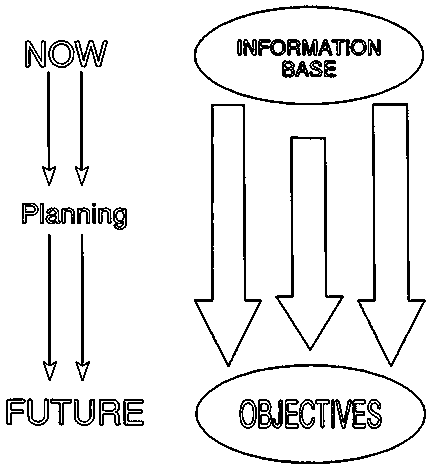
EXHIBIT 2
|
THE INFORMATION BASE NEEDED FOR PLANNING |
· A knowledge of:
- where you wish to go, or
- what you wish to achieve
· An understanding of your own:
- capabilities
- strengths
- weaknesses
- resources
· An assessment of:
- market trends
- scientific and technological trends
- political tends
- competition
EXHIBIT 3
|
GOAL |
|
CONSTRAINTS AND OPPORTUNITIES |
|
OBJECTIVES |
|
PROGRAMMES |
|
TACTICS |
SCHEDULING - BUDGETING - LOGISTICS |
|
Concrete steps to implement programme |
|
|
|
|
|
|
|
|
|
|
EXHIBIT 4
|
AN EXAMPLE OF PLANNING |
|
GOAL · Increased participation of agricultural research institutes in national development. CONSTRAINTS - OPPORTUNITIES · No or weak existing mechanism to get research results to farmers OBJECTIVES · Develop effective mechanisms to get research results to farmers. PROGRAMMES · A system of extension agents. TACTICS · 1. Set up an extension division within the agency for agricultural research and development SCHEDULING - BUDGETING - LOGISTICS · Tactic #1 - to be initiated in week 3; · Tactic #2 - to be initiated in week 1; |
EXHIBIT 5
|
PLANNING CONSIDERATIONS |
|
· The first stage of any type of planning is the conscious and explicit statement of the ultimate goals · Planning precedes the functions of - organizing · Planning specifies - what should be done · Planning is the process whereby a manger looks to the future and discovers alternative courses of action · Planning is desirable at all levels of an organization · Planning is an iterative process · In planning, the modern manager must anticipate changes which might require discarding old ways and adopting new · Planning should be done within a framework that enables planners to view any planning step from as many points of view as possible · Planning should consider as many points of view as possible |
EXHIBIT 6
|
THE VALUE OF PLANNING |
|
· It - gives direction · Increases the probability of achieving the declared purpose and of being effective · Provides coordinated effort and optimizes use of limited resources · Provides measurement indices and knowledge of "How we are doing" · Improves public relations by making everyone better able to interpret an organizations goals and achievements · Forces staff to improve management practices and to assess overall impact · Improves staff morale · Increases foresight in terms of - meeting future community needs and operations requirements · Makes managers more future-oriented, and increases their thinking about tomorrow |
EXHIBIT 7 - THE INTERRELATIONSHIPS OF THE FOUR STRUCTURAL FUNCTIONS OF MANAGEMENT
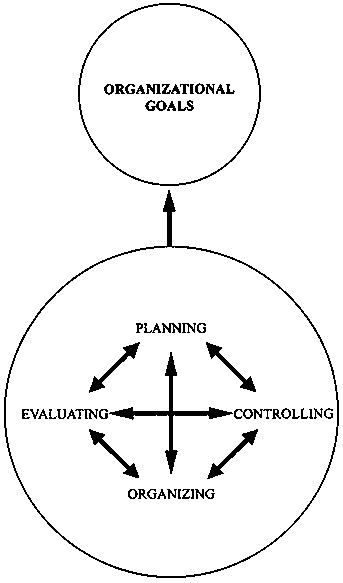
EXHIBIT 8 - PLANS AS THE FOUNDATION OF MANAGEMENT
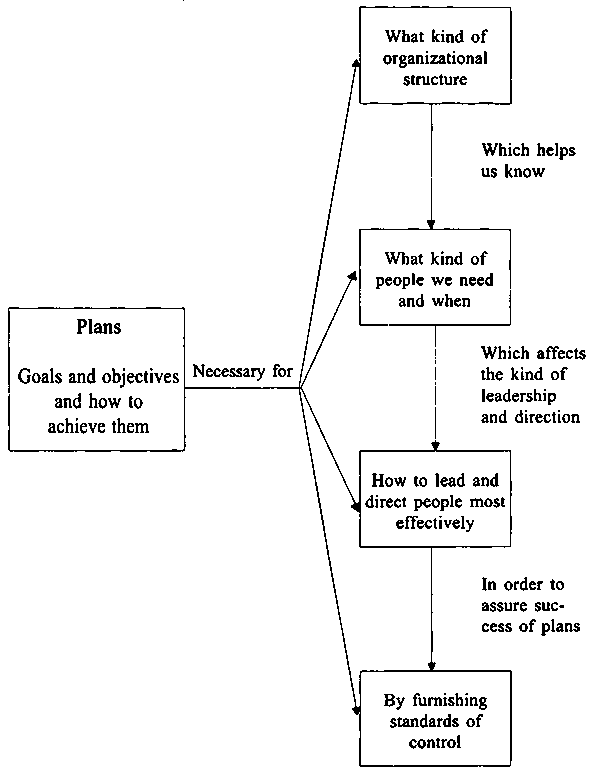
EXHIBIT 9 - FOUR MAJOR DIMENSIONS TO CONSIDER WHEN DEVELOPING A PLAN
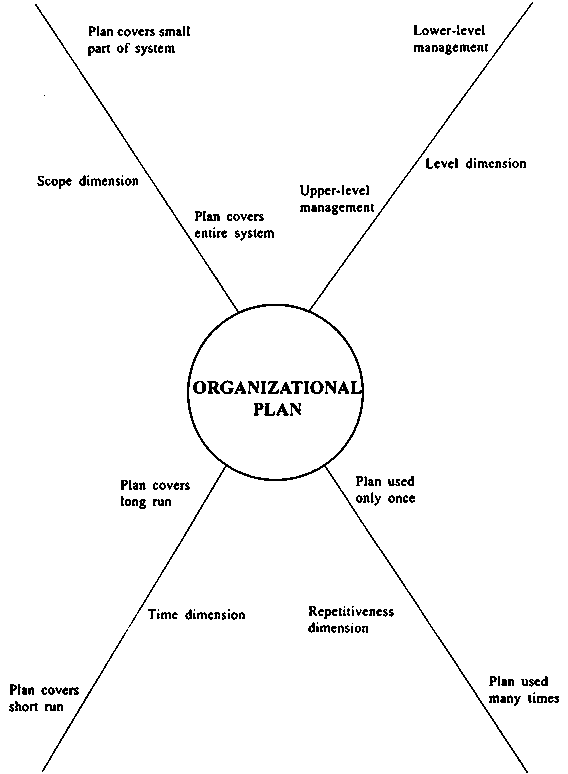
EXHIBIT 10 - THE PLANNING ENVIRONMENT
Hand-out - Some axioms of planning
1. A viable programme meets the needs of
· the formal organization,
· individuals, and
· groups,
but
A. the perfect plan is not perfect from an organizational, individual nor group standpoint, andB. the three needs should be borne in mind during the conception and design of a programme, as well as during its execution.
2. Effective planning is incomplete planning.
A. The optimum amount of detail is roughly proportional to the organization's experience in planning.B. The less able and trustworthy a planning leader's subordinates, the less she or he can plan in any way.
3. Every well-drawn plan is out of date by the time it is in use.
4. Planning creates anti-planning.
5. The planning leader who is effective for a sustained period has political power.
6. Good planning does not always succeed. Poor planning does not always fail.
7. The act of planning itself changes the situation in which the organization operates.
(From The Human Side of Planning by D.W. Ewing)
Summary
Introduction
1. Difficulties faced by NARS
2. Advantages and specific aspects of national LTPs
3. General presentation of the proposed procedure
4. Determination of the level of long-term financial and human resources for the NARS
5. Allocation of resources
6. Conclusions
7. References
Most NARS in developing countries are facing both qualitative and quantitative problems, which in part explains their inefficient use of national and foreign resources, their modest scientific results and their low level of effectiveness in supporting agricultural development.
The qualitative deficiencies are essentially related to NARS' structures and operation. The quantitative deficiencies are reflected in frequently imbalanced allocations of research resources: not only within each country, but also among regions, research programmes and different categories of human, physical and financial resources. Imbalances can be corrected only within the framework of a coherent strategy that justifies the development of a long-term national agricultural research (AR) plan.
Notwithstanding their apparent sophistication, quantitative methods of AR planning tried so far - such as scoring and cost-benefit analysis - in developing countries present serious drawbacks and remain largely subjective. A critical assessment of these methods in the context of more common AR planning experiences has led to the elaboration of new methodology, largely inspired by the national economic planning process often used in both developed and developing countries.
This method is based on the primacy of general and financial orientations given by the policy-makers, and on mobilization of the scientists (researchers, professors) and representatives of AR system partners (agricultural administrations and public services, farmers' organizations, etc.) through a specialized planning committee. It consists of the preparation of two or three 'target' long-term research plan proposals, which describe the main quantitative characteristics of the AR system (level and allocation of resources) for the final year of the plan, as the best possible with respect to:
· the constraints and potentials of national agricultural development,
· the available technologies and innovations, and
· the possibilities for mobilizing national and international scientific and financial resources.
The method involves, first, an estimate of the total AR budget and number of research years (1 research year = equivalent of 1 full-time researcher = associated support costs and overheads) expected for the final year of the plan. Then the allocation of these research years results in a procedure of analysis, confrontation and harmonization of the research needs by broad sectors (groups of commodities; other themes), assessed by the planning committees. This procedure uses matrix tables for expressing research-year needs by commodities, themes, disciplines and research centres. The final objective is to propose 'area' research programmes and regional centres endowed with a critical mass of resources to meet as inexpensively as possible the priority needs of agricultural development.
The proposal chosen by policy-makers can be only an indicative, flexible reference, aimed essentially at improving the short- to medium-term decision process. In the long term, AR system evolution would rely principally on the solution of structural and operational deficiencies, and on the attitude of experienced research staff and managers responsive to the agricultural realities of their country and to international scientific advances.
In most developing countries, agricultural research (AR) activities at the national level are generally conducted by either government institutions specializing in AR or by institutions which are not primarily involved in AR, such as agricultural faculties, rural development societies, agro-food industries, etc. In any country, such organizations and the politico-administrative bodies that run them (ministries of agriculture, of research, of education, of finance, etc.) constitute the national agricultural research system (NARS).
The operation of NARS requires constant decisions, variable in scope and level of responsibility. The most important of these decisions are those that change the structures, orientations and resources of NARS or of its principal components. Such decisions can only be properly taken and implemented if they are based on a good understanding of the past and present positions of NARS, and on at least minimal agreement with the people involved: scientists and potential users of the research results, such as extension services, agricultural cooperatives and farms, agro-food industries, etc. The decision making process can be formalized by the establishment of planning and programming mechanisms.
This note therefore deals with the long-term planning of national AR, so-called strategic planning. This may seem surprising, especially at a time when the ideology of planning is being questioned almost everywhere in the world, including in socialist countries, and when most of the developing countries, faced with severe economic and financial crises, are forced to give priority to short-term management. Nevertheless, it is justified for two main reasons.
The first is the unsatisfactory current situation and the low level of effectiveness of most Third World NARS in supporting rural development (see Section 1 below). Improvement of NARS will require profound and comprehensive qualitative and quantitative changes over a long period of time. In this context, the availability of a national long-term plan (LTP) is essential in order to define a strategy of evolution as a reference point for sounder short- or medium-term decisions. This is the main concern of any long-term national planning process, which should not be considered an end in itself, but rather an instrument to facilitate and improve medium-term planning and/or annual or multi-annual AR programming, both at the overall NARS level and at the level of one of its individual scientific organizations (see Section 2 below).
The second reason is that, despite its importance, national long-term planning - as opposed to medium-term planning and programming - has so far only led to a very limited number of concrete applications and publications. This gap has to be filled, based essentially on a critical review of the literature and experiences in the field. 1
1. See Section 3 for a new approach to long-term national AR planning, and Sections 4 and 5 for a new method for the determination of the level allocation of resources. These have been worked out based on field experiences in several countries.
1.1 Imbalances in the allocation of resources
1.2 Structural and functional deficiencies
1.3 Modest results compared to the resources involved
Most NARS in the Third World face problems which can be presented here only in brief. We shall consider first those which are mainly quantitative-and which are manifested by perceptible imbalances in the allocation of research resources. Then we shall consider qualitative deficiencies, notably those related to the structure and operation of NARS. These deficiencies are reflected in a relatively inefficient use of available resources.
The most striking and frequently observed imbalances in most countries concern the allocation of resources among regions, sectors of production and research programmes, and, finally, within the broad categories of resources.
Unequal allocation of resources among the different regions of a country frequently leads to excessive concentration in the capital and its surroundings. These urban poles have attracted about 75% of the scientists in sub-Saharan francophone Africa and more than 50% in many Latin American countries. This phenomenon is only partially explained by the need for research in agricultural areas around the capitals, or by the need for maintenance of equipment or access to information in other fields of research (soil science, agro-food technology, economics, etc.). It seems to be more expressed in countries that are less developed and more centralist. Outside the capitals, it is unusual to find research centres with the critical mass of resources at their disposal needed to be able to respond effectively and inexpensively to the various needs of regional farming systems and to provide their research staff with a professional and social environment conducive to stability.
The unsatisfactory allocation of resources among different sectors and research programmes often leads to a lack of interest in livestock production, forests and in the problems of the protection of natural resources. Compared with crop research, these scientific fields have the drawbacks of being relatively costly and yielding results only in the long term, and of being more difficult to transfer through extension. Rural economics and sociology are also often neglected, at least in institutions specializing in AR, despite their significance for the definition of national agricultural policies. In general, too few research programmes have mobilized real teams on a sustainable basis, endowed with adequate resources comparable to those of the international agricultural research centres (IARCs). Research is too often carried out by isolated scientists, who have to cover several activities, and which rarely results in other than scrappy results, with little significance and very limited interest for the development process.
Imbalances observed among the different categories of resources (human, physical and financial) can generally be identified by reading the budgets of the scientific institutions. In most cases, a high proportion of the annual budget is allocated to staff costs, and the remaining funds for operation and equipment are obviously insufficient to ensure full employment of the staff. In many NARS, researchers can only work half-time at best. In sub-Saharan Africa, this rate of employment would be even lower without foreign financial aid which, in many countries, pays for the majority of the operating and equipment expenses. Almost everywhere in the Third World the shortage of research funds is particularly desperate in agricultural faculties and universities in general, which are therefore marginalized within NARS, even though they often contain scientists with superior academic training.
Imbalances can also be seen within human, physical and financial resources. Concerning staffing, imbalances are evident in the poor ratio of scientists to other categories of employees, with, very often, only a limited number of skilled technicians. This situation often means that a disproportionately heavy share of research management falls on the best qualified and most experienced researchers. As far as physical resources are concerned, research centres and stations are too numerous and too specialized within the non-unified NARS, which is reflected in a relative excess of infrastructure, their underutilization and in high real or opportunity costs, to the detriment of other research facilities. Concerning financial resources, in addition to the budgetary imbalances mentioned above, national funds for equipment and operations usually fluctuate from year to year, and are so unstable in some countries that they permit only day-to-day management.
All these imbalances lead to an inefficient use of the available resources. In most NARS, a reduction in numbers of unskilled staff and a better distribution of research forces throughout the country would lower overall costs. With the same budget, it would often be possible to improve facilities for national scientists and to substantially reduce their disguised unemployment. It is obvious that unsatisfactory allocations are the result of NARS' structural and functional deficiencies, which will be discussed below.
These deficiencies will be examined in terms of both structural and overall functioning of NARS, and management of scientific and technical organizations.
NARS' structures pose no problems when research forces are largely concentrated in a single, multi-purpose agricultural research institution (ARI) or in a limited number of research institutes with complementary tasks. They do pose problems, however, in NARS which are split and poorly integrated. Such NARS - relatively numerous in the Third World - are characterized by:
· the presence of many, small scientific and technical organizations in relation to the size of the NARS; and· the absence of a higher policy body responsible for conceiving and implementing a national AR policy, with political and financial authority over all the scientific and technical organizations involved, or at least over the highest ones.
In such NARS, competition among scientific organizations and their political and administrative supervisors at the national level is often uncontrolled. This is accompanied by a certain squandering of resources, e.g., in the duplication of programmes and resources.
Structures considered a priori to be suitable do not, however, guarantee a good functioning of AR. Even under such favourable circumstances, imbalanced allocation of resources often persists, owing to the absence or inefficiency of mechanisms for evaluation, programming and planning of AR activities and resources.
Consideration of the main problems of management of scientific organizations themselves will be limited to problems related to managers and to human, physical and financial resources of ARIs.
Directors are frequently obliged to manage their institutions without clear policy guidance from their government superiors, and yet at the same time are not free from frequent and arbitrary interference. Moreover, the absence or irregular operation of collective decision making and advisory or evaluating bodies, such as boards or scientific councils, often leads to an autocratic and centralistic management of the institutions by their directors.
As for staff management, the frequently occurring situation of an absence of specific staff regulations creates many well-known problems in the selection and career development of researchers. When regulations exist, they seldom foster teamwork. Under these circumstances, institutions have difficulty in consolidating their human potential and ensuring the achievement of their objectives.
The management of financial and physical resources is often one of the major weakness of ARIs in developing countries. This is mainly because of understaffed and underequipped departments (computers are a rarity) and to the rigid and bureaucratic operating regulations of public institutions. This often results in a mediocre and sluggish information system, an incomplete use of allocated funds, delays and overcosts in orders and payments for goods and services and negligent maintenance of infrastructure, equipment and vehicles. Such deficiencies create severe obstacles to the normal progress of research activities, and accentuate the squandering of financial and physical resources.
Owing to the shortcomings noted in the previous paragraphs, most NARS in developing countries can show only modest results in scientific terms but especially with respect to impact on development. The deficiencies of agricultural policy and of extension services should not overshadow the responsibilities of NARS in the development process. In fact, a great proportion of technical innovations originating from NARS have proved to be too risky or too complex and ill-adapted to development needs, largely because they resulted from scientific practices that relied too much on work done in controlled environments (research stations and laboratories).
The situation has been improving as a result of increasing applied research through field trials and on farming systems. People everywhere are becoming more aware of the need to work out intensification models adapted to the needs and capacities for evolution of the main production types of regional farming systems. Although this trend is promising, it can only be pursued if NARS organize themselves around regional research centres, where research teams can cooperate closely with public and private regional agricultural organizations.
So far, NARS have not achieved their aim of being the effective development tools expected after the success of the green revolution. Obviously, the great - possibly too great - expectations aroused in the 1960s and 1970s, followed by an increase in funding to NARs, did not materialize. With very few exceptions, NARS no longer have the same benevolent attention from their governments. In many countries, particularly in Africa and Latin America, this change in the national attitude has unfortunately coincided with serious economic and financial crises, and with greater stringency in bilateral and multilateral foreign aid. Therefore, today, most NARS are having hard times, with, for some of them, drastic cuts in their funding.
2.1 Need for a long-term strategy
2.2 Specific aspects of LTPs
Only a few NARS in developing countries will be able to play an important role in the rural development process without vigorous and continuous support from national authorities concerned with financing, implementation and application of AR. To improve NARS' situations, the following points must be taken into consideration:
· better use must be made of the financial resources available, through balanced allocation in order to ensure the best possible use of human and physical resources. This may often require reductions in staffing (sometimes including scientists) and of infrastructure;· research programmes and centres need to be set up and supported with the necessary resources in order to be able to respond to the pressing problems of agricultural production and of the rural environment, with optimal use of research funds and close cooperation with extension and development organizations; and
· the quality-oriented problems noted earlier need solving, especially those related to the structure of NARS, the operation of their institutions and conditions of employment for the research staff.
Such quantitative and qualitative transformations of NARS cannot all be accomplished at the same time. Some changes will require more time, such as geographically redeploying research forces to new regional research centres; recruiting and training young scientists for boosted programmes; eliminating unnecessary unskilled staff; increasing (both relatively and absolutely) funding for equipment and operations; and improving the management of financial and physical resources. Other transformations may be very rapid, like restructuring the supervisory and scientific organizations of NARS; issuing appropriate staff regulations; or setting up advisory and evaluation bodies.
To sum up, the creation of well-organized, economic and efficient NARS requires the definition and continuing application of measures of all sorts, which can become coherent and effective only through national strategies for long-term development. The elaboration of such strategies fully justifies the preparation of national AR plans to cover periods of 8 to 15 years (equivalent to two or three Four-Year or Five-Year Plans). These LTPs then serve as reference points for the creation of medium-term plans (MTPs) or short-term action programmes.
For a better delineation of the content and the advantage of the LTP, a few concepts generally used in medium-term planning will be described below.
An MTP for AR is usually has two elements: the target plan and its operational programme. The target plan describes the main characteristics of the NARS (level and allocation of resources, structures and methods of operation), which are considered to be the best possible at the termination of the plan with respect to national research needs, the country's policy choices, possibilities for mobilization of national and foreign resources and the NARS' capacity for development. The operational programme of the target plan shows the strategy for mobilization of resources and for any reorganization of NARS, as well as the corresponding measures to be applied during the planning period.
An MTP should be prepared within the framework of an operational and continuing planning system. After official approval of the plan, this planning system would be responsible for:
· taking concrete decisions (opening staff positions, assigning funds);· following up the implementation of national decisions, and those related to foreign assistance; and
· evaluation to revalidate or revise the plan in order to keep up with its progress, and to be aware of constraints or new opportunities during the execution of the plan.
In long-term planning, it would be unrealistic to propose a precise model for the structures and the operation of NARS in the far distant future. This task can only be approached in terms of orientations and general principles. Therefore the target plan will be composed essentially of a quantitative target plan proposal (QTPP) that provides a relatively precise outline of the NARS desired at termination, and covering levels and allocations of its resources among commodities, scientific disciplines, regions, etc. Under these conditions, the operational programme for the LTP could have two forms:
· it could restrict itself to a few general suggestions concerning strategies for the mobilization of resources and the re-organization of the NARS, and call for the preparation of an MTP to deal with these aspects in detail; or, if the preparation of an MTP is unlikely to be soon,· it could propose a short-term programme of action considered essential to provide a positive start to the LTP.
In any case, it cannot be the task of the LTP to go into the details of planning in the short or medium terms, or to propose, as an MTP might do, a broad and detailed re-structuring of NARS, such as mergers of institutions, the creation of new institutions, the suppression of established ones, new definitions of responsibilities between organizations and ministries, etc., or to give a precise schedule for staffing or budgeting the different institutions comprising the NARS.
Finally, the LTP will essentially be a guide for decision making regarding the level of resources and their allocation to research programmes, regions, staff costs, operation, equipment, etc. This may sound restrictive, but it has many advantages.
First of all, the LTP would have no immediate institutional concerns. Its basic proposals would relate to the resources and would be put forward only with reference to the priority problems and the national options for rural development, as well as to the national scientific and financial capacities for AR. This means that the scientific and technical organizations concerned, together with the scientists, can participate in drafting the LTP in all serenity. '
Second, if the results of the target LTP are independent of the structures, it is evident that their availability can ultimately facilitate the development of proposals or decisions more securely based on the structures of NARS and their operation.
Third, it becomes possible to establish a close complementary relationship between the LTP and an MTP. Till now, most MTPs have been prepared according to the 'upstream' process of pluri-annual programming. This process consists essentially of beginning with the present situation (notably of programmes) and striving to improve it by progressive adjustments. In its most elaborate form, such as the Côte d'Ivoire experience, pluri-annual programming consists of:
· analysing AR programmes and projects (parts of programmes) that are under way or newly proposed by NARS institutions;· comparing them by taking into account their socio-economic and scientific advantages and whether they are in line with the country's broad development orientations; and
· selecting priorities, respecting budgetary constraints for the period considered. Then, for the four to five years of MTP period, additional needs for resources for starting programmes and projects are stressed, resources for research activities underway are maintained, and resources for activities that are winding down are deducted.
The programming process is not only an upstream process, as it generally involves some considerations of prospective future development of the NARS. See Du Plessix et al. (1973) and Trouchaud (1979).
The existence of an LTP should improve the quality of MTPs by complementing the upstream process by a balancing downstream process, starting from the QTPP for the LTP.
The final advantage of the LTP is the chance to consider in the plan only those problems relating to the determination of the level of resources for the NARS and their allocation. This will be discussed following presentation of the general planning procedure.
3.1 Launching stage
3.2 Statement of the LTP strategic orientation framework
3.3 Development of LTP QTPPs
3.4 Completion of the LTP
Many developing countries have experience in planning, generally through the preparation of national economic and social development MTPs. The practices in this area certainly vary, but are usually have two major elements:
· political primacy, so that the government decides to start the preparation of the plan, names its responsibilities, outlines the broad preliminary orientations, chooses among the plan's possible provisional options and decides about plan application; and· the mobilization of experts and representatives of the country's socio-professional groupings (through working committees and consultations), in order to ensure that the plan is accurately prepared and is broadly acceptable by the nation without major disagreement over its application.
For obvious reasons, the process of LTP development should follow these practices and principles. This justifies the proposal for the general procedure set out in Table 1, which describes the four main stages and the three levels of responsibility, with emphasis on some aspects other than those related to the level and allocation of resources, which will be examined in Sections 4 and 5.
Table 1 LTP preparation: levels of responsibility, main stages and operations
|
MAIN STAGES |
LEVELS OF RESPONSIBILITY | ||
|
|
POLITICAL LEVEL (Government authorities) |
POLITICO-PROFESSIONAL LEVEL (Ad hoc Committee) |
PROFESSIONAL LEVEL (Specialized committees) |
|
1. Launching |
· NARS diagnosis |
· Create specialized committees |
|
|
|
· Decision to prepare LTP |
|
|
|
|
· Create Ad hoc Committee |
|
|
|
2. Statement of strategic orientation |
· Definition of LTP's guiding principles (role of AR; ways and means of improving its effectiveness) |
| |
|
|
· Orientation for long-term national and foreign financial resources |
| |
|
3. Development of target LTP proposals |
|
· Standard resources and costs per research year (RY) |
|
|
|
|
· Fixing of long-term RY range expected |
|
|
|
|
· Fixing of indicative RY ranges by specialized committees |
|
|
3.1 Preparatory |
|
Information-training seminar on LTP and methods of development of quantitative target LTP | |
|
3.2 Sectorial approach |
|
Leadership and supervision of specialized committees' work |
Preparation of specialized reports |
|
3.3 Global approach |
|
· Harmonization of sectorial research proposals | |
|
|
|
· Non-sectorial research needs proposals | |
|
|
|
· Final quantitative target plan proposals (QTPP) | |
|
4. Completion of LTP proposals |
|
· Finalization of the QTPP |
|
|
|
|
· Development of implementation strategies for QTPP (resource mobilization; NARS organization) |
|
|
|
|
· First draft of LTP report |
|
|
5. Decisions |
· Analysis of LTP proposals |
Final version of the LTP report |
|
|
|
· Choice of one proposal |
|
|
|
|
[ · Preparation of an MTP] |
|
|
This stage requires a policy decision by the government authorities concerned (usually the Ministry of Planning, of Research or of Agriculture). It assumes the availability of a thorough diagnosis of the NARS, and is accompanied by the designation of an Ad hoc Committee, representing the politico-professional level, which will actually be responsible for the preparation of the LTP. One of its primary functions will be the creation of specialized committees.
3.1.1. Necessity for a thorough diagnosis of the NARS
The diagnosis of the NARS must include a precise and critical inventory of the levels and allocation of current resources (human, physical and financial, both national and foreign) and of their evolution in the past. This will be indispensable for the determination of the levels -of resources to be considered in the long term.
The diagnosis must also cover qualitative aspects related to the mobilization of resources; conditions of service, stability, availability and location of scientific staff; size, stability and productivity of programmes; adaptation of infrastructure and other physical resources to research needs; methods of management of financial resources; etc.), and to the structures and the operation of the NARS and its scientific organizations.
Finally, the diagnosis should lead to valid assessments of the effectiveness of the NARS (estimated degree of scientists' effective time used for research; judgments on scientific results) and of its role (practical relationships with development organizations), and to an attempt to stress the NARS' main strengths and weaknesses.
The most important elements of the diagnosis will be used later as references for the preparation of the statement of the planning orientation framework and for defining the LTP implementation strategy.
3.1.2 Ad hoc and specialized committees: composition and significance
It must be stressed that the LTP should not be simply a plan for the scientists or research organizations. For it to be properly considered a national plan, its preparation has to mobilize representatives of all parties involved. The composition of the committees must therefore reflect this imperative, and at the same time guarantee the scientific, technical and financial credibility of the LTP.
The Ad hoc Committee is directly responsible for the whole process of LTP preparation. Its members are drawn from the politico-professional level: delegates of the ministers concerned with AR (research, agriculture, education, planning, finance, etc.), representatives of the public and private users of AR (administration, development services, farmers' organizations, etc.), and directors of the main scientific and technical organizations of the NARS. It is supported by a secretariat of experts familiar with planning and rural development.
The role of the specialized committees is to identify, prioritize and quantify research needs in each field defined by the Ad hoc Committee. For greater efficiency, the committees should be formed on the basis of production sectors or commodity groups. 1
1. In the Niger, four sectorial committees operated in the fields of: rain-fed crops; irrigated and intensive crops; livestock production; and environment (forests, soils, fisheries and wildlife) (Casas, Labouesse and Soumana, 1 989). In Tunisia, with its more diversified agricultural production, more sectors were studied (cereals, food legumes, industrial and horticultural crops, tree fruits, etc.) (Casas, Labouesse and Rocheteau, 1987).
At the same time, however, it is essential to create a specialized 'horizontal' committee to cover 'national and regional agricultural economics,' which will provide information complementary to those of the 'vertical' sectorial committees by taking account of relations among groups of commodities at the levels of the farm (farming systems), of regions (agrarian systems) and of the country itself. Each of the specialized committees should be composed of a limited number of permanent members (not more than a dozen), chosen from among the best specialists of the NARS and of the users of AR (administration, development services, farmers' organizations, etc.).
In the second stage, government authorities set out the strategic orientation of the LTP in a policy document which will be the basic and essential reference for the planning work. It will be prepared by the Ad hoc Committee, working in close cooperation with the government authorities. In its final form, this policy statement must be available to the specialized committees called upon to intervene in the following stage. This statement represents the guiding principles for the development of the LTP. The principles may vary from country to country, but, as a general rule, they contain guidelines for the expected role of AR, a description of the ways and means by which this statement should improve the effectiveness of NARS, and a presentation of possible trends in long-term AR financial resources.
3.2.1 The expected role of AR
The primary goal of AR is to support agricultural and rural development by:
· proposing technical innovations adapted to the physical and socio-economic conditions and to the capacities for change of rural areas;· producing technical and socio-economic information (soil maps, inventories of biological resources, surveys of farms and marketing systems, etc.); and
· it should also support academic and in-service training for the national (public and private) senior staff, etc.
3.2.2 Ways and means of improving the effectiveness of AR
The strategic policy statement should help overcome the principal quantitative and qualitative deficiencies of NARS identified in the diagnosis, by:
· balancing sectorial and regional research efforts;
· creating programmes and centres endowed with a critical mass of resources;
· ensuring a better coordination of scientific organizations and their supervisors;
· developing international scientific relationships;
· and so forth.
Most of these proposals should be general, in order to not disturb the work of the committees, but some should be specific or even imperative (e.g., to create a research centre in a specific region).
3.2.3 Long-term financial resources orientation
The strategic policy statement should give precise indications on this point, particularly by setting an indicative rate of growth in long-term national public AR expenses. Lack of clear long-term financial guidelines is a major constraint, which is routine in the preparation of socio-economic development plans. It is therefore essential to guide the committees and to avoid unrealistic LTP proposals. These points will be discussed in detail in Section 4.
This third stage is by far the most important and delicate of the procedure. It consists of developing two or three QTPPs for the LTP, with different levels and allocations of resources, to be submitted to national authorities. It involves three successive phases, resembling those which are generally found in the preparation of national socio-economic development plans.
The first phase consists of preparatory work conducted by the Ad hoc Committee, aimed at facilitating and guiding the next two phases. This preparatory work should determine the foreseeable range (maximum and minimum levels) of total financial resources expected in the long term, and the corresponding range in the total number of research years (RYs) or equivalent full-time researchers, through a preliminary calculation of standard resources and costs per RY. This number will itself be broken down into indicative numbers of RYs allotted to the different specialized committees. The work concludes with a three-to-four-day information seminar for all members of the specialized committees, addressing the aims and method of development of the LTP.
The second phase is devoted to a sectoral approach to research needs (expressed in RYs) based on an analysis of the needs and potentials of rural development.
The third phase consists of a global approach to research needs. After (i) a review and harmonization of the sectoral proposals, (ii) an elaboration of the non-sectoral research proposals, and (iii) an analysis of all the previous proposals by region, the secretariat of the Ad hoc Committee and the leaders of the specialized committees develop the final QTPPs for the LTP.
The third stage, with its three phases, will not be discussed further here, since it is covered in Sections 4 and 5 on methods of determining levels and allocations of LTP financial and human resources.
The fourth stage, executed by the Ad hoc Committee, consists of finalizing the QTPPs, with presentation of all their financial implications estimated from the standard costs defined during the preparatory work of the third stage. There remains the preparation for the government authorities of a first provisional report, presenting the complete proposals for the LTP by adding either a proposal for a well-defined programme of short-term action specifying the measures considered indispensable to start the LTP, or a brief statement concerning the implementation of the QTPPs (strategies for mobilization of resources and re-organization of the NARS), details of which will be worked out later during the preparation of the MTP.
The fifth and last stage is devoted to decisions. After the analysis of the provisional report, the government authorities choose among the prospective plan proposals and implementation scenarios. The Ad hoc Committee thereafter prepares the final version of the report based on the LTP selected.
4.1 Determining the level of financial resources
4.2 Determining the level of human resources requirements
Realistic and acceptable LTP proposals must be based on precise information from policy-makers on the desirable and possible evolution of financial resources available for AR. This information must primarily cover national public resources, which is usually the largest element. It must also cover other resources, such as the country's private sector, foreign cooperation, etc. Such information is a policy decision for the future development of AR. It expresses the government's view of the future capacity of the revised NARS to effectively serve rural development. It sums up clearly the government's assessment of:
· the past and present levels of financial resources for AR, their origin and their allocation (national public or other resources, foreign resources; staffing, equipment and operational costs); and· future possibilities for national (particularly public) and foreign financing, depending a great deal on the prospects for evolution of the country's economy and agriculture.
4.1.1 Past trends and current levels of financial resources for AR
This information should have been collected during the NARS diagnosis, but, as a precaution, the Ad hoc Committee should re-evaluate total current resources and their components, taking special notice of current AR expenditures in non-specialized public, semi-public and private NARS organizations, and possible public AR expenditures on loans. Estimates should be as accurate and recent as possible, since they will have decisive influence on the estimate of financial resources to be expected in the long term. Earlier AR resources, both public and private, can be restricted to those reported (in current prices, adjusted to constant prices) by the biggest NARS organizations.
This information can lead to initial options on desirable trends in long-term financing for AR. Severe imbalances between national and foreign resources, or between staffing costs and costs for operations and equipment, are of course more easily absorbed with a rapidly expanding national AR budget. A rapid increase in financial resources in the past might justify a slowing down during the period of the LTP; in contrast, stagnation or reduction in these resources could call for an accelerated future increase.
These options can be bolstered by international comparisons, especially using the most convenient criterion, namely the ratio of national AR expenditure to agricultural gross domestic product (AGDP). Unfortunately such comparisons are not easy to make, since AR expenditures are rarely evaluated on a standard basis, and the data available generally concern only the public institutions specializing in AR, rather than the totality of the NARSs. Some international organizations have recommended that developing countries should invest 1 % of their AGDP1 in AR.
1. Even 2% investment has been recommended, which is the average ratio observed in developed countries, although, for developed countries, the ratio of AR expenses: AGDP is not significant, as a large part of AR resources is dedicated to the agro-industrial sector, which is often economically more important than the agricultural sector. Here it would be more suitable to use the ratio AR expenses: agricultural and agro-industrial GDP, which ranges between 1 and 1.5% in most developed countries (Casas, 1 988).
This recommendation, however, may not have the same significance for all countries. The percentage might be too high for countries with large, relatively homogeneous agricultural areas and only a few important commodities; it would probably be too low for countries with the opposite characteristics.
4.1.2 Possibilities of long-term financing of AR
Although the discussion above provides some idea of the trend in AR resources, only consideration of the total range of possible public, private and foreign financing can permit one to determine the probable level of financial resources that the LTP could mobilize.
Possibilities of public financing
These possibilities can be assessed by examining past trends - particularly growth rates - and probable future trends, expressed in constant currency units, of
· the total public budget,
· the budget for rural development, and
· the budget for scientific research.
Observations must cover a fairly long period in order to eliminate 'accidents' related to too favourable or unfavourable years (weather conditions, extreme price fluctuations for export commodities, etc.) Analysis of these data should provide an assessment of the long-term tendencies in the growth rates of these three budgets.
In a conservative and not very optimistic hypothesis, in which AR would receive no preferential budgetary support from the government, the lowest of the three above-mentioned rates, Rmin, could be taken as the minimum growth rate of the public budget for AR.
A more optimistic hypothesis would reflect a desire by the government to provide the country with a renewed and strengthened NARS in the long term. The budget for AR would be relatively preferential, and its growth rate would be higher than that of the total budget. We shall see below how this maximum rate, Rmax, can be precisely determined from the previous minimum rate, Rmin.
Thus we arrive at a range of indicative annual growth rates for public expenditures for AR. Taking these rates, we can then calculate the maximum (PEmax) and minimum (PEmin) amounts, expressed in constant currency units, for annual public expenditure anticipated at plan termination, and which the LTP must take into account, by applying the following formulae:
PEmax =PE0 x (1+ Rmax)n
and
PEmin =PE0 x (1+ Rmin)n
where:
PE0 = total actual annual public expenditures (for the reference year used to estimate PE0)
n = number of years separating the reference year and final year of the LTP
Rmax, and Rmin are expressed as percentages.
Other possibilities of financing
With the help of information from the diagnosis and review of NARS, we can establish the annual maximum (OEmax) and minimum (OEmin) overall expenditures, i.e., the amounts of other financial resources that can reasonably be expected at plan termination. It is wiser to propose growth rates for these resources similar to or not much higher than those of the public AR budget.
Determining the indicative ranges of total annual AR expenditures
From the above, indicative total expenditures at plan termination can be obtained. The maximum (TEmax) and minimum (TEmin) amounts of annual financial resources to be expected at plan termination can be calculated by:
TEmax= PEmax + OEmax
and
TEmin= PEmin + OEmin
At this stage of LTP preparation, the range of possible total expenditures must be considered as flexible, open to adjustment, depending on:
· the quality and advantages of the LTP, which might possibly justify the approval of increased efforts to provide AR funds by government authorities and donors; and· possible adjustments - upward or downward - reflecting economic and budgetary prospects during the preparation period of the LTP.
Furthermore, to give direction and to provide a suitable framework for the planning committees, the range of total financial resources must remain relatively narrow. The maximum amount of total expenditure (TEmax) should not be more than 30% or 40% higher than the minimum (TEmin). If the same margin is observed for public expenditures, the value of PEmax can be directly calculated from PEmin, with no need for reference to the maximum growth rate, Rmax, which can be calculated a posteriori as indicative.
Finally, the method proposed for determining the levels of long-term funding for AR is based on procedures which are somewhat empirical, but as realistic as possible because they are based on a thorough understanding of the procedures for allocation of public budgetary resources, and not simply on the vague indications (with or without figures) provided by some national authorities concerned with AR.
In order to determine the level of staffing needed, we shall use average norms for long-term, annual costs per research scientist. The methodology for this procedure is discussed below.
4.2.1 Justification for the use of standard costs per research year
Among the human, physical and financial resources covered in the LTP, scientists are considered to be the most significant and decisive resource. They are the most significant because their allocation among commodities, the major research areas and the agro-ecological regions is enough to give a clear picture of the scientific potential of the LTP and of its connection with the problems and possibilities of agricultural development.
They are decisive because the amount and allocation of other research resources depends directly on the number, specialization and location of scientists. The link between scientists and other resources varies according to the field of research. Thus 'biological' research .in plant and animal production is more demanding than rural economics and sociological research in terms of scientific equipment, infrastructure and unskilled labour (farm workers), but less demanding in terms of surveyors and secretarial staff. Soil and forestry research rely heavily on means of transport. Nevertheless, it is obvious that, in a diversified NARS, these resources must, on the whole, be more or less proportionate to the number of scientists or RYs.
The proposed procedure is supported by the long-term definition of average 'optimal' norms for associated needs per RY in terms of staff categories and of costs of operation and equipment. Such norms are currently used in the formulation of the budgetary requests of many AR institutions in developed countries. If they are rarely or little used in developing countries, this is probably because of the budgetary impossibility of meeting these norms in the short or medium term. However, their use in the preparation of LTPs for NARS in developing countries has two great advantages.
First, in the long term it ensures a good balance among the various categories of resources, and guarantees their full employment, which can help overcome the underemployment that is a major weakness of many NARS, as stressed in Section 1.
Second, and more important, it facilitates the calculation of an average annual cost of the 'operational' RY, i.e., the RY endowed with all the means deemed necessary to one, full-time researcher's activity. Knowing this average cost is the only convenient way of converting NARS' total long-term funding into a total number of RYs. This conversion will considerably facilitate the preparation of the target LTP proposals. From the moment they respect this total number of RYs (expressed in accounting terms, like total expenditures, within brackets), the Ad hoc and specialized committees can concentrate on identifying the priority needs for RYs, without worrying about the needs for other resources or about their cost.
4.2.2 Estimating the average long-term cost of an operational RY
The anticipated average cost of the operational RY during the last year of the LTP is calculated by establishing the average needs per researcher for support staff (technicians, administrators, unskilled workers, etc.) and for operating and equipment expenses, together with an estimate of the long-term unit costs for the staff member. These can be laid out as in Table 2.
Establishing standard resource requirements per RY
These norms are specific to each NARS, and are established based on the experience of the country's scientists and directors, and on the observation of the national AR programmes and organizations. Favourable situations in NARS of neighbouring countries or in IARCs may also be examined critically. Some comments can be made concerning the norms presented in Table 2.
For the support staff, only a limited number of broad staff categories should be considered, carefully specifying the training or the qualifications required in the long term (academic degree or education level recognized by specific evaluation by national scientific organizations) (see Explanatory note (1) to Table 2).
Table 2 Estimates of long-term research expenses per RY in the Niger (in CFA millions; 1986)
|
CATEGORIES OF EXPENDITURE |
PROJECTED DISTRIBUTION OF STAFF CATEGORIES (1) |
ANNUAL UNIT COSTS (2) |
COST PER RESEARCHER | |
|
A. Salaries and social |
1.00 |
Researcher |
2.7 |
2.7 |
|
benefits |
0.15 |
Other senior staff |
2.5 |
0.4 |
|
|
1.00 |
Research assistant |
1.3 |
1.3 |
|
|
2.00 |
Technicians |
0.9 |
1.8 |
|
|
3.00 |
Auxiliaries |
0.3 |
0.9 |
|
Subtotal |
7.1 | |||
|
B. Expenditures for operation, equipment, and investment (3) |
8.0 | |||
|
C. Total A + B |
15.1 | |||
Explanatory notes
(1) Researchers are highly qualified officials directly responsible for origination and conduct of research activities. The staff regulations must specify modalities for their recruitment (equivalent of MSc at minimum) and promotion. Other senior staff are highly qualified staff (equivalent to MSc) responsible for overall scientific, technical, administrative and financial management of research departments, research centres, research support services, finance control and management, etc. Research assistants are staff with the equivalent of two years of university education, performing research activity (laboratories, experimental and support stations, field studies, data treatment, technical workshops, etc.) or administrative (accountants, executive secretaries) tasks. Technicians are qualified staff (high school diploma or equivalent level of experience and ability) who assist researchers and research assistants in technical, administrative (secretaries, accounting) and maintenance (electricians, plumbers, mechanics, etc.) tasks. Auxiliaries are unskilled staff (drivers, guards, agricultural workers, animal handlers, cleaners, etc.).(2) Estimates made from costs observed at the National Agricultural Research Institute of the Niger (INRAN) in 1986, taking account of a rise in research worker's salaries and social benefits (+ CFA 0.3 million/year), corresponding to an increase in salaries linked to higher qualifications and status comparable to that of university professors.
(3) In the Niger, a preliminary estimate would distribute expenditures for operation, equipment and investment as follows:
· 25% 'basic support for researchers' (transport costs, inputs for laboratories and stations, supplies, etc.);· 25% 'fluid' (electricity, telephone, water), and general expenses (operation of general management of the DG, centres and stations);
· 25% equipment (scientific, transport) and equipment maintenance;
· 25% capital (construction, land development works) and amortization.
Source : Casas, Labouesse and Soumana, 1989.
Annual costs of operation and equipment at the termination of the plan cover the various categories of expenditures other than for staff (see Explanatory note (3) to Table 2). In developing countries, these costs are relatively high if research workers and their support staff are fully employed. According to estimates available, costs would be between $US 15 000 and $US 25 000/RY.
Two comments are worth making concerning operation and equipment costs. First, they should not be underestimated (a common fault), in order to avoid ending up with LTP proposals with underevaluated costs or with too many staff members having to work part time for lack of sufficient funds. Second, in the poorest countries, such amounts may represent the cost of more than thirty unskilled government jobs.
These norms are only valid at the level of the global LTP. When the time comes for LTP implementation, it must be remembered that all fields of research do not have the same norms, and adjustments must be expected.
Estimate of long-term annual unit cost for staff
These unit costs will be estimated by re-evaluating the actual costs (salaries, bonuses, social benefits, etc.), taking into consideration: (1) a prudent estimate of general salary trends in the public sector, and (2) a possible improvement in the career structure scheme of research staff, linked to higher qualifications and to possible upgradings of their salaries in relation to those of other, more favoured, public activities.
Long-term annual cost of the operational RY
This cost (CRY) is obtained by adding together the annual expenditures for staff and the operating and equipment expenses. It will be expressed in national constant currency (based on the reference year used to estimate the current expenditures of NARS). Even if rigorous procedures are followed, this cost will still have only an approximate value. Its amount can vary widely (from $US 50 000 to $US 100 000) from country to country, depending primarily on salary levels.
Determining levels of human resources requirements
The total maximum and minimum number of RYs expected at the termination of the plan, which the Ad hoc Committee must take as relatively flexible reference values, will be:
Nmax = TEmax / CRY
and
Nmin = TEmin / CRY
The availability of these numbers of equivalents of full-time researchers (i.e., RYs) should permit us, by going back to the previously established norms, to estimate the numbers of staff members in other categories, but such estimates are not useful at this stage of preparation of the LTP.
5.1 General criteria for allocation of AR resources
5.2 Quantitative methods of resource allocation: content and limitations
5.3 A proposed method for allocation of resources
Allocation of research resources will result in the assignment of researchers (and their support resources) to scientific fields, either commodities or groups of commodities, subjects, scientific disciplines, or to either the country as a whole or only one or several of its agro-ecological zones.
In the great majority of countries, the authorities take these decisions empirically, using common sense, scientific and technical background, and their knowledge of national AR and agriculture. The desire for better management of more-or-less scarce resources has led, however, to experimentation with quantitative methods of allocation, which aim not at replacing the judgment of decision-makers, but at supporting it.
Whether they are empirical or quantitative, these methods of decision making try to weigh alternative uses for expected or available resources. To this end, their criteria are the benefit from and cost of anticipated research activities. After describing these criteria, we shall discuss the content and the limitations of quantitative methods of resource allocation currently being tried, although mostly in developing countries. These limitations explain the proposal for a new method, to which most of this Section 5 is devoted.
Appraisal of expected research depends on different criteria according to the nature of research. For applied research, aimed at the production of technical innovations, ex ante appraisals are made for the speed and breadth of diffusion of these innovations, and for the possible distribution of expected economic benefits.
Speed and breadth of diffusion of innovations depend on:
· their intrinsic value, i.e., expected increase in crop yields or livestock performance; farmers' gains; reductions in costs, agricultural work or difficulty, etc.· ease of diffusion, i.e., simplicity of implementation, adaptation to farming needs and to the capacity for evolution of farmers and their socio-economic environment (price ratios, access to certain factors of production, agricultural credit, etc.); and
· importance of the commodities involved, (and of their ecological environments) judged by various criteria, including contribution to AGDP and to national food supply (in calories, protein, etc.), area occupied, number of farms and farming jobs involved, etc.
The distribution of expected benefits may affect the potential beneficiaries to different extents: farmers, consumers, agro-food industries, regions and national government. The last-named must preserve certain economic and political balances. For this reason, the advantages of technical innovations should be appraised for the tax revenues they may provide, for their contribution to improvement in foreign trade, and for their effect on certain target groups (large- or small-scale farmers, urban or rural consumers, etc.).
The benefit of research aimed at production of knowledge is appraised very differently. The availability of technical and socio-economic information may be important for improving agricultural policy or for a better orientation of research; basic or methodological work can enable further applied research to proceed more rapidly or embody a training aspect.
The expected cost of research depends on the quality and quantity of the resources to be mobilized (particularly scientists), on the expected duration of the research, and on programme organization (the idea of a critical mass of resources, as mentioned earlier).
The comparison of the expected benefits and costs associated with a set of
alternative research activities facilitates the identification of those activities
which could ensure the greatest productivity from the available or expected
resources.
Three methods or families of methods have been tested in developing countries, namely congruence, scoring, and cost-benefit analysis. A very good critical presentation of these quantitative methods has been done by Montes Llamas (1986). See also other references.
5.2.1 The Congruence or Proportionality method
This method consists of assigning research resources to commodities in proportion to their contribution to AGDP, considered to be the best indicator of their national importance. This is a very simple method, and its shortcomings are obvious. It takes into account only commodity-oriented research and disregards the economies of scale that are generally possible for research applied to important national commodities. For example, although millet and sorghum represent half of AGDP of some countries in Sahelian Africa, they will not require the same proportion of research resources.
5.2.2 The Scoring method
So far, this method has been used principally to propose a ranking of research priorities by commodity. In the simplest scoring tests, ranking is done by attributing to each commodity a weighted grade which takes into account, in the long term, two criteria: (1) the commodity's socio-economic importance (contribution to AGDP, exports, agricultural employment, etc.), and (2) the priorities of agricultural policy, expressed by assigning different weights to the criteria of socio-economic importance (see Table 3).
Table 3 A simplified example of the use of scoring
Consider a country whose agriculture is based entirely on four major commodities: rice, cassava, sugar cane and cattle. The first table shows the contribution of these commodities to AGDP, exports and agricultural employment, and their respective ranking with regard to these three criteria.
|
|
CONTRIBUTIONS (%) |
SIMPLE RANKING |
||||
|
AGDP |
EXPORTS |
EMPLOYMENT |
AGDP |
EXPORT |
EMPLOYMENT |
|
|
RICE |
35 |
0 |
20 |
1 |
4 |
3 |
|
CASSAVA |
30 |
30 |
20 |
2 |
2 |
3 |
|
SUGAR CANE |
15 |
50 |
50 |
4 |
1 |
1 |
|
CATTLE |
20 |
20 |
30 |
3 |
3 |
1 |
By applying two different sets of weighting coefficients - which are supposed to represent government preferences - to the above simple ranking, we obtain the following two rankings (A and B), providing two orders of priority for the commodities.
|
|
WEIGHTING |
|
|
WEIGHTING |
|
|
||||
|
AGDP X0.6 |
EXPORTS X0.1 |
EMPLOYMENT X0.3 |
TOTAL WEIGHT |
RANK A |
AGDP X0.4 |
EXPORTS X0.3 |
EMPLOYMENT X0.3 |
TOTAL WEIGHT |
RANK B |
|
|
RICE |
0.6 |
0.4 |
0.9 |
1.9 |
1 |
0.4 |
1.2 |
0.9 |
2.5 |
3 |
|
CASSAVA |
1.2 |
0.2 |
0.9 |
2.3 |
2 |
0.8 |
0.6 |
0.9 |
2.3 |
1 |
|
SUGAR CANE |
2.4 |
0.1 |
0.6 |
3.1 |
4 |
1.6 |
0.3 |
0.6 |
2.5 |
3 |
|
CATTLE |
1.8 |
0.3 |
0.3 |
2.4 |
3 |
1.2 |
0.9 |
0.3 |
2.4 |
2 |
With the first set of coefficients, preference being given to the value of production, rice is the commodity with highest priority in research, followed by cassava, cattle and sugar cane. With the second set (more importance given to exports), the ranking is changed: cassava comes first, followed by cattle, with rice and sugar cane equal third.
More recent work has led to the development and testing of more sophisticated scoring methods. Some of them, still applied only to commodity-oriented research, take into account not only the socio-economic importance of commodities but also some of the other criteria cited in Section 5.1, particularly criteria related to anticipated cost of the research, its probability of success, possible relations with IARCs, etc. Other work based on a scoring approach consisted of carrying out in a single country, independent scorings of commodities and of scientific disciplines (for the latter, indications of national and regional orders of priority were included) (Norton and Pardey, 1988).
These methods of scoring have the advantage of proposing a formal, structured framework for reflection on the problem of research priorities; even for the most elaborate methods, however, they some grave drawbacks:
1. The greatest weakness of scoring arises from the problems posed by selection and weighing the criteria of priority among research fields. First, several of the criteria most frequently used are not independent. In particular, there is significant overlap between most of the criteria related to the socio-economic importance of commodities (contribution to AGDP, agricultural employment, etc.) and to the impact of innovations. This has led, in a majority of scoring exercises, to obvious, commonsensical results: the most important commodities are always among those of highest priority for research.
Further, certain possible criteria for priority are inevitably contradictory or incompatible, particularly in the poorer countries. Thus it is not possible, in all cases and at the same time, to increase production for internal consumption and for export; increase farm productivity, competitiveness of products, and agricultural employment; and aim at rapid agricultural growth and greater social justice. Although it is normal for some regions to be privileged in the long term (for their high production potential or for their socio-economic backwardness), it is unusual for others to be deliberately abandoned. One cannot expect research results that are simultaneously sure, rapid, very attractive and easily transferable. Scoring cannot take these contradictions into account: it means additions but not subtractions. As a result, scorers tend to retain only those criteria which are mutually coherent, and thus to oversimplify the expression of national agricultural policies. Scoring tests appear to be even more tainted with subjectivity since they use, for the sake of greater accuracy, large numbers of criteria.
2. Scoring ignores the complexity of agricultural realities. Scoring deals with commodities taken in isolation (e.g., 74 for the Dominican Republic). Many commodities, however, maintain or can maintain complementary relations (mixed cropping or rotated crops, livestock production and fodder resources, etc.) within existing or possible farming systems. In the long term and in most developing countries, the intensification of these relations, especially by broadening and deepening the combination of agriculture and livestock production, will be virtually indispensable for the promotion of self-sustained agricultural development and for the preservation of natural resources. Because scoring cannot take such facts and requirements into account, it leads to obvious errors in priority setting.
3. A similar over-simplification prevails in the approach to scientific disciplines. To consider them in isolation amounts to ignoring the important interactions between some of them (plant breeding and plant protection; genetic-environmental interactions for livestock production; etc.) and to turning a deaf ear to the interdisciplinary needs of most programmes, particularly those which apply to commodities.
4. Scoring ends up with priority setting without identifying the amount of resources to be allocated. Should we, as in a cost-benefit analysis, assign available resources to first-priority research until they are exhausted? Or is it necessary that resources allocated to commodities and disciplines respect the ranking of research priorities? In either case, there is no indication of how to proceed from priority setting to resource allocation. Perhaps it is significant that most of the scorings done so far have gone no further than proposing rankings of research priorities.
5. Finally, scoring of research priorities does not take into account expected productivity or profitability of resources, as is done in the cost-benefit analysis method. Small-scale research programmes on commodities of secondary importance may prove to be more profitable than large-scale programmes applied to commodities of first priority.
To conclude, by its oversimplified approach to AR realities, scoring, despite its apparent sophistication, remains a very subjective method of determining research priorities. Its scope is further limited by the fact that it demands a lot of work and, in the end, provides no operational tool for the actual allocation of resources.
5.2.3 Cost-benefit analysis
This method consists of ranking research programmes according to the decreasing value of their expected rate of financial return, calculated from a precise assessment of expected costs and benefits. Planning or programming assigns available or expected resources according to this ranking.
Cost-benefit analysis has two great advantages. First, it is an integrated and complete method of allocation of resources: for the chosen programmes, all details are available on the amounts of human, physical and financial resources by region, commodity, subject and scientific discipline. Second, determination of rates of financial return from AR programmes facilitates comparison of the advantages of this activity with that of other agricultural or non-agricultural activities. Since it is supposed to be highly profitable, AR can only benefit from such comparisons.
These advantages, however, are largely offset by some major drawbacks. The first and worst is that it is burdensome and subjective. In fact, this method entails an enormous amount of work in order to develop precisely each of the possible programmes, and to estimate their expected cost and benefits. These estimates are even more difficult and chancy than the often questioned ex post evaluations made on the profitability of AR programmes. 1 The main difficulties in obtaining these estimates for each programme are:
1. For a severe criticism of ex post and ex ante cost-benefit analysis of agricultural research (which frequently overestimates agricultural research profitability), see Montes Llamas, 1986.· for research costs: definition of indirect costs throughout the duration of the programme (taking into account common research charges, costs of other national and foreign research work useful for advancement of the programme concerned), amortization of human investments (costs of staff training) developed before the programme's conception and start, etc.;
· for benefits: uncertainties about the expected technical innovations and about the speed and breadth of their diffusion, changes in commodity prices and production factors, the problem of distributing innovation benefits between AR and others involved in the extension process.
Such estimates of financial return can only be very approximate and subjective, especially in developing countries where knowledge about agriculture and natural resources is inadequate or where information and statistical forecasts are scarce and unreliable.
Further, the profitability of most non-commodity programmes cannot be calculated easily, although they can mobilize 30% or more of a NARS' resources.
The second drawback is the theoretically questionable nature of the method of ranking programmes. In principle, allocation of resources among alternative programmes is optimal when it achieves equal average productivity (or rate of return).
In order to satisfy this economic principle, it would be necessary, at the expense of a considerable amount of extra work, to either:
· go back to the programmes considered and modify their content to achieve equal profitability of their resources (generally by increasing the resources in the more profitable programmes and decreasing them in the less profitable ones); or· from the start, consider - for each commodity and for each research subject - not one programme but several alternative programmes of varying breadth and profitability.
A third major drawback of cost-benefit analysis is that it can eliminate certain important commodities and subjects whose profitability is low or chancy. This would be the case in many countries with regard to research on livestock production or protection of natural resources, which are relatively costly and the results of which are difficult to diffuse. In contrast, plant production taking place in ecologically favourable environments or in large-scale farming systems would be systematically privileged. Therefore, this method arises from too economistic a view of the role of government authorities who (unlike those who finance private research) cannot deliberately sacrifice important fields of research just because they are difficult or have only long-term effects.
Finally, cost-benefit analysis is alluring but of little use in the preparation of the LTP. It seems better adapted to pluri-annual programming of research activities for a limited number of new programmes.
The method proposed was conceived as applicable to most of the NARS, that is, for medium-size countries with populations of approximately 5 to 40 million; for larger countries it would need further adjustment. After the presentation of the method in general, the principles and operational tools - used first in a sectorial and then in a global approach to the needs - will be discussed in detail.
5.3.1 General basis of the method
The proposed method is based on the criteria for allocation of resources, as presented in Section 5.1, and strives to take into account the complexity of agricultural policies, agricultural realities and research itself.
National agricultural policies are frequently contradictory; they also change over time. For this reason, ad hoc and sectorial committees must appraise research needs with some prudence and independently of government authorities. 1 To this end, the committees should:
1. Government authorities should, normally, accept such an attitude, since they often count on the results of research (innovations, information, etc.) to improve agricultural policy.· avoid being too confined within political priorities not previously submitted to an in-depth assessment, or which could be questionable or occasional;
· give preference to needs showing a certain performance or stability despite changing trends in agricultural policy; and
· endow NARS with sufficient flexibility and adaptability to cope with urgent research needs arising from exceptional biological or climatic circumstances or government requests: the reputation of AR depends largely on the ability of NARS to respond to such situations.
This triple requirement is a determining factor in the preparation of the proposal for research allocation. It justifies:
· the consideration of research area programmes and research area projects instead of research programmes and projects;· the proposal of national-level research area programmes, with their elementary area projects for the most important national commodities and subjects, and autonomous research area projects for the others; 1 and
1 The concepts of 'research area programmes' and 'autonomous research area projects' parallel the concepts of 'research programmes' and 'autonomous projects.' An autonomous project can itself be a small research programme, as distinguished from an elementary research project, which is part of a programme and usually connected to other elementary projects within the programme. For more details, see Du Plessix (1973) and Trouchaud (1979).· the assignment of different priority degrees not to the area programmes and projects but to their RYs, which allows proposals of programmes and projects of varying importance depending on available resources.
In this way, we avoid the selection of only the big or most profitable programmes, as generally results from the scoring or cost-benefit analysis methods. We also avoid proposing inflexible programmes that the two quantitative methods would insist on selecting or rejecting entirely.
The method also takes into account the complexity of agricultural realities and of research itself: research needs are perceived not only commodity by commodity and subject by subject, but also by production sector, by region and by scientific discipline. In fact, with the dual sectorial and global approach to needs, the LTP proposals are not merely the sum of individual programmes or sectorial, regional or disciplinary research plans, but the result of a complete and coherent picture of research needs, which strive to respond to the country's agricultural development problems, while minimizing the importance of research resources. This integrated approach is possible because research proposals are presented in matrix tables which have major advantages: they are easy to set up, adjust, and allow for both aggregation and additions.
5.3.2 Principles and operational tools peculiar to the method
This section briefly presents the concepts of research area programmes and research area projects, and matrix tables.
Considerations of research area programmes and research area projects
When considering research area programmes and research area projects, the first step in decision making for research allocation is to propose several alternatives for the duration of research. The final objective of resource allocation is to propose two or three alternative sets of RYs. Each RY should have a scientific scope (specialization by discipline, by scientific subject or by commodity, or some combination of the three), a geographic location, and a specific place within research teams responsible for research programmes and projects of NARS in the long term.
These proposals cannot claim, like the cost-benefit analysis method, to prepare detailed research programmes and projects (with their scientific and geographical objectives, methods, durations and human, physical and financial resource requirements). Such a procedure would be unrealistic: it can only be seriously considered for short- or medium-term programming and ought to be essentially the responsibility and competence of the leaders of scientific institutions and of scientists. Target LTP proposals can identify research needs only in terms of research area programmes and research area projects, terms which cover all the possible long-term programmes and projects the teams can implement.
Research area programmes and research area projects have two major advantages. First, they essentially refer to permanent and ongoing research capacities which normally are expected to grow in time as the competence of their staff increases. Second, they leave NARS directors and staff free to create the research programmes and projects best adapted to the varying biological, physical, socio-economic and political conditions prevailing in the long term. This will give NARS flexibility and adaptability to respond to even the most urgent and unpredictable development needs.
For convenience henceforth, a distinction will be made within the research area programmes between actual area programmes and autonomous area projects, according to whether they require big or small research teams.
National research area programmes for important national commodities and subjects
In the long term, research on commodities which are currently the most important and on major horizontal scientific subjects (preservation of natural resources, farming systems, social sciences, etc.) have a permanent priority that must be taken into account by all government authorities.
For each of these important commodities and subjects, a research area programme with a relatively large research staff will be established. This proposal is based on the fact that all countries except the smallest should, in the long term, acquire a sufficient number of researchers to cope with their major development needs. This is the only way to ensure the scientific autonomy of each country and to take advantage of the possibilities of international scientific cooperation.
The scientific specialization and the geographic location of the RYs of each area programme must be expressed in a research strategy with a comprehensive approach to the priority problems, without overlooking important aspects or wasting resources. Consequently, each national research area programme related to an important commodity could, for its own specific needs (excluding research needs that are in common with other commodity programmes) mobilize a limited number of multidisciplinary research teams of scientists (one to four teams depending on the country's geographical and economic size), based in the research centres located in regions which (1) are of national importance for commodity production, and (2) differ in agro-ecological and socio-economic conditions; 1 a few generalists or polyvalent researchers in other research centres located in less important regions, or even in marginal production areas which have a specific scientific interest in the area programme involved. 2 Each generalist would act as a relay for the multidisciplinary research teams and, with their support, would carry out work in accordance with the national research area programme and local needs.
1 Regions that are agro-ecologically close but have distinct socio-economic characteristics (race, culture, religion, population density, distance from routes of communications or frontiers) have differing farming systems and consumption patterns, and therefore have different research requirements.2 Special agro-ecological conditions (of interest for experimental observations, production of basic seed, etc.), presence of indigenous plant species related to different farming systems and consumption patterns, etc.
First priority would be given to a minimum research area programme assembling the RYs (including portions of RYs) considered indispensable for the integrated study of the priority problems of the commodity concerned.
As a second priority, the RYs considered not indispensable but likely to improve productivity and stability would be added to this minimum research area programme. These RYs would help the central multidisciplinary units by reinforcing the disciplines already represented and by adding new disciplines, or by broadening the geographical zone of intervention of scientists, or both. 1
1. Researchers in a minimum research area programme can get involved with distant regions from their research centre only occasionally, or by relying on technicians permanently located there.
Research needs related to important subjects could be approached in the same manner (first priority: irreducible needs; second priority: additional needs), taking into account the following specific observations.
To facilitate linkage between research and regional development (administration, development projects, farmers' organizations, etc.), each regional research centre should have a farming systems research (FSR) team that would:
· analyse and characterize regional farming systems and rank the constraints to their development;· develop models for intensification of agricultural production, adapted to the main types of farms in each broad agro-ecological and economic region, by sorting, combining and adapting specialized technical innovations through on-station and on-farm experiments; and
· improve the orientation of specialized (sectorial and thematic) research. '
These FSR teams would be within NARS and act as an interface between the specialized research teams and the development services (extension services and farmers). Their size and composition can only be determined through a centre-by-centre (or region-by-region) analysis of the sectorial research proposals.
The needs of social sciences research will be partially studied by rural economists and sociologists of the FSR teams. The inclusion of other specialists should be anticipated for a more thorough study of problems related to land tenure, rural employment, agricultural credit, inputs supply, processing and marketing of agricultural products, organization and operation of rural societies, etc.
The needs of soils and social sciences will usually require a principal research unit near the capital to provide for equipment maintenance and for access to statistical and other information.
Autonomous research area projects for less important commodities and subjects
Less important commodities and subjects will be approached through autonomous research area projects, which are small programmes with a very limited number of generalists or polyvalent researchers. 1 Much more than the researchers in specific fields of research, they will depend on close links with foreign scientific communities. The proposed RYs could have three varying priorities depending on the situation.
1. A project devoted to a secondary crop could, for instance, be limited to one or two generalists located in the research centre(s) covering the regions most concerned.
As first and second priorities (irreducible and additional research needs), commodities and subjects retained would be those with permanent priority, such as:
· food commodities of minor national interest but of importance for certain regions and/or certain populations (e.g., dairy and horticulture production near big cities); and· support research in cross-disciplinary scientific fields with great interest for most or all of NARS (tissue culture, biometrics, etc.).
Second and third priorities (additional needs and useful-but-not-indispensable needs) would cover other commodities (including new commodities to be introduced) and secondary scientific subjects.
Matrix tables for the presentation of RY proposals
It is essential that the committees' RY proposals be presented in a standardized form in order to allow their aggregation and to facilitate a global approach to research needs. Each committee must present its proposals as two element matrix tables (EMTs) showing:
· in one axis, for both tables: the scientific disciplines specific to the field of study, with, for each discipline, two or three columns showing the degrees of priority attributed to RYs; and· in the other axis, for the sectorial or thematic EMT: the commodities or the scientific subjects associated with the field of study, followed by the locations of RYs (by research site or centre); and, for the regional EMT: research centres, followed by commodities or subjects.
Table 4 is an example of a sectorial EMT with two degrees of priority. It presents two proposals (slightly simplified) for rain-fed crops in the Niger, one having 32.5 RY as priority 1, the other 37.5 RY as priorities 1+2. These proposals combine:
· three national research area programmes for millet (7.5 RY as priority 1), cowpea (5.5 RY) and sorghum (5.5 RY);· two autonomous research area projects for maize (2 RY) and sesame (1 RY (priority 2));
· one small research area programme for groundnuts (3 RY), representing an intermediary situation between the above programmes and autonomous projects; and
· direct common research area needs, adding 9 RY concerned with basic seed production, plant physiology (drought tolerance), and post-harvest technology (storage and processing).
Table 5 summarizes the above proposals, using the same data as Table 4 but showing the needs by commodities and the common needs for each research centre. In this presentation by centres, it seems to be possible and desirable to set up common laboratories for agronomy and plant protection.
The two EMTs are connected in various ways with other tables dealing with other commodity sectors and horizontal fields of research. Thus, some researchers in the field of rain-fed crop protection also work on irrigated crops (research needs assigned to other EMTs), which explains the existence of fractions of RYs in two centres; research needs in soils, engineering, economics, biometrics, etc., of rain-fed crops are integrated into another EMT relating to complementary needs common to all research fields.
The EMTs can be connected and combined in two global matrix tables. Table 6 shows the sectorial and thematic global matrix table. Across, all of the disciplines involved are listed 1. The global regional matrix table (not presented here), summarizing all the proposed RYs by research sites, provides a picture of their research activities. These two global tables show the connections between the EMTs, like those for the Niger.
1. For the LTP proposals in the Niger, 30 disciplines were identified, including those of the generalists for plant production, livestock production and forestry.
The aggregation of RYs presented in the EMT and global matrix tables can be calculated manually, but more efficiently using a computer, especially for LTP proposals containing more than 300 RY.
5.3.3 Sectorial and global approaches to research needs
The proposed method proceeds in turn to a sectorial and to a global approach to research needs (always expressed in RYs). It takes into account the expected long-term resources, the problems and potentials of agricultural development, research results already available and expected, and the requirements of good national research organization.
Sectorial approach to research needs
This approach essentially concerns the specialized sectorial committees by production sector (groups of commodities). Each committee must proceed successively to:
· identify and rank the development problems and potentials of each sector at country and regional levels;· identify and assign priority ratings by region for these development problems and potentials, according to expected likelihood of their being solved or developed through research;
· identify research needs corresponding to the development problems and potentials identified; and
· quantify these needs in terms of research area programmes and autonomous research area projects, together with their RY requirements and their priority rating (1, 2 or 3).
The sectorial committees will prepare brief sectorial reports (say, 30 to 40 pages each) according to standardized formats (see Table 7 at the end of this Reading Note for an indicative Table of Contents), and will finally summarize the research needs in EMTs.
Table 4 Proposed commodity RYs for rain-fed crops in the Niger (Priorities 1 & 2)
|
COMMODITY AND LOCATION |
PLANT BREEDING |
PLANT PHYSIOLOGY |
AGRONOMY |
PHYTOPATHOLOGY |
ENTOMOLOGY |
WEED SCIENCE |
GENERALISTS |
TECHNOLOGY |
TOTAL | |||||||||
|
|
1 |
2 |
1 |
2 |
1 |
2 |
1 |
2 |
1 |
2 |
1 |
2 |
1 |
2 |
1 |
2 |
1 |
2 |
|
MILLET | ||||||||||||||||||
|
Kollo |
1.0 |
|
|
|
1.0 |
|
|
|
1.0 |
|
0.5 |
|
|
|
|
|
3.5 |
|
|
Bengou |
|
|
|
|
|
|
|
|
|
|
|
|
|
|
|
|
|
1.0 |
|
Maradi |
1.0 |
|
|
|
1.0 |
|
0.5 |
|
1.0 |
|
0.5 |
|
|
|
|
|
4.0 |
|
|
Subtotal |
2.0 |
|
|
|
2.0 |
|
0.5 |
|
2.0 |
|
1.0 |
|
|
|
|
|
7.5 |
1.0 |
|
COWPEA | ||||||||||||||||||
|
Kollo |
1.0 |
|
|
|
0.5 |
|
0.5 |
|
0.5 |
|
|
|
|
|
|
|
2.5 |
|
|
Maradi |
1.0 |
|
|
|
0.5 |
|
0.5 |
|
0.5 |
|
0.5 |
|
|
|
|
|
3.0 |
|
|
Subtotal |
2.0 |
|
|
|
1.0 |
|
1.0 |
|
1.0 |
|
0.5 |
|
|
|
|
|
5.5 |
|
|
SORGHUM | ||||||||||||||||||
|
Kollo |
1.0 |
|
|
|
0.5 |
|
|
|
|
|
|
|
|
|
|
|
1.5 |
|
|
Benghou |
|
|
|
|
|
|
|
|
|
|
|
|
1.0 |
|
|
|
1.0 |
|
|
Maradi |
1.0 |
|
|
|
1.0 |
|
0.5 |
|
0.5 |
|
|
|
|
|
|
|
3.0 |
|
|
Subtotal |
2.0 |
|
|
|
1.5 |
|
0.5 |
|
0.5 |
|
|
|
1.0 |
|
|
|
5.5 |
|
|
GROUNDNUT | ||||||||||||||||||
|
Bengou |
|
|
|
|
|
|
|
|
|
|
|
|
1.0 |
|
|
|
1.5 |
|
|
Maradi |
1.0 |
|
|
|
0.5 |
|
|
|
0.5 |
|
|
|
|
|
|
|
1.0 |
|
|
Zinder |
|
|
|
|
|
|
|
|
|
|
|
|
|
1.0 |
|
|
3.0 |
|
|
Subtotal |
1.0 |
|
|
|
0.5 |
|
|
|
|
|
|
|
1.0 |
1.0 |
|
|
5.5 |
|
|
MAIZE | ||||||||||||||||||
|
Kollo |
|
|
|
|
|
|
|
|
|
|
|
|
1.0 |
|
|
|
1.0 |
|
|
Diffa |
|
|
|
|
|
|
|
|
|
|
|
|
1.0 |
|
|
|
2.0 |
|
|
Subtotal |
|
|
|
|
|
|
|
|
|
|
|
|
2.0 |
|
|
|
|
1.0 |
|
SESAME MARADI |
|
|
|
|
|
|
|
|
|
|
|
|
|
1.0 |
|
|
|
1.0 |
|
COMMON NEEDS | ||||||||||||||||||
|
Niamey |
|
|
2.0 |
|
|
|
|
|
|
|
|
|
|
|
3.0 |
1.0 |
5.0 |
1.0 |
|
Maradi |
3.0 |
|
|
|
|
|
|
|
|
|
|
|
|
|
|
|
3.0 |
1.0 |
|
Zinder |
|
|
|
1.0 |
1.0 |
|
|
|
|
|
|
|
|
|
|
|
1.0 |
|
|
Subtotal |
3.0 |
|
2.0 |
1.0 |
1.0 |
|
|
|
|
|
|
|
|
|
3.0 |
1.0 |
9.0 |
2.0 |
|
Total |
10.0 |
|
2.0 |
1.0 |
6.0 |
|
2.0 |
|
4.0 |
|
1.5 |
|
4.0 |
3.0 |
3.0 |
1.0 |
32.5 |
5.0 |
Source: Adapted from Casas, Labouesse and Soumana, 1989.
Table 5 Proposed research centre RYs for rain-fed crops in the Niger (Priorities 1 & 2), developed from Table 4
|
COMMODITY AND LOCATION |
PLANT BREEDING |
PLANT PHYSIOLOGY |
AGRONOMY |
PHYTOPATHOLOGY |
ENTOMOLOGY |
WEED SCIENCE |
GENERALISTS |
TECHNOLOGY |
TOTAL | |||||||||
|
|
1 |
2 |
1 |
2 |
1 |
2 |
1 |
2 |
1 |
2 |
1 |
2 |
1 |
2 |
1 |
2 |
1 |
2 |
|
NIAMEY | ||||||||||||||||||
|
Common Needs |
|
|
2.0 |
|
|
|
|
|
|
|
|
|
|
|
3.0 |
1.0 |
5.0 |
1.0 |
|
KOLLO | ||||||||||||||||||
|
Millet |
1.0 |
|
|
|
1.0 |
|
|
|
1.0 |
|
0.5 |
|
|
|
|
|
3.5 |
|
|
Cowpea |
1.0 |
|
|
|
0.5 |
|
0.5 |
|
0.5 |
|
|
|
|
|
|
|
2.5 |
|
|
Sorghum |
1.0 |
|
|
|
0.5 |
|
|
|
|
|
|
|
|
|
|
|
1.5 |
|
|
Maize |
|
|
|
|
|
|
|
|
|
|
|
|
1.0 |
|
|
|
1.0 |
|
|
Subtotal |
3.0 |
|
|
|
2.0 |
|
0.5 |
|
1.5 |
|
0.5 |
|
1.0 |
|
|
|
8.5 |
|
|
BENGOU | ||||||||||||||||||
|
Millet |
|
|
|
|
|
|
|
|
|
|
|
|
|
1.0 |
|
|
|
1.0 |
|
Sorghum |
|
|
|
|
|
|
|
|
|
|
|
|
1.0 |
|
|
|
1.0 |
|
|
Groundnut |
|
|
|
|
|
|
|
|
|
|
|
|
1.0 |
|
|
|
1.0 |
|
|
Subtotal |
|
|
|
|
|
|
|
|
|
|
|
|
2.0 |
1.0 |
|
|
2.0 |
1.0 |
|
MARADI | ||||||||||||||||||
|
Millet |
1.0 |
|
|
|
1.0 |
|
0.5 |
|
1.0 |
|
0.5 |
|
|
|
|
|
4.0 |
|
|
Cowpea |
1.0 |
|
|
|
0.5 |
|
0.5 |
|
0.5 |
|
0.5 |
|
|
|
|
|
3.0 |
|
|
Sorghum |
1.0 |
|
|
|
1.0 |
|
0.5 |
|
0.5 |
|
|
|
|
|
|
|
3.0 |
|
|
Groundnut |
1.0 |
|
|
|
0.5 |
|
|
|
0.5 |
|
|
|
|
|
|
|
2.0 |
|
|
Sesame |
|
|
|
|
|
|
|
|
|
|
|
|
|
1.0 |
|
|
|
1.0 |
|
Common Needs |
3.0 |
|
|
|
|
|
|
|
|
|
|
|
|
|
|
|
3.0 |
|
|
Subtotal |
7.0 |
|
|
|
3.0 |
|
1.5 |
|
2.5 |
|
1.0 |
|
|
1.0 |
|
|
15.0 |
1.0 |
|
ZINDER | ||||||||||||||||||
|
Groundnut |
|
|
|
|
|
|
|
|
|
|
|
|
|
1.0 |
|
|
1.0 |
1.0 |
|
Common Needs |
|
|
|
1.0 |
1.0 |
|
|
|
|
|
|
|
|
|
|
|
|
1.0 |
|
Subtotal |
|
|
|
1.0 |
1.0 |
|
|
|
|
|
|
|
|
1.0 |
|
|
1.0 |
2.0 |
|
DIFFA |
|
|
|
|
|
|
|
|
|
|
|
|
1.0 |
|
|
|
1.0 |
|
|
Maize |
|
|
|
|
|
|
|
|
|
|
|
|
|
|
|
|
|
|
|
TOTAL |
10.0 |
|
2.0 |
1.0 |
6.0 |
|
2.0 |
|
4.0 |
|
1.5 |
|
4.0 |
3.0 |
3.0 |
1.0 |
32.5 |
5.0 |
Source: Adapted from Casas, Labouesse and Soumana, 1989.
The committee addressing national and regional agricultural economics considerations also has to prepare a report (see Table 8 at the end of this Reading Note for an indicative Table of Contents). At the stage of the sectorial approach to research needs, the report will not contain research proposals (needs related to FSR and social sciences will be presented later) but will serve essentially for reference and as a source of information (particularly statistics) for the sectorial committees.
As indicated in Section 3.3, before the sectorial approach can be initiated, the Ad hoc Committee must allot an indicative 'quota' of RYs to each sectorial committee. This precaution is essential in order to avoid outsized and imbalanced sectorial research proposals that would disturb the later global approach. Setting these indicative quotas is a delicate and country-specific job, based essentially on the prospects of national agricultural development, any imbalances in the sectorial distribution of current research efforts, the .scientific and technical background of the Ad hoc Committee members, and on knowledge about neighbouring NARS.
It should be recalled that the total number of RYs expected in the long term (Nmax and Nmin) does not have to be attributed to the sectorial committees only. The indications from the results of our own experience in the preparation of LTPs are that about 15% of these totals could be reserved for FSR teams, and 10 to 15% for social sciences (beyond those included in FSR) and for complementary research needs, as discussed below.
In any case, sectorial quotas of RYs are only indicative. This means that the committees could exceed them if their proposals were well grounded. In the last analysis, decisions on these matters will be made during the global approach.
Global approach to research needs
Elaboration of the global approach is the responsibility of the secretariat of the Ad hoc Committee together with the leaders of the specialized committees. It involves:
· a first harmonization of the sectorial research proposals,· identification and quantification of non-sectorial research needs, especially those relating to FSR and to rural economy and sociology, and
· final readjustments after an analysis of the regional allocations of the proposed RYs.
The harmonization of sectorial proposals is based on a critical analysis of the specialized committees' reports. Its objectives are:
· to re-evaluate the degree of priority in each sector through inter-sectorial comparisons, in order to guarantee that research needs assigned the same degree of priority (1,2 or 3) will have equal advantages (on the basis of discussions about the approximate anticipated costs and benefits of the research area programmes and projects); and· to define certain linkages and synergies between the different sectorial research needs, in order to avoid duplication (for example, a common approach to the research needs of agronomy and plant protection for crops covered by different committees).
The identification of non-sectorial research needs will be made first for FSR and for social sciences, as discussed earlier, and subsequently for complementary research needs involving some or all of the different research fields inventoried so far: bioclimatology, tissue culture, agricultural engineering, computer-biometrics, etc.
Finally, the regional approach to research needs will facilitate the finalization of the global approach. The grouping of all the above proposals by research centre (existing or new) should permit an appreciation of the first profile anticipated for each centre and each region, with their total number of RYs and the distribution of RY by commodities, subjects and scientific disciplines. This information will then be used for two purposes.
First, it has to be ascertained for each region that the research proposals correspond to the priority needs of agricultural development as presented in the report of the national and regional agricultural economics specialized committee, remembering that earlier proposals might have anticipated the coverage of certain regional needs by researchers located in other regions. Thereafter, it will be verified whether previous work has really led to the proposal to create research centres in the main regions of the country, bringing to each one the critical mass of resources necessary for effectiveness and continuity of work, as well as with regard to the reasonable cost of the research (cf. Section 1.1).
The conclusions of this study deal with the nature of the quantitative target LTP proposals, and the advantages and limitations of long-term planning.
The quantitative LTP proposals obtained by the proposed procedure are largely a reflection of the knowledge, experience and scientific and technical background of the committee members involved in their preparation. They are not the only possible proposals: the same method would have led other specialists to proposals that would doubtlessly be closely related but different. They are not necessarily optimal: no method can guarantee such a result. They are the result of pragmatic and conscientious choices made by the committees and, as such, they are certainly less subjective than proposals chosen by any of the previous quantitative methods.
These quantitative proposals represent only one part of the complete LTP proposals to be presented to the government authorities for selection (cf. Section 3.4). It is important that all the work accomplished will lead, either directly or after preparation of an MTP, to the adoption of a precise programme of action related to the mobilization of resources and to the structural and operational reorganization of NARS. For these later stages, it must be remembered that the best decisions are made by the people who have to apply them or bear the consequences, or both.
Finally, two important qualifying remarks can be made concerning the implementation of an LTP or MTP. The first is that a plan is not a rigid prescription to be followed imperatively; it can only be a flexible indication, aimed essentially at improving the short-term decision making process and at achieving a better response to anticipated and unforeseen developments in the national economy and its international relations. The second remark is that the future of any NARS is primarily conditioned by the quality of the scientists: only competent and experienced researchers, who are open to the agricultural problems of the country and to the progress of agricultural science, can effectively support national rural development. For this reason, a plan must first of all encourage the appropriate training of scientists and the crucial need for their integration into the international scientific community. This observation holds true for all qualified research personnel.
Finally, the development of NARS will largely depend on the quality and conduct of its managers, particularly on their capacity for dialogue with scientists and national and foreign partners of the national agricultural research institutions (NARIs). From this point of view, the proposed planning method, characterized by its participatory procedure, has also a certain pedagogical value.
National systems of agricultural research
Arnon, I. 1989. Agricultural Research and Technology Transfer. London: Elsevier.
Casas, J. (ed) 1988. Agricultural Research in Countries of the Mediterranean Region. Proceedings of the ICAMAS/CEC DG XII Instanbul Seminar, 1-3 December 1986. [ICAMAS/CIHEAM] Options Mediterranéennes Study Series.
Casas, J., & Labouesse, F. 1988. Les systemes nationaux de recherche agronomique en Afrique sub-sahariene francophone: la crise de croissance et les perspectives d'évolution. Montpellier: INRA-Economie et sociologie rurales.
CGIAR. 1985. International Agricultural Research Centres: Achievements and Potential Washington, D.C.: CGIAR.
FAO. 1984. National agricultural research. Report of an evaluation study in selected countries. FAO, Rome.
Oram, P., & Bindlish, V. 1987. Investment in Agricultural Research in Developing Countries: Progress, Problems and Determination of Priorities. Washington, D.C.: IFPRI.
Ruttan, V.W., & Pray, C.E. 1987. Policy for Agricultural Research. (Boulder, CO: Westview Press.
Trigo, E., Pineiro, M., & Ardila, J.Y. 1982. Organization de la investigación agropecuaria en America Latina. San Jose, Costa Rica: IICA.
World Bank. 1987. West Africa Agricultural Research Review. Washington, D.C.: World Bank.
AR Planning Methods and Experiences
Ardouin-Dumazet, P., et al. 1988. Niger: Projet national de recherche agronomique. Report provisoire de preparation. FAO, Rome.
Arnon, I. 1978. The Planning and Programming of Agricultural Research. FAO, Rome.
Casas, J., Labouesse, F., & Rocheteau, G. 1987. Programme de developpement de la recherche agricole en Tunisie. Vol. 2: Proposition d'un programme national a long terme. The Hague: ISNAR-Ministere de l'Agriculture de Tunisie.
Casas, J., Labouesse, F., Soumana, I., et al. 1989. Programme de developpement de la recherche agronomique au Niger. Tome II: Proposition d'un plan national a long terme. The Hague: ISNAR-Ministere du Plan du Niger.
Casas, J., & Labouesse, F. 1989. Élaboration d'un plan national a long terme de recherche agronomique: premieres propositions de niveaux et d'allocations de ressources. Note preliminaire. The Hague: ISNAR - Ministere de l'agriculture du Mali.
Contant, R., & Bottomley, A. 1988. Priority setting in agricultural research. ISNAR Working Paper, No. 10.
Daniels, D., & Nestel, B. (eds) 1981. Resource Allocation to Agricultural Research. Proceedings of a workshop held in Singapore, June 1981.
FOFIFA. 1988. (sous la dir. de Ravohitrarivo, C.P.) Plan directeur de la recherche agricole Antananarivo, Madagascar: FOFIFA.
CGIAR. 1985. Indicators for priority setting among commodities. In: TAC Review of CGIAR: Priorities and Future Strategies, Annex 2. TAC Secretariat, Rome.
ICA. 1981. Plan nacional de investigacion agropecuaria del ICA. Bogota: ICA.
Montes Llamas, G. 1986. Las prioridades y la asignacion de recursos en la investigacion agricola: una evaluacion criteria. Cali, Colombia: ICA-CIAT-BID.
Norton, W.N., & Pardey, G.P. 1988. Priority-setting mechanisms for national agricultural research systems: present experience and future needs. ISNAR Working Paper, No. 7.
Shumway, C.R., & McCracken, R.J. 1975. Use of scoring models in evaluation research programs. American Journal of Agricultural Economics, 57: 714-718.
UNESCO. 1975. Method for priority determination in science and technology. UNESCO, Paris.
Other references
Bremond, J., & Lidsky, C. 1973. Les planifications économiques Paris: Hatier.
Du Plessix, D.J. et al. 1973. La programmation de la recherche agronomique en Côte d'Ivoire. Colloque IIP, Abidjan 1973.
Fevrier, R. 1969. La programmation de la recherche agronomique. In: La recherche agronomique et les problèmes agricoles. Paris: INRA.
Godet, M. 1988. Prospective et planification stratégique. Paris: Economica.
Schuh, G.E., & Tollini, H. 1979. Costs and benefits of agricultural research: the state of the art. World Bank Staff Working Paper, No. 360.
Temmar, H.M. 1988. Planification du developpement. Les procédures et les institutions. Algiers: Publisud.
Trouchaud, J.P. 1979. Rapport de mission en Haute-Volta (appui a l'organisation de la recherche scientifique et technologique). ORSTOM, Paris.
Table 7 A proposed Table of Contents for a specialized committee report covering a group of commodities
|
Chapter 1. Basic information on the commodities concerned |
|
National and regional importance in agricultural production (contribution to AGDP, number of farmers), foreign trade, food consumption: past, present situation, trends. Available statistics and remarks. Main economic partners concerned in production, production support (input supply, credit, extension, etc.), storage, processing, marketing of the commodities: state, parastatal, cooperative and private enterprises and services. Past, present and anticipated governmental agricultural policy towards the commodities (pricing, marketing, existing and anticipated development projects, etc.). |
|
Chapter 2 Development problems and potentials of the commodities |
|
This chapter mainly deals with current national commodities. It presents, for the country as a whole and for each large region, (i) the degree of current seriousness and long-term permanency of the technical and economic problems faced by the commodities, and the major limitations to their development; (ii) the development potential (possibilities of geographical extension and of intensification), and expected solutions from agricultural and economic policy (prices, extension, roads, etc.) and from AR (innovations and information already available or expected). Distinguish between: · problems common to all or most of these commodities: soil conservation, seasonal lack of labour forces, weaknesses of agricultural credit and of marketing of inputs and products, etc., and · commodity-specific problems (plant breeding and protection, storage, etc.). Prospects for the possible introduction of new commodities: advantages, technical and economic difficulties, regions potentially concerned. |
|
Chapter 3 Priorities of research needs |
|
Recapitulation of the research needs mentioned in Chapter 2; location of corresponding research areas, ranking of these areas taking into account; (1) the development problem intensity and the production potentialities, (2) research results already available and expected, with considerations concerning their value (refer to the state of the art and international cooperation in scientific areas concerned) and their anticipated diffusion. Presentation of needs in RYs by research area programmes and autonomous research area projects in sectorial tables by order of priority (two or three levels of priority). Give explanatory remarks concerning these tables, mainly the number of RYs: (1) according to commodities and their common research needs: (2) by scientific discipline; (3) by research centre. Provide a brief comparison of research needs planned, against the present research situation for the commodities concerned. |
Table 8 A proposed Table of Contents for the report of the specialized committee for national and regional agricultural economics
|
Chapter 1 General information on the national agricultural economy |
|
Data on the role (past, present and projected) of agriculture in the national economy: as proportion of the gross domestic product, of the working population and of imports and exports; evolution of rural and urban incomes; etc. Data on the sectorial and regional composition of agriculture: contribution of various commodities to AGDP; distribution of AGDP by regions. Food consumption: calory, protein, etc., intakes. National agricultural policy; broad orientations and their evolution. Implementation tools: projects, prices, imports, etc. Proportion of the national budget provided for agriculture. |
|
Chapter 2 Information on the larger agricultural and administrative regions |
|
General description of the broad agricultural regions (climate, population, infrastructure, etc.). Section on each broad region with description of their principal farming systems: main characteristics of representative production units (average size, cropping, animal husbandry systems, etc.) and of their socio-economic environments; ranking of limiting factors and potentials. The level of knowledge of these systems has to be mentioned. |
|
Chapter 3 Need for research on farming systems, rural economics and sociology |
|
Chapter to be written - after finalizing the global approach - in collaboration with the other sectorial committees. - FSR: profile of each regional FSR team (number of FSR researchers for crops, livestock, environment and socio-economy); - General rural economics and sociology: research needs in commodity or sector economic analysis; land tenure, agricultural funding, rural population, etc. In general, most research centres should have at least 20 or 30 RYs (or a total of 1 50 to 250 permanent employees, according to the norms established), a number at which economies of scale generally begin to be perceptible for infrastructure and equipment. As far as possible, the proposal should avoid recommending that a small number of large research centres covers overly extensive regions. Such a structure would lead to scale dis-economies (e.g., more difficult management of the centres and increasing costs of transportation) and would weaken researchers' relations with development services and farmers' organizations. Nevertheless, exceptions can be made for less important agricultural regions or for new centres that can only expand at a later date. Furthermore, to encourage possibilities for dialogue among scientific disciplines and to minimize the risks of discontinuity of research work, each important discipline should, if possible, be represented in each centre by at least two researchers. This regional approach may lead to considerable adjustments in the proposals. In order to reduce or to facilitate them, it is essential that the sectorial committees: - take into consideration only a limited number of possible research centres (which should be identified, or at least indicated in the statement of the strategic orientation of the plan); and - indicate the degree of rigidity to flexibility of the projected location for each proposed RY. At the end we arrive at the preliminary two or three final quantitative target LTP proposals, presented in the form of a set of matrix tables (cf. Section 5.3.2). This quantitative information will be supplemented by calculations (from Table 1) of the numbers of other categories of staff, annual budgets (national and foreign) for operation and equipment at termination of the plan, and growth rates of the various resources. At this stage, the Ad hoc Committee is able to write a first provisional report for the government authorities. The report should include a small number of significant tables, and be illustrated by maps and graphs as appropriate; the matrix tables and other detailed tables should be presented as annexes. The report should be as succinct as possible. Previous information should be synthesized in order to point out: - major features of the LTP proposal; - their advantages compared to the present NARS (improvement of regional and sectorial balance of AR efforts, of balances between research resources, of research-development relations); and - that full consideration has been taken of the financial constraints set up by the government. |
