


Session Guide - The institute-level planning process
Hand-out 1 - A planning example
|
DATE |
|
|
TIME |
|
|
FORMAT |
Plenary participatory lecture |
|
TRAINER |
|
|
OBJECTIVES |
|
At the end of this session participants should be able to describe an eight-step process of long-range planning at the institute level. |
|
INSTRUCTIONAL MATERIALS |
|
Exhibit 1 The eight steps |
|
Exhibit 2 Planning process flow chart |
|
Exhibit, 3 Consensus building: an aid to planning |
|
Hand-out 1 A planning example |
|
SPECIAL EQUIPMENTS AND AIDS |
|
Overhead projector and chalkboard |
Initiate the session by asking the participants if any of them have previously been involved in a long-range planning exercise. If some have, try to elicit from them a description of the process in terms of the steps taken, the time involved in the exercise and the resources devoted to the planning effort. The trainer may wish to note the planning process on the chalkboard.
Show EXHIBIT 1 and discuss each step, noting that objectives are at a lower hierarchal level than goals. After discussing the first three steps the trainer should draw on the chalkboard the diagrammatic planning process exhibit used in Session 1 (Exhibit 3: Principles of Research Planning), and note the similarities between this generalized planning process and the current process being discussed for institute-level planning.
The logistics of the plan includes the resources, such as staff, equipment, facilities, etc., needed to carry out the operational plans denoted in Step VI of EXHIBIT 1. Finally, recall, as we noted in the previous session, that planning is an interactive process. We should take into account this iterative nature by including a formal recycling step, as shown in the last step in EXHIBIT 1.
Show EXHIBIT 2. Using the flow chart, discuss how the various planning steps naturally flow from one to next. Note that Step II, Assessment of Constraints and Opportunities at the Institute Level, is not included in the flow chart as it is not one of the plan outputs, exhibit 2 being a flow chart of plan outputs.
The institute's goal leads to institute strategic objectives. Based on these objectives, programme goals are formulated. Programme goals lead to programme strategic objectives. These strategic objectives result in the institute's operational plan for the goal of interest. Also flowing from programme strategic objectives is the programme operational plan for meeting those objectives. Based on the operational plans, one is able to determine the resources or logistics needed to carry out these plans. The summation of the needed programme logistics (usually expressed in terms of project budgets) results in the institute logistics for the given goal. The trainer should provide some simple examples of the process of moving from institute goals to logistics.
Note that it is important during the entire planning process that as many institute staff members as possible be involved in developing and implementing the plan. This will help ensure that no good thoughts are overlooked. Consensus building is very helpful in planning. Show EXHIBIT 3 and discuss 'How do you build consensus?' Participants should be encouraged to share their experiences in this regard.
Give participants Hand-out 1. This example should be reviewed in detail, showing how each step in the process logically leads to the next. Start with institute Goal I and follow the example through to the logistics for Goal I.
You have achieved consensus decision when all members of your group support the decision, though it may not be exactly what each of them wants. Consensus decisions are better than decisions arrived at through voting or executive order because everyone supports them. This makes implementation easier. Show EXHIBIT 3 and discuss what one should do and what one should not do during the process of planning through consensus.
EXHIBIT 1
|
THE EIGHT STEPS: A PROCESS OF LONG-RANGE PLANNING FOR RESEARCH INSTITUTES | |
|
STEP I |
Goal setting and the search for new opportunities (Institute level) |
|
STEP I |
Assessment of constraints and opportunities (Institute level) |
|
STEP III |
Strategic objectives (Institute level) |
|
STEP IV |
Transferring institute-level strategic objectives to multiprogramme goal setting |
|
STEP V |
Strategic objectives (Programme level) |
|
STEP VI |
Operational plans (Programme level) |
|
STEP VII |
Logistics of the plan (synthesized from programme operational plans) |
|
STEP VIII |
Recycling of the plan (reiterations) |
EXHIBIT 2 - PLANNING PROCESS
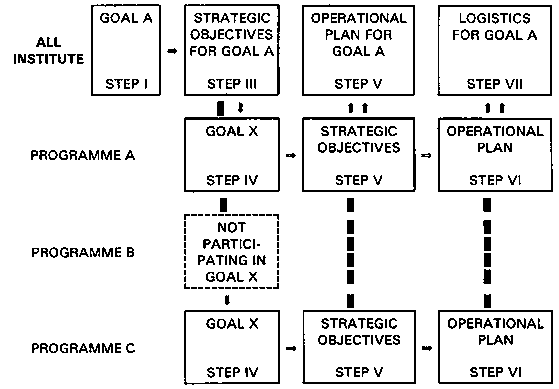
EXHIBIT 3
|
CONSENSUS BUILDING: AN AID TO PLANNING | |
|
DO'S |
DON'TS |
|
DO get all your assumptions and issues 'on the table' |
DON'T come to easy, early agreements |
|
DO get everyone to participate and listen to everyone's input |
DON'T vote (although a show of hands is OK as an indicator) |
|
DO look at disagreements as opportunities to get new points of view |
DON'T compete or argue strongly for extreme positions |
|
DO consider all the alternatives before arriving at a solution |
DON'T make executive decisions if you can avoid it |
|
DO decide the criteria for a 'good' solution before discussing solutions |
DON'T talk about solutions until everyone agrees on the problem |
|
DO get all the data you can on the issue |
DON'T be negative |
|
DO make sure that people to be affected by the decision also help to make the decision |
DON'T discourage divergent points of view |
|
LEVEL: All institute | |
|
GOAL 1: To increase the value of coconuts in the national economy | |
|
STRATEGIC OBJECTIVES FOR GOAL 1 |
1A To increase productivity of the nation's coconut plantations |
|
|
1B To discover additional coconut product formulations with a potential international market |
|
|
1C To assist the local metal-working industry to improve their ability to produce coconut processing equipment |
|
PROGRAMME STRATEGIES FOR GOAL 1 | |
|
AGRICULTURAL ENGINEERING PROGRAMME |
1A To improve harvest and post-harvest equipment and facilities |
|
|
1C To assist the local metal-working industry to improve their ability to produce coconut processing equipment |
|
FOOD PROCESSING PROGRAMME |
1B To discover additional coconut product formulations with potential international markets |
|
GENETICS PROGRAMME |
1A To identify coconut cultivars with higher productivity |
|
|
1B To identify coconut cultivars with fruit with improved taste characteristics appropriate for international markets |
TACTICS TO ACHIEVE GOAL 1
|
|
Operational Plans |
|
Logistic requirements |
|
1A-1 |
Develop improved coconut storage facilities |
1A |
2 engineers and 2 extension agents/data collectors to initiate first year of post-harvest equipment and facilities project, etc. |
|
1A-2 |
Identify cultivars that will increase tree productivity by 20% in 5 years |
|
|
|
1B-1 |
Screen current formulations that may have international market potential |
1B |
1 researcher with food formulation background; a new autoclave; etc. |
|
1B-2 |
Ensure that trees identified with production increase potential also produce coconuts that meet the required taste requirements |
|
|
|
1C-1 |
Develop new or improved coconut processing equipment designs |
1C |
1 master trainer/consultant for metal-working technology; a new vehicle to transport trainer/ consultant to metal-working firms; etc. |
|
1C-2 |
Improve skills of metal-working technicians through training |
|
|
|
|
Strategic Objectives |
|
Operational Plans |
|
1A-1 |
Develop improved coconut storage facilities |
1A |
Establish project to determine criteria and design of facility; produce prototype facility; demonstrate to farmers |
|
1C-1 |
Develop new or improved coconut processing equipment designs |
1C |
Set up training/consulting team to visit interested metal-working firms on a regular basis |
|
1C-2 |
Improve skills of metal-working technicians through training |
|
|
|
1B-1A |
Develop taste preference profiles for major international markets |
1B |
Establish a project to develop a formulation for canned coconut milk, etc. |
|
1B-1B |
Screen current formulations that may have international market potential |
|
|
|
1B-1C |
Develop new formulations |
|
|
|
1A-2 |
Identify cultivars that will increase productivity by 20% in 5 years |
1B |
Establish a test plot to screen indigenous and imported germ-plasm for productivity, etc. |
|
1B-2 |
Ensure that trees with the desired productivity also have fruit with the needed taste characteristics |
|
|
