


Session guide - Setting goals and objectives
|
DATE |
|
|
TIME |
|
|
FORMAT |
Plenary participatory lecture |
|
TRAINER |
|
|
OBJECTIVES | ||
|
At the end of this session, participants should: | ||
|
|
1. Know the relationship of institutional goals to the other major institutional management functions. | |
|
|
2. Be aware of major factors influencing institute goals. | |
|
|
3. Be aware of questions that may be asked to assess constraints and opportunities which influence reaching organizational goals. | |
|
|
4. Be aware of how strategic objectives relate to goals at the institute level. | |
|
|
5. Know questions which can assist in transferring institute strategic objectives into multiprogramme goals. | |
|
INSTRUCTIONAL MATERIALS | ||
|
Exhibit 1 |
Interrelationships of the four functions of management in attaining organizational goals | |
|
Exhibit 2 |
Major influencing factors | |
|
Exhibit 3 |
Mission and mandate of the Peruvian National Institute for the | |
|
|
Development of Agro-industry | |
|
Exhibit 4 |
Mission and mandate of the Institute of Agricultural Sciences of Burundi | |
|
Exhibit 5 |
Mission and mandate of the Central Food Technology Research Institute of India | |
|
Exhibit 6 |
Mission and mandate of the Livestock Research Institute, Mpwapwa, Tanzania | |
|
Exhibit 7 |
Mission and mandate of the National Institute of Science and Technology of the Philippines | |
|
Exhibit 8 |
Objectives from a Thai Five-Year Plan | |
|
Exhibit 9 |
Summary results of the Korean Institute of Science and Technology food technology needs and opportunities assessment | |
|
Exhibit 10 |
Assessment of constraints and opportunities at the institute level | |
|
Exhibit 11 |
Strategic objectives at the institute level | |
|
Exhibit 12 |
A-B-C Priority System | |
|
Exhibit 13 |
Transferring institute objectives to multiprogramme goals | |
|
SPECIAL EQUIPMENT AND AIDS | ||
|
Overhead projector and chalkboard | ||
Initiate the session by showing EXHIBIT 1, discussing the relationships of institute goals with the four major structural management functions of planning; monitoring and controlling; organizing; and evaluating.
Ask participants to suggest factors which influence the derivation of institute goals. Note these on the chalkboard. Then show EXHIBIT 2 and assess whether or not the participants' suggested factors fall within one of these three categories. Try to summarize influencing factors suggested by participants which do not fall within one of these three categories.
By showing and discussing EXHIBITS 3 to 7, analyse with participants how missions and mandates can affect the establishment of institute goals.
Following the discussion of the ways through which an institute's mission and mandate can affect its goals, move to the next major factor listed in EXHIBIT 2 and discuss this by showing an excerpt from a national development plan of interest. EXHIBIT 8 shows two objectives from a national Five-Year Plan of Thailand. The first objective could suggest research in the area of plant genetics; the second could suggest a social science research project. EXHIBIT 9 presents the results of a client-needs assessment in Korea. Show this exhibit and note how client needs can point to institute research goals.
Evolve a list of questions through discussions which would assist institute management in setting and examining institute goals. Discuss how such questions could influence the establishment of goals. The trainer should be prepared with his or her own relevant examples.
Show EXHIBIT 10. Discuss these general questions, which can help in determining constraints to and opportunities for achieving institute goals. Ask participants to suggest additional questions which could be useful for this purpose.
Show EXHIBIT 11. By asking each of the questions in this exhibit, try to elicit how these questions can assist in translating institute goals into institute strategic objectives.
As one can normally suggest many objectives which could assist in achieving a goal, some method of prioritization is often required. EXHIBIT 12 shows one such priority system.
Show EXHIBIT 13. Note how these questions can help institute management in moving from institutional objectives to a series of programmatic goals.
EXHIBIT 1 - INTERRELATIONS OF THE FOUR STRUCTURAL FUNCTIONS OF MANAGEMENT IN ATTAINING ORGANIZATIONAL GOALS
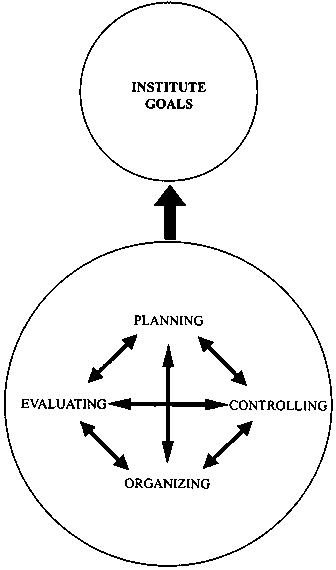
EXHIBIT 2 - MAJOR FACTORS INFLUENCING INSTITUTE GOALS
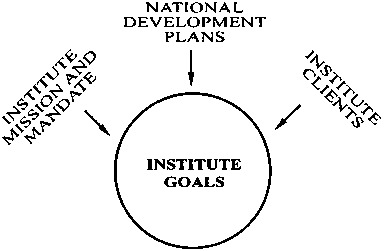
EXHIBIT 3 - MISSION AND MANDATE - 1
|
PERUVIAN NATIONAL INSTITUTE FOR THE DEVELOPMENT OF AGRO-INDUSTRY (INDDA) |
· Develop new industries based on the use of native raw materials· Substitute imported products in part or in whole by national products
· Encourage the development of processed or semi-processed materials instead of raw materials for export
· Raise the nutritional standard of the population by applied research and development of food products
· Assist in the increase of cultivated areas of certain crops and livestock with currently limited markets by investigation of new industrial applications
· To increase productivity of natural forests, reducing the cost of their products
· Create new employment opportunities through contributions to food industry and productivity
Source: INDDA Brochure
EXHIBIT 4 - MISSION AND MANDATE - 2
|
THE INSTITUTE OF AGRICULTURAL SCIENCES OF BURUNDI |
· To promote the scientific and technical development of agriculture, animal husbandry and forestry in BurundiSource: From a report by J. Kafurera
EXHIBIT 5 - MISSION AND MANDATE - 3
|
THE CENTRAL FOOD TECHNOLOGY RESEARCH INSTITUTE (CFTRI), INDIA |
· To promote the technical and economic progress of India's food and allied industries through research and development work, designed to generate and apply relevant technology for the maximal conservation and optimal utilization of the nation's food resourcesSource: as stated in 30 Years of CFTRI
EXHIBIT 6 - MISSION AND MANDATE - 4
|
THE LIVESTOCK RESEARCH INSTITUTE, MPWAPWA, TANZANIA |
1. To undertake studies on the various livestock diseases prevailing in the country2. To undertake studies on various animal husbandry problems
Source: in a report by M.L. Kyomo
EXHIBIT 7 - MISSION AND MANDATE - 5
|
THE NATIONAL INSTITUTE OF SCIENCE AND TECHNOLOGY. THE PHILIPPINES |
1. To implement and conduct programmes of scientific and technological research and development as may be directed by the board.2. To cooperate with private enterprise in research activities relating to scientific and technological problems of industry, agriculture, engineering, mathematics and the natural, biological and social sciences.
3. To conduct studies through its research centres on industrial, agricultural, medical, biological and related fields, and to cooperate with other government agencies along these lines.
4. To perform analyses and tests for the purpose of establishing suitable standards of products, to calibrate weights and measures, to determine the quality and composition of materials, and to issue certifications in relation thereto.
5. To provide government entities and local industrial organizations with data of a scientific and/or technological nature, subject to established laws and regulations on national security.
6. To establish, expand, maintain and operate pilot plants, research centres, test and standards laboratories, experimental stations and documentation facilities.
7. To study and evaluate project proposals for research and development in the industrial, agricultural, medical, biological and related fields, from public and private sectors, and to recommend necessary financial, technical and other appropriate assistance thereto.
8. To receive assignments of patents, grant exclusive rights to their use, and charge and collect reasonable fees or charges for their use in accordance with the policies of the institute.
9. To keep posted on research projects and activities financed or assisted under this act.
10. To recommend deserving citizens for training, government and private grants and scholarships in the Philippines and abroad in science, other than nuclear science, technology, mathematics and science teaching.
Source: as stated in the Philippine Science Act, 1958
EXHIBIT 8 - OBJECTIVES
|
FROM A THAI FIVE-YEAR PLAN |
· ...· To accelerate research on sugar cane varieties, with a productivity target of 10 tons per /-a/and a sweetness target of 10 CCS
· ....
· To get millers and farmers to cooperate in formulating production plan
· ...
EXHIBIT 9 - SUMMARY RESULTS OF THE KOREAN INSTITUTE OF SCIENCE AND TECHNOLOGY NEEDS AND OPPORTUNITIES ASSESSMENT
|
Among the problems faced by Korea's food processing industry were: · unregulated supply, quality and consistency of domestic raw material; · uneconomic operation on a short, seasonal basis or at a fraction of full capacity; and · high cost of packaging materials (mostly cans). The assessment resulted in 24 recommendations relating to need for research in the areas of processing, storage, distribution and raw material. |
EXHIBIT 10 - ASSESSMENTS OF CONSTRAINTS AND OPPORTUNITIES AT THE INSTITUTE LEVEL
QUESTIONS
WHAT MIGHT PREVENT US FROM REACHING OUR GOALS?
WHERE ARE WE CAPABLE OF GOING?
WHERE ARE WE STRONG? - WHERE ARE WE WEAK?
WHAT DOES THE AGRICULTURAL SECTOR KNOW OF US?
WHAT DO THEY THINK OF US?
WHAT DO WE KNOW ABOUT OUR NATIONAL AGRICULTURE AND AGRO-INDUSTRY?
HOW DO OUR GOALS REINFORCE NATIONAL GOALS?
WILL OUR STAFF SUPPORT A LONG-RANGE PLANNING EFFORT?
WHERE ARE OUR STAFF STRENGTHS?'
WHERE ARE THEIR WEAKNESSES?
WHAT ARE THE RISKS OF CHANGE?
ARE OUR FACILITIES ADEQUATE?
EXHIBIT 11 - STRATEGIC OBJECTIVES AT THE INSTITUTE LEVEL
QUESTIONS
WHAT OBJECTIVES WILL GET US TO EACH INSTITUTE GOAL?
WHICH OBJECTIVES WILL REQUIRE A HIGHER LEVEL OF APPROVAL?
WHAT WILL THESE OBJECTIVES LOOK LIKE?
WHAT PROGRAMMES WILL DO THAT?
WILL THE NEW OBJECTIVES ADDRESS EXISTING PROBLEMS? - IF SO, TO WHAT EXTENT?
CAN WE MEASURE THE SUCCESS OR FAILURE OF EACH OBJECTIVE?
DO THESE OBJECTIVES GIVE ENOUGH ATTENTION TO:
- AGRICULTURE-RELATED GOALS?
- GOVERNMENT-RELATED GOALS?
- INSTITUTE STAFF GOALS?
ARE THESE NEW OBJECTIVES, OR STALE, OLD IDEAS?
HOW CAN WE REACH OUT INTO THE ORGANIZATION FOR NEW CONCEPTS?
EXHIBIT 12 - THE A-B-C PRIORITY SYSTEM
After putting together the full list of proposed institute strategic objectives, assign to each an A, B or C priority.
|
A = MUST DO |
If institute goals are to be reached. |
|
|
These would make it easier to |
|
B = SHOULD DO |
reach institute goals quickly, but could be put off temporarily if necessary |
|
C = LIKE TO DO |
These are desirable, but could be eliminated, or postponed until work has been completed on any A or B priorities. |
EXHIBIT 13 - TRANSFERRING INSTITUTE STRATEGIC OBJECTIVES TO MULTIPROGRAMME GOALS
QUESTIONS
HOW CAN EACH PROGRAMME IDENTIFY ITS OWN GOALS AS A CONTRIBUTORY ELEMENT TO THE OVERALL INSTITUTE STRATEGIC GOALS?
CAN THE PROGRAMME PROPOSE NEW GOALS WHICH SHOULD BE CONSIDERED AT THE INSTITUTE LEVEL?
ARE THESE PROGRAMME GOALS
- TOO AMBITIOUS?
- TOO CAUTIOUS?
HOW CAN WE BE SURE THAT THERE ARE NOT BETTER SOLUTIONS?
CAN WE GENERATE BETTER APPROACHES BY JOINT PLANNING WITH OTHER PROGRAMMES?
