Sudan's sheep population
Tribal subtypes of Sudan desert sheep (figure 1)
Sudan is the largest country in Africa, covering an area of more than 2.5 million square kilometres. It also has one of the largest livestock populations on the continent: cattle, sheep, goats and camels were estimated to number about 45 million in the mid-1970s (Watson et al, 1977), and about 55 million a decade later (FAO, 1985).
Over the same period, the number of sheep has grown at 2.8% per year, and so the proportion of sheep in Sudan's livestock population has remained constant at about 36%. Sheep therefore play an important social and economic role in the country, and are a valuable strategic resource for both local and export purposes.
Sudan sheep have been classified by, for example, Bennett et al (1948), McLeroy (1961a; 1961b) and Wilson and Clarke (1975). Based on physical features and ecological distribution, four main local groups have been identified: Sudan Desert, Sudan Nilotic, Sudan Arid Upland and Sudan Equatorial Upland. Fused ecotype groups, resulting from non-systematic crossbreeding at the boundaries of the ecozones of the pure types, have also been recognised.
More than 65% of the sheep in Sudan are of the Sudan Desert breed. Compared with the other types, this breed has remarkable productive and marketing features, and so is given priority in research and development programmes.
Current attitudes to modern agriculture and livestock production in the irrigated areas have stimulated the idea of integrated cereal crop and livestock farming as a means of maximising production. As a result of improved feed resources (natural grazing, agricultural byproducts and grown fodder) due to the presence of abundant water, there is good potential for sheep production in the irrigated areas. This is confirmed by the large number of sheep reared in these areas (about 28% of the national population).
Performance characterisation and evaluation of sheep is a prerequisite to further progress in improving their productivity. The National Sheep Research Station at El-Huda has been working on evaluating the performance of subtypes of the Sudan Desert sheep - Shugor, Dubasi and Watish. This report presents the initial results of this work.
Shugor
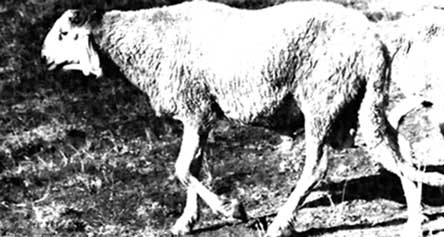
Shugor are moderately large sheep ranging in colour from light to dark brown. They have occasional patches of wool under the hair. They are found mainly along and to the west of the White Nile, and are most common in the western part of the Gezira, where they graze on cotton residues and other agricultural byproducts. Their migratory movements are longer than those of the Dubasi and it is not uncommon to find Shugor flocks deep in the Gezira area.
Dubasi
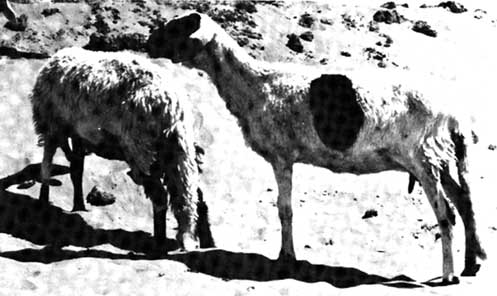
Dubasi are the prototype sheep of the Gezira area, especially the northern part, and are concentrated in the villages of the Dubaseen tribes (hence 'Dubasi'). These sheep are similar in size to the Shugor but their thin coat is usually parti-coloured white and black. The distribution of the black patches on the skin varies among regions and breeders. Some breeders select sheep with saddled backs with black plates or patches. It is rare to find Dubasi farther to the west along the White Nile.
Watish
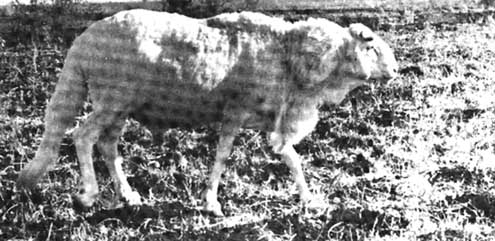
The Watish subtype is somewhat smaller and stockier than either the Shugor or the Dubasi. Three colour groups - fawn, red, and white with light spottings - have been recognise (McLeroy, 1961b). Watish are hardy sheep and live under relatively high rainfall conditions between latitudes 10° and 11°N and mainly along the Blue Nile, south of Wad Medani into the Fung area. They are mainly owned by nomadic and semi-nomadic tribes, including the Kenana, the Rufaa El Hoy and the Beni Meharib.
Figure 1. Shugor, subtype of Sudan Desert sheep (A)
Figure 1. Dubasi, subtype of Sudan Desert sheep (B)
Figure 1. Watish, subtype of Sudan Desert sheep (C)