El-Huda National Sheep Research Station
Flock management
Data collection and initial preparation
Statistical analysis
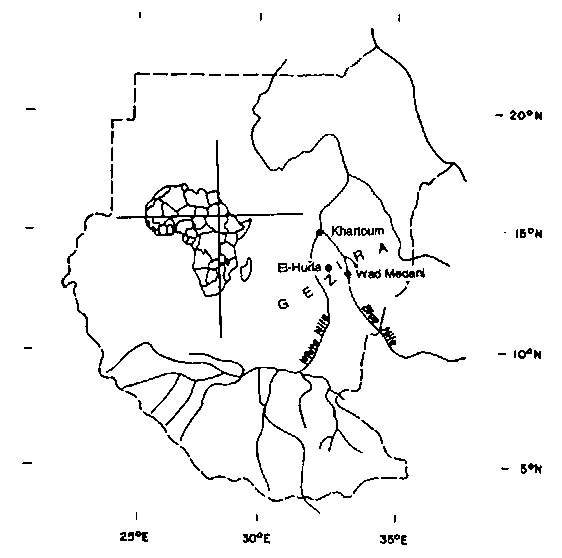
El-Huda lies at approximately 14°15'N latitude and 32°50'E longitude, at an altitude of about 250 m, about 90 km north-west of Wad Medani and about 150 km south of Khartoum (Figure 2). The station covers an area of about 150 ha of a levelled clay plain, of which 100 ha are available for forage cultivation.
The present sheep research station was previously (1960-71) a division of the community development centre at El-Huda. The objective of that division was to help to improve the nutritional standards of the tenant farmers in the area through services that included the provision of dairy and poultry products.
Recognising the role that the sheep industry can play in the livestock and national economies, the Sudanese Government decided that this division should be concerned only with research work on sheep. Access to several different genotypes of sheep was relatively easy as El-Huda lies central to the main marketing and breeding areas in the region where two of the main subtypes (Shugor and Dubasi) of Sudan Desert sheep are reared.
The work of the El-Huda National Sheep Research Station includes:
· basic research to characterise the performance of Sudan Desert sheep subtypes· development research to identify more specialised genotypes for specific production objectives
· development of selected germplasm, for propagation under station or similar conditions
· assessing possibilities for developing the existing sheep production and marketing systems
· studying problems associated with sheep productivity under irrigated conditions with special reference to feeding levels and disease control.
Figure 2. The location of El-Huda National Sheep Research Station, Sudan
Climate
No meteorological data are available for El-Huda station or town. Meteorological information can be inferred from data collected at Wad Medani Meteorological Station for the period 1951-80 (Table 1).
The year can be divided into three seasons:
· winter (November to February)
· hot summer (March to June)
· wet summer (July to October)
Prevailing winds during November to April are dry and northerly, while southerly winds blow during May to October and are associated with the rainy season.
Feed resources
The feed resources at the station comprise grown forages including pillesesara (Phaseolus trilobus), lucerne (Medicago sativa), dolichos bean (Dolichos purpureus) and several varieties of Sudan grass (Sorghum sudanense), particularly the local cultivar Abu sabaeen. Sorghum (Sorghum vulgare) grain and stover, groundnut hay, agricultural byproducts (cottonseed cake, wheat bran, sugar-cane molasses) and natural grasses growing on fallow land and canal banks are also available.
Feed resources are, however, limited. The station does not have its own irrigation capabilities but relies wholly on those of the Gezira Board. This arrangement is inconvenient for summer forage production as priority in water supply is given to cotton.
Table 1. Climatological normals for 1951-80 for Wad Medani town (90 km south-east of El-Huda), Sudan
|
Month |
Temperature (°C) |
Relative humidity (%) |
Rainfall (mm) |
Wind direction |
|||
|
Maximum |
Minimum |
||||||
|
Mean |
Highest |
Mean |
Lowest |
||||
|
January |
33.1 |
40.6 |
14.0 |
5.7 |
32 |
trace |
N |
|
February |
35.1 |
43.3 |
15.7 |
3.3 |
32 |
0.4 |
N |
|
March |
38.4 |
44.8 |
18.7 |
7.3 |
19 |
5.2 |
N |
|
April |
40.9 |
46.1 |
21.5 |
12.0 |
18 |
9.4 |
N |
|
May |
41.5 |
46.2 |
24.3 |
15.6 |
26 |
47.8 |
SW |
|
June |
39.6 |
45.2 |
24.6 |
16.7 |
41 |
48.3 |
SSW |
|
July |
35.7 |
43.8 |
22.8 |
18.5 |
60 |
117.7 |
S |
|
August |
33.4 |
46.0 |
22.1 |
18.0 |
70 |
79.3 |
S |
|
September |
35.3 |
41.4 |
21.9 |
17.0 |
63 |
71.9 |
S |
|
October |
37.8 |
41.5 |
21.6 |
11.1 |
47 |
41.7 |
S |
|
November |
36.3 |
41.5 |
18.2 |
8.7 |
35 |
6.7 |
NNW |
|
December |
33.4 |
40.0 |
14.8 |
4.1 |
35 |
trace |
N |
|
Annual |
36.7 |
- |
18.2 |
- |
40 |
428.4 |
- |
The station flocks
The research flocks comprise Shugor, Dubasi and Watish tribal subtypes of Sudan Desert sheep. The former two types were collected about 1971 from local private breeding flocks and livestock markets. The Watish was introduced in April 1977 from El-Neisheiba livestock station at Wad Medani. Additional sheep have been bought over the years to increase the flock size for research purposes.
Because the history of purchased, or 'foundation', animals was not known, these animals were originally grouped on the basis of dentition; they were thus initially allocated to one of seven age groups - four for animals having no permanent incisors and three for those having permanent incisors. Animals born on the station could be grouped according to their absolute ages.
General management
The three subtypes were usually kept separate from each other to avoid any unplanned cross breeding. Breeding males and females were separated except at breeding time. Usually there were four separate functional groups: suckling ewes and their young; weaned lambs; flocks with rams; and pregnant ewes. Only suckling lambs and breeding ewes were housed and fed in pens. Other groups were grazed on forage or on the natural range, in one or two flocks within each functional group.
Nutrition
Flock nutrition was based on stored forage and agricultural byproducts, although harvested fields were also grazed before being irrigated for regrowth or ploughed for the next sowing season. Concentrate supplementation was provided only to suckling ewes, breeding ewes and ewes close to lambing. Breeding ewes were allowed a rising level of concentrate supplement for two weeks before the introduction of rams. A mineral salt lick and water were always available. The animals were allowed about 1 kg each of a concentrate mixture of wheat bran (40%), cottonseed cake (30%) and crushed sorghum grain (30%). Stored forage and straw were provided to animals that were confined for breeding and suckling. During rainy days and when there was a shortage of forage and straw, all animals received an extra 0.45 kg of wheat bran. During the drought years of 1981-84, when there was a severe shortage of cereal grain for human consumption, sheep were fed sugar-cane molasses and urea combined with wheat bran.
Breeding and mating plans
Sudanese sheep are not seasonal breeders and may have lambs throughout the year. Many local breeders, however, have attempted to establish two main breeding seasons, one during the wheat and cotton harvest in the winter and the other during the rainy season. Nutritional conditions at these periods provide natural flushing. There are therefore two lambing seasons, in summer (July-August), when the majority of flocks lamb, and in winter (December-January). Because of the soaring cost of living and of keeping sheep, some breeders are now turning to more intensified rearing so that lambs are available at all periods of the year. To achieve this, they spend more money on supplementary feed and allow rams to run freely with recently lambed ewes.
The general policy at the station was to maintain purebred flocks, except for very limited inter-flock breeding in 1978 and 1979. The usual practice at the station was to carry out summer and autumn matings to produce autumn and winter lamb crops. Most parturitions occurred from July through December (Figure 3).
In each breeding season ewes were grouped by age and randomly allocated to breeding rams, so that each ram was mated to about 20-25 ewes of similar age. These breeding groups were maintained for six weeks following which the ewes were reassembled into one flock and the rams joined the breeding rams' flock.
Weaned ewe lambs joined the breeding flocks at about seven to eight months of age. Continuous culling of barren, old and sick ewes, old and heavy rams and surplus young males was a normal practice.
Figure 3. Frequency distribution of month of parturition of Sudan Desert sheep at El-Huda, Sudan
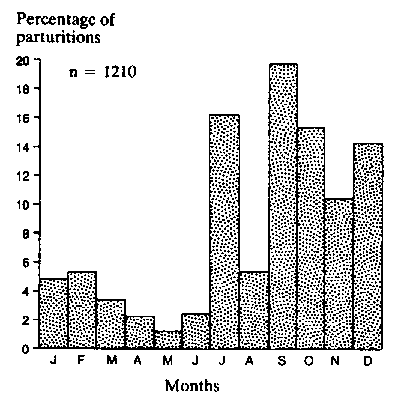
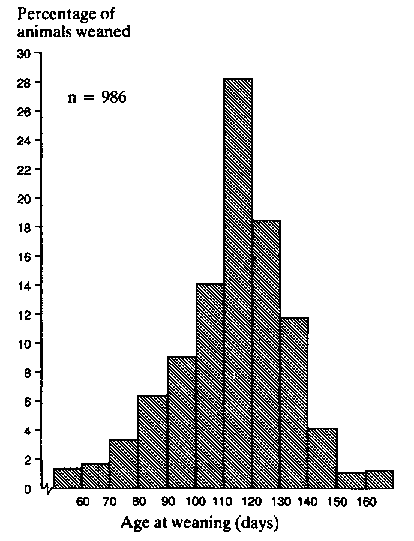
Figure 4. Frequency distribution of age at weaning of Sudan Desert lambs at El-Huda, Sudan
Lamb rearing
Lambs were given special attention at birth and during the first two weeks of life. Newly lambed ewes were kept in confinement and fed with their lambs for at least the first week following lambing. During this period, great care was taken to ensure that the lambs were well fed. After the first week, lambed ewes were taken to graze for a short period each day and then returned to the pens. While the ewes were away the young lambs were given small quantities of hay.
Two weaning practices were followed during the period of study: group weaning at an age of about 16 weeks; or individual weaning at exactly 16 weeks of age. Age at weaning was quite well controlled, the most common weaning age being between 110 and 120 days (Figure 4). Weaned lambs were kept together until they were about six months old: thereafter the sexes were segregated and reared separately.
Disease control
Routine disease control measures comprised vaccination against endemic diseases, drenching against internal parasites and ectoparasite and tick control.
Occasional tests for brucellosis were carried out. Newly purchased sheep were medically treated and quarantined before joining the flock.
Physical and performance data were regularly entered into performance registers.
Physical measurements on the live animal were made with a tape and a measuring stick. The measurements were:
· body length (from the tip of the scapular to the pin bone)· heart girth (the circumference of the chest)
· chest depth (between the breast and the withers)
· height at withers (from the highest point on the dorsum of the animal to the ground surface at the level of the front feet)
· ear length (from the base of the ear at the skull along the dorsal surface to the tip of the ear).
Performance data from the registers were transferred to computer coding sheets in preparation for statistical analysis. Three coding sheets were used:
· a "Basic Record" containing information on an animal's identity, subtype, source and pedigree, sex, colour, parity, birth and weaning dates, and reasons for entry and exit and dates at which these occurred· a "Weight Record" showing an animal's identity, date of birth and weight at birth and at each subsequent (dated) weighing
· a "Birth Record" showing a dam's identity, and the birth dates, numbers, identities, sexes and parities of her offspring.
Data were initially tested for completeness and conformity using commercial software (Dixon et al, 1985; SPSS Inc. 1983). The major analyses were carried out using least-squares fixed-and mixed-model procedures (Harvey, 1977). Unequal and disproportionate subclass numbers gave unbalanced factorial designs for which conventional analysis of variance techniques would not have been applicable. The models used included: the random effects of sire within subtype; the random effects of the dam (where she appeared in the analytical matrix more than once); and the fixed effects of origin (foundation or born on station), parturition number, year of birth or parturition, season of birth or parturition, type of birth or parturition, and sex of young. Parturition number was the true parity for station-born ewes, but for foundation ewes whose previous reproductive history was not known, "parity" was taken as the number of parturitions on the station: in both cases, fourth and subsequent parturitions were treated as a single effect (>3).
The residual mean square was used as the error term to test the significance of all differences evaluated among groups except in analyses where sires were used, when the error term for breed was sire-within-breed. Linear contrasts of least-squares means were computed to determine the significance of differences within groups for all characters where the difference was significant in the analysis of variance.
None of the foundation animals had sire or dam records, so sire could not be used in analyses involving these animals. Heritabilities were calculated by the paternal half-sibling method. Repeatabilities were calculated using the variance components among and within ewes.
Productivity indices were constructed for individual ewes from data on litter weight at 120 or 150 days, parturition interval and young survival (the death of a litter resulting in a zero index for a particular female). Three indices were calculated:
Index I = Weight (kg) of young produced per female per year = 
Index II = Weight (g) of young produced per kg liveweight of female per year = 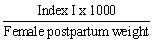
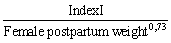
Index III = Weight (kg) of young produced per kg metabolic weight of female per year =