Body measurements
Reproductive performance
Weight and growth
Offtake and mortality
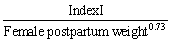
Productivity indices
Determination of the degree of relationship between physical measurements in sheep may help to provide means for predicting traits which are not normally easily measured under field conditions. In the present study, determinations were made by regressing the measurements of ear length, heart girth, body length, chest depth and height at withers on the age of the animal. The regression coefficients of these measurements are shown in Table 2. As might be expected, the relationship between ear length and age of the animal is poor. There were highly significant (P<0.001) regression coefficients between the remaining live measurements and age in all three subtypes.
These relationships were further classified using the significance of the regression coefficients, as indicated by t- values (the regression coefficient (b) divided by the standard error of b; see Table 2). For Shugor and Dubasi chest depth showed the best relationship with age, followed by heart girth, body length and withers height. For Watish the ranking was heart girth, chest depth, body length and withers height. Heart girth is the most variable live measurement since it reflects condition (and, in some cases, physiological status) in the animal. Chest depth, body length and height at withers are skeletal measurements and are less variable than heart girth.
Table 2. Regression coefficients for estimates (cm) of ear length, heart girth, body length, chess depth and withers height for three subtypes of Sudan Desert sheep at El-Huda, Sudan
|
Physical measurement and coefficienta |
Value of coefficient for subtypes |
||
|
Shugor |
Dubasi |
Watish |
|
|
Ear length |
|
|
|
|
a |
16.6 |
16.5 |
15.3 |
|
b |
0.27 |
-0.95 |
2.50 |
|
SE(b) |
0.95 |
1.1 |
1.5 |
|
Heart girth |
|
|
|
|
a |
74.0 |
74.8 |
72.6 |
|
b |
56 |
47 |
73 |
|
SE(b) |
6.2 |
7.2 |
8.1 |
|
Body length |
|
|
|
|
a |
52.4 |
52.3 |
51.4 |
|
b |
30 |
37 |
34 |
|
SE(b) |
3.8 |
5.8 |
5.3 |
|
Chest depth |
|
|
|
|
a |
28.0 |
28.0 |
27.2 |
|
b |
28 |
24 |
24 |
|
SE(b) |
2.7 |
3.1 |
3.5 |
|
Height at withers |
|
|
|
|
a |
66.2 |
67.2 |
63.1 |
|
b |
35 |
32 |
33 |
|
SE(b) |
4.6 |
5.6 |
6.6 |
a a and b are the parameters of the equation y = a + b(age x 10-4), where y is the physical measurement, and age is measured in days. SE(b) is the standard error of the regression coefficientAll regressions, except for ear length, were highly significant (P<0.001)
The reproductive performance of sheep is a major factor in productivity: it depends an various factors including age at first lambing, litter size, lambing interval and the lifetime productivity of the ewe, this last being related to her longevity. An early age at first lambing is conducive to increased productivity and improvement of breeding value. Intensification of management and early introduction of maiden ewes for breeding will modify age at first lambing. Management and ewe liveweight at weaning play an important role in determining when the first postpartum heat occurs and hence the length of the lambing interval.
Early reproductive traits
Weight at first conception
The occurrence of sexual maturity in sheep is related to a target weight which can be intrinsic to the animal or influenced by nutritional level and management (Allen and Lamming, 1961; Younis et al, 1978; Suleiman, 1982). Such effects also influence the ovulation rate and the intensity of heat in maiden ewes at puberty.
In the present study, the mean weight at first conception of the Shugor, Dubasi and Watish ewe lambs was 35.1 kg (Table 3). The subtype of the ewe and the season and year in which she first conceived had significant influences on this weight: in addition there were significant differences in weight of ewes which subsequently gave birth to singles or twins. Differences between years are, however, confounded with seasonal variations and the specific managements and rearing procedures followed in different years.
In an earlier investigation into characteristics of ewes lambing for the first time at El-Huda (Sulieman et al, 1985) lambs conceived for the first time when they weighed about 20 kg.
Table 3. Least-squares mean weights (kg) associated with first lambing of Sudan Desert ewes at El-Huda, Sudan
|
Factor |
Weight (kg) at first conception |
Weight (kg) at first parturition |
Weight (kg) at 120 days after first parturition |
|||
|
n |
Mean |
n |
Mean |
n |
Mean |
|
|
Overall least-squares mean |
151 |
35.1 |
135 |
37.9 |
124 |
37.0 |
|
SE |
|
0.95 |
|
0.83 |
|
0.76 |
|
Subtype |
|
|
|
|
|
|
|
Shugor |
38 |
35.8a |
38 |
39.3a |
35 |
38.5a |
|
Dubasi |
64 |
36.8a |
54 |
40.4a |
51 |
37.7a |
|
Watish |
49 |
32.7b |
43 |
34.0b |
38 |
34.7b |
|
Significance of F-test |
|
** |
|
** |
|
** |
|
Parturition type |
|
|
|
|
|
|
|
Single |
132 |
33.0a |
121 |
37.4 |
109 |
36.2 |
|
Twin |
19 |
37.2b |
14 |
38.3 |
15 |
37.8 |
|
Significance of F-test |
|
* |
|
ns |
|
ns |
|
Season |
|
|
|
|
|
|
|
Winter |
17 |
35.9a |
56 |
37.1 |
46 |
35.3 |
|
Hot summer |
87 |
37.2b |
12 |
39.7 |
13 |
37.2 |
|
Wet summer |
47 |
32.2a |
67 |
36.8 |
65 |
38.3 |
|
Significance of F-test |
|
*** |
|
ns |
|
ns |
|
Year |
|
|
|
|
|
|
|
1978 |
12 |
32.1a |
10 |
39.7a |
17 |
36.4a |
|
1979 |
34 |
39.0b |
26 |
40.1a |
23 |
37.5a |
|
1980 |
22 |
35.4ac |
14 |
39.5a |
6 |
41.6b |
|
1981 |
- |
- |
9 |
34.3b |
4 |
30.9c |
|
1982 |
61 |
36.8bc |
39 |
35.6bc |
36 |
36.4a |
|
1983 |
22 |
32.3a |
22 |
38.5ac |
25 |
39.1ab |
|
1984 |
- |
- |
15 |
37.5ab |
13 |
36.8ab |
|
Significance of F-test |
|
** |
|
*' |
|
** |
|
Residual SD |
|
6.25 |
|
5.20 |
|
4.36 |
In the same column, and within a factor, means followed by the same letter do not differ significantly (P>0.05)
|
*** P<0.001 |
** P<0.01 |
* P<0.05 |
ns = not significant |
Weight at first parturition
The weight of a gimmer at first lambing has an important effect on her future reproductive performance. This is particularly so because while the ewe lamb is still growing, pregnancy could cause a growth check unless adequate nutrition is provided. A growth check in the pregnant gimmer at first lambing may delay return to oestrus after parturition and hence extend the lambing interval. Underweight pregnant gimmers may abort the foetus.
In the present study, the mean weight at first parturition was 37.9 kg (Table 3). Only subtype and year of parturition exerted significant influences on this weight.
In an earlier investigation (Sulieman et al, 1985) liveweights of Shugor, Dubasi and Watish ewes at first parturition were 31.8, 31.1 and 25.4 kg respectively.
Weight at 120 days after first parturition
The mean weight of a gimmer at first lambing 120 days after her first parturition, that is, when her litter was weaned, was 37.0 kg (Table 3). Only subtype and year of parturition had significant effects on this weight.
Age at first lambing
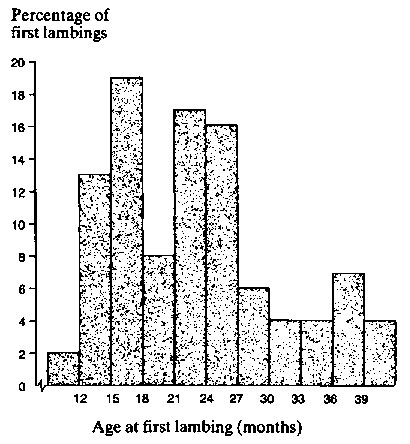
The unadjusted mean age at first parturition in the present study was 758 days (SD = 238.1; n = 237). Figure 5 shows the distribution of ages at first lambing. The least-squares analysis showed that only the year in which a gimmer at first lambing was born had an effect on the age at which she bore her first lamb.
The least-squares mean age at first lambing was 688.8 days (SE = 42.51). The linear contrasts of year of birth effects (1976-80) showed that gimmers born in 1977 were youngest of all at first lambing (583.2 days) while gimmers born in 1979 were oldest (810.9 days). Animals born in 1978 and 1980 were also younger at first lambing than the overall average while those born in 1976 were older. These between-year variations resulted mainly from variations in management of weaned ewe lambs.
In a previous study (Suleiman, 1982), mean age at first lambing for Shugor, Dubasi and Watish ewe lambs was calculated as 605.3 days (SE = 12.0). None of season of year, nutritional treatment or subtype exerted a significant influence on age at first lambing. In a more recent investigation, Sulieman et al (1985) found a mean age at first lambing of 421.0 days for a similar group of gimmers which were joined to a ram immediately after weaning.
Figure 5. Frequency distribution of ages at first lambing of Sudan Desert ewes at El-Huda, Sudan
Litter sizes
The unadjusted mean litter size was 1.18 (SD = 0.40; n = 1090). The analysis of variance showed that subtype, season of parturition, year of parturition and the parity of station-born ewes significantly influenced this trait (Table 4).
The least-squares mean litter size was 1.22 (Table 4). A polynomial analysis of litter size in relation to parity in station-born ewes showed the increase to be linear from first to fourth parity.
Introducing ewe weight at conception as a covariate on a reduced sample (n = 363) indicated that heavier weights at conception led to increased litter sizes. For every additional kilogramme of liveweight at conception the increase in litter size was 0.01 Iambs (P<0.001) but it is probable that this increase is related as much to ewe age as to weight per se and also to the larger litter sizes of the heavier Shugor ewes.
Results of earlier analyses of litter size in Sudan Desert sheep, usually on smaller samples and over shorter time periods, are inconsistent. Differences among tribal subtypes have, however, been similar to those demonstrated in the current study. In the only previous three-breed analysis (Sulieman and Eissawi, 1984a), Shugor had larger litters (1.25) than either Dubasi (1.16) or Watish (1.16) although the differences between groups were not significant. A recent two-breed analysis for ewes born in 1979-81 (El-Karim and Owen, 1987) showed that Shugor had significantly larger litters (1.25) thaWatish (1.13). An earlier two-breed analysis of Shugor and Dubasi ewes (Sulieman et al, 1978) indicated a litter size of these two types combined of about 1.30 lambs. The only detailed analysis of reproductive performance of Sudan Desert sheep from a traditional system (in Darfur, western Sudan) showed the potential of Sudan Desert sheep for greater output in the litter size of 1.45 lambs (Wilson, 1976).
Table 4. Least-squares mean litter sizes (numbers of lambs), lambing intervals (days) and annual reproductive rates (lambs/ewe/year) of Sudan Desert ewes at El-Huda, Sudan
|
Factor |
Litter size (number of lambs) |
Lambing interval (days) |
Annual reproductive rate (lambs/ewe/year) |
|||
|
n |
Mean |
n |
Mean |
n |
Mean |
|
|
Overall least-squares mean |
1090 |
1.22 |
452 |
426 |
452 |
1.11 |
|
SE |
|
0.022 |
|
20.0 |
|
0.071 |
|
Subtype |
|
|
|
|
|
|
|
Shugor |
386 |
1.30a |
161 |
449a |
161 |
1.18a |
|
Dubasi |
394 |
1.18b |
201 |
425ab |
201 |
1.01b |
|
Watish |
310 |
1.17b |
90 |
403b |
90 |
1.14ab |
|
Significance of F-test |
|
*** |
|
+ |
|
* |
|
Dam origin |
|
|
|
|
|
|
|
Station-born |
347 |
1.24 |
94 |
427 |
94 |
1.06 |
|
Foundation |
743 |
1.20 |
358 |
425 |
358 |
1.16 |
|
Significance of F-test |
|
ns |
|
ns |
|
ns |
|
Parturition type |
|
|
|
|
|
|
|
Single |
- |
- |
362 |
428 |
- |
- |
|
Twin |
- |
- |
90 |
423 |
- |
- |
|
Significance of F-test |
|
ns |
|
ns |
|
ns |
|
Season of parturition |
|
|
|
|
|
|
|
Winter |
348 |
1.19ab |
62 |
447a |
62 |
1.08 |
|
Hot summer |
93 |
1.28b |
54 |
445a |
54 |
1.09 |
|
Wet summer |
649 |
1.19a |
336 |
385b |
336 |
1.15 |
|
Significance of F-test |
|
+ |
|
** |
|
ns |
|
Year of parturition |
|
|
|
|
|
|
|
1975 |
24 |
1.18ab |
24 |
369a |
24 |
1.11 |
|
1976 |
102 |
1.20ab |
93 |
404a |
93 |
1.17 |
|
1977 |
103 |
1.23ab |
84 |
429ac |
84 |
1.04 |
|
1978 |
149 |
1.31a |
132 |
449bc |
132 |
1.17 |
|
1979 |
157 |
1.24ac |
119 |
478b |
119 |
1.04 |
|
1980 |
190 |
1.23ac |
|
|
|
|
|
1981 |
106 |
1.17bc |
- |
- |
- |
- |
|
1982 |
139 |
1.26ac |
- |
- |
- |
- |
|
1983 |
120 |
1.13b |
- |
- |
- |
- |
|
Significance of F-test |
|
* |
|
* |
|
ns |
|
Parity (Station-born ewes) |
|
|
|
|
|
|
|
1 |
175 |
1.13a |
54 |
435 |
54 |
1.02 |
|
2 |
92 |
1.21ab |
30 |
421 |
30 |
1.17 |
|
3 |
50 |
1.24ab |
7 |
408 |
7 |
1.29 |
|
>3 |
30 |
1.36b |
3 |
443 |
3 |
0.75 |
|
Significance of F-test |
|
* |
|
ns |
|
ns |
|
Parity on station (Foundation ewes) |
|
|
|
|
|
|
|
1 |
246 |
1.17 |
140 |
458a |
140 |
1.11 |
|
2 |
193 |
1.20 |
111 |
403bc |
111 |
1.19 |
|
3 |
151 |
1.21 |
69 |
387b |
69 |
1.22 |
|
>3 |
153 |
1.22 |
38 |
451ac |
38 |
1.12 |
|
Significance of F-test |
|
ns |
|
** |
|
ns |
|
Residual SD |
|
0.389 |
|
146 |
|
0.542 |
In the same column, and within a factor, means followed by the same letter do not differ significantly
(P>0.05)
|
*** P<0.001 |
** P<0.01 |
* P<0.05 |
+ P<0.1 |
ns = not significant |
Lambing intervals
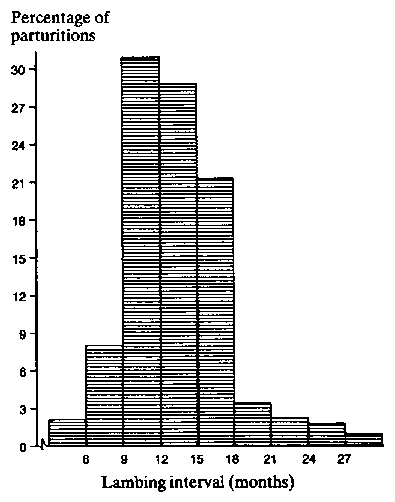
The unadjusted mean interval between successive lambings was 421 days (SD = 150.1; n = 452). The frequency distribution of lambing intervals is shown in Figure 6. The analysis of variance showed significant differences in the interval resulting from the season and year of the parturition and the parity on the station of foundation ewes, and barely significant (P = 0.08) differences among breeds (Table 4).
The least-squares mean lambing interval was 426 days (Table 4).
Ewe postpartum liveweight did not have a significant effect on lambing interval although there was a trend that indicated that lambing interval decreased by about 4.4 days for every 1 kg increase in postpartum liveweight.
The only previous analysis of lambing intervals of all three types at El-Huda station (Sulieman and Eissawi, 1984a) found much shorter lambing intervals of 293 (SD = 48.0), 311 (SD = 58.5) and 367 (SD = 100.1) days for Shugor, Dubasi and Watish ewes. The relatively long intervals between births at El-Huda station should not be taken as an indication of inherent performance of Sudan Desert sheep or of any photoperiod-induced seasonality. In southern Darfur an unadjusted interval of 272 days (SD = 58.6) has been calculated (Wilson, 1976), the longer periods between births at El-Huda resulting from management restrictions on breeding.
Figure 6. Frequency distribution of lambing intervals of Sudan Desert sheep at El-Huda, Sudan
Annual reproductive rates
The unadjusted annual reproductive rate, calculated as litter size x 365/subsequent parturition interval was 1.15 lambs per ewe per year (SD = 0.547; n = 452). The analysis of variance showed that annual reproductive rate was significantly affected only by subtype (Table 4).
The least-squares mean annual reproductive rate was 1.11 Iambs per ewe per year (Table 4). Shugor and Watish types had a similar output of young per year. The Watish did not differ significantly from the Dubasi in annual lamb output but the Shugor was clearly superior to the Dubasi, producing, on average, 0.17 more lambs per year. Interactions between litter size and the intervals between births led to their being no differences in annual output of lambs per ewe in relation to the season or the year of production. A tendency to shorter intervals at third true parity of station-born ewes and third lambing on station of foundation ewes followed by an increased interval was responsible for a slight quadratic trend of increasing annual reproductive rate to that point in the reproductive career of ewes followed by a reduced output: this tendency was more marked in station-born than in foundation ewes.
Summary
Watish ewes had the lowest weights at first conception, at first parturition and at weaning after first parturition, although they did not lose weight during the lactation period as the two other subtypes did.
Season affected weight at first conception - gimmers conceiving during the hot summer were heavier than those conceiving during the winter or wet summer - but not weight at first parturition or at weaning after first parturition.
Shugor produced larger litters than Dubasi or Watish. Ewes lambing in the hot summer (de, conceiving in the late wet summer/early winter (post-rains period)) produced larger litters than ewes lambing in other seasons.
Ewes lambing in the wet summer had shorter intervals to the next parturition than ewes lambing in other seasons.
Watish and Shugor had higher annual reproductive rates than Dubasi.
Weight and growth are important aspects of overall productivity, especially where meat is the main product. Heavier birth weights provide lambs with a good start in life and rapid growth in the pre- and postweaning periods ensures resistance to disease as well as early maturity. Faster growing lambs, of heavier weights at a given age, reach puberty earlier than slower growing ones. Early puberty and successful early breeding reduce the generation interval, enabling faster genetic gains to be made, this in turn enabling a faster rate of improvement of total flock productivity.
Birth weight
The unadjusted mean weight at birth for all three subtypes was 3.64 kg (SD = 0.77; n = 728). Distributions of birth weights are shown in Figure 7. The analysis of variance showed that birth weight differed significantly among subtypes, between birth types (single or twin), among seasons and years of birth and in relation to parity (Table 5).
The least-squares mean birth weight for the three subtypes and four types of crossbreds among them was 3.29 (Table 5).
Winter-born lambs were heavier than lambs born during the hot summer and lambs born in the wet summer were heavier than those born in either of the other two seasons. These seasonal weight differences of lambs at birth are related in part to the dam's actual weight at parturition, but more specifically to the changing condition - rising or falling weight - of the ewe in the immediate prepartum period.
For station-born ewes, birth weights increased linearly with parity. For foundation ewes, a polynomial regression showed this relationship to be non-linear.
On a reduced sample of 343 lambs of the three purebred genotypes the heritability of birth weight was estimated at 0.25 (SE = 0.156). Repeatability of birth weight for 334 ewes with an average of 1.77 lambings each was 0.31 (SE = 0.058). Lamb birth weight increased (P<0.001) by 32.5 g for every kilogramme increase in ewe postpartum weight but it is probable that this was directly related to the observed effects of subtype on birth weight and on dam postpartum weight.
Birth weights found in this study are at about the middle of the range of 2.5 kg to 4.2 kg for birth weights of Sudan Desert sheep from El-Huda and elsewhere found in earlier studies (El-Amin and Rizgalla, 1976; El-Amin and Sulieman, 1979; Sulieman et al, 1985).
Figure 7. Overall distribution of weights at birth of subtypes of Sudan Desert sheep at El-Huda, Sudan

Figure 7. Distribution of weights at birth of Watish subtype of Sudan Desert sheep at El-Huda, Sudan
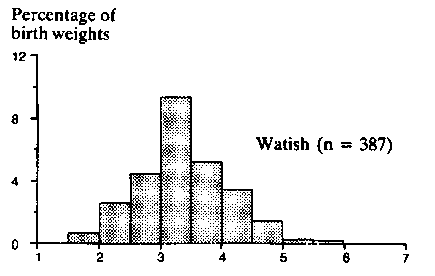
Figure 7. Distribution of weights at birth of Dubasi subtype of Sudan Desert sheep at El-Huda, Sudan
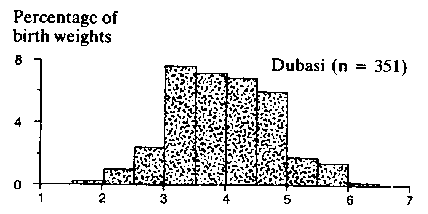
Figure 7. Distribution of weights at birth of Shugor subtype of Sudan Desert sheep at El-Huda, Sudan
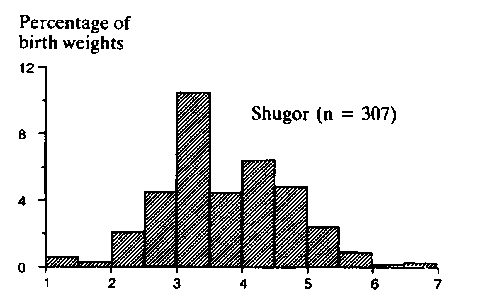
Table 5. Least-squares mean weights (kg) and average daily weight gains (al from birth to 120 days of Sudan Desert lambs at El-Huda, Sudan
|
Factor |
n |
Weight (kg) at age (days) |
Average daily gain (g) for period (days) |
|||||
|
0 |
30 |
90 |
120 |
0-30 |
30-120 |
0-120 |
||
|
Overall least-squares mean |
728 |
3.29 |
7.4 |
14.0 |
16.7 |
136 |
103 |
111 |
|
SE |
|
0.059 |
0.17 |
0.28 |
0.33 |
5.5 |
2.9 |
2.7 |
|
Subtype |
|
|
|
|
|
|
|
|
|
Shugor |
189 |
3.62a |
7.7abc |
14.1ab |
16.9a |
136 |
101a |
110a |
|
Shugor x Watish |
16 |
3.10b |
7.1abcd |
14.1abc |
17.0ab |
132 |
110ac |
115a |
|
Dubasi x Shugor |
36 |
3.28bc |
7.7be |
14.7ab |
17.1a |
147 |
104ac |
115a |
|
Dubasi |
207 |
3.47c |
7.8ab |
13.9a |
16.3a |
145 |
94bc |
107a |
|
Watish x Shugor |
28 |
3.13b |
7.3abd |
14.4ab |
17.0a |
139 |
107a |
115a |
|
Watish x Dubasi |
57 |
3.24b |
7.1cde |
14.1b |
17.2a |
128 |
112a |
116a |
|
Watish |
195 |
3.17b |
6.9d |
12.7c |
15.2b |
125 |
91b |
99b |
|
Significance of F-test |
|
*** |
*** |
*** |
*** |
ns |
** |
** |
|
Dam origin |
|
|
|
|
|
|
|
|
|
Station-born |
304 |
3.25 |
7.3 |
13.8 |
16.4 |
133 |
101 |
109 |
|
Foundation |
424 |
3.32 |
7.5 |
14.2 |
16.9 |
139 |
104 |
113 |
|
Significance of F-test |
|
ns |
ns |
ns |
ns |
ns |
ns |
ns |
|
Sex |
|
|
|
|
|
|
|
|
|
Female |
412 |
3.24 |
7.1a |
13.4a |
15.7a |
128a |
96a |
104a |
|
Male |
316 |
3.33 |
7.7b |
14.6b |
17.6b |
144b |
109b |
118b |
|
Significance of F-test |
|
ns |
*** |
*** |
*** |
*** |
*** |
*** |
|
Birth type |
|
|
|
|
|
|
|
|
|
Single |
520 |
3.64a |
8.4a |
15.8a |
18.9a |
158a |
116a |
126a |
|
Twin |
208 |
2.94b |
6.4b |
12.1b |
14.5b |
114b |
89b |
96b |
|
Significance of F-test |
|
*** |
*** |
*** |
*** |
*** |
*** |
*** |
|
Season of birth |
|
|
|
|
|
|
|
|
|
Winter |
194 |
3.33a |
7.5a |
13.6a |
15.7a |
138a |
91a |
103a |
|
Hot summer |
34 |
3.02b |
6.3b |
12.6b |
16.0b |
110b |
108b |
108a |
|
Wet summer |
500 |
3.51c |
8.3c |
15.8c |
18.2c |
159c |
109b |
122b |
|
Significance of F-test |
|
*** |
*** |
*** |
*** |
*** |
*** |
*** |
|
Year of birth |
|
|
|
|
|
|
|
|
|
1976 |
28 |
3.79a |
7.7ab |
16.0a |
20.7a |
130ac |
144a |
140a |
|
1977 |
37 |
3.28bce |
7.3a |
14.2bd |
16.7bc |
134ac |
104bc |
111bc |
|
1978 |
114 |
3.52ab |
7.6a |
14.6b |
16.9bc |
136ac |
103b |
111b |
|
1979 |
139 |
3.50b |
8.2b |
14.1b |
16.5c |
155a |
93c |
108b |
|
1980 |
132 |
2.97d |
7.5a |
13.0c |
14.4d |
151ac |
77d |
95d |
|
1981 |
66 |
2.88d |
7.4a |
12.3c |
14.4d |
152ac |
76d |
95de |
|
1982 |
120 |
3.30e |
6.2c |
13.1cd |
15.9c |
97b |
107b |
104be |
|
1983 |
92 |
3.07cd |
7.1a |
14.7ab |
17.8b |
134c |
119e |
122c |
|
Significance of F-test |
|
*** |
*** |
*** |
*** |
*** |
*** |
*** |
|
Parity (Station-born ewes) |
|
|
|
|
|
|
|
|
|
1 |
119 |
3.09a |
6.6a |
12.8a |
15.6a |
117a |
99 |
104 |
|
2 |
98 |
3.21ab |
7.2b |
13.6ab |
16.2ab |
134b |
99 |
108 |
|
3 |
55 |
3.41b |
7.8c |
14.4b |
17.1b |
147bc |
103 |
114 |
|
>3 |
32 |
3.30ab |
7.4bc |
14.3b |
16.8a |
135c |
104 |
112 |
|
Significance of F-test |
|
* |
*** |
** |
* |
* |
ns |
ns |
|
Parity on station (Foundation ewes) |
|
|
|
|
|
|
|
|
|
1 |
105 |
3.12a |
6.6a |
13.1a |
15.6a |
117a |
99a |
103a |
|
2 |
108 |
3.42b |
8.0b |
15.2b |
18.0b |
151b |
111b |
121b |
|
3 |
104 |
3.43b |
8.0b |
14.6bc |
17.2bc |
151bc |
102a |
114bc |
|
>3 |
107 |
3.33b |
7.4c |
14.0c |
16.7c |
135c |
104ab |
111ac |
|
Significance of F-test |
|
** |
*** |
*** |
* |
*** |
* |
*** |
|
Residual SD |
|
0.616 |
1.82 |
2.97 |
3.46 |
57.4 |
30.7 |
27.9 |
In the same column, and within a factor, means followed by the same letter do not differ significantly (P>0.05)
|
*** P<0.001 |
** P<0.01 |
* P<0.05 |
ns = not significant |
Weight and growth from birth to 120 days
Unadjusted mean weights (n = 728) were 8.4 kg (SD = 2.25) at 30 days, 15.2 kg (SD = 3.83) at 90 days and 17.4 kg (SD = 4.58) at weaning at 120 days. Unadjusted mean growth rates were 159 g/d (SD = 66.04) for 0-30 days, 99 g/d (SD = 39.26) for 30-120 days and 114 g/d (SD = 35.43) overall from birth to weaning.
The analysis of variance showed that subtype, sex, birth type, season and year of birth and birth order within dam origin all affected weight at 30, 90 and 120 days (Table 5).
Growth rates from birth to 30 days did not differ among subtypes, nor were they influenced by dam origin; but they were influenced by all the other sources of variation tested. From 30 to 120 days there were differences in growth rates among genotypes, between sexes, between single and twin lambs and among lambs born in different seasons and different years. Lambs out of station-born and foundation ewes did not show differences in daily rates of gain and parity did not influence gain in lambs of station-born ewes but lambs born of foundation ewes having given birth a different number of times on the station grew at different rates. Average daily gains of lambs from birth to weaning at 120 days were influenced by the same sources of variation as for the period 30-120 days.
The least-squares mean weights at 30, 90 and 120 days were 7.4, 14.0 and 16.7 kg (Table 5). The least-squares mean daily weight gains (Table 5) were 136 g for the period 0-30 days, 103 g for the period 30120 days and 111 g for the period from birth to weaning at 120 days.
Heterosis at 90 days was 6.0% in Watish x Dubasi, 7.4% in Watish x Shugor and 5.2% in Shugor x Watish lambs. At 120 days heterosis was 9.7% for Watish x Dubasi and 5.9% for both Watish x Shugor and Shugor x Watish. Dubasi x Shugor showed 5.0% heterosis at 90 days and 2.4% at 120 days. Heterosis in growth rates to 120 days was 11.0% for Watish x Dubasi and 10.0% for both Watish x Shugor and Shugor x Watish, but only 6% for Dubasi x Shugor.
Differences among years in weights-at-age and in growth rates appear to be related as much to management and to feed supply problems as to natural climatic conditions.
The linear and quadratic forms of the differences in birth weights in relation to parity and number of birth at El-Huda of station-born and foundation ewes were maintained for early weights up to weaning. This resulted from similar differences in growth in the different classes of parity and number of lambings in the lambs of the different types of ewe.
Heritability estimates for weights at 90 days and 120 days were 0.405 (SE = 0.181) and 0.238 (SE = 0.154). Genetic correlations between birth weight and 90-day and 120-day weights were 0.319 (SE = 0.443) and 0.346 (SE = 0.569). Heritabilities of growth rates were 0.234 (SE = 0.153) for 30-120 days and 0.264 (SE = 0.158) for 0-120 days. Repeatabilities of weights at 90 and 120 days, and of growth, were very low.
Weaning weights in this analysis are somewhat lower than have been previously recorded for selected and specially fed groups of lambs of the three purebred genotypes. Weaning at 120 days in these last groups has resulted in weights of 22.4 kg (SE = 0.31) for the three purebred types (Sulieman and Eissawi, 1984b), and Shugor and Dubasi lambs on experimental treatments attained weights at 90 days (17.2 kg (SE = 0.81) and 18.8 kg (SE = 0.87 kg)) superior to those attained by the naturally reared lambs analysed in this study. Earlier records for Watish lambs (El-Amin and Rizgalla, 1976) of 12 kg at 90 days do seem, however, to be similar to those recorded in the present analysis.
Weight and growth from 120 to 365 days
Unadjusted mean weights (n = 361) were 17.2 kg (SD = 3.89) at 120 days, 19.1 kg (SD = 4.57) at 150 days, 24.8 kg (SD = 6.55) at 240 days and 29.9 kg (SD = 7.23) at one year. Daily gain averaged 52 g for the period 120-365 days.
The analysis of variance (see Table 6) showed that weight at 120 days was influenced by genotype, sex, birth type and year of birth but not by dam origin, season of birth or parity. At 150 days the season in which a lamb had been born also had an influence on its weight. Season also affected weight at 240 days but at 365 days lambs born in different seasons did not show any differences in weight. Differences in the rate at which animals gained weight were evident in relation to subtype, sex and year.
Least-squares mean weights were 16.5 kg at 120 days, 18.4 kg at 150 days, 25.3 kg at 240 days and 31.7 kg at one year. The least-squares mean daily gain was 61 g for 120-365 days (Table 6).
All the crossbred genotypes except Watish x Shugor showed heterosis in weights at different ages, this being considerable at one year, and in growth rates. Watish x Dubasi lambs weighed 33.1 kg at 365 days, exhibiting heterosis of 7.5% in weight and heterosis of 13.3% in growth from 120 to 365 days. Shugor x Watish lambs showed heterosis of 10.1% in weight at one year and of 15% in growth in the period from weaning to one year. Dubasi x Shugor were superior to the mid-parental value by 9.0% in weight at 365 days and grew faster by 10.7%.
Table 6. Least-square mean weights (kg) and average daily weight gains (g) from 120 to 365 days of Sudan Desert sheep at El-Huda, Sudan
|
Factor |
Weight (kg) at age (days) |
Average daily gain (g) for period (days) |
||||
|
n |
120 |
150 |
240 |
365 |
120-365 |
|
|
Overall least-squares mean |
361 |
16.5 |
18.4 |
25.3 |
31.7 |
61 |
|
SE |
|
0.47 |
0.53 |
0.72 |
0.81 |
2.7 |
|
Subtype |
|
|
|
|
|
|
|
Shugor |
89 |
16.6a |
18.6a |
25.1ad |
32.5a |
64a |
|
Shugor x Watish |
14 |
16.8ab |
19.2ab |
28.3b |
33.9a |
69a |
|
Dubasi x Shugor |
15 |
17.5a |
20.0a |
28.3abd |
34.1a |
67a |
|
Dubasi |
118 |
15.8ab |
17.3b |
23.4ce |
29.9b |
57b |
|
Watish x Shugor |
7 |
17.4ab |
18.3ab |
24.4abcd |
29.4ab |
49b |
|
Watish x Dubasi |
17 |
16.3ab |
18.3ab |
24.5de |
33.1a |
68a |
|
Watish |
101 |
15.1b |
17.0b |
22.9ce |
29.1b |
56b |
|
Significance of F-test |
|
* |
** |
*** |
*** |
** |
|
Dam origin |
|
|
|
|
|
|
|
Station-born |
145 |
16.4 |
18.3 |
25.6 |
31.6 |
62 |
|
Foundation |
216 |
16.7 |
18.5 |
24.9 |
31.8 |
61 |
|
Significance of F-test |
|
ns |
ns |
ns |
ns |
ns |
|
Sex |
|
|
|
|
|
|
|
Female |
269 |
15.8a |
17.4a |
23.0a |
29.0a |
54a |
|
Male |
92 |
17.3b |
19.4b |
27.5b |
34.4b |
69b |
|
Significance of F-test |
|
*** |
*** |
*** |
*** |
*** |
|
Birth type |
|
|
|
|
|
|
|
Single |
253 |
18.7a |
20.8a |
27.3a |
33.4a |
59 |
|
Twin |
108 |
14.4b |
16.0b |
23.2b |
30.0b |
63 |
|
Significance of F-test |
|
*** |
*** |
*** |
*** |
ns |
|
Season of birth |
|
|
|
|
|
|
|
Winter |
84 |
17.0 |
18.3ab |
24.4a |
30.9 |
56 |
|
Hot summer |
12 |
15.1 |
17.3b |
24.1a |
32.1 |
69 |
|
Wet summer |
265 |
17.4 |
19.6a |
27.2b |
32.1 |
60 |
|
Significance of F-test |
|
ns |
* |
** |
ns |
ns |
|
Year of birth |
|
|
|
|
|
|
|
1977 |
30 |
18.0a |
20.0a |
26.5a |
33.9a |
64a |
|
1978 |
44 |
17.3a |
19.2a |
27.2a |
33.3b |
65a |
|
1979 |
88 |
17.0a |
18.7a |
23.9bf |
27.5c |
42b |
|
1980 |
56 |
15.6b |
16.7b |
21.1cd |
28.8c |
53c |
|
1981 |
44 |
13.3c |
14.8c |
22.4df |
28.5c |
61ac |
|
1982 |
83 |
16.6ab |
19.5a |
29.2e |
37.0d |
83d |
|
1983 |
16 |
17.8a |
20.0a |
26.5abe |
32.9ab |
61ac |
|
Significance of F-test |
|
*** |
*** |
*** |
*** |
*** |
|
Parity (Station- born ewes) |
|
|
|
|
|
|
|
1 |
62 |
16.2 |
18.5 |
25.1 |
31.7 |
63 |
|
2 |
44 |
16.0 |
17.7 |
24.4 |
30.1 |
57 |
|
3 |
27 |
16.7 |
18.7 |
25.5 |
31.1 |
58 |
|
>3 |
12 |
16.5 |
18.3 |
27.2 |
33.4 |
69 |
|
Significance of F-test |
|
ns |
ns |
ns |
ns |
ns |
|
Parity on station (Foundation ewes) |
|
|
|
|
|
|
|
1 |
40 |
15.9 |
17.8 |
24.3 |
31.7 |
64 |
|
2 |
57 |
17.2 |
18.7 |
24.6 |
31.5 |
58 |
|
3 |
55 |
16.7 |
18.5 |
25.1 |
32.2 |
63 |
|
>3 |
64 |
16.9 |
18.9 |
25.7 |
31.9 |
61 |
|
Significance of F-test |
|
ns |
ns |
ns |
ns |
ns |
|
Residual SD |
|
3.13 |
3.55 |
4.83 |
5.42 |
18.4 |
In the same column, and within a factor, means followed by the same letter do not differ significantly (P>0.05)
|
*** P<0.001 |
** P<0.01 |
* P<0.05 |
ns = not significant |
Differences in weights related to season of birth changed throughout this growth phase, presumably due to changes in nutrition and feed availability as animals moved through the seasons. The differences in weight of lambs in relation to year, already noted for the preweaning period, persisted until 365 days. Lambs born in 1980 and 1981, lightest at weaning, remained among the lightest at one year although growth rates of lambs born in 1981 were not worse than the average, presumably due to efforts to supply adequate feed during 1982. Lambs born in 1979 were the lightest at 365 days and had exhibited very slow growth rates due to feed shortages during 1980. As a result of corrective nutritional management, 1982 lambs were by far the heaviest of all years at 365 days and had the fastest growth rates.
A significant subtype x sex interaction found in a subsidiary analysis appeared to be due to a greater difference in weights between males and females of the Shugor subtype than the effects of sexual dimorphism in the other two types.
Repeatabilities of weights were 0.23 (SE = 0.111) at 150 days, 0.25 (SE = 0.109) at 240 days and 0.17 (SE = 0.117) at 365 days.
There are few comparative data on weights in the range of 120-365 days for Sudan Desert sheep. Weights of 22 to 27 kg at six months and of 30 to 32 kg at one year appear to cover the general range (Wilson, 1976; Osman et al, 1988; Sulieman et al, in press).
Weight and growth of females from one to three years
Unadjusted mean weights (n = 81) of females were 27.5 kg (SD = 5.12) at one year, 34.4 kg (SD = 5.60) at 18 months, 36.5 kg (SD = 6.05) at two years and 40.8 kg (SD = 6.25) at three years. The unadjusted growth rate was 18 g/d (SD = 10.1) for the period 1-3 years.
The analysis of variance showed that very few of the sources of variation tested had any influence on female weights at these relatively advanced ages (Table 7). The effects of type of birth persisted to 18 months but weights of single and twin-born gimmers did not differ thereafter. Weight differences related to year of birth were evident at 18 months and two years and gimmers out of foundation ewes with different numbers of parturitions on the station had different weights at one year. Growth rates of this last class of animal also differed.
The least-squares mean weights of females at one year, 18 months, two years and three years were 25.6 kg, 32.6 kg, 35.6 kg and 38.9 kg (Table 7). The least-squares mean growth rate was 18 g/d.
Associations between weight and growth at different ages
Phenotypic correlations among weights and weight gains are shown in Tables 8 to 10. All correlations at the preweaning stage were positive and significant. In the postweaning period only the correlation between weaning weight and gain to one year was negative, and non-significant; all other correlations were positive and significant. There were negative correlations between weight at 365 days and growth in the period 365-1095 days and between 550-day weight and growth over the same period. All other correlations among weights and growth from one year to three years were positive and significant.
An explanation for the negative correlations between weight and growth rate is that as the body approaches maturity its growth slows. An additional reason for the negative correlation is that increased maintenance requirements at heavier weights result in less feed being available for growth.
Postpartum weights and weights at weaning of young
The unadjusted mean weight of females immediately postpartum was 39.5 kg (SD = 6.43). When lambs were weaned at about 120 days the unadjusted mean weight of their dams was 39.1 kg (SD = 5.69). The analysis of variance showed that genotype, year of parturition and parity significantly affected the postpartum weight (Table 11). Postpartum weights did not differ between dams of different origin, those which had given birth to singles or twins, or those giving birth in different seasons. Weights of ewes when their lambs were weaned were affected by the same sources of variation as parturition weight but, in addition, the season in which the parturition had taken place also affected the ewe's weight four months later.
The least-squares mean postpartum weight was 40.5 kg and weight at lamb weaning, 120 days postpartum, was 38.9 kg (Table 11). A slight loss of weight occurred between parturition and weaning due to the demand of lactation. Effects of the variables considered were similar at both stages.
The poor management and nutrition identified in 1981 and 1982 in the growth performance of lambs was also manifest in ewe weights. Postpartum weights were lighter in these two years than in any of the others, as (with the exception of 1984) were 120-day-postpartum weights. There was, however, a greater loss in weight during the lactation period for ewes lambing in 1978 than for those lambing in any other year.
Table 7. Least-squares mean weights (kg) and average daily weight gains (g) from 365 to 1095 days of Sudan Desert ewes at El-Huda, Sudan
|
Factor |
n |
Weight (kg) at age (days) |
Average daily gain (g) for period (days) |
|||
|
365 |
550 |
730 |
1095 |
365-1095 |
||
|
Overall least-squares mean |
81 |
25.6 |
32.6 |
35.6 |
38.9 |
18 |
|
SE |
|
0.99 |
1.11 |
1.06 |
1.25 |
2.0 |
|
Subtype |
|
|
|
|
|
|
|
Shugor |
21 |
27.2 |
33.7 |
36.2 |
39.1 |
16 |
|
Dubasi |
40 |
24.7 |
33.5 |
36.9 |
40.7 |
21 |
|
Watish |
20 |
24.9 |
30.6 |
33.8 |
36.9 |
16 |
|
Significance of F-test |
|
ns |
ns |
ns |
ns |
ns |
|
Dam origin |
|
|
|
|
|
|
|
Station-born |
29 |
25.3 |
32.5 |
36.2 |
39.4 |
19 |
|
Foundation |
52 |
25.9 |
32.7 |
35.0 |
38.4 |
17 |
|
Significance of F-test |
|
ns |
ns |
ns |
ns |
ns |
|
Birth type |
|
|
|
|
|
|
|
Single |
68 |
28.8a |
34.8a |
37.3 |
41.0 |
16 |
|
Twin |
13 |
22.4b |
30.4b |
33.9 |
36.9 |
19 |
|
Significance of F-test |
|
*** |
* |
ns |
ns |
ns |
|
Season of birth |
|
|
|
|
|
|
|
Winter |
16 |
26.4 |
32.5 |
36.7 |
39.2 |
17 |
|
Wet summer |
65 |
24.8 |
32.7 |
34.6 |
38.6 |
18 |
|
Significance of F-test |
|
ns |
ns |
ns |
ns |
ns |
|
Year of birth |
|
|
|
|
|
|
|
1977 |
17 |
27.8 |
35.9a |
41.0a |
41.1 |
18 |
|
1978 |
12 |
26.8 |
33.1ab |
37.4ac |
39.8 |
17 |
|
1979 |
17 |
23.7 |
28.8b |
30.8b |
36.8 |
17 |
|
1980 |
26 |
26.7 |
32.7ab |
34.7c |
38.8 |
16 |
|
1981 |
9 |
22.9 |
32.4ab |
34.2abc |
38.1 |
20 |
|
Significance of F-test |
|
ns |
* |
*** |
ns |
ns |
|
Parity (Station-born ewes) |
|
|
|
|
|
|
|
1 |
16 |
27.5 |
32.9 |
36.9 |
39.2 |
16 |
|
2 |
6 |
24.7 |
33.6 |
37.2 |
42.0 |
23 |
|
3 |
7 |
23.7 |
30.8 |
34.6 |
37.0 |
18 |
|
Significance of F-test |
|
ns |
ns |
ns |
ns |
ns |
|
Parity on station (Foundation ewes) |
|
|
|
|
|
|
|
1 |
9 |
26.7ab |
33.4 |
33.2 |
36.3 |
13a |
|
2 |
19 |
23.3a |
31.6 |
36.4 |
41.6 |
25b |
|
3 |
13 |
29.1b |
34.1 |
36.0 |
37.4 |
11a |
|
>3 |
11 |
24.4a |
31.9 |
34.6 |
38.5 |
19ab |
|
Significance of F-test |
|
* |
ns |
ns |
ns |
** |
|
Residual SD |
|
4.71 |
5.28 |
5.09 |
5.96 |
9.58 |
In the same column, and within a factor, means followed by the same letter do not differ significantly (P>0.05)
|
*** P<0.001 |
** P<0.01 |
* P<0.05 |
ns = not significant |
Table 8. Phenotypic correlations among weights and average daily weight gains from birth to 120 days for Sudan Desert sheep at El-Huda, Sudan (n = 728)
|
|
Weight at age (days) |
Average daily gain for period (days) |
||||||
|
10 |
30 |
90 |
120 |
0-30 |
0-120 |
30-120 |
||
|
Weight at: |
|
|
|
|
|
|
|
|
|
|
Birth |
0.77** |
0.50** |
0.50** |
0.49** |
0.17** |
0.35** |
0.32** |
|
|
10 days |
|
0.92** |
0.73** |
0.65** |
0.74** |
0.56** |
0.26** |
|
|
30 days |
|
|
0.76*** |
0.66** |
0.94*** |
0.62** |
0.22** |
|
|
90 days |
|
|
|
0.93** |
0.66** |
0.90** |
0.72** |
|
|
120 days |
|
|
|
|
0.55** |
0.99*** |
0.88** |
|
Average daily gain for: |
|
|
|
|
|
|
|
|
|
|
0-30 days |
|
|
|
|
|
0.57** |
0.12* |
|
|
0-120 days |
|
|
|
|
|
|
0.89** |
|
*** P<0.001 |
** P<0.01 |
* P<0.05 |
Table 9. Phenotypic correlations among weights and average daily weight gains from 120 to 365 days for Sudan Desert sheep at El-Huda, Sudan (n = 361)
|
|
Weight at age (days) |
Average daily gain for period (days) |
|||
|
150 |
240 |
365 |
120-365 |
||
|
Weight at: |
|
|
|
|
|
|
|
120 days |
0.93** |
0.67** |
0.53** |
-0.01ns |
|
|
150 days |
|
0.80** |
0.66** |
0.19* |
|
|
240 days |
|
|
0.83** |
0.55** |
|
|
365 days |
|
|
|
0.84** |
|
** P<0.01 |
* P<0.05 |
ns = not significant |
Table 10. Phenotypic correlations among weights and average daily weight gains from one to three years for Sudan Desert sheep at El-Huda, Sudan (n = 81)
|
|
Weight at age (days) |
Average daily gain for period (days) |
|||
|
550 |
730 |
1095 |
365-1095 |
||
|
Weight at: |
|
|
|
|
|
|
|
365 days |
0.71** |
0.43** |
0.17* |
-0.54** |
|
|
550 days |
|
0.44** |
0.44** |
-0.11ns |
|
|
730 days |
|
|
0.69** |
0.28* |
|
|
1095 days |
|
|
|
0.74** |
|
** P<0.01 |
*P<0.05 |
ns = not significant |
Table 11. Least-squares mean weights (kg) postpartum and 120 days postpartum of Sudan Desert ewes at El-Huda, Sudan
|
Factor |
Postpartum weight (kg) |
Weight (kg) at 120 days postpartum |
||
|
n |
Mean |
n |
Mean |
|
|
Overall least-squares mean |
432 |
40.5 |
435 |
38.9 |
|
SE |
|
0.51 |
|
0.45 |
|
Subtype |
|
|
|
|
|
Shugor |
95 |
42.3a |
92 |
41.2a |
|
Dubasi |
174 |
42.2a |
185 |
40.0a |
|
Watish |
163 |
37.0b |
158 |
35.4b |
|
Significance of F-test |
|
*** |
|
*** |
|
Dam origin |
|
|
|
|
|
Station-born |
213 |
41.0 |
197 |
38.9 |
|
Foundation |
219 |
40.0 |
238 |
38.8 |
|
Significance of F-test |
|
ns |
|
ns |
|
Parturition type |
|
|
|
|
|
Single |
376 |
40.1 |
371 |
38.6 |
|
Twin |
56 |
40.9 |
64 |
39.1 |
|
Significance of F-test |
|
ns |
|
ns |
|
Season of parturition |
|
|
|
|
|
Winter |
148 |
40.9 |
143 |
39.2a |
|
Hot summer |
34 |
40.1 |
35 |
37.1b |
|
Wet summer |
250 |
40.5 |
257 |
40.3a |
|
Significance of F-test |
|
ns |
|
*** |
|
Year of parturition |
|
|
|
|
|
1978 |
48 |
44.2a |
80 |
40.0ac |
|
1979 |
71 |
42.4ae |
94 |
40.6a |
|
1980 |
62 |
41.0be |
43 |
39.0acd |
|
1981 |
58 |
38.1cd |
31 |
36.4be |
|
1982 |
111 |
38.0d |
105 |
38.7cf |
|
1983 |
65 |
39.5bd |
67 |
40.2a |
|
1984 |
17 |
40.2de |
15 |
37.2bdf |
|
Significance of F-test |
|
*** |
|
*** |
|
Parity (Station-born ewes) |
|
|
|
|
|
1 |
125 |
37.5a |
124 |
35.8a |
|
2 |
48 |
41.2b |
44 |
37.9b |
|
3 |
25 |
42.4b |
18 |
40.5c |
|
>3 |
15 |
43.0b |
11 |
41.2c |
|
Significance of F-test |
|
*** |
|
*** |
|
Parity on station (Foundation ewes) |
|
|
|
|
|
1 |
10 |
35.5a |
21 |
36.4a |
|
2 |
64 |
41.4bc |
73 |
39.0b |
|
3 |
70 |
40.3b |
78 |
39.0b |
|
>3 |
75 |
42.6c |
66 |
41.0c |
|
Significance of F-test |
|
*** |
|
*** |
|
Residual SD |
|
5.18 |
|
4.42 |
In the same column, and within a factor, means followed by the same letter do not differ significantly (P>0.05)
|
*** P<0.001 |
ns = not significant |
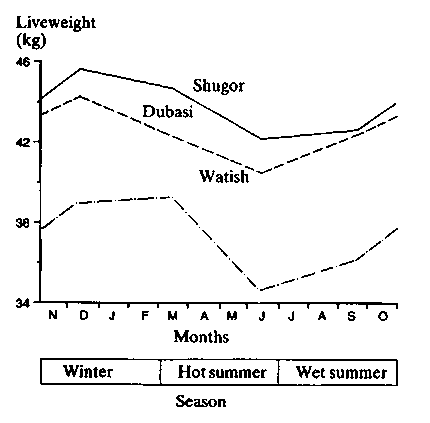
Figure 8. Seasonal weight changes in Shugor, Dubasi and Watish adult females at El-Huda, Sudan
Seasonal and long-term weight changes of breeding females
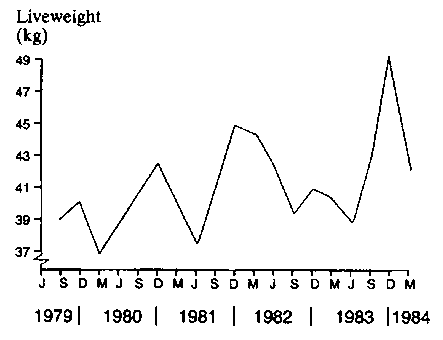
Adult female weights, excluding ewes from two months prepartum to one month postpartum, averaged 41.6 kg on an annual basis for the period late 1979 to early 1984. Fluctuations throughout the year were of the order of 2.4 kg with greater weight changes being shown by Watish ewes than by the other two subtypes (Figure 8). Ewes lost weight rapidly in the hot summer season and regained this throughout the wet summer and into the first part of the winter. Over the period 1979 to 1984 there was an apparent increase in mature ewe weights Figure 9).
Figure 9. Long-term changes in weight of Sudan Desert ewes at El-Huda, Sudan
Summary
Shugor lambs were heavier at birth than all other pure- and crossbred genotypes. Lambs out of Watish ewes (whether by Watish or Shugor sires) were slightly lighter at birth than other genotypes (and significantly lighter than other purebreds). Purebred Watish remained lighter than the other purebred genotypes to weaning and were lighter than all of the genotypes from weaning to 365 days of age. Thereafter subtype effects on weight were insignificant.
Lambs born as singles were heavier at birth than twin lambs, and this advantage was maintained up to 18 months of age, after which there were no significant differences.
Males were heavier and grew faster than females from birth to one year of age.
There were no subtype differences in growth rate in the first 30 days. From 30 to 120 days, growth rates of Dubasi and Watish were lower than those of other genotypes, and overall from birth to weaning Watish grew slowest.
Lambs born in the wet summer were heavier at birth than those born in other seasons, and this superiority was maintained to weaning. By one year, however, differences in weight were not significant.
Advantages obtained from improved reproduction and growth in a flock of sheep are better maintained if high survival rates of young and adults can be assured. High survival rates also help progress in the flock by making more animals available for genetic studies from which superior germplasm might be selected. Various factors affect the survival rate in a flock from conception to marketing or breeding age.
Exit reasons of 1605 sheep from the station and the proportion of animals removed for each reason are shown in Table 12.
Mortality from birth to 365 days
Unadjusted mean mortality rates were 5.9% on the first day (excluding abortion), 15.2% at 30 days, 28.5% at 120 days, 32.1% at 150 days, 41.5% at 24p days and 45.1% at 365 days. The analysis of variance (see Table 13) showed subtype effects to be significant at weaning at 120 days and at all ages thereafter. Dam origin did not significantly affect mortality rates at birth, 30, 120 and 365 days. Sex influenced mortality rate very considerably up to 365 days. The type of birth began to influence the mortality at 120 days. Season and year of birth greatly influenced mortality at all ages from 30 days. The parity of station born ewes had some effect on the mortality rate at birth, had highly significant effect at 30 to 120 days, showed a reduced effect at 150 days and ceased to influence mortality altogether after that. The number of times a foundation ewe had lambed on the station had no influence on the mortality of her lambs.
Table 12. Flock removals from El-Huda, Sudan, 1975-86
|
Reason |
Number |
Per cent of total |
|
Experimental slaughtera |
235 |
14.6 |
|
Death |
531 |
33.1 |
|
"Lost" |
205 |
12.8 |
|
Slaughter for guests |
15 |
0.9 |
|
Breeding insufficiency |
1 |
0.1 |
|
Abortion/Stillbirth |
49 |
3.1 |
|
Laboratory experimentationb |
21 |
1.3 |
|
Sold and culled |
548 |
34.1 |
|
Total |
1605 |
100.0 |
a Slaughtered on station for carcass evaluation or for other experimental reasons
b Transferred off the station to Central veterinary Laboratory and university of Khartoum
The least-squares mean mortality rates were 6.43, 22.60, 37.61, 43.18, 52.77 and 55.50% at birth, 30, 120, 150, 240, and 365 days (Table 13). At all ages from weaning at 120 days Watish had significantly lower mortality rates than the other two purebreds. In relation to dam origin, death rates were higher in young of station-born ewes than in those out of foundation ewes at 150 days and at 240 days. Males had a greater mortality rate than females throughout and lambs born as part of a multiple litter had a higher death rate at weaning and thereafter than those born as singles.
At 30 days lambs born in the stressful hot summer season had a higher death rate than those born in the cooler winter or wet summer seasons. Year of birth had an effect on mortality starting at 30 days. In general, death rates were highest in lambs born in the early years of the study. Higher death risks were encountered at older ages, however, in the previously noted poor years of 1980 and 1981 and there was also a relatively high mortality rate in animals at 240 days and at 365 days for lambs born in 1983.
Lambs born to station-born dams at their second parity had the lowest death rate of young of ewes in that group. Lambs of first parity station-born ewes had the highest death rate of all.
There were differences (P<0.001) among sires in the ability of their offspring to survive. The heritability of mortality was 0.501 (SE = 0.19) at weaning. Repeatabilities within dams were low. Lamb birth weight influenced (P<0.01) mortality at all age from 30 days to 365 days. For every kilogramme extra birth weight, mortality was reduced by 3.7% at 30 days, 6.8% at 120 days, 7.3% at 150 days, 8.4% at 240 days and 8.2% at 365 days.
Earlier studies have shown similar levels for early death rates. Mortalities of 47.0 and 40.5% to weaning at 120 days have already been recorded for Shugor and Dubasi lambs (Sulieman et al, 1978; 1983). The lower mortality rate of Watish sheep noted in this study is similar to the 29.4% mortality rate at weaning already recorded for this subtype (El-Amin and Rizgalla, 1976). The higher mortality of males in this study differs from earlier results which tended to show equal mortalities in both sexes (El-Amin and Rizgalla, 1976; Sulieman et al, 1978; 1983). Higher death risk in twins compared with singles is as expected.
Seasonal effects analysed in previous studies have been conflicting: highest death rates to weaning were recorded in winter-born lambs (50.0%) while those born in the hot summer (22.5%) and the wet summer (27.5%) had lower but similar rates (El-Amin and Rizgalla, 1976) but other studies (for example, Sulieman et al, 1983) failed to show any seasonal differences. Effects of year on mortality support evidence from reproductive and growth performance that 1980 and 1981 were extremely poor years at El-Huda.
Adult mortality
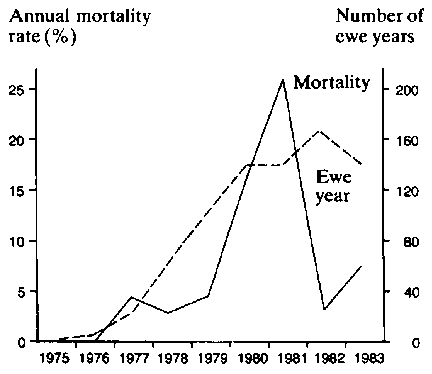
Mortality in sheep older than one year averaged 10.4% per year in females and 12.8% per year in males over the nine-year period 1975-83. A total of 81 adult female sheep died for 781 ewe-years and 14 adult males for 110 ram-years. Mortality rates varied among years (Figure 10) with very high death rates occurring in 1980 and 1981.
Previous studies carried out at the station also underline the high death rates in 1980 and 1981, with average adult mortality rates of 16.2% (Sulieman, 1983) and 25.4% (Sulieman et al, 1983).
Unadjusted indices at 120 days were 16.9 kg of weaned lamb per ewe per year (SD = 9.50), 425.3 g of weaned lamb per kg ewe per year (SD = 247.28) and 1.15 kg of weaned lamb per kg of ewe metabolic weight per year (SD = 0.656). At 150 days the three indices were 18.6 kg (SD = 10.90),466.8 g (SD = 282.56) and 1.26 kg (SD = 0.752). There were 146 observations in each case.
Table 13. Least-squares mean mortality rates (%) at specified ages from birth to 365 days of Sudan Desert sheep at El-Huda, Sudan
|
Factor |
n |
Mortality (%) at age (days) |
|||||
|
0 |
30 |
120 |
150 |
240 |
365 |
||
|
Overall least-squares mean |
708 |
6.43 |
22.60 |
37.61 |
43.18 |
52.77 |
55.50 |
|
SE |
|
1.48 |
2.13 |
2.60 |
2.64 |
2.80 |
2.83 |
|
Subtype |
|
|
|
|
|
|
|
|
Shugor |
238 |
6.77 |
23.88 |
40.51a |
48.52a |
57.29a |
59.99a |
|
Dubasi |
272 |
8.74 |
25.56 |
42.57a |
46.34a |
48.40ab |
55.48a |
|
Watish |
198 |
3.76 |
18.36 |
29.74b |
34.68b |
45.53b |
46.84b |
|
Significance of F-test |
|
ns |
ns |
** |
** |
** |
* |
|
Dam origin |
|
|
|
|
|
|
|
|
Station-born |
282 |
5.97 |
25.37 |
41.25 |
48.53a |
57.98a |
59.64 |
|
Foundation |
426 |
6.88 |
19.82 |
33.96 |
37.83b |
47.55b |
51.35 |
|
Significance of F-test |
|
ns |
ns |
ns |
* |
* |
ns |
|
Sex |
|
|
|
|
|
|
|
|
Female |
449 |
4.58a |
18.04a |
29.73a |
33.90a |
40.09a |
42.02a |
|
Male |
259 |
8.27b |
27.16b |
45.48b |
52.46b |
65.45b |
68.98b |
|
Significance of F-test |
|
* |
*** |
*** |
*** |
*** |
*** |
|
Birth type |
|
|
|
|
|
|
|
|
Single |
490 |
6.70 |
20.71 |
32.37a |
37.37a |
48.38a |
50.88a |
|
Twin |
218 |
6.15 |
24.49 |
42.84b |
48.98b |
57.15b |
60.12b |
|
Significance of F-test |
|
ns |
ns |
** |
** |
* |
* |
|
Season of birth |
|
|
|
|
|
|
|
|
Winter |
256 |
5.42 |
19.33a |
44.18a |
51.11a |
55.99a |
57.69a |
|
Hot summer |
63 |
8.55 |
34.90b |
48.83a |
54.69a |
66.36a |
67.72a |
|
Wet summer |
389 |
5.31 |
13.57a |
19.81b |
23.73b |
35.95b |
41.09b |
|
Significance of F-test |
|
ns |
*** |
*** |
*** |
*** |
** |
|
Year of birth |
|
|
|
|
|
|
|
|
1976 |
57 |
8.06 |
42.09a |
60.29a |
69.64a |
69.50a |
69.78a |
|
1977 |
74 |
1.50 |
23.66bc |
48.89ab |
55.44b |
65.07a |
64.49abd |
|
1978 |
78 |
10.44 |
29.90b |
40.93b |
49.19bc |
63.10a |
61.41abd |
|
1979 |
86 |
9.24 |
23.46bd |
37.42b |
44.30bc |
47.78bc |
52.94b |
|
1980 |
171 |
6.61 |
18.74cd |
38.23b |
41.83c |
56.78ab |
62.06abd |
|
1981 |
101 |
1.63 |
14.34cd |
35.22b |
39.42c |
58.08ab |
62.71abd |
|
1982 |
107 |
2.90 |
11.04c |
21.37c |
24.81d |
25.35c |
25.26c |
|
1983 |
34 |
11.04 |
17.55bc |
18.49c |
20.80d |
36.48 |
45.35d |
|
Significance of F-test |
|
ns |
*** |
*** |
*** |
*** |
*** |
|
Parity (Station-born ewes) |
|
|
|
|
|
|
|
|
1 |
148 |
11.74a |
34.90a |
54.08a |
60.28a |
67.09 |
67.91 |
|
2 |
61 |
2.82b |
11.98b |
28.10b |
37.81b |
51.23 |
54.33 |
|
3 |
51 |
8.02ab |
26.20a |
44.21a |
46.37b |
55.04 |
55.76 |
|
>3 |
22 |
3.31ab |
28.42ab |
38.60ab |
49.65ab |
58.57 |
60.57 |
|
Significance of F-test |
|
* |
*** |
*** |
** |
ns |
ns |
|
Parity on station (Foundation ewes) |
|
|
|
|
|
|
|
|
1 |
129 |
6.51 |
25.84 |
36.43 |
39.00 |
48.47 |
51.75 |
|
2 |
118 |
6.34 |
16.64 |
25.68 |
29.65 |
43.59 |
49.49 |
|
3 |
74 |
7.60 |
14.99 |
31.51 |
36.64 |
43.47 |
47.81 |
|
>3 |
105 |
7.07 |
21.81 |
42.23 |
46.03 |
54.68 |
56.36 |
|
Significance of F-test |
|
ns |
ns |
ns |
ns |
ns |
ns |
|
Residual SD |
|
7.35 |
10.6 |
13.0 |
13.2 |
14.0 |
14.1 |
In the same column, and within a factor, means followed by the same letter do not differ significantly
(P>0.05)
|
*** P<0.001 |
** P<0.01 |
* P<0.05 |
ns = not significant |
The analysis of variance showed that only season and year of parturition influenced the 120-day indices. The parturition type almost exerted a significant influence on the 120-day indices having slightly more effect on Index I (P = 0.055) and Index III (P = 0.059) than on Index II (P = 0.063). At 150 days the indices were influenced by type, season and year of parturition but not by any of the other sources of variation.
Figure 10. Annual adult mortality rates and number of years of ewe-presence at El-Huda, Sudan, 1975-83
The least-squares mean indices I, II and III at 120 days were 16.8 kg, 419 g and 1.14 kg; at 150 days the least-squares mean values were 18.5 kg, 461 g and 1.25 kg (Table 14).
There were no differences among subtypes in any of the indices at either 120 or 150 days. Shugor had the largest litter size of the three purebreds but had a longer lambing interval than Watish. The reproductive component of the productivity index did not differ between Shugor and Watish overall (Table 4) but the Shugor was superior to the Dubasi in reproductive performance while there were no differences between Dubasi and Watish. The contribution of lamb weight to the indices did not differ between
Shugor and Dubasi at 120 days, nor between Dubasi and Watish at the same age but Shugor lambs were heavier than Watish ones (Table 6). At 150 days Shugor lambs were heavier than both Dubasi and Watish ones, between which there was no difference. Mortality at 120 and 150 days was less in the Watish than in the Shugor and the Dubasi, between which there were no differences (Table 13). The different effects of these components of the indices resulted in there being no differences in the breed indices. The lighter postpartum weight of the Watish ewes did, in fact, lead to apparently slightly higher Indices II and III for this subtype.
There were no differences in indices between dams of different origins. Ewes giving birth to singles did not have indices that were significantly different from those giving birth to twins, at 120 days. At 150 days, however, ewes that produced twins produced more weight of young than those that produced single lambs. This was probably mainly due to a change in relative growth rates between single and twin lambs after weaning. Growth was significantly faster in singles before weaning than in twins (Table 5) but after weaning there were no differences in growth rates. Indeed there was some indication that twins grew faster than singles after weaning (Table 6) probably because singles suffered more from lack of milk after being weaned than did twins.
Indices of ewes that gave birth in the wet summer were superior to those that gave birth in the hot summer. Ewes that lambed in the winter were intermediate between ewes lambing in either of the other two seasons. This was mainly due to better growth and lower mortality rates of lambs born in the wet summer as reproductive performance was similar for ewes lambing in all seasons. Effects of year on indices show the expected results based on reproductive performance, lamb growth and mortality, with 1980 and 1981 providing indices generally well below the mean and 1982 and 1983 indices generally greater than the mean.
Table 14. Least-squares mean productivity indicesa at 120 and 150 days of Sudan Desert sheep at El-Huda, Sudan
|
Factor |
n |
120 days |
150 days |
||||
|
Index I |
Index II |
Index III |
Index I |
Index II |
Index III |
||
|
(kg) |
(g) |
(kg) |
(kg) |
(g) |
(kg) |
||
|
Overall least-squares mean |
146 |
16.8 |
419 |
1.14 |
18.5 |
461 |
1.25 |
|
SE |
|
1.81 |
47.4 |
0.126 |
2.04 |
53.2 |
0.141 |
|
Subtype |
|
|
|
|
|
|
|
|
Shugor |
35 |
17.1 |
421 |
1.15 |
18.9 |
468 |
1.27 |
|
Dubasi |
58 |
16.4 |
395 |
1.08 |
18.2 |
437 |
1.20 |
|
Watish |
53 |
16.9 |
443 |
1.19 |
18.3 |
479 |
1.28 |
|
Significance of F-test |
|
ns |
ns |
ns |
ns |
ns |
ns |
|
Dam origin |
|
|
|
|
|
|
|
|
Station-born |
64 |
17.7 |
436 |
1.19 |
19.3 |
472 |
1.29 |
|
Foundation |
82 |
15.9 |
403 |
1.09 |
17.7 |
450 |
1.21 |
|
Significance of F-test |
|
ns |
ns |
ns |
ns |
ns |
ns |
|
Parturition type |
|
|
|
|
|
|
|
|
Single |
123 |
14.7 |
366 |
0.99 |
16.0a |
397a |
1.08a |
|
Twin |
23 |
18.9 |
473 |
1.28 |
21.0b |
525b |
1.42b |
|
Significance of F-test |
|
ns |
ns |
ns |
* |
* |
* |
|
Season of parturition |
|
|
|
|
|
|
|
|
Winter |
37 |
17.6ab |
454ab |
1.22ab |
18.5a |
475ab |
1.28ab |
|
Hot summer |
7 |
12.1b |
280b |
0.77b |
13.3a |
310b |
0.85b |
|
Wet summer |
102 |
20.8a |
525a |
1.42a |
23.7b |
598a |
1.62a |
|
Significance of F-test |
|
* |
* |
* |
* |
* |
* |
|
Year of parturition |
|
|
|
|
|
|
|
|
1978 |
23 |
17.1ab |
384ab |
1.07ab |
17.5ab |
393ab |
1.10 |
|
1979 |
35 |
15.6a |
372ab |
1.02ab |
16.4ab |
389ab |
1.07ab |
|
1980 |
25 |
12.2a |
299a |
0.81a |
12.7a |
313a |
0.85a |
|
1981 |
16 |
11.8a |
297ab |
0.80ab |
13.4ab |
339ab |
0.92ab |
|
1982 |
42 |
17.0a |
431b |
1.16b |
19.5b |
496b |
1.34b |
|
1983 |
5 |
27.3b |
734c |
1.95c |
31.3c |
837c |
2.23c |
|
Significance of F-test |
|
* |
* |
* |
* |
** |
** |
|
Parity (Station-born ewes) |
|
|
|
|
|
|
|
|
1 |
38 |
15.2 |
405 |
1.08 |
16.2 |
434 |
1.16 |
|
2 |
16 |
16.8 |
407 |
1.11 |
18.0 |
436 |
1.19 |
|
3 |
8 |
18.2 |
449 |
1.22 |
20.2 |
494 |
1.34 |
|
>3 |
2 |
20.8 |
485 |
1.34 |
22.3 |
526 |
1.47 |
|
Significance of F-test |
|
ns |
ns |
ns |
ns |
ns |
ns |
|
Parity on station (Foundation ewes) |
|
|
|
|
|
|
|
|
1 |
5 |
10.1 |
285 |
0.75 |
11.7 |
331 |
0.87 |
|
2 |
27 |
17.2 |
430 |
1.17 |
18.6 |
467 |
1.26 |
|
3 |
26 |
18.2 |
459 |
1.24 |
20.5 |
519 |
1.41 |
|
>3 |
24 |
18.1 |
436 |
1.20 |
20.0 |
483 |
1.32 |
|
Significance of F-test |
|
ns |
ns |
ns |
ns |
ns |
ns |
|
Residual SD |
|
28.6 |
748 |
6.28 |
32.1 |
840 |
7.05 |
a Productivity indices are calculated as follows:Index I = Weight (kg) of young produced per female per year =

Index II = Weight (g) of young produced per kg liveweight of female per year =
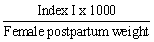
Index III = Weight (kg) of young produced per kg metabolic weight of female per year =
In the same column, and within a factor, means followed by the same letter do not differ significantly (P>0.05)
|
** P<0.01 |
* P<0.05 |
ns = not significant |