R.T. Wilson
Husbandry
Nutrition
Productivity
Potential for improved production
Tropical Africa has one-sixth of the total world flock of sheep and one-third of all goats. There are 0.71 goats and sheep per inhabitant in tropical Africa but their distribution is uneven, tending to the drier areas (Table 26). Within the semi-arid and humid zones the number of goats and sheep per head of human population varies from as low as 0. 07 in Sierra Leone and 0.13 in the Congo and Zaire to as high as 6.0 in Djibouti and 5.4 in Mauritania. In the countries in which ILCA has zonal programmes the figures are 2.13 for Mali, 1.65 for Ethiopia, 0.73 for Kenya and 0.47 for Nigeria; production from small ruminants is important in all these countries. Total meat production from small ruminants in Africa is 1.15 million tonnes (16% of world production), total milk production is 1.99 million tonnes (14% of world total) and total skin production is 211 000 tonnes (15% of world production). The total milk production from goats in Africa is about 3 times that from sheep.
Sheep and goats contribute about 17% of the total ruminant biomass in Africa (Table 26). This percentage varies from 9.3% in wet tropical Africa (including Tanzania and Zambia) to 35% in the Mediterranean Littoral. There are slightly more sheep than goats, and as sheep are generally bigger than goats they contribute more to meat production, although the value of goats is increased by their better milk production.
Table 26. The regional importance of sheep and goats in Africa. Numbers and areas adapted from FAO (1981a). Biomass calculated from mean population weights (cattle 206 kg, camel 307 kg, sheep 30 kg, goat 18 kg, buffalo excluded).
|
Parameter |
Region |
||||
|
Total |
Semi-arid and arid |
Humid |
Mediterranean Littoral |
Southern Africa |
|
|
Total area (106 km²) |
28.8 |
10.6 |
9.4 |
5.7 |
3.1 |
|
Agricultural population (106) |
271.9 |
108.2 |
107.4 |
41.7 |
14.5 |
|
Number of goats (106) |
141.1 |
93.5 |
23.2 |
12.6 |
11.8 |
|
Number of sheep (106) |
162.2 |
78.0 |
14.7 |
35.0 |
34.7 |
|
Ratio of goats: sheep |
0.87 |
1.19 |
1.58 |
0.36 |
0.34 |
|
Density of (goats + sheep)/km² |
10.5 |
16.2 |
4.0 |
6.1 |
15.0 |
|
Number of (goats + sheep) / person |
1.11 |
1.59 |
0.35 |
0.83 |
3.21 |
|
(goats + sheep) as % of ruminant biomass |
16.8 |
16.5 |
9.3 |
34.7 |
18.4 |
The term husbandry is used in a rather wide sense to include breed types (because these have undoubtedly developed in response to local needs and have been influenced by selection pressure), ownership patterns (because these reflect the preferences and needs of the human population) and management (which does exist under traditional systems in spite of a lingering feeling in some quarters that this type of husbandry proceeds on an ad hoc basis).
Breed types. Both goats and sheep of the semi-arid zones are generally larger than those of the more humid zones. They have for long been considered "unproductive" but it is doubtful if any other type of animal - at least of those currently domesticated - could produce as much in terms of returns for resources utilised. Over large areas of the West African Sahel there is little differentiation of breed or type in conditions of similar ecology. In general in the west and to some extent extending across the Sudan, where differentiation does occur it is found along east-west lines which follow the main ecological zones. In East Africa the situation is more complicated, being influenced by climate and altitude, by the diverse origins of the ethnic groups owning sheep and goats and by importations into the area. These importations may be of considerable antiquity - from Arabia and south-west Asia, for example - or more recently from the developed areas of Europe, Australia and South Africa. Table 27 indicates some of the main races of goats and sheep in the semi-arid areas and the economic justification for them.
In the humid zones there is little differentiation into breeds or types in either goats or sheep nor indeed is there any functional division. Both species are of the dwarf type, the extreme in goats often having a grotesque appearance. Goats seldom weigh more than 25 kg and sheep are little bigger although some of the intermediate type of Djallonke males in the sub-humid zone of West Africa may weigh as much as 35 or 40 kg. These types are generally trypanotolerant. In this zone the principal, if not the sole, reason for keeping small ruminants is for the production of meat (although it is said to be very greasy and is not liked by the peoples of the more arid areas) with the skins also being cooked and eaten. Milk production is very poor.
In the Mediterranean Littoral the Merino is important in some areas as it is in Southern Africa. In Southern Africa the Karakul sheep and Angora goat are also important, particularly in Namibia (South-West Africa). Recent attempts to "improve" local races with these breeds in tropical Africa, with the exception of the Highlands, have met with almost universal failure (see, for example, Wilson, 1981). No traces of these attempts can be seen in the stock existing to-day. In East Africa, apart from the out-and-out "European" operations, some progress has been made towards improvement of native breeds by the introduction of the Blackhead Persian and its derivative, the Dorper, in particular in Masai flocks. Similarly, the Boer goat and a prolific fast-growing local breed, the Boran, are being introduced, by the Masai themselves, into traditional flocks.
Table 27. Principal types of goats and sheep in semi-arid Africa and their aptitude for production
|
Species Breed/type |
Country/Zone |
Mature liveweight (kg) |
Production aptitude |
|
GOATS |
|||
|
Sudan Desert / Sahel |
Senegal to Sudan: arid and semi-arid |
35 |
Meat, milk |
|
Maradi / Red Sokoto |
Niger/Nigeria: southern semi-arid |
30 |
Skin, Milk and Meat |
|
Nubian |
Sudan: riverine |
50 |
Milk |
|
Abyssinian |
Ethiopia: arid/semi-arid |
30 |
Milk |
|
Small East African |
Kenya: upland semi-arid |
35 |
Milk, Meat |
|
Mubende |
Uganda: upland semi-arid |
30 |
Skin and Meat |
|
Boer |
Kenya: upland semi-arid |
45 |
Meat crossbreeding |
|
SHEEP |
|
|
|
|
Black Moor / Zhagawa |
Mauritania / Tchad / Sudan: arid desert fringe |
35 |
Meat, Hair |
|
Sudan Desert |
Sudan: arid desert fringe |
50 |
Meat, Milk (Skin) |
|
Sahel (West African Fellata) |
Mali / Niger / Tchad: Sahel, northern semi-arid |
40 |
Meat (Skin) |
|
Macina |
Mali: Niger flood plain |
35 |
Wool, Meat |
|
East African fat-tailed |
Ethiopia: semi-arid |
30 |
Milk (Meat) |
|
Masai |
Kenya: upland semi-arid |
35 |
Fat meat (Skin) |
|
Sahel x Forest / Nilotic |
Mali: semi-arid/sub-humid |
45 |
Meat - supplementary fed |
|
Blackhead Persian/ Dorper |
Kenya: upland semi-arid |
40 |
Meat - crossbreeding |
In general under present conditions there would appear to be adequate genetic material in the indigenous races for production to be raised to a much higher level than the current average. Only when this level has been reached and when the constraining ecological and economic conditions can be overcome, should consideration be given to further "improvement" by races less well adapted to the rigours the zone.
Ownership. The ownership pattern is very varied and, for an outsider at least, extremely difficult to establish and understand. The ramifications of many African kinship systems; the extremely complicated systems of "stock friends", loans and herd splitting; the herding out procedures involving professional herders often of a different ethnic group all lead to a rather fluid idea of ownership which often involves many displacements of an animal over its lifetime.
It would nonetheless be true to say that larger numbers are owned by individuals or families in the drier areas than in the less dry ones. In West Africa and the Sudan this in effect means that flock size decreases from north to south and in Ethiopia and Kenya there is a trend to smaller flocks at higher altitudes. This trend reflects the obvious change of system from a purely pastoral one associated with the very dry areas through an agro-pastoral one in the less dry areas (and where the agricultural component may be assuming more importance) to an agricultural one in the gradation to a sub-humid climate.
What is perhaps less obvious in the ownership pattern is the gradual change in emphasis from sheep to goats as the macro-management system moves from nomadism to sedentary and from pastoral to agricultural. This is reflected not so much in the size of flocks as in the numbers of owners who either have preferences for goats over sheep or who, for other reasons, are forced to keep goats. Goats are, of course, generally more prolific than sheep and are probably less trouble to manage for the agriculturalists and agro-pastoralists who are recent entrants into animal husbandry. Table 28 provides some idea of the distribution of ownership in an agro-pastoral system composed of two subsystems in the semi-arid zone of Mali; Table 29 indicates patterns in the humid zone of south-west Nigeria while Table 30 shows additional data for Kenya and Tchad.
In recent years, although there is little hard evidence to support such a contention, it is probable that the goat population has been increasing not only in absolute numbers but in relative terms in comparison with sheep. This is perhaps due to their higher total reproductive rate and their wider dietary range. Although, as can be seen in the section on productivity goats are not generally as productive as sheep when calculated on the same basis in terms of meat production (although there are exceptions), their superior milking ability undoubtedly renders them more attractive overall, particularly in the drier areas. Trends in total population and in numbers of families owning small ruminants are thus likely to continue towards goats and away from sheep, at least in the traditional sectors.
Table 28. Ownership patterns of sheep and goats in an agro-pastoral area in central Mali.
|
|
Irrigated Rice sub-system |
Rainfed Millet sub-system |
|||||
|
Goats |
|
Sheep |
Goats |
|
Sheep |
||
|
Number of owners studied |
|
27 |
|
|
16 |
|
|
|
Number owning sheep or goats |
26 |
|
15 |
16 |
|
9 |
|
|
Number owning goats but not sheep |
|
12 |
|
|
7 |
|
|
|
Number owning sheep but not goats |
|
1 |
|
|
0 |
|
|
|
Mean flock size a) |
9.0 |
|
6.4 |
38.2 |
|
7.1 |
|
|
|
± s.d |
6.03 |
|
13.51 |
27,75 |
|
14.81 |
|
Mean flock sizeb) |
9.3 |
|
11.5 |
38.2 |
|
12.6 |
|
|
|
± s.d |
5.87 |
|
17.0 |
27.75 |
|
18.27 |
|
Range in flock size |
0-23 |
|
0-64 |
2-91 |
|
0-58 |
|
Notes:
(a) of all owners i. e. irrespective of whether the holding of one species of stock is nil
(b) of only those flocks in which animals are held, i. e. nil holdings excluded.
Table 29. Pattern of small ruminant ownership in the humid zone of south-west Nigeria. Source: Mosi et al. (1982).
|
|
Forest zone |
Derived Savanna Zone | |
|
Percentage of farmers owning small ruminants |
|
| |
|
Mean flock sizes |
73 |
20 | |
|
|
Goats only |
2.8 |
3 7 |
|
|
Sheep only |
2.0 |
- |
|
|
Mixed flocks |
5.1 |
5.3 |
Management. Until recently, and indeed the feeling lingers on in some quarters, it was considered that under traditional systems of operation no management was practised. Only a little thought shows the inherent nonsense of this tenet. Nomadism is a sophisticated management response to a resource base which is always seasonally and often totally deficient. Stall feeding is equally a response to the availability of a surplus of nutrients in a particular environment and to a demand, often very strictly confined in time and space, for a convenient quantity of meat. These management options are the extremes of a wide range of such which form a continuum from the almost totally unendowed very arid end of our spectrum to the much more favourable environment at the sub-humid end of the scale where irrigation possibilities may provide the opportunity for relatively sophisticated interventions. In the very humid zones all management is sedentary with animals often being stall fed or given quantities of household and crop waste and being tied or housed at night.
Table 30. Livestock owning in agro-pastoral and pastoral societies in Kenya and Tchad. Sources: Kenya- Christie Peacock (personal communication); Tchad - Dumas (1977).
|
|
Kenya |
Tchad |
|||
|
Masai |
Karapokot |
Zioud |
Salamat |
Gondeye-Tchein |
|
|
Production system |
Pastoral |
Agro-Pastoral |
Pastoral |
Agro-pastoral |
Agro pastoral |
|
Average holdings |
|
|
|
|
|
|
Cattle |
157.3 |
11.78 |
36.4 |
133.3 2.1 |
|
|
Sheep |
44.0 |
5.35 |
43.5 |
2.0 |
1.3 |
|
Goats |
83.1 |
13.64 |
45.0 |
46.3 |
4.7 |
Table 31 indicates the strategies ("macro"-management) and tactics ("micro"-management) of traditional owners in the African semi-arid zone. With only few exceptions there are clear trends from low to higher rainfall which are: nomadism to stall feeding; uncontrolled or very loosely controlled ranging by day and open camp at night to very restricted herding by day and confinement at night; a tendency to generally smaller flock sizes as conditions improve and an increased emphasis on goats associated with the agro-pastoral zones as already mentioned in the section on ownership. Large scale modern management of sheep (for wool and to a lesser extent for fat lamb) is confined to the highland areas of Kenya.
Prestige and perverse supply were once catch words used to typify the attitudes of traditional livestock owners. Undoubtedly African pastoralists are conservative but it is doubtful if they are any more so than their peers in Australia or America. Their reasons for keeping stock are rarely irrational and are perfectly in keeping with the problems encountered and the short and long term goals of the owners. One aspect which supports this contention relates to the age and sex structure of the flocks. Whatever the main economic objective in keeping goats or sheep, a remarkable similarity in flock structure is apparent across the whole of the semi-arid zone, as can be seen from Table 32. With the single exception of the Afar of Ethiopia whose subsistence is almost entirely milk, all the flocks have around 75% of females (and somewhere in the region of 55% of the total flock breeding females in excess of twelve months of age). In a sample of flocks belonging to four different ethnic groups in Mali, covering the whole range of "macro"-management systems and including more than ten thousand animals, the mean percentage of females was 74.7 with a standard deviation of + 3.07. Breeding females in this sample showed even less variation at 54.3 (+ 2.43)% of the total flock. Contrary to another popular misconception, there are very few old unproductive females in the flocks, this class of stock being usually less than 5% in large scale flocks and rarely exceeding 10% in the small agro-pastoral ones. The main management practice used to achieve this structure and stability is the early culling of males which are sold or slaughtered for home consumption. Males of reproductive age are kept, strictly speaking, in numbers in excess of those actually required for breeding. There is, of course, the consideration of losses from diseases and of a temporary sterility as a result of nutritional deficiencies: when these factors are taken into account the number of males is seen to be no more than reasonable. Where older males other than breeding animals are kept they usually contribute directly to the flock economy in terms of wool or hair or to specialised dietary requirements such as, for example, in the ease of the Masai. In the humid zones flock structures are even more heavily weighted to females with as many as 80% females in the derived savanna areas and 83% in the true forest area (Mosi, Opasina, Heywood, Carew and Valez, 1982).
Table 31. Ecology and management of goats and sheep in semi-arid Africa
It has to be said that the true pastoralists are much better at flock management, for example in terms of foraging time allowed to their animals and in control of mating to certain desired males, than the recent entrants into the livestock industry. These agriculturalists and agro-pastoralist appear to have much to learn before maximum production levels are achieved. With better management and with more efficient use of agricultural by-products and tree fodder, productivity could be raised considerably from these areas.
According to IEMVT (1980) the studies done on the nutrient requirements of small ruminants in the tropics are for the most part fragmentary. They quote voluntary intake for sheep as between 1.8 and 3.0 kg dry matter for maintenance, 3.0 - 3.8 kg DM for the last six weeks of pregnancy and 4.4 - 6.0 kg DM for lactation, all figures expressed per 100 kg liveweight for 35 kg sheep. ILCA studies in the semi-arid zone of Mali have shown large fluctuations in DM intake over time from about 1.6 to 3.2% of liveweight for both sheep and goats with mean values of 2.6%. Seasonal trends here were difficult to detect but there was low intake of DM from October to January (i. e. in the eary dry season) with goats eating much less than sheep in the rains. On average mature male sheep ingested 0.70 MJ of energy per day while goats averaged 0.53 MJ. It has also been difficult to isolate the effects of mixed species flocks on the nutrition requirements and intake of goats and sheep. It is possible that either one or other species largely determines the activity and consumption patterns of both at certain times of the year, depending on the type of food available and this could have some effect on overall productivity. In the dry zones of Mali goats spend as much as 87% of their time on browse while sheep spend only 34% of theirs. ILCA studies in Kenya have shown that goats spend 56% of their time browsing compared with no time at all by sheep. While the truism that goats are principally browsers and sheep mainly grazers thus appears to be confirmed, it is necessary to he cautious in this respect. In studies in the humid zone Carew, Mosi, Mba and Egbunike (1982) showed that goats spent 98.7% of their feeding time browsing but sheep also spent 92.6% of time browsing in the forest zone while in the derived savanna zone sheep (61.1%) actually spent more of the feeding time, and much more of total time, in browsing than goats (52.2%).
The conventional wisdom of the greater efficiency of goats over sheep in the digestibility of organic matter, e rude protein and fibre (Devendra and Burns, 1970) has also been challenged recently (McDowell and Woodward, 1982). It is apparent that a great deal of further work is required before nutritional aspects can be properly evaluated and the relation of nutrition to breeding physiology and reproductive performance probably needs special attention.
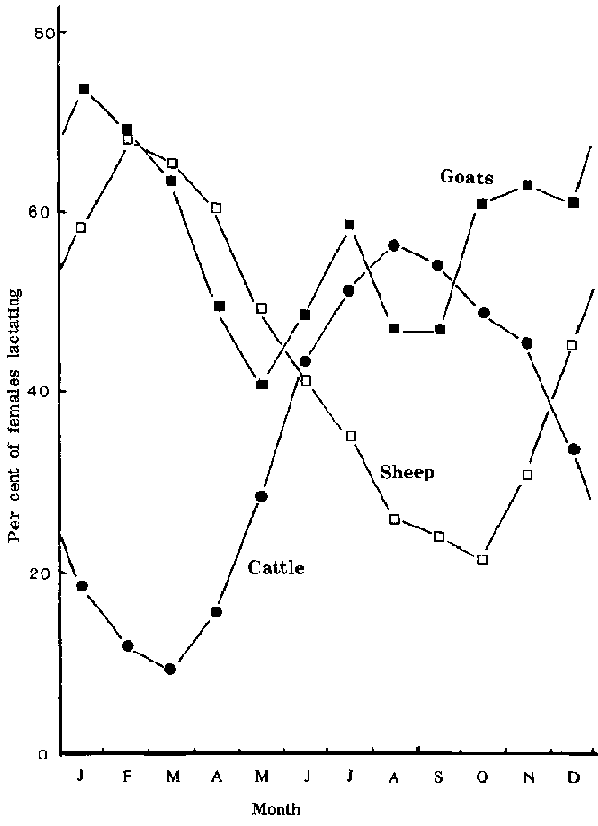
Improved nutrition greatly increases the growth rate of indigenous animals, but the seasonality of the food supply has only minor effects on reproduction with both goats and sheep producing young all the year round even in the semi-arid areas with monomodal rainfall. This is not the ease for cattle where more than 60% of births occur in a 10-week period related to conception in the previous rainy season.
Table 26 showed that goats and sheep account for almost 17% of the total domestic ruminant biomass. This in itself is a not inconsiderable figure but nonetheless gives no indication of the real contribution of this class of stock to total animal production. On account of the higher prolificacy and the shorter generation cycle, offtake figures are much higher than for cattle or camels. Based on figures for biomass and offtake rates, sheep and goats can be expected, as Table 33 shows, to contribute almost 30% of total meat protein (excluding poultry and pigs) in the semi-arid zones. This high contribution is often not acknowledged, the trade in sheep and especially goat meat being internal to the countries concerned or on a much smaller scale even within the flocks themselves. That the figure of 30% per cent is not far out is supported by the data for registered slaughterings in the principal towns in four of the Sahelian states shown in Table 34. In 1970 the figure was almost 36% and in 1976, after a lengthy period of drought, sheep and goats contributed overall 43.2% to meat production on average and more than 70% in Niger. The ability to withstand drought conditions and to recover from them much more quickly than cattle is a not inconsiderable factor in the production potential of goats and sheep.
In addition, as can be seen from Figure 2, in drier areas, goats in particular, and sheep to a lesser extent contribute to human welfare by assuring a supply of milk at the time of year when cows' milk is not available.
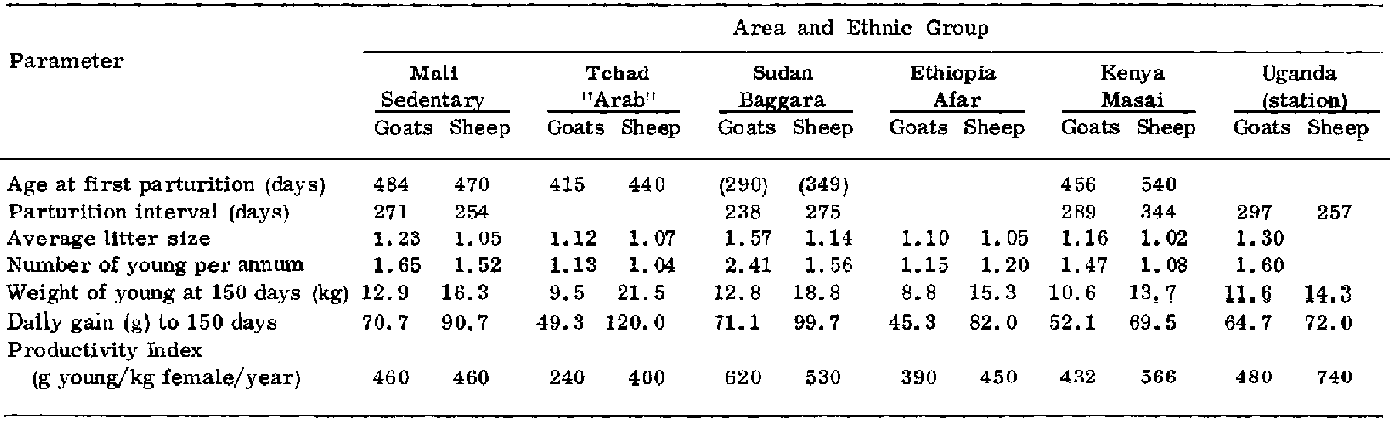
At the level of the individual animal some of the ways in which the relatively high productivity is achieved are shown in Table 35. Sheep give birth for the first time at about 15 months of age on the average: goats are generally two to three weeks earlier. Parturition intervals vary from 8 to 10 months. Although the semiarid races are not as prolific as the small races of the more humid zones, twin births are common in goats and are far from unusual in sheep. In these races the number of young born per year is thus in general about 1.6 per breeding female for goats and somewhat less for sheep. In the forest races because of the higher rate of multiple births, rates of annual reproduction in goats are in excess of 2.0 and not much less than this in sheep. In all types the first litter is smaller, as would be expected, than subsequent litters.
Table 33. Contribution of domestic herbivores to liveweight biomass and to meat production in eight African semi-arid countries.
|
|
Cattle |
Camels |
Sheep + Goats | |
|
Total liveweight biomass (tonnes) |
14100000 |
1900000 |
2800000 | |
|
Offtake rate (%) |
14.5 |
6.2 |
30.0 | |
|
Total carcass weight available at 50% |
990000 |
60000 |
410000 | |
|
|
dressing percentage (tonnes) |
|
|
|
|
Species as % of total liveweight biomass |
75.3 |
10.0 |
14.7 | |
|
Contribution of species to total meat |
68 |
4 |
28 | |
|
|
availability |
|
|
|
Table 34. The contribution of sheep and goats to registered slaughterings in four African countries before and after a drought period ('000 livestock unit equivalents and percentages)
|
Country |
1970 |
1976 |
||||||
|
Cattle |
Sheep + Goats |
Total |
Sheep + Goats % of total |
Cattle |
Sheep + Goats |
Total |
Sheep + Goats % of total |
|
|
Mauritania |
21 |
4 |
25 |
16 |
10 |
3 |
13 |
23 |
|
Mali |
80 |
23 |
103 |
22 |
90 |
38 |
128 |
30 |
|
Niger |
62 |
79 |
141 |
56 |
33 |
89 |
122 |
73 |
|
Tchad |
56 |
10 |
66 |
15 |
55 |
13 |
68 |
19 |
|
All |
219 |
116 |
335 |
35 |
188 |
143 |
331 |
43 |
Growth rates in the semi-arid races are some three times more rapid than the rates in forest types when expressed simply as grams/day. However forest types have similar or slightly greater productivity indices calculated per unit weight of breeding female (ILCA, 1979b). The withdrawal of males for slaughter at light weights (90% of marketed and home slaughtered males in Darfur, for example, have liveweights less than 20 kg) represents some loss of potential meat availability but is certainly an efficient use of the resource base.
Figure 2. Complementarity of lactations in mixed species production systems
|
cold dry |
hot dry |
rains |
post rains |
cold dry |
|
Season | ||||
Table 35. Some measured production parameters for African goats and sheep in semi-arid areas
There are few data available on aspects of production other than meat. Such products include milk, wool, hair and skins and the contribution of manure to the agricultural systems with which goats and sheep in the less dry areas are associated. Data collection on some of these aspects may well be beyond the means of a simple animal scientist and may require considerable cross-disciplinary inputs from sociologists and economists as well as agronomists. These products are certainly worthy of much more attention than they have received.
While mortality rates in small ruminants are considered to he high (up to 40% in goats and 30-35% in sheep before weaning and up to 10% in older animals) losses due entirely to disease are difficult to categorise. Country statistics in this subject, as for animal numbers, must be to a certain extent suspect and while there is a voluminous and rapidly growing literature on small ruminant disease at least when compared with productive aspects - it would be true to say that the real causes of most mortalities are only suspected rather than known. Except in certain clear-cut eases death usually supervenes as a result of a complex of factors involving nutrition, management and disease.
The semi-arid zones of Africa represent a difficult environment with seasonal, and occasionally much longer, severe stress periods. Different kinds of stress, for example trypanosome infections and extremely heavy parasite burdens affect forest types. Goats and sheep are obviously fairly well adapted to these stress conditions. "Modern" technical inputs, even where available, are beyond the financial, and often physical, reach of the owners.
Although nothing akin to a "green revolution" can he expected, this does not mean that improvement is not possible. In the case of liveweight gain, for example, consider one specific and one general example. In Darfur flocks studied in 1972-74, one male sheep, reared under exactly the same conditions as his contemporaries, gained 265 g per day to 12 weeks of age when he weighed 26.5 kg: this rate of gain compares very well with the 299 g mean achieved in New Zealand for grass-fed lambs. A general example concerns the so-called "mouton de ease" of West Africa. In Mali, the feeding of rice bran, leaves of Khaya senegalensis and cow-pea haulm can lead to weight gains which are 50% higher than those of similar animals reared on the open range and on millet and rice stubbles. It is apparent that the genetic base is not as impoverished as many people think. In terms of weight gain, however, it is often just the fastest growing males, which would be the best sires, which are removed from the flocks.
Management has been shown to be an important factor in overall performance. A general lift in production so that the worst flocks can be raised to the level of the current average producer, thus raising the existing output by 15-20%, should not be too difficult to achieve. This target could be attained by encouraging the worst owners to follow the practices of the better ones. It is just this field the one of management - that is most likely to be successful in raising production levels at the least cost.