P . HorstInstitut für Tierproduktion
Lentzeallée 75
D-1000 Berlin 33
West Germany
Summary
Resume
Introduction
Backgrounds and needs for a research project
Experimental concept
Project results and future orientation
Conclusions: What makes a model?
References
In an analysis of a collaborative research and development project, the factors necessary to its success, such as mutual confidence in personal relations, a common conceptual approach, common interest at the individual and institutional level and a multidisciplinary approach to cover all aspects of production and allow close collaboration with development aspects are presented. The successful creation of a dual purpose goat in Malaysia is used as a model to illustrate these points.
Une analyse d'un projet conjoint de recherche-développement présente les facteurs nécessaires à la réussite d'une telle collaboration en termes de relation personnelle confiante et d'accord conceptuel, d'intérêt mutuel aussi bien au niveau des chercheurs que des institutions, une approche multidisciplinaire est vivement recommandée pour couvrir les différents domaines de recherche impliqués, et pour permettre un lien très étroit avec le développement. La réussite de projet de création d'une race caprine mixte en Malaysie est analysée en regard de ces facteurs.
Long term international cooperation in research and development is based on personal confidence and agreement on the required research concepts. It also requires the mutual interest of participating persons and institutions in advancing scientific knowledge by means of joint, multidisciplinary research programmes through contributions from different subject areas and cultural backgrounds. The success of a project depends on defining an appropriate research concept (Figure 1), the elaboration of strategies which can guarantee significant results and which will allow extensions to connected fields and to other partners.
In this paper the successful fulfilment of a cooperative project on goats will be used as a model case. The project was created between Malaysian and German universities using the conditions already cited to promote development and research. The joint project arose from the well-known fact that there has been considerable neglect of goat research in modern animal science as well as in agricultural extension. In contrast to this, the social and ecological significance of this species in developing countries (where about 95% of the world goat population is found) demand that it should be better understood and utilized more efficiently. An additional reason for using goats as a cooperative scientific object is that this species, because of its size and reproductive capacity, is an efficient vehicle for research innovations in terms of time and costs, which are otherwise the main external constraints to research.
Figure 1. Stages in a cooperative research and development project in Malaysia.
· Finding of research concept and research objectives· Exploration and exploitation of goat potential· Creation of international research partnership
· Tropical country
· Scientific institution- personnel qualifications
- technical standard
- institutional infrastructure· Evaluation of research background
· Macro-economic significance of the subsector
· Socio-economic profile of production systems
· Bio-technological limitations in reproduction and production· Formulation of a development oriented research programme with the aims of
· Solving biological constraints- genetic potential
- disease status· Improving technical deficiencies
- housing and construction
- feeding and supplementation
reproduction management· Elaborating appropriate extension technologies and experimentally testing in the field
· Transferring of positive results to national improvement schemes
· Realization of joint working programme
· Building up of research facilities
· Scientific and technical training and exchange
· Establishment of experimental material
· Application of experimental treatments
· Data collection and data management
· Data analysis and results interpretation
· Subprojectwise finalization and (level-orientated) academic qualifications· Development of a research and training unit for
· Interdisciplinary research
· Academic teaching
· Technical training
· Extension in development and research· Revision and continuation
Agriculture in Malaysia is dominated by perennial tree crops and permanent irrigated rice which cover 93% of the total cultivated area. The rural community is characterized by the predominance of small economic units encompassing smallholders, plantation employees and other landless rural households with limited resource availability and low incomes. Short and medium term improvement in household income is only feasible by expanding and intensifying animal production. The Malaysian goat population of about 350 000 provides only about 20% of the total market demand for goat meat, which enjoys a strong consumer preference and fetches high retail prices.
Goats can play a role in development when used as a model for problem analysis (Peters et al, 1979; Mukherjee et al, 1982) owing to their small size, short generation interval and adaptive capacity. Adjustment of flock size to available resources is easy, they require low capital inputs for starting or expanding the flock, they enable distribution of risk and can be sold whenever desired. The obvious benefits are an increase in family income, a smoothing of seasonal cash shortages and reduced overall financial risk.
The Malaysian goat population comprises small-framed animals incorporating the original Kambing Katjang with addition of exotic (and larger framed goats) such as Jamnapari, Anglo-nubian and Alpine. The local goat is primarily a meat producer and is known for its prolificacy and ability to breed all the year round. The use of this local stock as an efficient meat producer is, however, limited, due to its slow growth rate and low effective reproductive or maternal ability which contributes to the known biological antagonism between fecundity and rearing ability. The necessary increases in goat numbers and individual productivity in Malaysia are constrained by inadequate husbandry practices, especially in the less intensive production systems. Development activities also encounter problems in reproductive and productive performance, especially where intrinsic changes in husbandry levels require appropriate adjustments in genetic performance.
Two problem spheres were identified demanding research for an appropriate development of smallholder goat units. These spheres are the improvement of rearing techniques such as nutrient supply and temperature control (to improve survival and early growth of the kid) and the systematic introduction and multiplication of exotic stock to provide genetic variability and genetic improvement which could improve the potential for growth and for pre- and post-natal maternal ability as well as helping to decrease inbreeding.
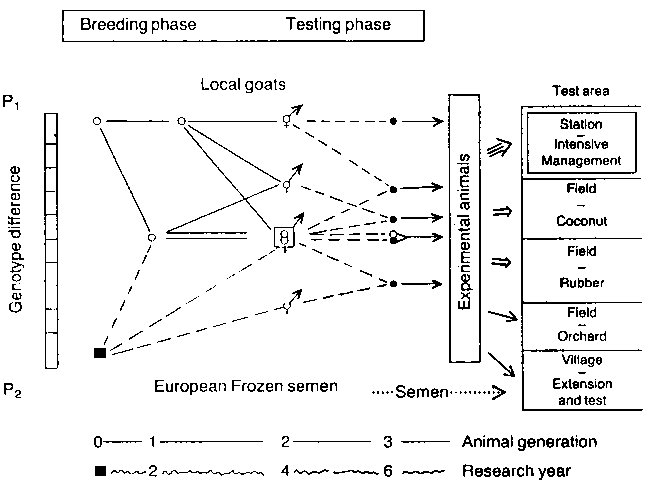
Based on biological constraints and technical deficiencies, the experimental design was directed mainly to a breeding project in the form of a controlled nucleus herd. This design allows the development of adapted husbandry methods and the introduction of development innovations into lower ranking production systems, mainly through gene transfer. The structure of development research activities of the Malaysian project (Figure 2) shows the basic idea of creating a nucleus goat herd and implementation of a breeding programme to produce contemporary breeding groups with a differentiated gene structure. The different genetic material can be tested simultaneously under different management systems and introduced into different smallholder systems.
The development of the nucleus farm is a key issue in this concept, so all parts of the project are organized with respect to possible multiplication. A coordinated production process was also chosen which not only facilitates management, control and development but can also be adapted (in pure or mixed form) to other improved systems (Figure 3). The reproductive process, by its nature, needs long time periods and short and long term breeding goals generally need to be envisaged. In the Malaysian project, complex aims were formulated in order to make the most use of the available infrastructure and of the animal and human resources. The research aims included a contribution to breed documentation and local gene resource evaluation, improvement of the local goat population for increased meat production and maternal efficiency, assessment of phenotypic and genetic parameters of relevance to a locally adapted breeding programme (including the effects of varying proportions of exotic and indigenous genes), the levels of crossbreeding parameters (especially individual and maternal heterosis), and the significance of genotype x environment interactions.
Figure 2. Development ties in research activities in the Malaysian goat development project.
Figure 3. The coordinated production process on the Malaysian nucleus farm.
In the context of a more multidisciplinary approach, a network of biological, technical and economic investigations was propagated to develop and test modified production techniques in husbandry, nutrition and hygiene. The application and evaluation of various biotechnical procedures to facilitate improved breeding management via transfer, multiplication and preservation of valuable gene material was also an objective of the project.
The key concept was a reciprocal back-crossing programme between Malaysian local (preferably Kambing Katjang) and Improved German Fawn goats. Intercontinental deep frozen semen transfer was used to introduce the German blood. The reasons for the chosen breeding technologies and the use of the two different basic populations were based on:
the need for a breeding strategy for the systematic genetic improvement of the widely distributed local population characterized by high prolificacy and adaptability to the local conditions;the contrasting use of a European dairy type that could guarantee improvements in fecundity, in birth weight, in adult body size, in maternal capacity and in milking ability;
the fact that experimentation with genetically distant populations should produce significant crossbreeding and interaction parameters, so that the use of a relatively small experimental herd would be justified;
the availability of semen of the Improved German Fawn; and
the possibility of using the deep frozen semen technique for the first time in such a gene transfer operation because of the availability of a variety of genetically superior bucks of the German Fawn.
Simultaneous performance tests of different breeding groups under different systems and husbandry conditions were carried out (Figure 4). Observed genotype x environment interactions will be used for the formulation of the final breeding programme.
A satellite village testing programme was also carried out (Figure 2) for rapid transfer of genetic and technical improvements and to obtain continuous information on their practical effects. The relevance of appropriate extension approaches was also examined.
The joint goat breeding project is now in its ninth year of cooperation and is entering a new phase.
A wide spectrum of working results has already been achieved. The main one consists of the creation of a new breed with improved productive adaptability which is already in use in several private farms and is being used by national organizations for further multiplication and selection. In connection with a wide testing programme, the value of the systematic introduction of genes for improving growth and milk production has been proven. As well as significant additive genetic effects, important maternal direct and indirect (heterosis) effects have been explored, leading to the consolidation of a synthetic line of a dual-purpose type. Basic techniques have been adopted to build up a deep frozen semen bank, which not only uses imported resources but also valuable local ones. Oestrus behaviour, hormonal profile studies and modified synchronisation techniques have been introduced to improve gene transfer into the nucleus as well as into the field stock. Ultrasonic screening for early pregnancy diagnosis has been applied to goats for the first time in order to facilitate reproductive selection.
Management techniques for reducing peri-and post-natal kid losses have been developed. These include the introduction of boxes for overcoming low temperature losses of newborn, artificial rearing by whole milk replacer and early weaning procedures, mineral supplementation, and prophylaxis against coccidiosis and endoparasites. Different methods of using agricultural residues have been demonstrated. Possibilities for using goats in mixed farming systems under plantations as well as in combination with aquaculture have been examined and recommended for further application. Results achieved in the accompanying field programme have been directly tested at village level, demonstrating the possibility of a successful technology transfer from the nucleus flock to smallholdings.
During the course of the programme some 50 national and international conference papers and scientific publication have been produced and 7 Ph.D. and 8 M.Sc. dissertations have been, or are being, produced by both Malaysian and German students. The research and development project has been used as a training unit and several practical and instructional courses have been developed. Training activities will continue in the future and will be further developed to cover international and regional needs. The materials will also be used for in-service training of experts from development projects with a small ruminant component. The research component will continue to stress development activities and will, in particular, monitor the national breeding work on the new synthetic dual-purpose breed.
The second phase will be directed to higher productivity including breeding aspects (semen, embryo storage and transfer, genome analysis), to product processing and development (improvement of milk quality, new milk products and processing of skins), and to intensified biotechnology. In this respect, a local dairy strain will be created by further upgrading of the synthetics with improved German Fawn as long as upgraded generations prove superior to the preceding one.
It is hoped that the continuation of the project will form the basis of a more intensified form of multidisciplinary research. At the same time the project should attract more scientists and experts from local institutions and from abroad, thus promoting international cooperation in research and development and in exchange of scientific knowledge.
Based on its experience, the project may claim to have achieved an overall model character for development activities in animal production. Such a project needs to follow (Figure 1) clearly identified and jointly agreed stages in:
identifying feasible concepts and objectives;
creating substantial partnerships;
monitoring local research backgrounds;
defining and revising short and long term aims;
formulating systematic working programmes with fixed time horizons; and
integrating research, training and extension activities on the basis of a multidisciplinary approach.
Important aspects of this project have been institutional advancement, devotion to the jointly agreed scientific cooperation, and mutual confidence in the common activities. A national university involvement in such a research programme must also be seen as a special element of this model. As universities are devoted to education and research by idealism, developmental stimulation via partnerships between universities should be focused on development or applied research problems. As research concepts and research operations have a worldwide identity, this component can ideally be used for international development and cooperation. In agreement with Humboldt's concept, research should be a vehicle for advanced academic learning but can also contribute to improving the scientific standard of local universities.
A specific advantage of the research aspect in the context of development activities is its ubiquitous character and its use for enhancing personal reputation and professional advancement. It thus ensures personal involvement, long term commitment and success. In view of their open-minded character, international conceptual and structural aspects and worldwide recognition of professional standards and qualifications, national universities should have a special task in conducting long term international development programmes. This position has not yet been fully realised in national or in international development projects. The current project provides two models:
in the narrow sense, it concentrates on a subsector in animal production which is underdeveloped, in science and in practice, and which is particularly relevant to the world's poor; andin a wider sense, it stimulates academic activities in research, education and international exchange of knowledge in order to mobilize joint potentials for continuous development-oriented multidisciplinary research.
Peters K J. Deichert G. Drewes E, Fichtner G and Moll S. 1979. Goat production in low income economic units of selected areas in West Malaysia. Animal Research and Development 13: 88-113.
Mukherjee T K, Peters K J. Banumathi T. Deichert G and Horst P. 1982. Crossbreeding as a tool for overcoming the antagonism between fecundity and rearing ability in goats under tropical conditions. Proceedings of the IIIrd International Conference on Goat Production and Disease 353.