H. M. HassanAnimal Production Department
Faculty of Veterinary Medicine and Animal Husbandry
P.O. Box 2080
Mogadishu
Somalia
Summary
Resume
Introduction
Materials and methods
Results
Discussion
Conclusions
References
Productivity of Somali goats is generally low due to poor husbandry practices. The effects of nutrition on birth weight, body weight and hay intake of does fed diets varying in digestible energy during the last 4 mo of pregnancy were studied on 24 Somali-Arabian goats. Body weight of pregnant goats and kid birth weight increased with the level of digestible energy. Hay and total feed intake tended to decrease as digestible energy in the concentrate increased and also as goats approached parturition. None of these increases were significant. A low digestible energy level (29.3 Mcal/kg) in the concentrate is adequate for daily digestible energy requirements of Somali-Arabian goats during the last 6 wk of pregnancy.
La productivité des chèvres en Somalie est faible due à une conduite d'élevage déficiente. Un essai d'alimentation fut mis en place sur 24 chèvres Arabo-Somaliennes pour évaluer les effets de différents niveaux d'énergie digestible distribuée au cours des 4 derniers mois de gestation. Le poids moyen des chèvres gestantes et des jeunes à la naissance augmente avec le niveau d'énergie digestible. Le foin et la quantité totale ingérés pour les femelles gestantes ont tendance à diminuer lorsque l'énergie digestible du concentré augmente et que les chèvres approchent de la parturition Aucune de ces différences de poids n'était significative. Le niveau énergétique le plus bas (29,3 Mcal/kg) dans le concentré est adapté aux besoins en énergie digestible de la chèvre Arabo-Somalienne pendant les 6 dernières semaines de gestation.
In Somalia, goats outnumber all other domestic livestock by a substantial margin. Somalia has the third largest goat population in Africa south of the Sahara, after Nigeria and Ethiopia. Most Somali goats are raised for meat but the level of productivity is generally low owing to poor husbandry practices. In the rural areas goats are maintained under an extensive and free-ranging system and are subject to wide fluctuations in the availability of feed and water.
Energy requirements increase rapidly during late pregnancy and during this period nutrition has a great effect on animal production. The objectives of this study were to determine the effects of energy level during late pregnancy on doe body weight, birth weight and hay intake. A subsidiary objective was to demonstrate the use of locally available agro-industrial by-products as feed for goats in Somalia.
Stratified random sampling was used to sort 24 yearling female Somali-Arabian goats according to body weight to provide 6 lots of 4 animals each. The goats were fitted with leather collars and tied separately in each pen to allow individual feeding.
Three experimental concentrate diets (Table 1) varying in digestible energy content were fed to each of 2 pens during the final 4 mo of pregnancy. Sun-dried native hay was fed as roughage. Concentrate intake was recorded for individuals but daily hay consumption was measured on a pen basis. Water was supplied in plastic tubs ad libitum.
The goats were treated periodically against external and internal parasites during the study. Animals were weighed at 14 d intervals. Parturition dates and birth weights were recorded.
Table 1. Composition and analysis of experimental concentrate rations for goats in Somalia¹).
|
Composition and analysis |
Ration number |
|||
|
1 |
2 |
3 |
||
|
Composition |
||||
|
|
Sesame chaff |
18.8 |
16.5 |
2.8 |
|
|
Whole cottonseed |
6.1 |
34.2 |
48.3 |
|
|
Sesame cake |
9.3 |
3.1 |
0.5 |
|
|
Wheat bran |
25.5 |
20.3 |
16.3 |
|
|
Wheat |
19.9 |
4.9 |
9.9 |
|
|
Molasses |
19.9 |
19.9 |
19.9 |
|
|
Limestone |
0.1 |
0.6 |
1.7 |
|
|
Salt |
0.5 |
0.5 |
0.5 |
|
Calculated analysis |
||||
|
|
Dry matter |
87.6 |
88.4 |
88.4 |
|
|
Digestible energy |
29.3 |
31.5 |
33.0 |
|
|
Crude protein |
15.5 |
15.8 |
15.9 |
|
|
Crude fibre |
6.8 |
10.4 |
11.3 |
|
|
Calcium |
1.1 |
1.1 |
1.0 |
|
|
Phosphorus |
0.5 |
0.5 |
0.5 |
Note: 1. All figures are expressed as percentages except for digestible energy which is in Mcal/kg.
There was an increase in average body weight (Table 2) of the goats as pregnancy advanced and as the level of digestible energy in the concentrate increased but there were no differences (P > 0.05) in the increase among the treatments.
Table 2. Average body weights (kg) of pregnant Somali-Arabian goats fed diets varying in digestible energy.
|
Period1) |
Diet |
s.e. |
||
|
1 |
2 |
3 |
||
|
1 |
18.7 |
19.2 |
17.9 |
0.60 |
|
2 |
19.5 |
18.3 |
19.2 |
0.60 |
|
3 |
20.3 |
19.9 |
19.8 |
0.68 |
|
4 |
20.6 |
20.6 |
21.7 |
0.78 |
|
5 |
22.2 |
22.2 |
23.4 |
0.83 |
|
6 |
23.8 |
24.0 |
25.4 |
0.84 |
|
7 |
25.0 |
25.7 |
27.0 |
0.84 |
|
8 |
26.9 |
27.4 |
28.2 |
0.84 |
Note: 1. 14-d periods approaching parturition.
Daily concentrate intake was similar among the treatment groups (Table 3). Daily hay intake and total feed intake tended to decrease as the digestible energy level in the concentrate increased and as goats approached parturition.
Kid birth weight had a tendency to increase as the level of digestible energy fed to their dams increased. Dams on the lowest level of energy gave birth to kids which weighed 2.20 kg, on the intermediate level birth weight was 2.25 kg and on the high level it was 2.28 kg.
Table 3. Average daily consumption (kg) of concentrate, hay and total feed by pregnant Somali-Arabian goats on three diets varying in digestible energy.
|
Period 1) |
Diet |
s.e. |
|||
|
1 |
2 |
3 |
|||
|
Concentrate |
|||||
|
|
6 |
0.66 |
0.65 |
0.66 |
0.005 |
|
|
7 |
0.67 |
0.68 |
0.68 |
0.005 |
|
|
8 |
0.64 |
0.67 |
0.64 |
0.007 |
|
Hay |
|||||
|
|
6 |
0.35 |
0.34 |
0.32 |
0.003 |
|
|
7 |
0.33 |
0.29 |
0.31 |
0.003 |
|
|
8 |
0.34 |
0.30 |
0.32 |
0.004 |
|
Total feed |
|||||
|
|
6 |
1.01 |
0.99 |
0.98 |
0.110 |
|
|
7 |
1.00 |
0.97 |
0.97 |
0.010 |
|
|
8 |
0.98 |
0.97 |
0.96 |
0.008 |
Note: 1. 14 d periods approaching parturition.
Average body weight and average 14 d gain of pregnant goats increased as the digestible energy level in the concentrate increased. The improved body condition indicates that animals responded to a higher intake of digestible energy during late pregnancy (Morand-Fehr and Sauvant, 1978).
Daily concentrate intake was similar among the treatment groups. Weight increase thus resulted from the quality and not the quantity of feed. Daily hay intake and total feed intake tended to decrease as digestible energy in the concentrate increased. Reduced hay consumption as a response to a higher intake of digestible energy has been reported previously for sheep (Orr and Treacher, 1984). Average daily hay consumption also decreased slightly as goats approached parturition. Voluntary feed intake normally decreases markedly if it is compared to live weight during late gestation (Morand-Fehr, 1981).
Birth weight of kids tended to increase as dietary energy level of the concentrate fed during pregnancy increased, possibly indicating that the goats responded to the higher daily intake of digestible energy.
All treatment groups had adequate daily digestible energy intake during the last 6 wk of pregnancy. Hay intake of pregnant goats tended to decrease as the digestible energy in the concentrate fed during pregnancy increased and also tended to decrease as pregnancy advanced. Sesame chaff and cottonseed can be useful feed ingredients to meet a portion of the daily nutrient requirements of goats.
Morand-Fehr P. 1981. Nutrition and feeding of goats: Application to the temperate climatic conditions. In: C Gall (ed.), Goat production. Academic Press, London, UK.
Morand-Fehr P and Sauvant D. 1978. Nutrition and optimum performance of dairy goats. Livestock Production Science 5: 203-213.
Orr R J and Treacher T T. 1984. The effects of concentrate level on intake of hay by ewes in late pregnancy. Animal Production 39: 8998.
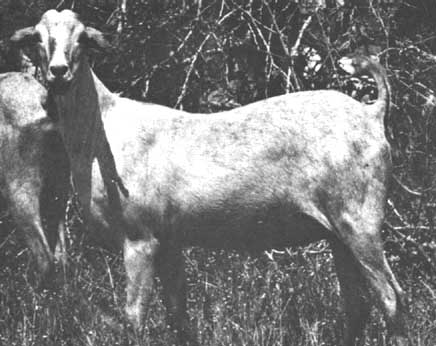
White Somali doe in coastal scrub near Kismayo