


L. ReynoldsHumid Zone Programme
International Livestock Centre for Africa
P.O. Box 5320
Ibadan
Nigeria
Summary
Resume
Introduction
Materials and methods
Results
Discussion
References
A trial involving 28 West African Dwarf (WAD) goats fed 4 levels of supplement of Leucaena leucocephala and Gliricidia sepium over a basal diet of Panicum maximum and dried cassava peels was conducted over 2 reproductive cycles. The provision of supplementary browse to pregnant and lactating goats and to their offspring from weaning to 24 wk improved growth and survival rates of the offspring. Productivity, calculated as weight of kid weaned/doe/yr increased by 0.64 kg for each 100 g of browse DM consumed by the does daily. Intake of DM increased as the level of supplementation rose, reaching 180 g/kg0 75/d for lactating adults. Growth rates of kids and productivity of dams was about half that recorded in earlier trials with WAD sheep which had a similar food intake.
Un essai a été conduit dans lequel 28 chèvres naines d'Afrique de l'Ouest ont été soumises pendant 2 cycles de reproduction à 4 niveaux de supplémentation à base de Leucaena leucocephala et de Gliricidia sepium. La ration de base était constituée par Panicum maximum et des épluchures de manioc séchées. La supplémentation sur des chèvres gestantes et allaitantes et sur leurs produits du sevrage à 24 semaines augmente la vitesse de croissance et le taux de survie des produits. La productivité, calculée en terme de poids de chevreau sevré par chèvre et par an, augmente de 0,64 kg pour chaque 100 g MS de légumineuses consommées quotidiennement par les femelles. L'ingestion de MS augmente jusqu'à ce que le niveau de supplémentation atteigne 180 g/kg 75/j pour les femelles adultes en lactation. La vitesse de croissance des chevreaux et la productivité des femelles furent environ la moitié de celles enregistrées au cours d'essais précédents chez le mouton Djallonké alors que l'ingestion par tête était similaire.
The use of multipurpose leguminous trees to maintain soil fertility, improve crop production and provide forage in a cut-and-carry system has been advocated for smallholder farmers in the humid zone of Africa (Kang et al, 1981; Atta-Krah et al, 1987). The acceptability of this concept has been demonstrated in on-farm trials in southwest Nigeria, where a typical farm household comprises 6-8 persons, cultivating 2 ha of land and owning 2-4 small ruminants (Reynolds and Atta-Krah, 1989).
Food intake and animal performance will increase if poor quality diets are supplemented to a protein level above 7% (Minson and Milford, 1967). Supplementation with tree legume foliage has been shown to improve goat growth rates at ages from 4 mo to 10 mo (van Eys et al, 1986) and to raise growth and survival rates of lambs up to 24 wk (Reynolds and Adediran, 1988).
The objective of the present study was to compare the productivity, over 2 reproductive cycles, of West African Dwarf (WAD) goats receiving different levels of mixed Leucaena leucocephala and Gliricidia sepium supplementation.
A total of 28 female WAD goats, aged 2-5 yr were housed with bucks for a 6 wk breeding period and 6 wk later were randomly allocated to one of 4 dietary treatment groups in individual pens. Goats remained on trial until their kids were weaned at 16 wk post-partum. Females were rebred after weaning for a further 6 wk and then randomly reallocated to one of the 4 dietary groups for the second reproductive cycle 6 wk later. At weaning, kids were kept in individual pens, on the same dietary treatments as their dams, until 24 wk postpartum. A basal diet of ad libitum chopped Panicum maximum plus 50 g of sun dried cassava peels was offered to the adults, with 4 levels of supplementation with a 1:1 (w/w) mixture of Leucaena leucocephala and Gliricidia sepium, ranging from 200 g DM/hd/d to 1200 g DM/hd/d. Levels offered to kids after weaning were scaled down to allow for the smaller body size (Table 1). Feed offered and refused was recorded daily, and samples collected for DM determination.
Water was available ad libitum and all animals had access to a mineral block. Systamex (Oxfendazole, Wellcome Foundation) treatment was given every 2 wk during the rainy season (May-Oct) and once every month during the dry period (Nov-Apr) against internal parasites. Animals were dipped with Gammatox (gamma benzene hexachloride, Cooper MacDougall and Robertson) against external parasites. Animals were weighed every 7 d and as soon after birth as practicable.
Table 1. Supplements of Leucaena and Gliricidia (g DM/d) offered to Nigerian WAD goats receiving chopped Panicum maximum.
|
Goat class |
Sun-dried cassava peel |
Treatment |
||||
|
1 |
2 |
3 |
4 |
|||
|
Adults |
50 |
200 |
400 |
800 |
1200 |
|
|
Kids |
|
|
|
|
|
|
|
|
16-20 wk |
16 |
62.5 |
125 |
250 |
375 |
|
|
20-24 wk |
20 |
75 |
150 |
300 |
450 |
The trial started in February 1986 and concluded in November 1987 after 2 reproductive cycles. In the first cycle parturitions occurred in July in the rainy season and kids reached the post-weaning stage by the dry season. In the second cycle kids were born in Apr-May, and both the pre- and post-weaning phases were completed during the wet season.
Mean DM levels in the wet season were 32.2% for grass, 34.5% for the edible portions of Leucaena and 32.8% for edible Gliricidia, compared to the dry season values of 35.0%, 35.8% and 34.8%.
Conception rates were 0.71 overall. Mean litter size was 1.32, being slightly higher in the second cycle (1.35) than in the first (1.30). No deaths occurred among the adults. Survival rate to weaning was 0.77, with no apparent effect of treatment (Table 2). Supplementation had an effect (P < 0.05) on kid survival to 24 wk. survival rising from 0.36 at the lowest level of feeding to 0.94 at the highest. This effect was more pronounced during the second cycle in the wet season when only 1 of 7 kids on the lowest supplement level survived to 24 wk.
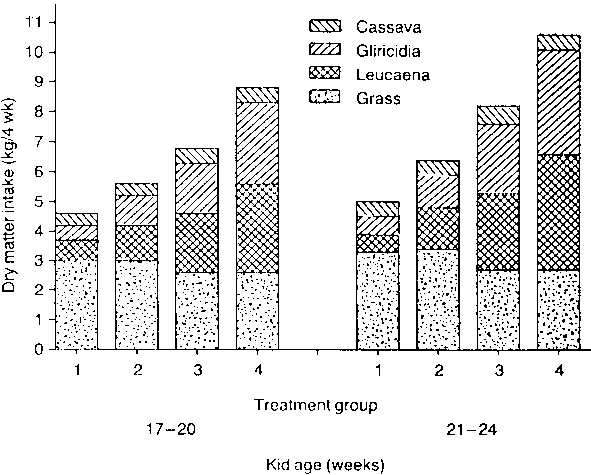
Dry matter intake by dams increased through Treatments 1 to 3 but was not further affected by the additional browse offered in Treatment 4 (Figure 1). Grass DM intake was reduced only at the highest level of supplementation, both before parturition (P < 0.05) and during lactation (P < 0.01). Adults in Treatment 4 were, therefore, selecting browse in preference to grass. Total intake during the first cycle decreased from 1.15 kg DM/hd/d during pregnancy to 0.96 kg DM/hd/d during lactation but was higher (about 1.42 kg DM/hd/d) throughout the second cycle. Total intake of kids post-weaning rose sharply (P < 0.001) with the level of supplementation (Figure 2).
Table 2. Effects of browse supplementation on survival rates of Nigerian WAD kids to weaning (16 wk) and 24 wk.
|
Treatment group |
Number born |
Litter size |
Survival rate |
|
|
Birth- weaning |
Birth-24 wk |
|||
|
1 |
11 |
1.22 |
0.72 |
0.36 |
|
2 |
13 |
1.30 |
0.46 |
0.46 |
|
3 |
11 |
1.37 |
0.91 |
0.82 |
|
4 |
18 |
1.38 |
0.94 |
0.94 |
Figure 1. Dry matter intake of West African Dwarf does in Nigeria on different levels of browse supplement.

Adult weight was 16.6 kg and 17.4 kg 1 wk post-partum in the first and second cycles. Birth weight of single kids in the first and second cycles was 0.92 kg and 1.02 kg and no effect of supplementation to does in late pregnancy was apparent. Supplementation to the dams significantly increased kid growth rate to weaning from 17.4 g/d at the lowest level to 31.5 g/d at the highest (Table 3). Direct supplementation to the kids significantly raised post-weaning growth rates, from -1.3 g/d at the lowest level to 21.0 g/d at the highest. Growth from birth to 24 wk was twice as fast (28.3 g/d) at the top level of supplementation than at the bottom one.
Figure 2. Dry matter intake of West African Dwarf kids in Nigeria on different levels of browse supplement.
The overall effects of supplementation are evident in the productivity index, calculated as weight of kid weaned/doe/yr, incorporating litter size, birth weight, growth and survival rates to weaning, and kidding interval. In the absence of any direct information of the effect of supplementation on kidding interval a single value of . Of 272 d, for WAD goats under village conditions (Adeoye, 1985) was used across treatments. The regression line (Figure 3) shows that supplementary browse given to dams in the final 2 mo of pregnancy and during 4 mo of lactation, increases the productivity index by 0.64 kg for each 100 g browse DM consumed daily (P < 0.05).
Table 3. Effects of browse supplementation on growth rates of Nigerian WAD kids to weaning (16 wk) and to 24 wk.
|
Treatment group |
Browse intake (g DM/d) |
Growth rate (g/d) |
|||
|
Dam1) |
Kids²) |
Birth-16 wk |
16-24 wk |
Birth-24 wk |
|
|
1 |
143 |
39 |
17.4a |
-1.3abc |
14.0a |
|
2 |
254 |
83 |
28.7b |
3.0b |
20.1a |
|
3 |
554 |
160 |
25.9b |
9.9c |
20.9a |
|
4 |
71 |
246 |
31.9c |
21.0d |
28.3b |
Note:1. 8 wk pre- to 16 wk postpartum.
2. Weaning (16 wk) to 24 wk. In the same column, values without a suffix letter in common differ (P < 0.05).
Earlier work on browse supplementation offered to WAD sheep in late pregnancy and during lactation, using Leucaena and Gliricidia, showed improvements in lamb survival rates and weaning weights (Reynolds and Adediran, 1988). Parturition intervals were reduced in continuous breeding systems when supplementary Leucaena and Gliricidia was available (ILCA, 1986). In other studies the inclusion of Leucaena and/or Gliricidia in a diet including Panicum and cassava for WAD goats (Ademosun et al, 1988) or one including Sesbania and Pennisetum purpureum for Indonesian goats (van Eys et al, 1986) was associated with a decrease in grass intake and, for the WAD goats, an increase in total DM intake.
In the present trial DM intake ranged from 180 g/kg0.75 /d in early lactation on the highest level of supplementation to 95 g/kg0.75/d in late lactation on the lowest level of supplement. This is considerably higher than the intake of around 70 g/kg0.75/d reported in a review of the effects of dietary combinations of Gliricidia, Leucaena and Panicum offered to growing WAD goats (Ademosun et al, 1988). An earlier study had indicated the potential capacity of the WAD goat on a diet of Pennisetum with a daily intake of 127 g/kg0.75 (Ademosun, 1970). Lactating sheep consume 20% to 70% more than comparable dry ewes (ARC, 1980). Ewes suckling twin lambs (152 g DM/kg0.75/d) ate more than those with single lambs (139 g DM/kg0.75/d) over a 10-12 wk lactation. An intake of 133-140 g/kg 0.75 /d has been reported for lactating British Alpine goats in the West Indies on forage plus concentrate diets (Devendra, 1971). Intake levels recorded in the present trial would appear to be similar to those recorded for lactating small ruminants elsewhere. It further appears that on forage diets the maximum daily intake in lactation is around 180 g/kg 0.75.
Intake boy Skids increased rapidly post-weaning from 68 g/kg0.75/d on the lowest and 97 g/kg0.75/d in the highest levels of supplementation in the first month, to 76 g/kg0.75/d and 106 g/kg0.75/d for the same rations in the second month.
Kid growth rates were poor, suggesting a poor feed to milk conversion efficiency by the dams or poor utilisation of milk and inefficient conversion of solid feed by the kids after weaning. On similar daily intake levels per capita, WAD sheep achieved a growth rate to weaning roughly twice as high as that recorded for goats in this trial (Reynolds and Adediran, 1988).
The major effect of supplementation was on kid survival to 24 wk. especially during the second reproductive cycle when kids were weaned in the middle of the rainy season and reached 24 wk before the rains had finished. On the lowest supplementation level survival rate was 0.12 compared to 0.90 at the highest level. A combination of higher kid weight at weaning and direct browse intake by the kids are the most probable factors involved in better survival.
The design of the present trial precluded a measure of the effects of supplements on parturition intervals. In other experiments weaning at 12 wk led to a parturition interval of 251 d compared to 272 d for 16 wk weaning (Chiboka et al, 1988). Supplementary concentrate feeding had less effect on parturition interval with 16 wk weaning than with 12 wk weaning. Other reported birth intervals for the WAD goat are 259 d in traditional free roaming systems (Mack, 1983) and 267 d for an intensive confined system (Bosman et al, 1988). The 272 d parturition interval used in this study to calculate the productivity index may be conservative and may, therefore, understate the overall benefit to be gained from supplementation. Further research is needed to clarify this point.
The productivity of WAD sheep, on similar diets to these goats, increased by 1.41 kg lamb weaned/ewe/yr for every 100 g browse DM consumed daily (Reynolds and Adediran, 1988). Sheep were therefore using the feed better than goats, possibly reflecting their greater potential for improved productivity.
Ademosun A A. 1970. Nutritive value of Nigerian forages. 1. Digestibility of Pennisetum purpureum by sheep and goats. Nigerian Agricultural Journal 1: 19-26.
Ademosun A A, Bosman H G and Jansen H J. 1988. Nutritional studies with West African Dwarf goats in the humid tropics. In: O B Smith and H G Bosman (eds.), Goat production in the humid tropics. Centre for Agricultural Publishing and Documentation, Wageningen, The Netherlands.
Adeoye S A O. 1985. Performance of West African Dwarf goats raised in southern Nigeria. Humid Zone Programme Document. International Livestock Centre for Africa, Ibadan, Nigeria.
ARC 1980. The nutrient requirements of ruminant livestock. Commonwealth Agricultural Bureaux, Farnham Royal, UK.
Atta-Krah A N. Sumberg J E and Reynolds L. 1987. Leguminous fodder trees in the farming system - an overview of research at the Humid Zone Programme of ILCA in southwestern Nigeria. In: I Haque, S Jutzi and P J H Neate (eds.), Potentials of forage legumes in farming systems of sub-Saharan Africa. International Livestock Centre for Africa, Addis Ababa, Ethiopia.
Bosman H G. Ademosun A A, Roessen P L and Huijsman A. 1988. Is there scope for intensive goat production in the humid tropics? In: O B Smith and H G Bosman (eds.), Goat production in the humid tropics. Centre for Agricultural Publishing and Documentation, Wageningen, The Netherlands.
Chiboka O. Somade B and Montsma G. 1988. Reproduction of West African Dwarf goats - a summary of research work at Ile-Ife, Nigeria. In: O B Smith and H G Bosman (eds.), Goat production in the humid tropics. Centre for Agricultural Publishing and Documentation, Wageningen, The Netherlands.
Devendra C. 1971. The nutrition of the goat. Proceedings of the IInd International Conference on Goats 171-180.
ILCA 1986. Annual Report 1985/1986. International Livestock Centre for Africa, Addis Ababa, Ethiopia.
Kang B T. Wilson G F and Lawson T L. 1981. Alley cropping - A stable alternative to shifting cultivation. International Institute of Tropical Agriculture, Ibadan, Nigeria.
Mack S D. 1983. Evaluation of the productivities of West African Dwarf sheep and goats in southwest Nigeria. Humid Zone Programme Document No. 7. International Livestock Centre for Africa, Ibadan, Nigeria.
Minson D J and Milford R. 1967. The voluntary intake and digestibility of diets containing different proportions of legumes and mature Pangola grass (Digitaria decumbens). Australian Journal of Experimental Agriculture and Animal Husbandry 7: 546-551.
Reynolds L and Adediran S O. 1988. The effects of browse supplementation on the productivity of West African Dwarf sheep over two reproductive cycles. In: O B Smith and H G Bosman (eds.), Goat production in the humid tropics. Centre for Agricultural Publishing and Documentation, Wageningen, The Netherlands.
Reynolds L and Atta-Krah A N. 1989. Alley farming with livestock. In: B T Kang and L Reynolds (eds.), Alley farming in the humid and subhumid tropics. International Development Research Council, Ottawa, Canada.
van Eys J E, Mathius I W. Pongsapan P and Johnson W L. 1986. Foliage of the tree legumes Gliricidia, Leucaena and Sesbania as supplement to Napier grass diets for growing goats. Journal of Agricultural Science, Cambridge 107: 227-233.

