A.H. El IdrissiDepartment of Microbiology
Hassan II Agricultural and Veterinary Institute
P.O. Box 6202
Rabat-Instituts
Morocco
Summary
Resume
Introduction
Materials and methods
Results
Discussion
References
A 4-layer sandwich ELISA was developed for the detection of Clostridium perfringens type D epsilon toxin. This method was sensitive to 6.25 ng/ml of purified toxin preparations. Similar sensitivity was obtained when ELISA was used to measure epsilon toxin in gut content preparations. The ELISA values correlated well with the mouse protection test when both assays were applied on intestinal content samples from animals suspected of pulpy kidney disease.
Une technique ELISA en 4 couches a été développée pour la détection de la toxine epsilon de Clostridium perfringens type D. Le test détecte un minimum de 6,25 ng/ml de toxine pure. La même sensibilité a été obtenue quand le test est utilisé sur des préparations de contenus intestinaux. Les résultats du test ELISA vent en concordance avec le test de protection sur souris quand les 2 tests vent compares sur des prélèvements issus d'animaux suspects de la maladie du rein pulpeux.
Clostridium perfringens type D is the major cause of a fatal enterotoxaemia also known as pulpy kidney disease. Epsilon is the principal toxin of this organism and is produced as an essentially inactive prototoxin which becomes activated by proteolytic enzymes in the gut. The diagnosis of enterotoxaemia is usually based on clinical signs and pathological findings but demonstration of toxins in the gut is the only confirmatory diagnosis. The most widely used method for toxin detection is the mouse protection test which is cumbersome, expensive and time consuming and, as the treatment of animals involved in the test is inhumane, alternative in vitro tests are required. A number of serological assays have been used, including radial immunodiffusion, reverse passive haemaglutination (Beh and Buttery, 1978) and counterimmuno-electrophoresis (Henderson, 1984). Methods used for measuring epsilon toxin include 2 ELISA tests, both using a double antibody sandwich technique (Weddell and Worthington, 1984; Naylor et al, 1987). This study describes a 4-layer sandwich ELISA for the detection of epsilon toxin.
Purification of epsilon toxin
Epsilon toxin was essentially produced as previously reported (Habeeb, 1969; Worthington et al, 1973). Toxic cultures of Clostridium perfringens type D were removed and centrifuged at 15 000 g for 20 min at 4°C and the supernatant was fractionned with ammonium sulphate (350 g/litre) at 4°C. The precipitate collected by centrifugation was dissolved in 0.01 M phosphate buffer (pH 7.0) and dialysed against distilled water. The supernatant concentrate constitutes the crude prototoxin.
Crude prototoxin (@ 1 g) was applied to a sephacel DEAE (Sigma Chemical Co) column equilibrated with 0.005 M phosphate buffer (pH 7.2). The elusion was made by the same buffer and the first peak was checked for toxin activity. Epsilon prototoxin purity was checked by SDS-PAGE and crossed immuno-electrophoresis (CIEP) (Laemmli, 1970; Axelsen et al, 1973). Toxoid was prepared by mixing purified epsilon prototoxin with an equal volume of 0.45% formaldehyde followed by incubation at 37°C for 48 hr. The toxoid solution was mixed with an equal volume of complete Freund adjuvant and 4 ml intramuscular injections were given to a sheep checked for anti-epsilon antibodies. The sheep was given a similar injection 3 wk later followed by 4 intravenous injections (1 ml of toxoid without adjuvant) at intervals of 1 wk. The sheep was bled 1 wk after the last injection. An injection of 4 ml of the same (toxoid ± adjuvant) mixture was given to 2 rabbits, each of which received 2 ml intramuscularly at different points. Similar injections were given 3 wk later and animals were bled 10 d after the last injection.
Sheep and rabbit sera were brought to 50% saturation with ammonium sulphate. The fractionned rabbit serum was applied to a column containing epsilon toxin coupled to CH-sepharose 4B (Sigma Chemical Co) and incubated for 16 hr at 20°C. Non-bound proteins were eluted with 0.05 M tris-HCl buffer (pH 8.0; 0.5 M NaCl). Antibodies bound to the gel were eluted with 0.2 M glycine-HCl buffer (pH 2.8; 4°C) and concentrated in a cellophane bag with Aquacide II (Calbiochem).
Sheep antiserum against epsilon antigen was diluted to 1/10 000 in carbonate buffer (pH 9.6) and 0.2 ml of diluted serum added to each well of microtitre plates (Voller et al, 1976). The plates were incubated overnight at 4°C and washed 5 times with PBS containing 0.05% of tween 20 (PBS-T). Test samples of toxin (0.2 ml) diluted in PBS-T were then added to the wells and the plates incubated for 2 hr at 37°C. After 5 washes with PBS-T, 0.2 ml of a 1/1000 dilution of affinity purified rabbit antiserum to epsilon toxin in PBS-T was added to each well. Following a 2 hr incubation at 37°C the plates were again washed and 0.2 ml of goat antirabbit IgG-peroxydase conjugate (Sigma Chemical Co) diluted to 1/1000 in PBS-T was added to each well. The plates were incubated for 1 hr at room temperature, washed and 0.2 ml of orthophenylendiamine/H2O2 was added to each well. The plates were incubated in the dark for 30 min at room temperature and the reaction stopped by the addition of 0.1 ml of 1 N HCl.
Absorbance was measured in a microplate reader (Titerteck Multiskan, Flow Laboratories) at 405 nm. Negative controls included coating the well with normal sheep serum in place of sheep antiserum, addition of PBS-T in place of epsilon toxin, and substitution of normal rabbit serum for rabbit antitoxin. Net A405 was determined by substracting the A405 of the blank from the A405 in wells with toxin-containing solutions.
To detect epsilon toxin in gut contents, 1 ml samples collected from slaughtered hearty animals were mixed with 1 ml of epsilon protoxin (@ 8 m g/ ml in PBS-T). After incubation for 30 min at room temperature, mixtures were centrifuged at 15 000 g for 30 min and the supernatant passed through 0.45 micron membranes. Filtrates were then diluted to 1/10 in PBS-T containing 50% (v/v) foetal bovine serum and doubling dilutions either in PBS-T or in 20% foetal bovine serum were examined for toxin presence by ELISA. As a preliminary evaluation, gut contents from animals which had died suddenly were tested by ELISA and mouse protection assay. Positive and negative controls were included in each test for the ELISA method. Proteins were determined by the Bio-Rad protein assay kit with bovine albumin as the standard.
Toxin samples or gut content filtrates were activated with trypsin (0.05%) and the mixtures kept at 37°C for 30 min and amounts of 0.5 ml were injected intravenously into mice. All samples causing death within 48 hr were tested for protection assay by commercial Clostridium perfringens type D antitoxin (Wellcome). A mixture of 0.5 ml of gut content filtrate and 0.3 ml of antiserum was incubated at room temperature for 30 min and 0.5 ml of the preparation was injected intravenously into each of 2 mice.
Epsilon toxin (prototoxin) purification
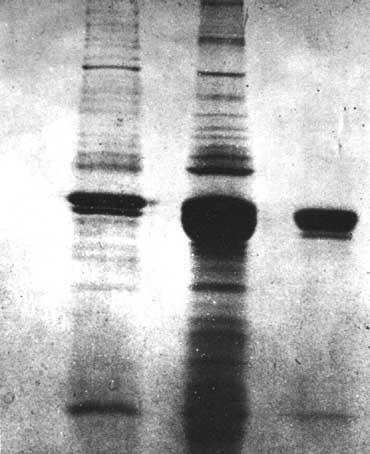
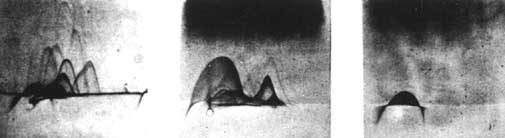
A 10-fold purification was obtained with a lethal activity recovery of 69% (Table 1). Prototoxin purity was tested by SDS-PAGE (Figure 1) and crossed IEP (Figure 2). With SDS-PAGE the purified preparation showed 2 closely spaced bands which, as demonstrated by crossed IEP, were immunologically identical. The purified protoxin showed one immunoprecipitin arc (Figure 2A) using commercial Clostridium perfringens type D diagnostic serum which gave several arcs with the culture supernatant (Figure 2B).
Anti-epsilon antibody preparation by affinity chromatography
Epsilon prototoxin antibodies were prepared from rabbit antisera against protoxin by affinity chromatography. The resulting antibody preparation was monospecific and gave a single immunoprecipitin arc against culture supernatant preparation in crossed IEP (Figure 3).
Table 1. Summary of purification of epsilon protoxin.
|
Step |
Total protein (mg) |
Total activity (mg) |
Specific activity (MLD/mg) |
Recovery (%) |
|
Culture supernatant |
5200 |
45 x 107 |
0,86 x 10⁵ |
100 |
|
Ammonium sulphate fraction |
1035 |
39 x107 |
3,8 x10⁵ |
87 |
|
DEAE sephacel column fraction |
390 |
31x107 |
7,9 x10 |
69 |
ELISA
The ELISA performed for toxin preparations in PBS-T detected levels as low as 6.25 ng/ml (Figure 4). When the purified toxin was mixed with gut contents and foetal bovine serum was used as the diluant, the ELISA method gave a dose response curve similar to that obtained with toxin preparations in PBS-T. When applied to field cases and compared to the mouse protection test the results indicated that all samples that were positive to the latter showed high ELISA readings, unlike the negative ones which showed relatively low readings (Figure 5).
The epsilon antigen produced was immunologically pure despite the electrophoretic heterogeneity revealed by SDS-PAGE, which seems to result from the continuous toxin degradation process during handling (Worthington et al, 1973).
Figure 4. Standard curve of purified epsilon prototoxin in the ELISA test (data reflect means of three absorbance values).

The ELISA technique was very sensitive, detecting as little as 6.25 ng/ml of epsilon toxin in purified and in intestinal content preparations, especially when foetal bovine serum was used as the diluant. As reported earlier (Weddell and Worthington, 1984; Naylor et al, 1987) the use of foetal bovine serum is necessary for detecting epsilon toxin in gut samples by ELISA because it neutralizes the proteolytic enzymes in the intestinal contents (Viscid) et al, 1984). The sensitivity of the technique appears similar to that from earlier experiments (Weddell and Worthington, 1984) in which a level of 7.8 ng/ml was detected by a direct sandwich ELISA. In our procedure commercial antirabbit IgG conjugate was used, which saves preparation of the conjugate. Affinity purified antibodies to epsilon antigen were necessary only for detecting antibody (second antibody) and their use as coating antibody did not improve the technique's sensitivity.
Figure 5. Comparison of ELISA and mouse protection tests on 31 gut content samples from suspected cases of enterotoxaemia.

The results shown in Figure 5 indicate that ELISA readings correlate well with the mouse protection test. The minimum absorbance (0.48) for a positive test by ELISA was about twice as high as the mean absorbance of all negative samples. This study confirms findings from earlier ones (Weddell and Worthington, 1984; Naylor et al, 1987) that ELISA is a reliable alternative test to mouse protection assay.
Axelsen N H. Kroll J and Weeke R. 1973. A manual of quantitative immunoelectrophoresis methods and applications. Universitets Forlaget, Oslo, Norway.
Beh K J and Buttery S H. 1978. Reverse phase passive haemaglutination and single radial immunodiffusion to detect epsilon antigen of Clostridium perfringens type D. Australian Veterinary Journal 54: 541-544.
Habeeb A F S A. 1969. Studies on E-prototoxin of Clostridium perfringens type D. I. Purification methods: Evidence for multiple forms of E-prototoxin. Archives of Biochemistry and Biophysics 130: 430-440.
Henderson T G. 1984. The detection of Clostridium perfringens type D enterotoxin in the intestinal contents of animals by counterimmuno-electrophoresis. New Zealand Journal of Science 27: 423-426.
Laemmli U K. 1970. Cleavage of structural proteins during the assembly of the head of bacteriophage T4. Nature (London) 227: 680685.
Naylor R D, Martin P K and Sharpe R T. 1987. Detection of Clostridium perfringens epsilon toxin by ELISA. Research in Veterinary Science 42: 255-685.
Viscidi R. Laughon B E, Hanvanich M, Bartlett J G and Yolken R H. 1984. Improved enzyme immunoassays for the detection of antigens in fecal specimens. Investigation and correction of interfering factors. Journal of Immunological Methods 67: 129-143.
Voller A, Bidwell D and Bartlett A. 1976. Microplate enzyme immunoassays for the immunodiagnosis of virus infection. In: N R Rose and H Friedman (eds.), Manual of clinical immunology. American Society for Microbiology, Washington DC, USA.
Weddell W and Worthington R W. 1984. An enzyme labelled immunosorbent assay for measuring Clostridium perfringens epsilon toxin gut contents. New Zealand Veterinary Journal 33: 36-37.
Worthington R W. Mulders M S G and van Rensburg J J. 1973. Clostridium perfringens type D epsilon prototoxin. Some chemical, immunological and biological properties of a highly purified prototoxin. Onderstepoort Journal of Veterinary Research 40: 145-152.