


Getachew TilahunInstitute of Pathobiology
University of Addis Ababa
P.O. Box 1176
Addis Ababa
Ethiopia
Summary
Resume
Introduction
Materials and methods
Results
Discussion
Acknowledgements
References
The pathogenicity of varying levels of single graded infections of Dictyocaulus filaria in Ethiopian highland and Hampshire cross lambs is described. Mortality, increased respiration rates, increased larval outputs, increased adult lungworms and loss of weight were observed in the infected groups. Symptoms were more severe in lambs receiving higher infective doses and Ethiopian highland sheep were more sensitive to infection than the Hampshire cross lambs. Uninfected control animals of both breeds performed well and gained weight.
La pathogénecité a différents niveaux d'infection de Dictyocaulus filaria sur des moutons Ethiopian highland et des croisés Hampshire est décrite. Dans les lots infectés la mortalité, une augmentation de la fréquence respiratoire, une augmentation de la production des larves et des adultes Dictyocaulus et une perte de poids ont été observes. Les symptômes de maladie étaient plus sérieux chez les agneaux ayant subi une dose infectante plus élevée et les moutons Ethiopian highland étaient plus sensibles a l'infection que les agneaux Hampshire croisés. Les animaux témoins des deux races non-infectés étaient plus performants et avaient un meilleur gain de poids.
The pathogenicity of Dictyocaulus filaria infection in sheep has received little attention. Some authors believe that it has a significant effect (Dunn, 1978; Stewart, 1983; Corba et al, 1985) while others associate it with mild eases of coughing and respiratory complications (Blood et al, 1979).
Attention has been drawn to the role which D. filaria might play in causing economic loss in sheep especially in the highland areas of Ethiopia. This is particularly important with the development of sheep farms in cooperatives and the preliminary work on irradiated D. filaria vaccine. Further investigation is required on the effects of the parasite on production. In this study the pathogenicity of verminous bronchitis in lambs caused by D. filaria is described.
This study used 16 Ethiopian highland and 16 Hampshire crossbred lambs of 4-5 mo reared under conditions of relatively minimal parasite exposure. The crossbreds had 75% Hampshire sire blood on Ethiopian highland dam. Lambs were first checked for D. filaria infection and were found to be free. Lambs were then randomized according to weight, age and sex and received broad spectrum anthelmintic 1 wk prior to initiation of the experiment. The animals were kept in groups indoors and fed hay with occasional wheat bran supplement. The lambs in each breed were divided into 4 groups, each of 4 animals. Group I animals were each given 5 x 10² D. filaria infective larvae, Group II animals received 2 x 10 , Group III received 5 x 10³ and Group IV was an uninfected control.
Infective D. filaria larvae were prepared in the laboratory using the method of Jovanovic (1977). Panacur (Hoechst) oral boli containing 250 mg fenbendazole per bolus were used and administered at 7.5 mg/kg body weight. Faecal samples, respiration rates and body temperature were taken 3 times a week and mean values for each week recorded. Faecal samples were taken direct from the rectum and D. filaria larval counts made according to Jovanovic (1977). Samples were also checked for eggs of gastrointestinal and liver parasites using standard procedures. Lambs were weighed every 7 d. Packed cell volume values were taken 3 times: prior to infection; during peak larval production; and at the end of the experiment.
All animals that survived infection were postmortemed 35-40 d after infection. Postmortem examination was also performed on all mortality cases using the method described by Dunn (1978). Attention was given to the respiratory tract with a careful examination for lungworms using Jovanovic's method (1977).
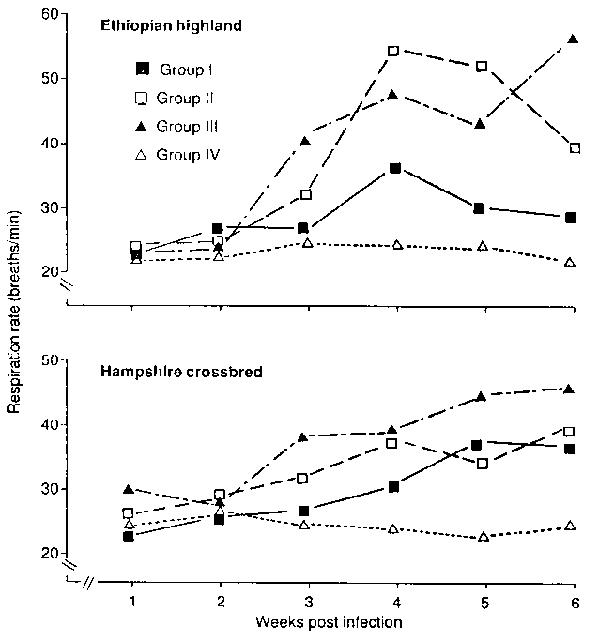
Infected lambs started shedding larvae at the end of week 4 and maximum number of larvae per gramme of faeces (lpg) was observed in week 6 (Figure 1). Local lambs shed more lpg than crossbred lambs. Increased respiration rates were seen in all infected groups, those receiving the highest infective dose having the highest rates (Figure 2). All infected groups lost weight or gained very little, while the uninfected controls performed well (Table 1). Response of lambs to D. filaria infection was generally related to the size of the infective dose. There was a slightly elevated body temperature in the infected groups with no significant differences between the groups. No differences in PCV were seen and values were within the normal range.
Mortality in Ethiopian sheep was higher than in the crossbreds. In Group I, 1 lamb died 4 wk post-infection and 14 adult D. filaria and 2 F. hepatica were recorded: the animal was coughing and was off feed for 6 d prior to death. In Group II, 2 animals died 4 wk after infection: in one 610 D. filaria, F. hepatica and Paramphistomum spp. were recovered: in the other 182 D. filaria worms were found. Two lambs died in Group III in which 1045 and 907 D. filaria parasites were recorded. In Group IV, 1 lamb died during week 3: no clinical signs nor gross lesions were observed.
Figure 1. Number of larvae per gramme of faeces in two types of sheep infected with graded doses of Dictyocaulus filaria larvae in Ethiopia.

Only 1 lamb from Group I of the crossbred animals died at the beginning of week 6 and 80 D. filaria worms were found.
A significantly greater number of D. filaria worms (P < 0. 01) was recovered from the lungs of the Ethiopian sheep than from the crossbreds at postmortem 40 d after infection (Table 2).
Figure 2. Respiration rates in two types of sheep infected with graded doses of Dictyocaulus filaria in Ethiopia.
This study shows that D. filaria worms start shedding larvae as early as 29 d post- infection. This is in agreement with earlier work by Corba et al (1983) and Jovanovic (1977). The highest number of D. filaria lpg of 656.3/lamb was in Group II. Based on earlier observations and the results from the current study, faecal larval outputs do not reflect the number of adult parasites (Jovanovic, 1977; Corba et al, 1983). In surviving lambs of all infected groups, there was a gradual increase in lpg.
Table 1. Mean weekly body weights and overall changes (kg) of Ethiopian highland and Hampshire cross lambs infected with single graded doses of Dictyocaulus filaria larvae.
|
Breed/ wk post-infection |
Group |
||||
|
I |
II |
III |
IV |
||
|
Ethiopian highland |
|
|
|
|
|
|
|
1 |
15.3 |
15.0 |
16.6 |
13.2 |
|
|
2 |
14.2 |
14.0 |
15.5 |
13.0 |
|
|
3 |
14.9 |
14.4 |
15.6 |
12.4 |
|
|
4 |
15.2 |
13.9 |
15.3 |
14.3 |
|
|
5 |
14.8 |
13.6 |
16.0 |
14.4 |
|
|
6 |
15.6 |
13.1 |
15.0 |
14.3 |
|
|
Weight change |
+0.3 |
-1.9 |
-1.6 |
+1.1 |
|
Hampshire |
|
|
|
|
|
|
|
1 |
23.8 |
28.8 |
26.9 |
24.1 |
|
|
2 |
22.1 |
27.3 |
25.1 |
24.8 |
|
|
3 |
22.2 |
27.1 |
25.3 |
25.0 |
|
|
4 |
22.1 |
27.3 |
26.0 |
25.0 |
|
|
5 |
22.6 |
27.0 |
24.1 |
26.6 |
|
|
6 |
23.8 |
25.6 |
24.1 |
26.6 |
|
|
Weight change |
0.0 |
-3.2 |
-2.2 |
+2.5 |
Table 2. Mean parasite recovery on postmortem from organs/tissues of Ethiopian highland and Hampshire cross lambs 40 days after single graded infection with Dictyocaulus filaria larvae.
|
Sheep breed/ treatment |
Organs/tissues |
|||
|
Lung (D. filaria) |
Liver (F. hepatica) |
Rumen (Paramphistomum spp.) |
||
|
Ethiopian highland |
|
|
|
|
|
|
I |
91.3 |
1.7 |
- |
|
|
II |
539.0 |
1.0 |
- |
|
|
III |
111.5 |
0.0 |
- |
|
|
IV |
0.0 |
3.3 |
- |
|
Hampshire crossbred |
|
|
|
|
|
|
I |
35.0 |
16.7 |
+ |
|
|
II |
50.8 |
3.5 |
+ |
|
|
III |
258.0 |
3.8 |
+ |
|
|
IV |
0.0 |
0.0 |
+ |
There was a rising dose-dependent response in the respiration rate. The highest respiration rate of 90/min was recorded in the local breed Group III lamb 1 d before it died. Uninfected control lambs had normal respiration rates. Depending on the infective dose, lambs either lost weight or showed poor gains. In animals that recovered from infection, body weight gains were inadequate, which probably indicates extensive lung damage affecting the overall performance.
Although body temperatures were high at some sampling dates, values were generally within the normal range and there were no major differences in the different infected groups. This is probably due to few complications with microbial organisms. No differences in PCV values were seen between the groups and values were within the normal range. The few individual eases of fascioliasis in some animals were not severe enough to bring about changes in these values.
The highest number of adult D. filaria worms recovered on postmortem was 1890 in a local breed lamb in Group III. Faecal larval output of this lamb 1 d before postmortem showed an lpg of 48.6. The lowest number of adult lungworms (38/lamb) was in a Hampshire lamb of Group III and the lpg taken 1 d prior to postmortem was 2.2. This indicated that there was no direct relationship between lpg and the number of adult worms in the lungs.
Although under field conditions sheep may not ingest such large doses on a single occasion, the results show that D. filaria has pathogenic effects at high infections. There was a general worsening of condition in the local breed, mortality occurring in all infected groups, whereas improvement in the intensity of infection and recovery of the animals was seen in the Hampshire cross lambs. Under experimental conditions the percentage "take" of ingested larvae is relatively slow, declining as the infective dose is increased but our findings confirm that the Hampshire cross lambs can withstand heavy experimental infections.
Significant differences in resistance, larval output, adult lungworms, weight gain, weight losses, respiration rates and mortality suggest breed differences. These findings thus indicate that there was a significant -impact on production of the local breed either direct from mortality or indirect from body weight loss. Hampshire cross lambs had a higher body weight at the beginning of the experiment which may (as the infective dose was not given per kg body weight) have influenced the outcome.
There are variations between breeds in susceptibility to helminth infections (Stewart, 1953; Scrivner, 1967; Allonby and Urquhart, 1973). In the Ethiopian highlands where D. filaria and other helminth parasites have a high prevalence, the selection of breeds with superior performance in the presence of infection is essential. If the resistance of Hampshire cross lambs shown by the current study is true for other helminth and microbial infections, it is suggested that an efficient approach would be to keep such resistant and better performing breeds in the presence of infection. Further studies on the exotic blood levels of this and other breeds that would best suit the environment should be made under field conditions.
I am grateful to J Duncan and P H Holmes for valuable advice. The technical assistance of Melaku Negash, Nega Negussie, Demeku Nega and Tsigie Mengistu is appreciated. This study was supported by IAEA Contract No. 3195, IFS Contract No. B-775-1, Addis Ababa University, and the Animal Breeding Section of the Ethiopian Ministry of Agriculture.
Allonby E W and Urquhart G M. 1973. Self-cure of Haemonchus contortus infections under field conditions. Parasitology 66: 43-53.
Blood D C, Henderson J A and Radostits O M. 1979. Veterinary medicine (5th edition). Bailliere Tindall, London, UK.
Corba J. Getachew T. Mulugetta A, Gorfe M and Lalic S. 1983. Studies on the ovine lungworm Dictyocaulus filaria vaccine. Helminthology 20: 287-294.
Dunn M A. 1978. Veterinary helminthology (2nd edition). William Heinemann Medical Books, London, UK.
Jovanovic M. 1977. Studies on D. filaria in Ethiopian Highland sheep. Ministry of Agriculture, Addis Ababa, Ethiopia (mimeo).
Scrivner L H. 1967. Genetic resistance to ostertagiasis and haemonchosis in lambs. Journal of the American Veterinary Medical Association 151: 1443-1446.
Stewart D F. 1983. Studies on resistance of sheep to infestation with Haemonchus contortus and Trichostrongylus spp. and on the immunological reactions of sheep exposed to infestation. V. The nature of the self-cure phenomenon. Australian Journal of Agricultural Research 4: 100-117.
