Kassahun Awgichew, Yibrah Yacob and I. FletcherInstitute of Agricultural Research
P.O. Box 2003
Addis Ababa
Ethiopia
Summary
Resume
Introduction
Materials and methods
Results
Discussion
References
The productivity of Ethiopian Adal and quarterbred Saanen x Adal goats was compared over 5 yr. Annual percentages of does kidding and of multiple births were 79 and 39. Kids born and kids weaned per doe joined were 1.12 and 0.95. Birth weights were 2.2 kg. Mortality rates from birth to weaning (3 mo), between 3 mo and 6 mo and between 6 mo and 12 mo were 14%, 6% and 4%. No differences (P > 0.05) between the genotypes were noted in any of the foregoing parameters. Quarterbred Saanen x Adal does produced more (P < 0.001) milk (31 kg) during a 12 wk lactation than Adal does (24 kg). Progeny of the quarterbreds were heavier (P < 0.01) at 3 mo (9.7 kg) and at 6 mo (13.6 kg) than those of the Adal at the same ages (8.9 kg and 12.8 kg). Mature weight did not differ between the 2 genotypes (P > 0.05). Crossing Adal goats with Saanens to the quarterbred level could increase milk production in the existing pastoral system without reducing other aspects of productivity and with no requirement for improved management or increased feed resources.
La productivité des Adal éthiopiennes et des quarteronnes Saanen x Adal a été comparée pendant 5 ans. Le pourcentage annuel de mises bas était de 79 p.cent et les naissances multiples de 39 p.cent. Les chevreaux nés et les chevreaux sevrés par chèvre étaient de 1,12 et 0,95. Le poids à la naissance était de 2,2 kg. Le taux de mortalité de la naissance au sevrage (3 mois), de 3-6 mois et de 612 mois était de 14 p.cent, 6 p.cent et 4 p.cent. Aucune différence (P > 0,05) entre les 2 génotypes n'a été observée pour ces paramètres. La quarteronne Saanen x Adal produit plus de lait (31 kg; P < 0,001) pendant 12 semaines de lactation que l'Adal (24 kg). Les produits des quarteronnes étaient plus lourds (P < 0,01) à 3 mois (9,7 kg) et à 6 mois (13,6 kg) que ceux des Adal aux mêmes ages (8,9 kg et 12,6 kg). Les poids adultes ne sont pas différents entre les 2 génotypes (P > 0,05). Le croisé de chèvres Adal avec des Saanen avec un niveau de 25 p.cent de Saanen et 75 p.cent d'Adal permet d'augmenter la production de lait dans le système pastoral existant sans réduire les autres aspects de la productivité et ne demande ni d'amélioration sensible de la conduite d'élevage ni des ressources fourragères.
Goat milk is an important dietary component of pastoralists in the Ethiopian lowlands where an estimated 75% of the country's 18 million goats is maintained (MOA, 1984). The productivity of Ethiopian goats is not well documented but there is limited evidence that individual does may produce more than 1 kg milk/d with an average daily production in the range of 0.2-0.4 kg (Galal and Getachew, 1977).
The potential to increase milk production through improved management inputs or increased feed resources is severely restricted. Development of genotypes capable of producing more milk within existing environmental constraints therefore appears to offer a promising means of increasing production in the pastoral regions. Although milk production is moderately heritable, it would take time to achieve substantial increases by selection within existing genotypes because the initial level of production is so low. More rapid increases might be expected from crossbreeding with exotic genotypes. A substantial increase in milk production has been demonstrated at the 50% level of crossbreeding between Saanen and Ethiopian highland goats (Galal et al, 1982) but in harsher areas there have been adaptation problems for first cross Saanen x lowland goats, indicating that a lower level of exotic genotype might be more suitable.
This paper reports a comparison of the productivity of purebred Adal and quarterbred Saanen x Adal goats in an Ethiopian lowland environment.
The Melka Werer Research Centre of the Ethiopian Institute of Agricultural Research is in the Rift Valley, about 180 km ENE of Addis Ababa at an altitude of 750 m. The Centre is partially irrigated from the Awash river but the surrounding country is semi-arid pastoral land (average annual rainfall 540 mm; monthly maximum temperature range of 31°C in December to 38°C in June).
An Adal goat flock was established in 1976. New bucks were introduced in the second year to broaden the genetic base. The flock has since been closed to outside introduction and replacement bucks and does have been selected on the basis of their dams' milk production. Four Israeli Saanen bucks were mated to part of the initial flock and 4 first cross bucks from this mating were then mated to Adal does to produce 1/4 Saanen x 3/4 Adal progeny. The quarterbred flock was then closed and replacement bucks and does have since also been selected on the basis of their dams' milk production. Data presented here for purebred and quarterbred goats are from a 5 yr period beginning in 1982, when sufficient numbers of crossbred does were first available for meaningful comparisons to be made.
All animals were treated regularly against internal and external parasites. Pure and cross-breds were run together within separate age and sex categories of adult males, adult females, weaner males and weaner females. Animals were penned at night and allowed to graze during the day on natural vegetation around roadways and irrigation channels, with occasional access to degraded irrigated Chloris gayana pasture. Breeding does remained penned in single sire groups for a 5 wk mating period in June and July each year, when they were fed freshly cut grass or hay, with a concentrate supplement of 200 g/hd/d to 300 g/hd/d. Does remained penned with their kids for 2 wk after kidding, during which time they were fed freshly cut grass or hay with a supplement of 150 g/hd/d.
New born kids were identified to their dams, tagged and weighed. Progeny weights were recorded at 15 d intervals until weaning at 3 mo, and monthly thereafter. Dam milk production was measured once each week to 12 wk postpartum. Dams were separated from their progeny in the late afternoon when they came in from grazing. Early next morning one half of the udder was milked out by hand and kids then allowed to suck to satiety before again being separated. In the afternoon, 24 hr after the initial separation on the previous day, half of the udder was again milked out. Total milk recorded at the morning and afternoon milkings was doubled to give an estimate of daily milk production.
Dam reproductive parameters and milk production and progeny growth and mortality were analysed using a microcomputer least-squares programme (Harvey, 1986). Data from 20 out-of-season and unplanned kiddings (in a total of 352 kiddings over 5 yr) were included in analyses of reproductive traits, since reproductive performance would otherwise have been understated. Milk production from out-of-season kiddings was not recorded, and progeny born out-of-season were excluded from growth and mortality analyses because of unknown genotype.
There were no differences (P > 0.05) between purebred and crossbred does in any of the reproductive traits recorded (Table 1). Number of kids born and weaned increased (P < 0.001) with increasing dam age up to 6 yr as a consequence of increasing multiple births (P < 0.001) and an increase in conception rate (P < 0.05) which was most pronounced between the first kidding at 2 yr and subsequent kiddings. There were no differences among years except in the incidence of abortion (P < 0.05) which was higher in 1982 than in subsequent years. The only significant interaction was a breed x year effect on conception rate (P < 0.05). Purebred and crossbred does that conceived were 93% and 91% in 1982, 84% and 85% in 1983, 96% and 82% in 1984, 66% and 99% in 1985, and 77% and 83% in 1986. There is no obvious reason why conception rates were seemingly higher in purebred than in crossbred does in 1984 and lower in 1985.
Crossbred does produced more milk (P < 0.001) than purebred does and production increased (P < 0.01) with age up to the third lactation at 4 yr (Table 2). An apparent further increase between 6 yr and 7 yr is considered more likely to be a consequence of prior culling of lower producing does than to an age effect per se. There were differences (P < 0.05) in production among years. There were no significant breed x age or breed x year interactions.
Postpartum weight increased (P < 0.001) with age (Table 2) but the increase beyond 5 yr is considered more likely to be a consequence of prior culling of poorer animals than an effect of age. There was a small but significant (P < 0.01) variation in postpartum body weight among years. There were no differences (P > 0.05) in weight between purebred and crossbred does and no significant breed x age or breed x year interactions.
Table 1. Least-squares means for reproductive traits of Adal and quarterbred Saanen x Adal goats in Ethiopia.
|
Variable |
n |
Major reproductive traits (%) |
Kids born/ doe mated (n) |
Kids weaned/ doe mated (n) |
||||
|
Conceived |
Aborted |
Kidded |
Multiple births1) |
|||||
|
Overall least-squares mean |
353 |
84 |
7 |
79 |
39 |
1.12 |
0.95 |
|
|
Breed:
|
Adal |
232 |
83 |
6 |
78 |
35 |
1:07 |
0.95 |
|
Saanen x Adal |
20 |
88 |
8 |
80 |
42 |
1.16 |
0,95 |
|
|
Age (years):
|
2 |
96 |
78 |
7 |
65 |
8 |
0.70 |
0.60 |
|
3 |
91 |
88 |
8 |
80 |
20 |
0.95 |
0.85 |
|
|
4 |
73 |
84 |
8 |
75 |
41 |
1.07 |
0.92 |
|
|
5 |
41 |
82 |
4 |
78 |
43 |
1.17 |
0.84 |
|
|
6 |
29 |
88 |
3 |
84 |
69 |
1.45 |
1.38 |
|
|
7 |
22 |
100 |
10 |
90 |
51 |
1.35 |
1.10 |
|
|
Year:
|
1982 |
41 |
92 |
17 |
75 |
33 |
1.02 |
0.89 |
|
1983 |
53 |
85 |
8 |
77 |
47 |
1.17 |
0.98 |
|
|
1984 |
76 |
89 |
2 |
87 |
34 |
1.15 |
0.99 |
|
|
1985 |
84 |
83 |
4 |
79 |
36 |
1.10 |
0.96 |
|
|
1986 |
98 |
80 |
3 |
77 |
44 |
1.14 |
0.92 |
|
Note: 1. All were twin births except 3 purebred and 1 crossbred sets of triplets born co 4 yr 5 yr and 6 yr dams.Within variable groups, and in the same column, values without a suffix letter in common differ (P < 0.05).
Table 2. Least-squares mean of total milk production and postpartum weight of Adal and quarterbred Saanen x Adal goats in Ethiopia.
|
Variable |
|
n |
Total milk production (kg) |
Postpartum weight (kg) |
|
Overall least-squares mean |
200 |
27.5 |
33.0 |
|
|
Breed: |
Adal |
122 |
24.0 |
33.0 |
|
Saanen x Adal |
78 |
31.1 |
32.9 |
|
|
Age (years):
|
2 |
41 |
22.1 |
27.0 |
|
3 |
55 |
25.7 |
30.8 |
|
|
4 |
42 |
28.1 |
33.2 |
|
|
5 |
32 |
27.8 |
33.5 |
|
|
6 |
19 |
28.4 |
35.0 |
|
|
7 |
11 |
33.1 |
38.2 |
|
|
Year:
|
1982 |
21 |
24.1 |
34.6 |
|
1983 |
30 |
27.5 |
34.0 |
|
|
1984 |
56 |
25.9 |
32.2 |
|
|
1985 |
37 |
28.9 |
32.6 |
|
|
1986 |
56 |
31.2 |
31.3 |
|
Within variable groups, and in the same column, values without a suffix letter in common differ (P < 0.05).
Breed had no effect on birth weight but crossbred progeny were heavier (P < 0.01) than purebreds at 3 mo and 6 mo (Table 3). At 12 mo there were no differences (P > 0.05) in weight between breeds. Male kids were heavier (P < 0.001) than females and single born were heavier (P < 0.001) than multiple born kids at all stages. Birth weight did not vary (P > 0.05) among years but there were year differences (P < 0.001) in weight at all other ages. There were no significant interactions (P > 0.05) between any main effects.
Table 3. Least-squares mean weights (kg) of Adal and quarterbred Saanen x Adal goats in Ethiopia.
There were no differences (P > 0.05) in mortality between purebred and crossbred kids and none between males and females (Table 4). Preweaning mortality was higher (P < 0.05) in multiple born than in single born kids and there was also a significant (P < 0.05) breed x birth type interaction. Preweaning mortality in single and multiple born kids was 10% and 11% in purebred kids, and 8% and 25% in crossbred ones. Birth type did not affect mortality after weaning. There were differences in mortality due to year at all stages between birth (P < 0.001) and 12 mo (P < 0.05).
Better reproductive performance and milk production with increasing dam age and differences in body weight between male and females and between single and multiple born progeny are well-known aspects of small ruminant production. The variations due to year recorded for most productivity measurements are not discussed, except to point out that 1984 (during which most production parameters were below average) was a year of widespread drought in Ethiopia. The fact that there were no significant breed x year interactions in any production parameters indicates that the superior productivity of crossbred does was maintained in the "poorer" as well as the "better" environmental years of the comparison.
Table 4. Least-squares mean mortality rates (%) of Adal and quarterbred Saanen x Adal goats in Ethiopia.
|
Variable |
|
n |
Mortality (%) |
|||
|
Birth-12 mo |
Birth-3 mo |
3-6 mo |
6-12 mo |
|||
|
Overall least-squares mean |
308 |
24 |
14 |
6 |
4 |
|
|
Breed:
|
Adal |
192 |
26 |
10 |
9 |
7 |
|
Saanen x Adal |
116 |
22 |
17 |
3 |
2 |
|
|
Sex:
|
male |
172 |
24 |
14 |
6 |
4 |
|
female |
136 |
25 |
14 |
6 |
5 |
|
|
Birth type: |
single |
161 |
18a |
9a |
5 |
4 |
|
multiple |
147 |
29b |
18b |
7 |
4 |
|
|
Year:
|
1982 |
31 |
13a |
7a |
6ab |
0a |
|
1983 |
49 |
20ab |
17b |
1a |
2a |
|
|
1984 |
70 |
46c |
19b |
14b |
13b |
|
|
1985 |
73 |
11a |
6a |
la |
4a |
|
|
1986 |
85 |
30b |
20b |
7ab |
3a |
|
Within variable groups, and in the same column, values without a suffix letter in common differ (P < 0.05).
The milk yields and progeny weights of Adal goats recorded here are similar to those reported in the initial stages of the breed characterisation programme at Melka Werer (Galal and Beniam, 1982). Reproduction parameters are not strictly comparable because of a change from an 8 mo to a 12 mo mating system. The percentage of multiple births in the present study was considerably higher than an estimated 10% in pastoralists' herds (Wilson, 1975) in northern Ethiopia, possibly due to the concentrate feeding practiced during the mating periods of the present investigation and possibly also in part to the severe drought of 1974.
Quarterbred Saanen x Adal does did not differ from purebred Adal does in mature body weight and their performance was similar in all respects except for higher milk production and consequently higher preweaning progeny growth. The milk yields of 24 kg for purebred does and 31 kg for quarterbred does are comparable to the yields of 19 kg and SO kg for highland and halfbred Saanen x highland does previously reported (Galal et al, 1982) if it is assumed that the superior productivity of the halfbred would be reduced by about half in the quarterbred and that there would also be some loss of heterosis in the backcross.
Milk yields recorded for both genotypes in this comparison were probably far less than the genetic potential. It has been suggested that a nutrient intake near to 2.5 times maintenance is required for maximum milk yield, and potential yield is likely to be reduced by 50% or more in tropical environments where the vegetation rarely allows a nutrient intake above 1.5 times maintenance (Sands and McDowell, 1978). A higher level of crossbreeding than the quarterbred used in this study would, nonetheless, be recommended for any milk goat improvement programme which could incorporate greater management inputs and improved feed resources. For the nomadic pastoralists around Melka Werer the quarterbred Saanen x Adal doe has much to offer, since milk production was increased by some 30% without loss of reproductive capacity, increased mortality, or increased mature body size which would necessitate an increase in feed resources for herd maintenance.
Galal E S E and Getachew Feleke. 1977. Milk production of some Ethiopian breeds of sheep and goats. Animal Production Bulletin No. 4. Institute of Agricultural Research, Addis Ababa, Ethiopia.
Galal E S E and Beniam Akalu. 1982. Characterization of some Ethiopian breeds of sheep and goats. 3. Adal goats. International Goat and Sheep Research accepted for publication.
Galal E S E, Kassahun Awgichew and Beyene Kebede. 1982. Goat production as affected by crossbreeding. 2. Milk production and doe traits. International Goat and Sheep Research accepted for publication.
Harvey W R. 1986. Mixed model least-squares and maximum likelihood computer programme (PC version). Department of Agriculture, Washington DC, USA.
MOA 1984. Livestock sub-sector review. Ministry of Agriculture, Addis Ababa, Ethiopia.
Sands M and McDowell R E. 1978. The potential of the goat for milk production in the tropics. Cornell International Agriculture Mimeograph No. 60. Cornell University, Ithaca, USA.
Wilson R T. 1975. Comparative data on two populations of sheep and goats in Sudan and Ethiopia. Sudan Journal of Veterinary Science and Animal Husbandry 16: 1-11.
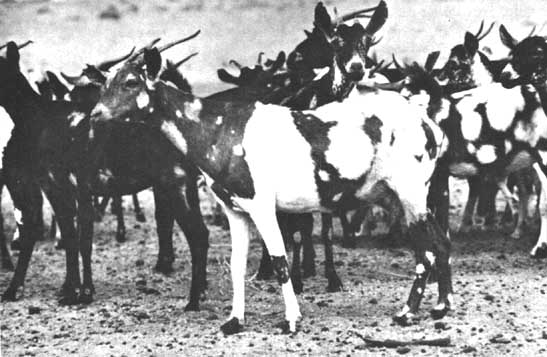
Adal goats in the Awash valley in Ethiopia