by
Terry Thomas
Head, Development Technology Unit, Engineering Department, Warwick University, Coventry, UK
Abstract
Trained animals are worthy of consideration as sources of power for stationary as well as mobile work applications. Actual energy costs are comparable to those of diesel oil, whilst reliability of animal power is greater than that of other sources. Animals are readily available and animal power convertors can be manufactured locally. A common requirement in the animal powered process is a gear to change motion type, orientation and speed. Animals can easily power low-speed machines, but their use with high-speed machines calls for more complex technology. Rope engines are a type of animal gear that have the advantage of local manufacturing at low cost, and are semi-transportable. Their technical difficulties are mostly limited to the rope tensioning mechanism. The essential components such as rope, arm on central pivot, pegs and pulleys, are easily available. A test was carried out in Zambia, with a new rope engine. A collaborative programme, involving inputs from various countries, is exploring designs, applications and the economics of such machines.
Economics of work energy sources
In any society most energy is "consumed" (that is, degraded) in the form of heat. Some however has to be in the form of work, a superior grade of energy that is relatively difficult and costly to produce. Typically one joule of work costs four times as much as one joule of heat to produce or to buy. In rural areas the ratio of costs may be much higher than 4:1 because the technology for producing work from locally available energy sources, such as solar radiation or solid biomass, is complex, or no longer available.
Fig. 1: General model of energy conversion for work.
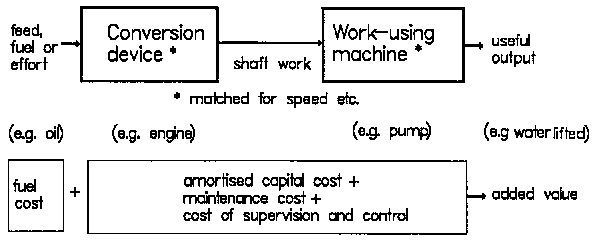
The main means of producing work energy are humans and animals, engines using oil or gas, power stations producing electricity from coal or oil, turbines capturing the energy in wind or falling water and photo-voltaic cells. A general model of this is shown in Fig. 1. In rural areas, mains electricity, gas and falling water are rarely available, and there are difficulties with several of the other alternatives. Where trained animals are available they are worth consideration as a source of work.
Mobile applications of work, such as cultivation and transport, are dominant in rural areas and for these animals have advantages over most of the alternative power sources listed above. For stationary applications these advantages are less marked.
For the purpose of measuring human energy input, people are part of "conversion devices" and food is "fuel". However, this is too callous, and it is more satisfactory to consider human output as "effort input" to some conversion device such as a sewing-machine treadle.
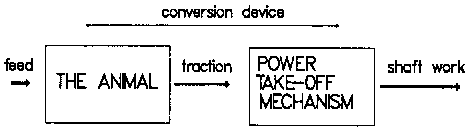
In the case of animal power, if we start with feed, it is helpful to divide the conversion device into two parts, as shown in Fig. 2.
Fuel costs
Some forms of energy input such as wind and solar radiation are free: in renewable energy systems the "fuel" itself has no cost. The next cheapest source of energy for a village is usually biomass which unfortunately cannot readily be converted into work despite efforts to revive the steam engine and the Stirling engine. Also relatively cheap, if it were available in rural areas, is mains electricity. Next in cost comes diesel fuel, typically US$ 0.04 to 0.10 per megajoule (MJ) of work extractable (1 MJ = 0.27 kilowatt-hours). Most expensive is human effort, costing about US$ 0.70 per MJ where wages are US$ 5 per 8-hour day. Work energy from animals has costs generally closer to diesel oil than to human effort, although in big cities like Calcutta one sees far more use of humans than use of animals for pure work production.
Other attributes of fuels
Price is not the only important attribute of a fuel: reliability and availability in space and time also matter. Most renewable energy sources are variable and also unpredictable: days can be cloudy, nights are dark, streams dry up and winds drop. The availability of oil fuels is erratic in many rural areas or alternatively the price fluctuates widely. Where mains electricity is connected, its reliability can be low. Animal feed varies markedly in price and even human labour is not constant in availability or cost from one season to another. Animal power could, in many cases, be reliably available, day and night, as long as reasonable limits on the number of consecutive animal work hours are not exceeded.
Capital costs of energy and machines
Wind-turbines and solar-cells are costly devices, so much so that even using free fuel they generate expensive work. Other converters are generally cheaper. Almost all display economies of scale: a ten-kilowatt motor or engine is cheaper than ten one-kilowatt engines. At low mean power levels, the capital cost of the engine may exceed the cost of the fuel it uses in its lifetime. For this and other reasons very small conversion devices are often not available in the market. It is also commonly found that for a given power throughput, fast engines and fast work-using devices are smaller and cheaper than slow ones. Thus a 1 kW motor or drill running at 2000 rpm is much cheaper than one running at 100 rpm.
Fig. 2: Schematic model of two-part conversion for obtaining work from animals.
The cheapest equipment is that worked by human effort. It is necessarily low power since humans can only sustain about 40 watts output over a working day. Sometimes it is also cheapest per unit of output. Electric motors are cheap, but usually irrelevant. Internal combustion engines are complex devices, mass-produced and of medium cost. Power take-off mechanisms for animals have historically been expensive per unit of output, as much as US$ 10,000 per kilowatt in contemporary currency. However, current design efforts may be able to reduce this to below US$ 500 per kW.
Certain classes of energy converter are manufactured in very few developing countries and so are only purchasable in hard currency. In Africa especially, any engine that can be locally made may have significant advantages of both cost and availability over one that must be imported. Generally, human and animal power converters are locally manufacturable, whereas solar cells and diesel engines are not. Turbines and electric motors are intermediate in difficulty of local production.
Supervision costs
For many processes, a person must be present continuously for reasons of control. If power levels are very low, such as in sewing or sorting seeds, transplanting rice or laying bricks, it may be uneconomic to use any power source other than the person controlling the process. However, once mechanization is present, there are potential economies of scale in supervision. It takes no more people to supervise a large hammer mill than to supervise a small one. With animal power, one person can usually supervise two animals and perhaps as many as six, if they are suitably harnessed together. How free such a "driver" is to per form other control functions (like holding hot metal to a hammer or directing irrigation water) is open to debate.
Maintenance costs
Breakdowns require expenditure on parts, maintenance and transport. They also incur lost production which can be costly. It is very desirable that maintenance and repair of rural equipment be locally performed. This is likely to be possible for human-powered machines and fairly likely for animal-powered ones. By contrast the repair of electric motors, diesel engines, photocells and turbines, and the high-speed equipment they drive, usually requires special parts and specialist skills. Even their routine maintenance is beyond the skills of most users. This is often reflected in high maintenance costs, repair delays and premature deterioration of equipment.
Animal-powered processes
General considerations
The output of the animal(s) has to be matched to the input of a driven process in several respects. The animal power take-off (or animal gear) has to perform this matching. The most obvious mismatch is that animals walk slowly in an approximately straight line, whereas the driven process is stationary and requires a rotating input often about a horizontal axis. The animal can be localized by being made to walk in a circle (usually over six meters in diameter) or back and forth, or the process itself can be made mobile. Change of motion type, of its orientation and its speed is still usually required
There must be sensible power matching, so that the intersection of the power-speed characteristics of animal and process results in both working close to their maximum sustainable power levels. This may be difficult if the process equipment was designed for a power source very different in size: machines meant to be coupled to diesel engines are often de signed for higher power levels than those easily supplied by animals.
Finally these should be matching in cost, reliability and control. Starting and stopping should be safe and feasible. As it may take several seconds to reach and halt an animal, such a delayed response must be accommodated. The speed of animals cannot be closely governed, nor is their pull constant. It is undesirable to impose rapidly fluctuating forces or sudden loss of load on the animals.
Low-speed machines
Animals have been used over many centuries to drive low-speed high-torque machines. These machines, once common in Europe and still to be found in Asia, are almost unknown in Africa. They are often bulky in proportion to their output, use a lot of material in their construction, and exhibit high energy losses. Most accept a drive that rotates at two to four revolutions per minute (rpm) about a vertical axis for such purposes as:
|
fruit-crushing |
a stone wheel in a circular trough |
|
clay pugging |
a drum containing metal paddles |
|
oil-expulsion |
a rotating pestle in a mortar |
|
cane-crushing |
one of a pair of vertical rollers is driven. |
In the case of water-lifting the output may be turned through 90 degrees as in the Persian wheel, or it may be slowly reciprocating.
Other low-speed machines such as treadmills and direct-drive grain mills were used historically. However they were so expensive that they have been totally eclipsed by the arrival of steam and oil engines.
High-speed machines
Much rural equipment needing a work energy input has been designed for a drive rotating drive at 100 rpm or more. As for a given power, torque falls as speed rises, these are compact low-torque devices. The drive shaft is usually horizontal and above ground level. Examples are:
· pumping by centrifugal or axial pump (100-1500 rpm);
· electricity generation (1000-3000 rpm);
· metal and wood machining (100-500 rpm);
· sawing (500-1500 rpm);
· grain milling by stone or hammers (200-1500 rpm);
· spinning (500-1500 rpm).
To obtain 100 rpm from an animal walking at 0.6 m s-1 round a circle of 6 m diameter requires gearing up the speed by 52:1. Such high gearing requires several stages, the first of which must handle the high torque of one or two animals lurching at the end of a three meter bar. Animal gears of this type were manufactured until at least 1920 and have been intermittently researched since (including currently in Botswana and India). They are however expensive and require manufacturing techniques that are uncommon in many developing countries. Other approaches to animal power take-off design have been adopted in several countries.
Requirements for animal power take-offs
From the foregoing, it is possible to develop a tentative specification for an animal power take-off to be used in villages where there is no mains electricity and where oil supply is erratic. If possible a take-off system should:
· give a horizontal output and shaft speed of at least 100 rpm;
· permit the attachment of two animals, preferably oxen;
· be manufacturable in the country using predominantly wood or mild steel;
· cost less than US$ 200;
· be movable (setup time less than two days) but not easily stolen;
· transmit at least 60% of the input energy;
· be safe;
· be durable and resistant to aberrant animal behaviour.
Rope-driven power take-off
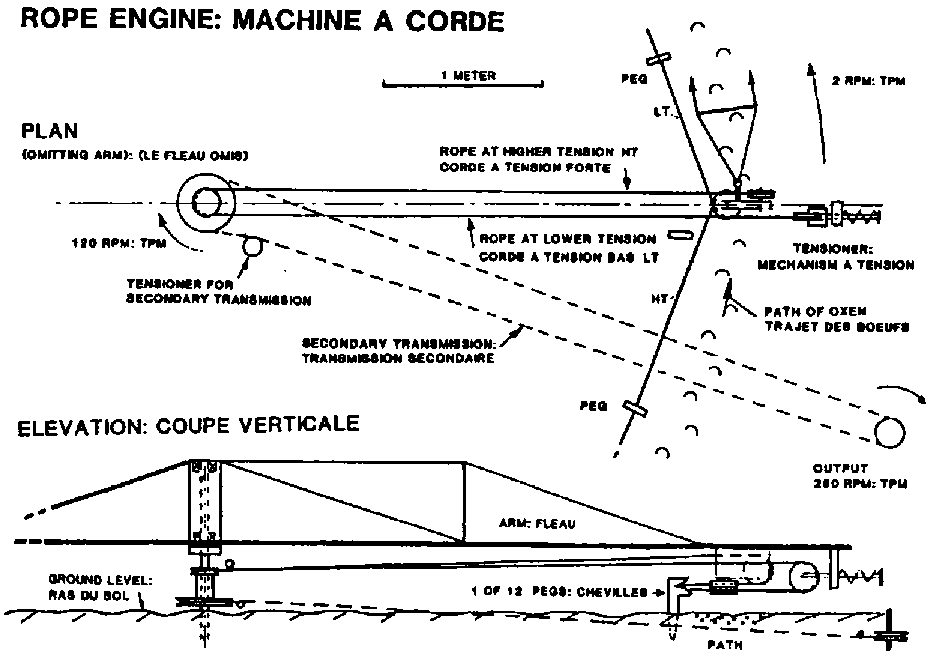
An animal gear should convert the animals' forward velocity (of say 0.6 m s-1) into rotary motion at a small effective radius. In a rope engine, the animal pulls a rope round a pulley. To obtain 100 rpm the pulley diameter should be less than 12 cm. For a practical machine it is not acceptable for the animals to be repeatedly unhitched from the rope to allow it to be rewound: so the animals must walk in a circle and the rope must be an endless loop. This is actually very difficult to devise. One solution lies in inverting the problem so that instead of a moving rope driving a stationary pulley, the rope is fixed and the pulley moves past it. The pulley can be mounted on an arm that is hauled round by the animals.
Unfortunately rotating shaft power is not very useful at the end of a swinging arm: any machine using the power would have to sit on that arm. It is much more convenient first to transmit the power to the central pivot on which the arm swings. From the central point the power may be further transmitted to a point outside the whole circulating assembly of animals and arm. Transmission to the centre can be achieved by various mechanisms, including use of a further rope or the redirection of the original rope.
Advantages of rope engines
The main advantage of a rope engine over most other animal gears, is its potential for local manufacture at low cost. Its principal parts are the rope (fairly cheap), an arm (of wood poles or angle-iron), a number of small pulleys (turned perhaps from hardwood), a similar number of bearings (possibly wood on steel shafts), and pegs to be set into the ground The ground provides the frame for the engine, although an arm at least 3 m long is also required No part of the machine is subject to large torques, and the maximum force on any component is about twice the pull of the animals. Sudden large forces, due to the animals lurching or snatching the rope tight, are released by the rope slipping on its pulleys.
Rope machines are semi-transportable. The central pivot and a circle of pegs have to be fixed firmly to the ground and therefore require some effort to move from one site to another. The rope, and the arm with its pulleys, are readily movable.
Maintenance is straightforward and might entail the safe storage of the rope, the lubrication of bearings and the correction of any warping of the arm. Repair requires the same skills as production, which are within the capability of a small workshop. Repairs do not have to be performed on site.
The simplest application for a rope engine is one requiring a torque at 100 rpm about the same vertical axis as the arm pivots. Some pumping and milling operations fit this specification. For most applications however transmission to outside the rope circle and a gearing up in speed are also needed Sawing or pumping may require further conversion to reciprocating motion.
Design issues in rope engines
The essential components of a rope engine are rope, an arm on a central pivot, pegs and pulleys. Each of these needs to be sized and selected or designed
Rope can be purchased. A safe working strength of about 5000 N (0.5 ton weight) should be quite adequate and this is obtainable from 10 mm or 12 mm ropes of various materials. An ideal rope should not rot, untwist, go brittle in sunlight or stretch excessively. Some natural ropes like sisal shrink by 15% when they get very wet: such shrinkage corresponds to the loss of 4 m in a 26 m loop. Any rope engine requires the rope to be tensed at its slackest point with a tension of at least one third the greatest force to be transmitted by the animal. The problem of maintaining such a tension as the rope stretches and shrinks is considerable. Indeed it is impractical for a dynamic tensioner to accommodate more than say 0.5 m of length variation. It is therefore helpful to have a dynamic tensioner with a small range, a static tensioner with a larger range (adjusted occasionally when the machine is stopped) and a rope that varies in length by much less than sisal's 15%. Finally the rope must be suitable for splicing, or otherwise producing a joint that will pass round a small pulley.
Fig.3: Plan and elevation of the rope engine currently being tested
The arm does not carry much load except for a compressive force that might cause it to buckle. However it does need to be stiff so that the pulleys at the outer end do not wag up and down. It would be possible to support the outer end of the arm on one or two wheels running on the ground or on a circular wall. However, this is expensive and given the light loads, a balanced or cantilevered truss supported only at the pivot should be simpler and cheaper. If two animals are harnessed to opposite ends of the arm (instead of both onto the same end), the arm has to be made much stronger and stiffer.
The central pivot (possibly a pipe thrust into the ground) has to support the arm via a thrust bearing, hold the arm horizontal via two radial bearings, and support the bearings carrying two V-pulleys subject to quite large lateral forces from ropes round them. It is difficult to provide any lateral support to the top of the pivot-post, so it must be rigidly held from below.
Pegs are not difficult to design. They must be set in a circle with rope-gripping slots facing outwards. Obviously the parts below ground are vulnerable to damp and termites. The optimum number of pegs is between 6 and 12.
Pulleys are of two types: guidance pulleys that should not grip the rope and power pulleys that do grip it. The wrap-around angle of rope on a power pulley is usually only half a revolution (180 degrees), so to get a good transfer of power such pulleys must have deep "V" profiles. The pulleys need bearings that can be lubricated and/or protected against the ingress of the dust that surrounds any animal gear.
Finally, there are the animals themselves requiring efficient harnesses. Their path should not be slippery nor prone to deep rutting, and it should be of sufficient radius (and perhaps also dished to slope inwards) for comfortable pulling. Because large outward forces can damage the engine, either the animals must be constrained by head ropes ("koggelstocks") or their attachment to the beam must release them should they pull outwards.
Prototype testing in Zambia
Following a request from Zambia, students at Warwick University (Chapling, da Silva, Blanch and Jones) have investigated different geometries and details for animal gears. The rope engine has appeared the most promising design, and a full-scale test version was built at Kasisi Agricultural Centre near Lusaka in September 1987 by members of that Centre and of Warwick's Development Technology Unit. Unfortunately the lack of radial constraint upon an angry ox resulted in damage to the prototype which is yet to be repaired. This machine was constructed of two 100 mm diameter poles, a pivot of 50 mm galvanised piping, hardwood pulleys turned on a lathe, axles of 12 mm mild steel bar and a number of hand-threaded bolts. The rope was 12 mm manila.
Since construction of the machine at Kasisi, further design studies of components have been carried out, and a collaboration programme involving inputs from Bangladesh, Botswana and Zambia is being established to explore designs, applications and economics of such machines.
Résumé
Par leur disponibilité et leur coût réduit, les animaux de trait dressés constituent une source d'énergie importante. Leurs aptitudes sont toutefois mieux adaptées aux travaux mobiles qu'aux machines stationnaires. L'énergie ainsi produite coûte moins cher que la main-d'œuvre humaine, tout en étant comparable au coût du gasoil. La disponibilité de la force animale est plus fiable que celle de la plupart des autres sources d'énergie motrice. Les équipements destinés d la traction animale peuvent être fabriqués localement. Leurs coûts de supervision sont favorablement influencés par l'économie d'échelle. Concernant les machines de traitement mûues par la force animale, le type de mouvement doit nécessairement être modifié, ainsi que son orientation et sa vitesse. La force animale convient parfaitement aux équipements d faible vitesse de rotation, mais des vitesses élevées occasionnent des configurations techniques plus complexes. Les machines d corde offrent l'avantage de pouvoir être fabriquées localement d un coût réduit, tout en étant semi-transportables. La difficulté technique principale réside dans le système de tension de la corde. Les artisans locaux peuvent aisément fournir les pièces essentielles. Une nouvelle machine à corde a été testée en Zambie. Un programme de collaboration entre quelques pays est actuellement mis en place pour explorer la conception, les applications et l'économie de telles machines.
References
Chapling J. 1987. Animal power take-off. Student project report. Engineering Department, Warwick University, UK (E)
Fraenkel P. 1985. Water lifting devices (pp.78-83). Intermediate Technology Publications, London, UK (E).
Löwe, P. 1986. Animal powered systems: an alternative approach to agricultural mechanization. Vieweg, for German Appropriate Technology Exchange (GATE), GTZ, Eschborn, Federal Republic of Germany. 60p. (E,F,G).
Major J. K 1978. Animal powered engines. Batsford, London, UK (E).
Müller, H. 1986. Oxpower in Zambian agriculture and rural transport. Edition Herodot socioeconomic Studies in Rural Development No. 65, Rader Verlag, Aachen, Federal Republic of Germany. 151p (E).
RIIC, 1986. Animal drawn pump. pp.33-37 in: Research and Development Report. Rural Industries Innovation Centre, Kanye, Botswana (E).
Roosenberg, R 1987. Animal-driven shaft power revisited. Tillers Report Summer 1987: 6-8, 1314. (Tillers Small Farm Program, Kalamazoo, Michigan USA). (E).
Srivastava N.S.L and Ojha T.P. 1987. Utilisation and economics of draft animal power. Central Institute of Agricultural Engineering, Bhopal, India. (E).
Watson, P. R 1981. Farming with draft animals. Transcentury Press, Washington, D.C, USA. 250p. (E).