


S.M. VirmaniInternational Crops Research Institute for the Semi-Arid Tropics (ICRISAT), Patancheru, Andhra Pradesh 502 324, India
Abstract
Introduction
Distribution of Vertisols and vertic soils in Africa
The climate of Tropical Africa
Thermal environment of Vertisols and vertic soils in Africa
Hygric environment
Role of soil-climate interaction studies in agricultural development
References
Vertisols and vertic soil cover 43 million ha in 28 countries in Africa. These soils are found in diverse agroecological environments. Niger, Chad, Somalia and southern Zimbabwe have large areas of arid tropical Vertisols. This region is characterised by low rainfall and a very short growing season. Such areas are used for extensive agriculture; where irrigation water is available Vertisols are highly productive. Large investments are required to develop and sustain irrigated agriculture in these Vertisol regions.
About 20 million ha of African Vertisols and vertic soils are found in dry semi-arid tropical climates. The growing season in these areas varies from 60 to 200 days, and under dryland conditions, one or two crops can be successfully grown. Some drainage is needed during the rainy months of the year. The cost to develop sustained agriculture in dry semi-arid tropical areas is relatively low.
Twenty-five percent of the Vertisol and vertic soils area of tropical Africa occur in dry/wet semi-arid climates, where the growing season varies from 180 to 300 days. These soils occur in high rainfall areas (>1000 mm year-1), and lack of drainage is a major constraint to increased agricultural production. These Vertisol regions are more suited to rangeland agriculture and agroforestry, because the cost to develop these areas for sustained arable crop production is relatively high.
Vertisols and vertic soils are potentially a highly productive group of African soils. If properly managed, they could be highly productive, but are highly prone to erosion. For sustainable agriculture on Vertisols, farming systems which include effective conservation techniques need to be developed and introduced.
This paper examines agroclimatic features in those areas of tropical Africa with Vertisols and vertic soils. Climatic features, particularly moisture, have been defined as the physical environment in which programmes to implement Vertisols technology will occur. No attempt has been made to catalogue the climate of the continent of Africa; but examples of climatic analysis have been cited to develop general principles in agronomically relevant terms. The paper focuses on the major climatic constraints and opportunities for dryland agriculture in African Vertisols and vertic soils areas.
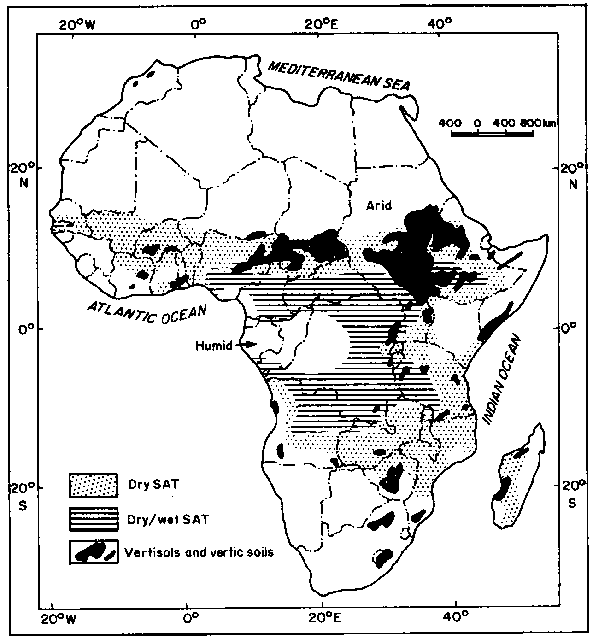
Vertisols and vertic soils occur extensively in Africa (Figure 1). From an estimated global 300 million ha, 43 million ha are located in tropical Africa (Dudal, 1980). This estimate falls far short of the 80 million ha in the vertic soil group suggested at the conference on 'Management of Vertisols Under Semi-Arid Conditions' organized by IBSRAM (Latham, 1987). From generalised soil maps in Africa (Hubble, 1984), we estimate that the total area of soils having 'vertic' properties in management-related terms, may be of the order of 100 million ha.
Figure 1. Distribution of African Vertisols and vertic soils, and climatic zones of Africa according to Troll.
Source: Troll (1965).
African Vertisols and vertic soils are found mainly in the tropics, between 18° N and 23° S latitudes. Only a small area of Vertisols in Lesotho and South Africa occurs outside tropical Africa (Figure 1). There are 28 African countries which have Vertisols and vertic soils (Table 1).
Table 1. African countries with Vertisols and vertic soils.
|
West Africa |
Senegal, Burkina Faso, Cote d'Ivoire, Ghana, Togo, Dahomey, Nigeria, Niger, Cameroon, Morocco. |
|
East Africa |
Somalia, Ethiopia, Kenya, Tanzania, Sudan. |
|
Central Africa |
Chad, Central African Republic, Zaire, Burundi, Uganda. |
|
Southern Africa |
Angola, Zambia, Zimbabwe, Botswana, South Africa, Lesotho, Mozambique, Madagascar. |
Climate is a primary determinant of arable agricultural development, and therefore an assessment of climate in agronomically relevant terms is essential. The data bases used in this paper are FAO, 1984; IAR/ILCA/ICRISAT, 1987; and WHO, 1971.
The thermal environment in the Vertisol areas of tropical Africa is greatly modified by altitude. In West and East Africa, in areas ranging from 200 to 500 m, mean annual temperatures exceed 28°C, and day temperatures rarely fall below 30°C. Average daily minimum temperatures range from 18 to 28 C in Ouagadougou, Burkina Faso, and Khartoum, Sudan. The hottest months are April to June, when maximum temperatures are around 40°C. Following the onset of the rainy season in July, maximum temperature declines. On an annual basis, the diurnal difference between the maximum and minimum temperatures is about 12-15°C (Figure 2).
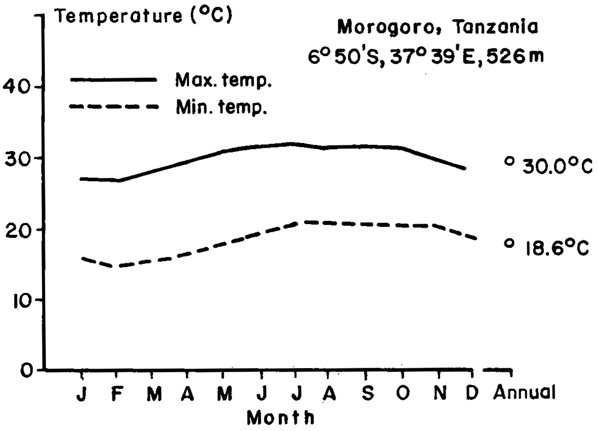
In the highlands of East Africa, Vertisols and associated soils occur at altitudes of 10003000 m. In these areas mean monthly maximum temperatures rarely exceed 30°C and the minimum temperature is usually below 15°C. In the single peaked rainfall areas the temperatures are relatively high during March and May (Figure 3). In the rainy months of June to September, the mean maximum temperature is around 20°C. In the winter months from October to February the minimum temperatures are quite low. Frosts are common above 2000 m. In the highlands of East Africa receiving bimodal rainfall (e.g. Nairobi, Kenya), temperatures are more or less uniform throughout the year (Figure 3).
Figure 2. Monthly and annual maximum and minimum temperatures at selected lowland locations in West and East Africa.

In southern Africa the mean monthly maximum temperatures rarely exceed 35°C and minimum temperatures do not generally fall below 15°C. The diurnal difference between maximum and minimum temperatures, on an annual basis, is around 12°C (Figure 4).
Research on the moisture environment of African Vertisols and vertic soils has assessed moisture adequacy for arable agricultural production. The length and characteristics of the growing season based on water budgets have been studied in some detail.
In order to discuss systematically the hygric environment, the climate of tropical Africa where Vertisols and vertic soils occur has been classified according to the Troll (1965) system. Such a zonation of climate is essential for adaptation and transfer of agrotechnology. This is analogous to concepts used extensively in soil resource assessment (Moore, 1978; Swindale, 1982). The relevant classes devised by Troll are:
3. Dry/wet semi-arid climates with 4.5-7.0 humid months.4a. Dry semi-arid climates with 2.0-4.5 humid months.
5. Arid climates with less than 2.0 humid months.
These zones in Africa are shown on Figure 1.
Figure 3. Monthly and annual maximum and minimum temperatures for two selected highland locations in East Africa.

Figure 4. Monthly and annual maximum and minimum temperatures at a typical southern African location.
Troll defined a humid month simply as one in which mean rainfall exceeds potential evapotranspiration. The vegetation associated with Troll's three climate classes for Africa listed above are dry savannah woodland, thorn savannah, and semi-desert, respectively. The term "semi-arid" was not invented by Troll. It was introduced by Thornthwaite (1948), and later used by Meigs (1953) in the preparation of world arid zone maps. ICRISAT has accepted the climatic classification of Troll as the working definition for its mandate region. This classification is ecologically oriented, emphasises the length of the dry season, and the length and quality of the wet season, all of which are relevant for improved agricultural production and soil water management.
A number of classifications have evolved to describe African tropical climates. Climate classification is essentially a geographic technique that allows simplification and generalisation based on climatic statistics (Hare, 1951). ICRISAT scientists believe it is best to adapt a climate classification scheme already in use and doubt if any further refining or integration of different climatic systems will be useful. Troll's agroclimatic classification adequately describes the hygric environment for crop production in tropical Africa. It takes into account rainfall adequacy to meet the evapotranspiration needs and is therefore oriented to agronomic management.
Only a small area of Vertisols and associated soils occur outside the semi-arid tropical zone (Figure 1).
Vertisols and vertic soils of the arid tropics in Africa
Niger, Chad, Sudan, Somalia, Zimbabwe and Botswana are some of the countries with large Vertisols areas in the arid tropical zone. An example of rainfall, potential evapotranspiration (PE), and water budget for this climatic zone is shown in Figure 5 for Khartoum, Sudan. Monthly PE exceeds the monthly rainfall in all months of the year. The annual rainfall of 158 mm meets only a small fraction (about 6%) of the annual PE needs.
Some 9 million ha, or about 20% of the Vertisol area, are in the arid tropics. In this climatic region the rainfall is scanty, and varies from 100 to 500 mm year-1. The annual rainfall varies widely from year to year (coefficient of variability (CV) is generally over 40%). The rainy season lasts not more than two months. Growing season for crops in dryland agriculture is usually 60 days or less. Such areas are agroecologically suited to livestock production, extensive farming or agroforestry systems. Crop production is possible only with irrigation, but the costs to develop and maintain irrigated agriculture are high: water has to be transported over long distances from high rainfall areas, or ground water has to be developed. Further, irrigated Vertisols in the tropics are susceptible to waterlogging, and saline and alkaline conditions may develop. High input and high technology agriculture can sustain arable crop production in tropical Vertisols and vertic soils occuring in arid climates.
Figure 5. Rainfall, potential evapotranspiration (PE) and water balance in an arid Vertisol location in tropical Africa.

Vertisols and vertic soils of the dry semi-arid tropics in Africa
Vertisols occur in many countries in the dry semiarid tropics (SAT), including Burkina Faso, Cote d'Ivoire, Ghana, Togo, Benin, Nigeria, Chad, Cameroon, Central African Republic, Sudan, Ethiopia, Kenya, Uganda, Tanzania, Zambia, Zimbabwe, Madagascar and Senegal. In such areas the rainfall is usually unimodal and there are 2.0-4.5 humid months when the monthly rainfall exceeds PE.
In the northern hemisphere, the rainy season generally extends from June through September. July, August and September show a positive water balance (Figure 6), but all the other months have a negative water balance.
In the southern hemisphere, for example at Bulawayo, Zimbabwe, the rainy season is somewhat longer (Figure 7), and lasts from November through March. Some rain may be received in October, April, and May. The humid months with a positive water balance are usually limited to December, January and February.
Figure 6. Rainfall, potential evapotranspiration (PE) and water balance in a dry semi-arid location in tropical Africa (northern hemisphere).

The dry SAT climatic areas of Africa receive 500-1500 mm rainfall annually, but most areas receive 700-1200 mm. The rainfall CV is 20-30%, and the crop growing season is 60-200 days, but more generally 90-200 days. Such areas are suited for dryland agriculture, and one or two crops can be successfully grown most years. Some drainage is needed for 2-3 months of the year, and the cost to develop Vertisols and vertic soils for improved management technologies is relatively low. Some 55% or 24 million ha of the Vertisols and vertic soils of tropical Africa occur in dry SAT climates.
Figure 7. Rainfall, potential evapotranspiration (PE) and water balance in a dry semiarid Vertisol location in tropical Africa (southern hemisphere).

Vertisols and vertic soils of the dry/wet semiarid tropics in Africa
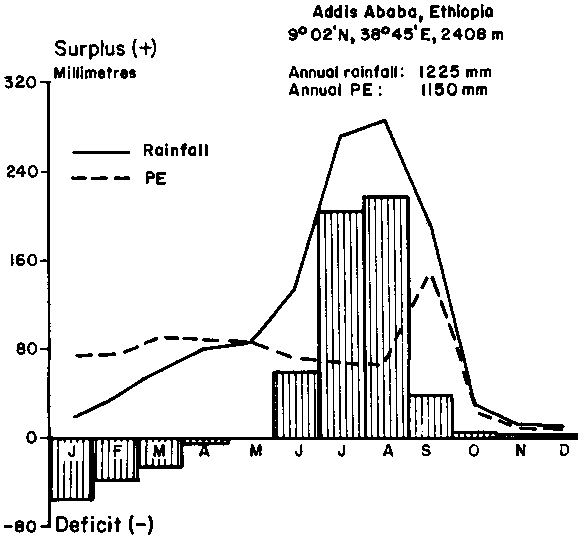
Sudan, Ethiopia, Burundi and Zaire have Vertisol areas in the dry/wet SAT region where the annual rainfall generally exceeds 1000 mm, and there are 4.5-7.0 humid months in a year. A typical example of this climate class is Addis Ababa, Ethiopia, where the annual rainfall is 1225 mm and the annual PE is 1150 mm (Figure 8). Seven months, May through November/December have a positive water balance and can be termed as 'humid months' according to Troll's (1965) definition. April has a small water deficit. The cropping season is May through October for the rainy season crops, and October through February for the cool (cold) post-rainy season crops.
About 25% of the area (10 million ha) of the Vertisols and vertic soils of Africa occur in dry/wet SAT climates, where the annual rainfall is 1000-2000 mm. The variability of the annual rainfall is low (CV 15-20% or less). The rainy season lasts 5-9 months with 4.5-7.0 'humid' months, and the dryland agriculture growing season is 180-300 days or more. Two or more crops can be raised in an intercropping or sequential fashion. This agroclimatic region is suited for agropastoral crop production and for agroforestry. Drainage of excess water is a major constraint to increased crop production. Development of Vertisols for sustained agriculture is fairly expensive in this agroclimatic zone.
Figure 8. Rainfall, potential evapotranspiration (PE) and water balance in a dry/wet SAT Vertisol location in eastern Africa.
Vertisols are heavy soils with more than 35% clay, are generally deep, and can hold considerable amounts of water (200-300 mm) in the soil profile. To understand the crop environment in the Vertisol regions of Africa, it is imperative that soil and climatic parameters be studied together. Growing season length in the tropics is closely related to the soil-water balance. The water balance not only determines the plant-available water, but also characterises the runoff and deep drainage components which are the key determinants of soil erosion and nutrient losses.
From the study presented in this paper, it is estimated that out of a total of 43 million ha of tropical Vertisols and associated soils in Africa, some 34 million ha are located in the dry and dry/wet semi-arid climates. Large tracts of this potentially productive agricultural land are found in some 20 countries of the continent. ICRISAT has shown that consistently high crop yields are possible under dryland management of semi-arid tropical Vertisols. At its research centre at Patancheru in Andhra Pradesh, India (17°27' N latitude, annual rainfall 743 mm, PE 1801 mm) over the past 11 years, ICRISAT has harvested yields of over 3 t ha-1 of food crops in its Vertisols watersheds, in spite of the usual rainfall variability (CV 30%), through adoption of improved crop production and soil and water conservation methods (Kanwar and Virmani, 1986). ILCA has also recorded three- or four-fold production increases over traditional crop yields by adapting some elements of ICRISAT's improved Vertisols management system to Ethiopian highland Vertisols at Debre Zeit (Jutzi and Mesfin Abebe, 1986).
The tropical climates have a strongly seasonal rainfall character, which is associated with high intensity, high volume storms. The Vertisols under such climatic conditions are susceptible to severe soil erosion. Any improved farming systems suggested to replace the traditional Vertisol management system must incorporate some elements of soil conservation.
Dudal R. 1980. Soil-related constraints to agricultural development in the tropics. In: Soil-related constraints to food production in the tropics. International Rice Research Institute, Los Banos, The Philippines.
FAO (Food and Agriculture Organization). 1984. Agroclimatological data for Africa, Part 1 countries north of the equator, Part II countries south of the equator. FAO Plant Production and Protection Series No. 22. FAO, Rome.
Hare F K. 1951. Climate classification. In: L D Stamp and S W Woolridge (eds), London essays in geography. London School of Economics and Political Science, London. pp. 111-134.
Hubble G D. 1984. The cracking clay soils: definition, distribution, nature, genesis and use. In: J W McGarity, H E Hoult and H B So (eds), The properties and utilization of cracking clay soils. Reviews in Rural Science No. 5. University of New England, Armidale, NSW, Australia. pp. 3-13.
IAR/ILCA/ICRISAT (Institute for Agricultural Research (Ethiopia)/International Livestock Centre for Africa/International Crops Research Institute for the Semi-Arid Tropics). 1987. Agroclimatic data analysis of selected locations in deep black clay soils (Vertisols) regions of Ethiopia. ICRISAT Training Reports. ICRISAT, Patancheru, Andra Pradesh, India.
Jutzi S and Mesfin Abebe. 1986. Improved agricultural utilization of Vertisols in the Ethiopian highlands - an interinstitutional approach to research and development. Paper presented at the first IBSRAM (International Board on Soil Research and Management) Regional Networkshop in Africa on Improved Management of Vertisols under Semi-Arid Conditions, Nairobi, Kenya, 1-6 December 1986.
Kanwar J S and Virmani S M. 1986. Management of Vertisols for improved crop production in the semi-arid tropics: a plan for a technology transfer network in Africa. Paper presented at the first IBSRAM (International Board on Soil Research and Management) Regional Networkshop in Africa on Improved Management of Vertisols under Semi-Arid Conditions, Nairobi, Kenya, 1-6 December 1986.
Latham M. 1987. Soil management network - management of Vertisols under semi-arid conditions. In: IBSRAM highlights 1986. IBSRAM (International Board on Soil Research and Management) Bangkok, Thailand.
Meigs P. 1953. World distribution of arid and semi-arid homoclimes. In: Review of research on Arid Zone Hydrology and Zone Programme. Unesco (United Nations Educational, Scientific and Cultural Organization), Paris.
Moore A W. 1978. Soil survey, soil classification and agricultural information transfer. In: L D Swindale (ed.), Soil-resource data for agricultural development. University of Hawaii, Honolulu. pp. 193-203.
Swindale L D. 1982. Distribution and use of arable soils in the semi-arid tropics. In: Managing soil resources. Twelfth International Congress of Soil Science, New Delhi, India, 8-16 February 1982. Indian Society of Soil Science, New Delhi, India. pp. 67-100.
Thornthwaite C W. 1948. An approach towards rational classification of climate. Geographical Review 38:55-94.
Troll C. 1965. Seasonal climates of the earth. In: E Rodenwaldt and H J Jusatz (eds), World maps of climatology, 2nd edition, Springer-Verlag, Berlin.
WHO (World Meteorological Organization). 1971. Climatological normals (Cling) for climate and climate ship stations for the period 1931-1960. WMO/OMM No. 117. T.P. 52. WHO, Geneva, Switzerland.
