


H. Eswaran and T. CookSoil Management Support Services
PO Box 2890, Washington DC 20013, USA
Abstract
Introduction
Classification
Soil morphological properties - microvariability
Management-related constraints
Conclusions
References
Vertisols, as a class of soils, are easily recognised because of their clayey textures, dark colours, and special physical attributes. These soils are very productive if well managed, but present constraints to low-input agriculture.
The classification of Vertisols according to Soil Taxonomy is summarised, and management-related properties of the soils are discussed. The surface microvariability of Vertisols, reflected in their internal soil properties, imposes constraints on their use for agronomic research and agriculture in general. Temporal changes in physical attributes of these soils require accurate timing of agricultural practices for efficient use. As the unique mineralogy of Vertisols makes these soils very susceptible to erosion, soil management practices must be geared to reduce soil loss.
In a landscape, soils typically form a continuum, with one soil grading almost imperceptibly into an adjoining soil. Because of the unique mineral and chemical composition of Vertisols, the transition to other soil types is usually clearly defined and can be easily delineated on a soil map.
Although their high natural fertility and positive response to management make Vertisols attractive for agriculture, some of their other properties impose critical limitations on low-input agriculture. The inherent limitations of Vertisols are largely a function of the moisture status of the soils and the narrow range of moisture conditions within which mechanical operations can be conducted. Farmers using traditional methods of agriculture are aware of the high risks associated with the use of these soils.
Even with high-input technologies, risk aversion is difficult since timing of tillage and of other farming operations is critical. As a consequence, the full agricultural potential of Vertisols has not yet been exploited in many parts of the world. This paper explains the classification of Vertisols according to Soil Taxonomy (Soil Survey Staff, 1975) and describes management practices that relate to the properties defined in the classification.
Despite their unique attributes, Vertisols were not recognized as a separate class of soils until the 7th Approximation (predecessor of Soil Taxonomy) was published in 1960 (Soil Survey Staff, 1960). Because Vertisols frequently occupy basin and lower landscape positions, they were referred to as alluvial soils and were differentiated from other similar soils by their dark colours. Soon, terms such as black clays and cracking clays appeared in the scientific literature. Farmers living on or near such soils gave them vernacular names. For example, in south India, farmers recognize at least four different kinds of Vertisols and use at least four names to connote their surface properties.
The mineral montmorillonite, which belongs to the smectite family of minerals, is responsible for the general attributes of the soils and their vertic properties. Identification of this mineral in the soil was made possible when X-ray diffraction techniques became commercially available in the early 1950s.
Since montmorillonite has the property of swelling and shrinking, the classification concept of Vertisols was based on their shrink-swell potential. This potential is a function of the clay content of the soil and the relative amounts of montmorillonite in the clay fraction. A soil layer 10 cm thick with this property is not a Vertisol. A minimum amount of clay, as well as a specific clay type, must be present in a minimum soil volume to provide the minimum expression. In addition, these soils crack during the dry season; the presence of cracks and the duration of cracking are also included in the definition of the Vertisols.
Each class in Soil Taxonomy is identified by a defining property or properties as well as by its position in the key. The definition of each taxon excludes or includes other properties which further define the soil. Although these default attributes are not spelled out in the definition, they are equally important for classification. Since Vertisols are recognized in the key to the orders after the Histosols, Spodosols and Oxisols, they cannot have the defining characteristics of these soils. Their placement in the key before the Aridisols, Ultisols, Mollisols, Alfisols, Inceptisols and Entisols implies that these soils may have only subordinate vertic properties.
The definition of Vertisols in Soil Taxonomy is based on four obligatory properties. Vertisols:
1. do not have a lithic or paralithic contact, petrocalcic horizon, or duripan within 50 cm of the surface;2. have 30% or more clay in all subhorizons to a depth of 50 cm or more after the soil has been mixed to a depth of 18 cm (for example, by ploughing);
3. have, at some time in most years unless irrigated or cultivated, open cracks at a depth of 50 cm that are at least 1 cm wide and extend upward to the surface or to the base of a plough layer or surface crust; and
4. have one or more of the following:
a. gilgai;b. at some depth between 25 cm and 1 m, slickensides close enough to intersect;
c. at some depth between 25 cm and 1 m, wedge-shaped natural structural aggregates that have their long axis tilted 10-60° from the horizontal.
Requirement (1) establishes the minimum soil volume, and the definition requires that there is no impermeable layer within 50 cm. Requirement (2) defines the minimum composition of the soil material. Requirements (3) and (4) define the minimum morphological expression of the vertic properties.
The suborder definitions are based on the length of time the cracks remain open or closed during the year, which requires field observations for several years. The four Vertisol suborders, which are defined precisely in Soil Taxonomy, are:
Xererts
These soils have a mean annual temperature of less than 22°C, a mean summer-winter temperature difference of less than 5°C, and are moistened during the winter when evapotranspiration is low. These are the Vertisols of the mediterranean areas, which occupy about 0.01% of the world's land surface.
Torrerts
These desert Vertisols have cracks that seldom close or only close about three times in 10 years. Information on these soils, which occupy about 0.001% of the world's land surface, is limited.
Uderts
The cracks in these Vertisols of the humid areas remain open less than 90 cumulative days in a year. It is estimated that they occupy about 0.03% of the world's land surface.
Usterts
These Vertisols of the semi-arid regions or the monsoonal climates occupy the largest area of all the suborders, 2.3 million km or 1.8% of the world's land surface.
The great groups in each suborder are defined by the colour of the upper 30 cm of the soil, particularly the moist Munsell chrome. The chrom great groups have a chrome of >1.5 and the pelf great groups have a chrome of <1.5. When these definitions were created, it was assumed that the pelf great groups were in general more poorly drained than the chrom great groups, but there are contradictory opinions on the relation between soil colour and drainage class (J. Comerma, CENIAP, Venezuela, 1986; personal communication). Nevertheless, there is a consensus to retain this separation at some categoric level, since it is a mappable criterion in the field.
The Vertisol subgroups identify intergrades to other soils or properties and are recognised in the taxon name by an adjective added to the great group name; for example, Aquic Chromudert, Entic Pellustert and Chromic Pelloxerert.
The control section for defining the family category is the section between 25 cm and 1 m depth. Criteria used in the family category are:
· particle-size class,
· mineralogy class,
· temperature class, and
· reaction class (if applicable).
Examples of family names are:
· fine, montmorillonitic, isothermic, Typic Pellustert,
· very-fine, mixed, thermic, Aquic Chromoxerert.
Since the classification of Vertisols in Soil Taxonomy was based on a limited number of soils, the International Committee on Vertisols (ICOMERT) is now working to improve the classification.
In order to appreciate the management-related properties of Vertisols, it is necessary to know not only the general soil properties, but also the properties in different parts of the soil. The situation is complicated for Vertisols by the temporal changes of soil properties in different parts of the soil as a function of depth, and the microvariability on the surface.
Figure 1 is a sketch of a pedon, showing gilgai microrelief on the surface and microrelief within the soil. It illustrates the short-range variability in profile characteristics. The amplitude of the gilgai may range from 1 to 10 m, making the soil surface topography highly variable. Cultivation may easily destroy the microrelief, but usually does not change the internal soil properties. Figure 1 illustrates how the surface topographic variations are mirror-imaged in the subsurface layers. Thus, even though the soil is levelled, the subsoil variations remain and will affect the water regime of the soil from point to point. If agronomists conducting field trials are unaware of these variations, they may obtain incorrect experimental results.
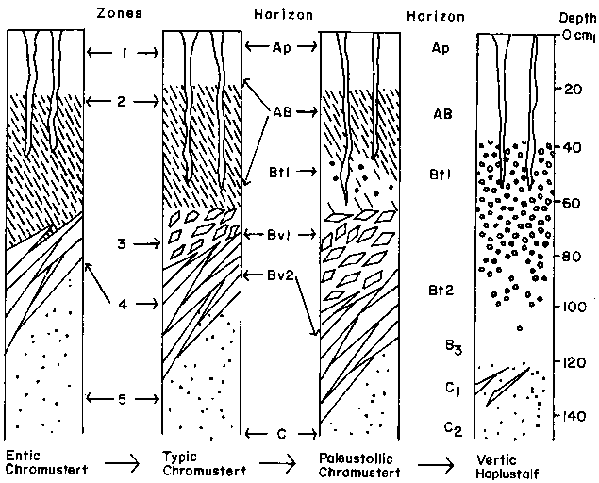
In a vertical section (Figure 2), the characteristic zonation of the soil profile is illustrated. The thickness of each zone is critical and partly controls the response to management techniques.
Figure 1. Cross-section of Gilgai microrelief.

Surface structure and consistency
Vertisols are extremely hard when they are dry, but when wet they become extremely plastic, to almost a liquid state, with a very low bearing capacity. Their structure and consistency are generally a direct function of the ratio of clay to sand and the mineral composition of the clay. Vertisols with more than 50% clay and a dominance of montmorillonite have poor theological characteristics, since montmorillonite has a high surface charge and a low Zero Point of Net Charge (ZPNC). At the normal pH of Vertisols (6.0-7.5), the soil is at least three units above the ZPNC, and if water is available, the mineral will be in a dispersed state.
Figure 2. Microphological differentiation of a sequence of soils (generalised).
In this situation, interparticle binding forces are minimal and aggregates rupture fast. On drying, the tissue-paper-like sheets of montmorillonite pack against each other to form a very compact, low porosity aggregate. The bulk density (Table 1) changes from about 1.33 g cm-3 at 0.03 MPa tension to more than 1.8 g cm-3 at oven-dry conditions. Few roots can penetrate a medium with a bulk density of more than 1.6 g cm-3, and the shrinking force also tends to crush any roots. Tillage, unless high energy machinery is used, is extremely difficult in the dry state. In the moist state, the low bearing capacity and the plastic nature of the material are deterrents. Thus, tillage can only be conducted at a moisture tension close to, but not at, field capacity.
There is no easy solution to this soil surface problem. One technique that mitigates the problem is the surface addition of mulch or non-Vertisol soils, preferably sandy materials. If a nearby source is available, farmers who use traditional cultivation methods could be encouraged to add other soil to the field annually. In south India, farmers add tank silt to Vertisols to build up the surface filth. In Kenya, trees are planted in holes filled with red Alfisols.
Another technique practiced in many countries is to prepare raised broadbeds, some of which are as high as 0.5 m and about 1 m wide. The beds are initially composed of very rough and very hard clods ranging in size from 1 to 10 cm or more. With alternate wetting and drying, the clods break down to a fine filth. The wetting and drying could be induced or accelerated by controlled sprinkler irrigation or left to the initial rain showers. Once the surface filth is obtained, the seedbed is smoothed and planted in one operation without additional manipulation. After germination, furrow irrigation provides further moisture. This technology is based directly on the properties of the montmorillonitic clay.
Grossman et al (1985) developed a relationship to estimate the bulk density of
Table 1. Coefficient of linear extensibility (COLE) and bulk densities of selected Vertisols.
|
Classification |
Depth (cm) |
COLE (cm cm-1) |
Bulk density (g cm-3) |
|
|
0.03 Mpa |
oven-dry |
|||
|
Udic Chromustert |
0- 8 |
0.106 |
1.34 |
1.82 |
|
|
36-76 |
0.115 |
1.32 |
1.84 |
|
Entic Chromoxerert |
0-13 |
0.060 |
1.10 |
1.83 |
|
|
13-38 |
0.174 |
1.14 |
1.85 |
|
Udic Pellustert |
0- 5 |
0.093 |
1.14 |
1.49 |
|
|
5-15 |
0.091 |
1.23 |
1.60 |
|
|
15-41 |
0.126 |
1.23 |
1.83 |
|
Typic Torrert |
5-25 |
0.124 |
1.23 |
1.75 |
|
|
40-60 |
0.117 |
1.12 |
1.56 |
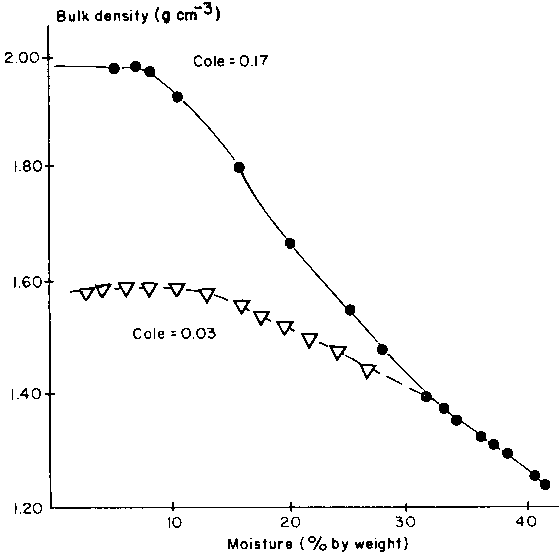
Vertisols at any specific moisture content. Figure 3 illustrates this relationship for two situations: one where the soil has a Coefficient of Linear Extensibility (COLE) of 0.03 cm cm-1, and the other where COLE is 0.17 cm cm-1. Both situations reach water contents below which shrinkage is near zero; the soil with the lower COLE reaches the equilibrium bulk density at a higher water content. At this bulk density, there is no further shrinkage. The equilibrium bulk density may be used to characterise the soils.
Figure 3. Bulk density and moisture relationships for Vertisols at two COLE values.
Surface cracking
Shrinking of the drying soil mass induces cracks which have a polygonal appearance. The cracks in Vertisols have been grouped into three sets (Grossman et al, 1985):
· Vertically oriented cracks which outline large blocks or prisms at the upper part of the soil. The cracks are wide, about 5-10 mm, and become progressively deeper as the soil dries out.· Cracks which form angular or blocky elements at the soil surface. These form at high water tensions, perhaps close to the wilting point.
· Cracks which form deeper in the soil and are related to the internal pedoturbation associated with the slickensides.
The first two sets of cracks exhibit properties that are important in land use and management.
Vertisols with a granular surface soil mulch (the first set) tend to have lower bulk densities, perhaps due to a slightly higher organic matter content and to the space between the granules. Soils with angular surface structure (the second set) are easier to till and roots can permeate the spaces and move deeper. In addition, the filled crack spaces are probably the most likely areas for roots to establish during the next season because water flows easily through these areas (Grossman et al, 1985).
Cracks have several indirect effects on crop performance. Because the rhizosphere is dehydrated last, the cracks normally form away from the stubble of the previous crop which sits at the centre of the polygon. In this case, dislodging of the plant is not a problem, but when the rhizosphere also dries out, soil shrinkage could strangle or shred crop roots.
Cracks also retard surface wetting from any off-season rains. At the beginning of the rainy season, much of the water is not available to the plants since the water is rapidly evacuated by the void system. During the initial rain showers, the subsoil below the zone of the cracks is moistened.
Successive rains moisten the top few centimetres of the soil, causing it to swell and seal the surface. Subsequent rains cause ponding, making tillage difficult and initiating erosion.
Moisture control
Moisture conservation during the dry season and removal of excess water during the wet season are crucial management practices for Vertisols, which differentiate them from most other soils. As a rule, Vertisols are clayey, and due to the montmorillonitic mineralogy, have a high water-holding capacity (Figure 4), resulting in a very low hydraulic conductivity and a low infiltration rates.
The high amount of available water illustrated in Figure 4 is deceptive, since not all the water is available to the plant. The water retention difference calculated from water retained at 0.03 MPa and 1.5 MPa tensions indicates the potential of the soil. Due to shrinkage and cracking, the water is not readily available to the roots even though there is moisture in the peas.
Conserving the soil moisture while inducing more uniform soil wetting and maintaining a suitable surface filth requires deep tillage prior to the onset of the rains. Mulching with organic residues and addition of non-Vertisol soils will aid this process considerably. Raised broadbeds have similar advantages. If the precipitation is characterised by high-intensity, short-duration storms, a network of contoured ditches would help channel run-off and keep much of the surface water from causing erosion.
Figure 4. Depth functions of available moisture.
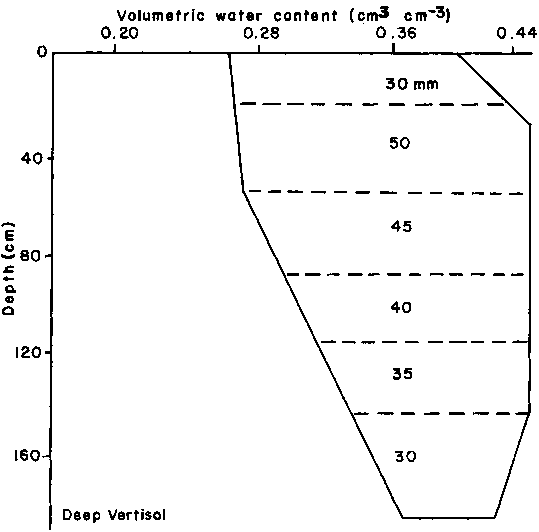
Source: Russell (1978).
At the end of the rainy season, the challenge is to reduce evapotranspiration losses and conserve soil moisture, so that a succeeding crop can be grown from the stored moisture. Surface soil temperatures of the top few centimeters may reach 60°C in the dry season. Mulching, in combination with deep filth, reduces evaporative losses and surface soil temperatures.
Matching crops to these soil conditions is also a partial solution, but socio-economic considerations do not always make this feasible.
Moisture management on single plots of land is difficult and in some cases impossible. A technically designed drainage and irrigation system for the whole catchment is beneficial and can increase moisture control.
Soil loss
The onset of the rains causes tremendous soil loss through erosion, but subsequent rains are less destructive. Depending on the slope, several management techniques are available and are well documented, particularly in publications of the International Crops Research Institute for the Semi-Arid Tropics (ICRISAT) (Kanwar et al, 1982). The propensity to erode is another feature of Vertisols and is related to the high charge and low ZPNC minerals in the colloid fraction.
The Vertisol definition stresses cracking, pedoturbation, and movement within the soil mass (slickensides). It should be noted, however, that from the management viewpoint, other characteristics appear to be more important: hardness when dry, plasticity when wet, a very low infiltration rate when the surface soil is sealed, very slow saturated hydraulic conductivity, compaction as a result of swelling, available water capacity, presence or absence of surface mulch, sodium saturation, possible salt content, rooting volume, and occurrence of permeable materials in the subsoil.
It is imperative that these characteristics be taken into account, if not in soil classification, then at least for technical assessments to evaluate the potential of these soils and determine management practices. In the development stages of Soil Taxonomy, a distinction was made at the great group level between "grumic" Vertisols that develop a loose, porous, surface mulch of discrete, very hard aggregates, and "mazic" Vertisols that, on the contrary, develop a platy or massive surface crust with uncoated silt or sand grains which persist after drying.
Subsequently, this differentiation was abandoned because it seemed to be influenced more by management and to vary from year to year. In humid areas, however, the crusting phenomenon seems to be frequent and is of importance for the soil water regime: less water intake, more hazards of waterlogging, difficult tillage, and poor seedbed conditions. The relationships between crusting in Vertisols and other soil-forming factors point to an intergrading toward Planosols (Dudal, 1973). In fact, where these soils are not ploughed, a thin albic horizon overlying heavy clay may be found.
While Vertisols make up a relatively homogeneous order in a taxonomic sense, it should be stressed that they show diverse characteristics that are important to their wetting, drying, and suitability for plant growth. The precipitation effectiveness on Vertisols is strongly influenced by water entry, water retention and water removal (when it occurs in excess of uptake capacity). This third factor is of particular importance in subhumid and humid zones for tillage operations and soil aeration during the growing period.
Management practices have been designed to overcome the physical problems of Vertisols. Since subsurface drainage is not feasible because permeability is slow, special attention has been given to surface drainage. Cambered beds, ridges, furrows, bunding, and broadbanks have been applied in Ghana, India, Indonesia, Trinidad, USA and Venezuela.
For the semi-arid tropics, ICRISAT (Kanwar et al, 1982) has developed a technology which allows Vertisols to be cropped in both the dry and wet seasons. The technology is conditioned by a certain soil depth and quantity of stored available water that covers the moisture requirements of the dry-season crop. Dependable rainfall is needed for seeding when the soil is still dry before the onset of the rains. Elements of this technology also might be applicable in more humid areas where tillage in wet conditions offers particular difficulties. Soil depth and water storage capacity are major factors in determining which components of a technology can be transferred.
Vertisols in subhumid and humid areas have been put to a wide range of uses. A major part is still used as pasture because tillage constraints have prevented these soils from being cultivated in a number of developing countries. Under rainfed conditions, and depending on the temperature regime, Vertisols produce wheat, maize, sorghum, soybeans, cassava, groundnuts and pigeonpeas. Under irrigation, Vertisols grow rice, sugarcane and cotton. Irrigation has to be adjusted to an initially fast infiltration through cracks, and a subsequent slow and rather shallow uptake of water when the cracks are closed.
Weed control is difficult because soil plasticity makes entering fields difficult when these soils are wet. In humid zones, Vertisols also are used for forestry in Argentina, Ghana, Indonesia, USA and other countries. Large areas of Vertisols are unused and offer a potential to increase agricultural production. While management difficulties of Vertisols deserve attention, their favourable features should be given equal emphasis: their high cation exchange capacity, the high base saturation in a majority of these soils, the high waterholding capacity, a favourable seedbed in the "grumic" soils, a certain stable fertility, and low salinity hazards because of the self-mulching process. With appropriate technologies, additional Vertisol areas can be cultivated, and those already in use can produce higher yields.
The great variability of Vertisols and the wide range of climatic conditions under which they occur should be fully considered when technologies are to be transferred. In addition to technical aspects, socioeconomic conditions should be taken into account. Farm size, cropping systems, labour availability, draught animal power, marketing facilities, and food habits may determine the success or failure of a technical innovation.
Proper management and timing of cultivation practices are critical factors in the efficient use of Vertisols. The shrink-swell characteristics of montmorillonites, which dominate the mineralogy of Vertisols, give the soil special attributes which impose constraints to low-input agriculture. With high energy and high inputs, Vertisols are perhaps the more productive soils. However, the challenge is to develop low-input technologies for Vertisols, such as those of ILCA and ICRISAT, that will enable small farmers in developing countries to achieve sustainable agriculture.
Dudal R. 1973. Planosols. In: E Schlichting and U Schwertmann (eds), Pseudogley und Gley. Verlag Chemie Weinheim. pp. 275-285.
Grossman R B. Nettleton W D and Brasher B R. 1985. Application of pedology to plan response prediction for tropical Vertisols. In: Proceedings of the Fifth International Soil Classification Workshop, Sudan. Soil Survey Administration, Sudan. pp. 97-116.
Kanwar J S. Kampen J. and Virmani SM. 1982. Management of Vertisols for maximizing crop production-the ICRISAT experience. In: Managing soil resources. Twelfth International Congress of Soil Science, New Delhi, India, 8-16 February 1982. Indian Society of Soil Science, New Delhi, India. pp. 94-118.
Russell M B. 1978. Profile moisture dynamics of soil in Vertisols and Alfisols. Proceeding of the International Workshop on the Agroclimatological Research Needs of the Semi-Arid Tropics. ICRISAT (International Crops Research Institute for the Semi-Arid Tropics). Hyderabad, India, pp. 75-87.
Soil Survey Staff. 1960. 7th Approximation. Soil Conservation Services, US Department of Agriculture. US Government Printing Office, Washington, DC.
Soil Survey Staff. 1975. Soil taxonomy: A basic system of soil classification for making and interpreting soil surveys. Agricultural Handbook No. 436. Soil Conservation Service, US Department of Agriculture. US Government Printing Office, Washington DC.
