


C.S. Kamara¹ and I. HaqueSoils and Plant Nutrition Section International Livestock Centre for Africa (ILCA)
PO Box 5689, Addis Ababa, Ethiopia
1. On leave from Soil Science Department, Njala University College, Sierra Leone
Abstract
Introduction
Materials and methods
Results and discussion
Acknowledgements
References
The influence of soil moisture on the consistency and bulk density of Vertisols in the Ethiopian highlands was investigated. A moisture content of 29-39% at the plastic limit was found to be the optimum for ploughing 18 Vertisols studied. The practical implications of consistency limits on tillage and other uses of the Vertisols in -the Ethiopian highlands are discussed. Curvilinear relationships were found between moisture content and bulk density. The problems of field determinations of bulk density for volumetric moisture content calculations are highlighted. A simple correction procedure for the reduction in soil eve volume in the determination of bulk density for volumetric moisture content calculations is presented.
Soil moisture has a major influence on the behaviour of Vertisols during tillage and weeding, and at harvest. While interest in estimating soil moisture has been strong, the relationship between soil moisture content and other soil properties that affect management and use has received little attention, particularly in sub-Saharan African soils.
Soil consistency is closely related to soil moisture. The moisture content affects the ability to work the soil, and the consistency is an index of that ability. The indices are important for tillage operations, and traffic by farm animals, farm implements and humans. Soil consistency has also been related to shrinking and swelling of clays, compressibility, strength and soil permeability, and has been used as a guide to when to begin soil manipulation (Sowers, 1965).
In addition to clay and critical moisture content, Nayak and Christensen (1971) concluded that the swelling potential of expansive soils was a function of the plasticity index. Paul (1982) used the consistency at the plastic limit to recommend a moisture content of 25-30% for tillage operations for shrinking and swelling clay soils in Guyana.
The consistency of abrasive and adhesive clay soils in Alabama was used to develop tillage equipment that allowed soil tillage over an extended moisture range, and hence increased the possibility of growing two crops in one growing season (Johnson et al, 1982). In Ethiopia, Berhanu Debele (1985) considered the consistency of Vertisols to be unfavourable and a limit to their ability to be worked productively, and to need investigation.
Knowledge of volumetric moisture content is required to assess the storage capacity of soils and for water balance studies. Bulk density is one property required to obtain volumetric moisture content. The shrinking and swelling of Vertisols alters their bulk density and hence their volumetric moisture content. Several researchers (Yule, 1984; Smith, 1984) have shown that errors in volumetric moisture calculation result when the bulk density is not determined at the right moisture content. Yule (1984), following Fox (1964), suggested the determination and use of the shrinkage curve for volumetric calculations. The generalised curve (Yule, 1984), estimated after Yule and Ritchie (1980a), contains both the swelling and shrinkage limits and can be constructed, indirectly, from cation exchange capacity, bulk density at the swelling limit, and the water content at the swelling limit. However, there can be errors in the estimates of both bulk density and water content at the swelling limit.
Yule (1984) used a soil cube as a working model to establish a relationship between moisture content and vertical shrinkage. Although such models help to establish and explain some of the concepts, there have always been practical limitations in their application.
Satisfactory sampling for bulk density at the swelling limit (Yule, 1984) requires determination of the structural water loss, swelling limit, and shrinkage limit of the Vertisol. The subsequent correction procedure proposed by Yule (1984) is only accurate for a dry profile with constant water depth, and consequently has practical limitations for application to Uderts.
The bulk density/soil moisture relationships and the moisture content at which bulk density values are taken have not been calculated for Vertisols in sub-Saharan Africa.
Reports of the extent and characteristics of shrinking and swelling in Vertisols, and their relationship with moisture content, are scarce. This paper reports on the influence of moisture content on the consistency limits, and on bulk density and its implications in volumetric determination of soil moisture for Vertisols in the Ethiopian highlands.
Sites and soils
The sites for this investigation were on ILCA Vertisol research and outreach project sites in the Ethiopian highlands. Some physical and chemical properties of the soils have been reported elsewhere (Kamara and Haque, 1987a).
Consistency limits
The consistency limits at the plastic and sticky points were determined according to the procedures described by Sowers (1965).
Bulk density and soil moisture
Field studies
The bulk densities of Vertisols were determined during the 1986 dry season at the ILCA Shola research site (SH/1/86) and at the ILCA Debre Zeit research station (DZ/4/86) in the Ethiopian highlands (Kamara and Haque, 1987b). At each location, 2.5 x 2.5-m plots were established by enclosing the plots with metal sheets extending 10 cm into the ground and 15 cm above the soil surface. The plots were flooded, covered with a plastic sheet and sampled periodically with an Edelman auger to determine bulk density and gravimetric moisture content.
Laboratory studies
Moisture content and bulk densities of soils from the SH/1/86 site were determined for disturbed and undisturbed samples. Known amounts of water were added to air-dried sieved (2-mm mesh) samples from each layer, and the samples were repacked into cores 8 cm in diameter and 5 cm deep. The cores (four for each layer) were then oven-dried for 48 hours to determine moisture content and reduction in volume of the soil core. Four undisturbed cores taken at each layer from profile SH/1/86 were oven-dried, and moisture content and volume reduction were also measured.
Soil consistency
Moisture content at the plastic and sticky consistency limits for 18 surface Vertisols are given in Table 1. Relative proportions of sand, silt and clay differ between the soils and are also shown to indicate the effect of the particles on consistency limits. Moisture content for all the soils varied from 29 to 39% at the plastic limit, and from 39 to 53% at the sticky point limit. Johnson et al (1982), Cooper and Georges (1982) and Paul (1982) have reported moisture contents of 28-40% for the plastic limit and 3246% for the sticky limit for Vertisols and some clay soils elsewhere.
Table 1. Particle size analysis and moisture content at the plastic limit and sticky point limit for surface Vertisols from the Ethiopian highlands.
|
Profile |
Depth |
Sand |
Silt |
Clay |
Moisture content |
||
|
Sticky point (%) |
Plastic limit (%) |
Plasticity index (%) |
|||||
|
NR/1/86 |
0-70 |
20 |
20 |
60 |
47±1.3 |
33±0.8 |
14 |
|
NR/2/86 |
0-52 |
18 |
20 |
62 |
49±2.0 |
38±1.3 |
11 |
|
NR/3/86 |
0-78 |
20 |
18 |
62 |
51±0.7 |
36±1.0 |
15 |
|
DZ/4/86 |
0-25 |
19 |
22 |
59 |
45±0,7 |
29±1.3 |
16 |
|
DZ/5/86 |
0-26 |
14 |
34 |
52 |
42±0.6 |
31±2.5 |
11 |
|
SH/1/86 |
0-23 |
19 |
21 |
60 |
50±0.8 |
36±1.0 |
14 |
|
SH/2/86 |
0-20 |
23 |
24 |
53 |
52±1.0 |
37±0.7 |
15 |
|
WY/1/86 |
0-34 |
15 |
21 |
64 |
48±0.6 |
33±1.2 |
15 |
|
WY/2/86 |
0-38 |
19 |
21 |
60 |
45±0.5 |
31±1.3 |
14 |
|
WT/1/86 |
0-49 |
18 |
17 |
65 |
51±0.5 |
34±0.4 |
17 |
|
WT/2/86 |
0-37 |
18 |
21 |
61 |
53±1.1 |
35±0.8 |
18 |
|
MW/2/86a |
0-41 |
16 |
42 |
42 |
42±0.6 |
36±1.4 |
6 |
|
SM/2/86 |
0-50 |
24 |
9 |
67 |
52±0.9 |
37±1.4 |
15 |
|
WG/1/86 |
0-40 |
15 |
21 |
64 |
50±0.8 |
38±5.0 |
12 |
|
DZ/3/86 |
0-22 |
11 |
39 |
50 |
39±2.0 |
30±0.8 |
9 |
|
DB/2/86a |
0-60 |
15 |
33 |
52 |
52±0.8 |
37±1.8 |
15 |
|
SD/2/86a |
0-26 |
27 |
4 |
28 |
49±1.4 |
39±0.7 |
10 |
a. Buried Vertisols (Kamara and Haque 1987a).
Profile moisture distribution at the sticky point and plastic limit for deep uniform-textured, medium to shallow uniform-textured and deep mixed-textured Vertisols are shown in Figure 1.
Moisture content is higher and more uniform for the profiles with a uniform texture than for those with a mixed texture. This is attributed to the different proportions of clay (Table 1) in the profiles (Kamara and Haque, 1987a). Consistency limits in Table 1 can be taken as surface values for determining land preparation requirements. Consistency limits at lower depths (Figure 1) should provide a basis for estimating and evaluating-indirectly-the subsoil water-holding capacity, permeability, strength of subsoil material to support farm buildings or roads, and subsoil shrinking and swelling.
Figure 1. Profile moisture distribution at the plastic and sticky point limits for Vertisols in the Ethiopian highlands.

Soils with a low sticky point, such as DZ/4/86 and DZ/5/86, are not strong enough to support farm buildings and roads. For both surface (Table 1) and subsoil (Figure 1), the high sticky point consistency of WT/1/86 will hold more moisture than the low sticky point consistency and low plastic limit soil at WY/1/86 site. Soil from the lowest layer of the DZ/4/86 profile (Figure 1) failed the plastic limit test because of the coarseness of the material in that layer (Kamara and Haque, 1987a).
Bulk density and soil moisture
Field studies
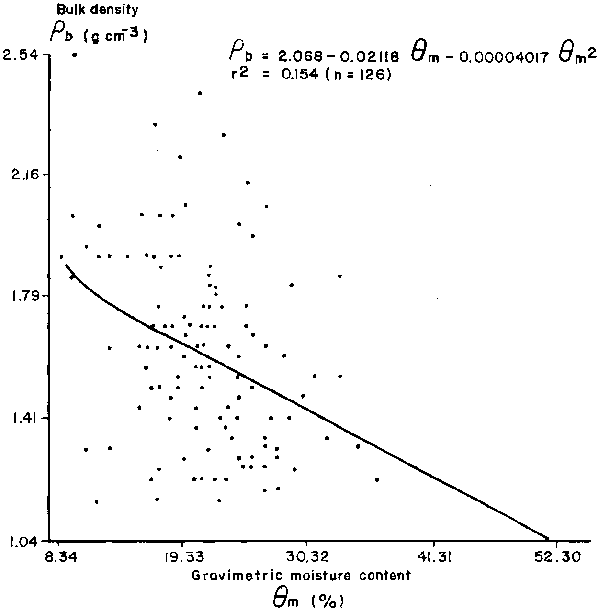
Regression analysis was employed to establish and study the relationship between moisture content and bulk density of Vertisols at two sites in the Ethiopian highlands. Figures 2 and 3 show the relationship between gravimetric moisture content (q m) and bulk density for the two sites. The relationships are curvilinear and significant at P=0.05.
From about 18% q m the relationships are linear with increased moisture content. For swelling and shrinking clay soils, the linear part of the curve supports the normal one-dimensional shrinkage concept while the other part is three-dimensional (Fox, 1964; Berndt and Coughlan, 1977; Yule and Ritchie, 1980a and 1980b; McIntyre, 1984).
Figure 2. Relationship between gravimetric moisture content and bulk density for a Vertisol (SH/1/86) at Shola, Ethiopia.
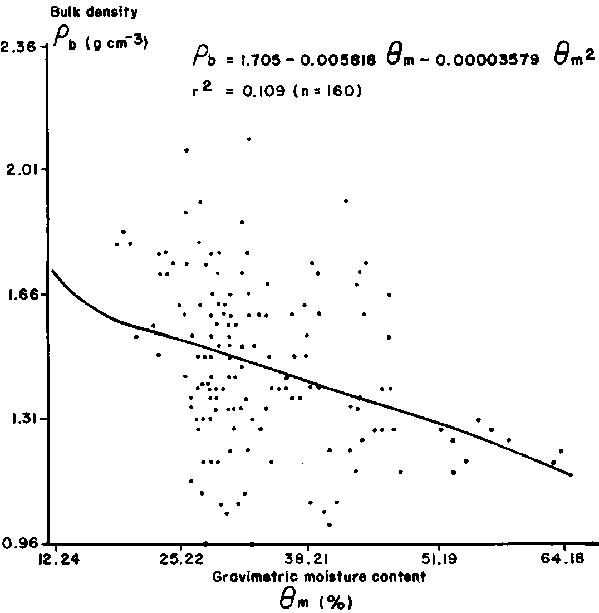
For black earth soils from Australia, Fox (1964) found that for undisturbed soil cores the transition point between one-dimensional and three-dimensional shrinkage was at about 45% moisture content. The differences in the transition points in the Shola and Debre Zeit Vertisols and the black earth soil in Australia may be due to differences in the composition of the soils (McIntyre, 1984).
Figure 3. Relationship between gravimetric moisture content and bulk density for a Vertisol (DZ/4/86) at Debre Zeit, Ethiopia.
Laboratory studies
The volume of a Vertisol core is reduced by oven drying for bulk density and moisture content determinations. Consequently, the volume of the cylindrical core used to determine soil bulk density does not represent the core volume as assumed for non-shrinking soils.
The relationships between moisture content and reduction in soil volume in the disturbed cores after oven-drying, and r² values, for the SH/1/86 profile in the Ethiopian highlands are given in Table 2.
The reduction in soil volume of undisturbed cores taken from five layers of the SH/1/86 profile, the bulk density corrected for the reduction in soil core volume, and the uncorrected densities, are shown in Table 3. The cores were taken on 9 June 1987 after the onset of the main rainy season to allow crack closure and profile moisture recharge.
Table 2. Regression equations and r² values of soil core volume reduction (Vr in %) as a function of percentage soil moisture (q m) of a Vertisol profile (SH/1/86) in Ethiopia.
|
Depth (cm) |
Regression equation |
r² |
|
0-23 |
V = -4.5440 + 0.6592 q m - 0.002862 q m² |
0.954a |
|
23-100 |
V = 5.0000 + 0.2363 q m + 0.001680 q m² |
0.984a |
|
100-127 |
V = 0.1279 + 0.6467 q m - 0.001651 q m² |
0.980a |
|
127-164 |
V = 3.2630 + 0.3310 q m + 0.001011 q m² |
0.983a |
|
164-200 |
V = -3.9440 + 0.6162 q m - 0.000847 q m² |
0.992a |
a. Significant at P=0.05.
The gravimetric moisture content that influenced soil core volume in the bulk density determination is included in Table 3. The soil moisture content at sampling was significantly different for some of the layers within the profile, and therefore the correction procedures suggested by Yule (1984) are inappropriate. The consequent volume reduction also differs between layers, which makes it necessary to ascertain the volume reduction for each Vertisol profile layer when determining bulk density.
The regression equations in Table 2 were used to predict the reduction in soil core volume for each layer in profile SH/1/86. The predicted bulk densities calculated for corrected and uncorrected soil core volumes are included in Table 3. The measured bulk densities from the undisturbed cores that were corrected for the reduction in volume were not statistically different from those predicted using disturbed cores. The disturbed core sample approach used in this investigation can therefore represent field conditions.
Oven-drying reduced the soil core volume of the Shola Vertisol by 52-72 cm, which resulted in an underestimation of the bulk density by 21-27%. The volume reduction for each layer in the profile was different because the moisture content within layers differed at sampling time. However the reduction in volume cannot be explained entirely by the moisture content because high moisture content did not always produce correspondingly high volume reductions.
High clay content is generally associated with high shrinkage, and hence reduced volume upon drying. The clay content in this profile increased with depth and ranged from 60 to 74%(Kamara and Haque, 1987a). The volume reduction should have shown a trend similar to the clay content if the clay content was a primary factor. Clay mineralogy and organic matter content might also be important. The mineralogy of this profile has not been investigated but profile organic matter has been reported to range from 5.25% at the surface to 0.09% at a depth of 2.0 m (Kamara and Haque, 1987a).
Table 3. Measured and predicted bulk density values for the Shola profile (SH/1/86)a.
|
|
Soil profile depth (cm) |
||||
|
0-23 |
23-100 |
100-127 |
127-164 |
164-200 |
|
|
Gravimetric moisture content (%) |
46±2.4a |
51±1.3b |
53±1.8bc |
47±1.7a |
47±1.Sa |
|
Oven-dry weight of soil core |
275.2±7.1 |
271.9±3.9 |
269.1±5.3 |
279.7±3.4 |
279.4±11 |
|
Volume reduction (cm³) measured |
72±4.4a |
71±4.2a |
52±7.1b |
65±5.9ac |
66±2.8ac |
|
predicted |
54 |
54 |
75 |
53 |
58 |
|
Uncorrected bulk density (g cm-3) measured |
1.09±0.03 |
1.08±0.02 |
1.07±0.02 |
1.11±0.01 |
1.11±0.04 |
|
predicted |
1.09 |
1.08 |
1.07 |
1.11 |
1.11 |
|
Corrected bulk density (g cm-3) measured |
1.52±0.02 |
1.510.02 |
1.35±0.05 |
1.51±0.03 |
1.51±0.03 |
|
predictedb |
1.39 |
1.38 |
1.52 |
1.41 |
1.45 |
a. Figures within rows followed by the same letters are not significantly different at P=0.05.
b. Values are not significantly different at P=0.05 (t. test comparison, Snedecor and Cochran, 1967).
The reduced volume and the calculated bulk densities for both the corrected and the uncorrected soil core volume reduction were used to calculate volumetric moisture content. This calculation was used to assess the magnitude of the underestimation when the reduced volume is not accounted for in the volumetric moisture calculations (Table 4).
Table 4. Calculated volumetric moisture content from uncorrected and corrected soil core volume for the Shola profile (SH/1/86).
|
Profile depth (cm) |
Measured |
Measured |
Predicted |
||
|
Uncorrected volumetric moisture content (g cm-3) |
Corrected volumetric moisture content (g cm-3) |
Under- estimation (%) |
Corrected volumetric moisture content (g cm-3) |
Under-estimation (%) |
|
|
0-23 |
0.501 |
0.699 |
28.32 |
0.639 |
21.59 |
|
23-100 |
0.551 |
0.770 |
28.44 |
0.704 |
21.73 |
|
100-127 |
0.567 |
0.716 |
20.81 |
0.806 |
29.65 |
|
127-164 |
0.522 |
0.710 |
26.47 |
0.663 |
21.26 |
|
164-200 |
0.522 |
0.710 |
26.47 |
0.682 |
23.46 |
Determination of field bulk density is always required for volumetric moisture calculations. Sampling for bulk density in Vertisols at maximum swelling limit (Yule, 1984) requires estimation of the various limits in the shrinkage curve and is hence time consuming, expensive, and impossible in areas where facilities are limited. The established relationships between moisture content and volume reduction (Table 2) for the SH/1/86 profile allow for quick estimation of a correction factor that can be used to determine the actual bulk density of the Vertisols. The advantages of this approach are that: sampling for bulk density can be done at any time during the year, as in non-swelling and non-shrinking soils; and that sampling depths can be varied.
This work was funded by the ILCA Vertisol management project through funds from the governments of Switzerland, Norway and Finland. The ILCA Soils and Plant Nutrition Section staff at Debre Zeit and Shola Headquarters are especially acknowledged for help with data collection.
Berhanu Debele. 1985. The Vertisols of Ethiopia: their properties, classification and management. In: Fifth Meeting of the Eastern African Sub-Committee for Soil Correlation and Land Evaluation. Wad Medani, Sudan, 510 December 1983. World Soil Resources Reports No. 56. FAO (Food and Agriculture Organization), Rome. pp. 31-54.
Berndt R D and Coughlan K J. 1977. The nature of changes in bulk density with water content in a cracking clay. Australian Journal of Soil Research 15: 27-37.
Cooper B R and Georges J E W. 1982. Importance of sugar-cane in the management of clay soils in Trinidad. Tropical Agriculture (Trinidad) 59: 183-188.
Fox W E. 1964. A study of bulk density and water in a swelling soil. Soil Science 98:307316.
Johnson C E, Schafer R L and Elkin C B. 1982. Prescribing tillage for clay soils. Tropical Agriculture (Trinidad) 59:92-96.
Kamara C S and Haque I. 1987a. The characteristics of Vertisols at ILCA's research and outreach sites in Ethiopia. PSD Working Document No. B5. International Livestock Centre for Africa (ILCA), Addis Ababa, Ethiopia.
Kamara C S and Haque I. 1987b. Studies on the field capacity of a Udic Vertisol. In: International Conference on Measurement of Soil and Plant Water Status, Utah State University, Logan, Utah, 6-10 July 1987. Utah State University Press, Logan, Utah, USA. Vol. 1, pp. 47-58.
McIntyre D S. 1984. The physics of volume change in cracking clay soils and the one dimensional misconception. In: J W McGarity, E H Hoult and H B So (eds). The properties and utilization of cracking clay soils. Reviews in Rural Science No. 5. University of New England, Armidale, NSW, Australia. pp. 116-122.
Nayak N V and Christensen R W. 1971. Swelling characteristic of compacted expansive soils. Clays and Clay Mineralogy 19:251-261.
Paul C L. 1982. Aspects of the management of salinity on swelling clay soils in Jamaica. Tropical Agriculture (Trinidad) 59-:162-166.
Smith G D. 1984. Soil constituent and prehistory effects on aggregates porosity in cracking clays. In: J W McGarity, H E Hoult and H B So (eds), The properties and utilization of cracking clay soils. Reviews in Rural Science No. 5. University of New England, Armidale, NSW, Australia. pp. 109-115.
Snedecor G W and Cochran W G. 1967. Statistical methods. The Iowa State University Press. 6th Edition. Ames, Iowa, USA.
Sowers G F. 1965. Consistency. In: C A Black (ea.), Methods of soil analysis. ASA monograph No. 9. Part 1:391-399.
Yule D F. 1984. Volumetric calculations in cracking clay soils. In: J W McGarity, E H Hoult and H B So (eds), The properties and utilization of cracking clay soils. Reviews in Rural Science No. 5. University of New England, Armidale, NSW, Australia. pp. 136-140.
Yule D F and Ritchie J T. 1980a. Soil shrinkage relationships of Texas Vertisols. I. Small cores. Journal of the Soil Science Society of America 44:1285-1291.
Yule D F and Ritchie J T. 1980b. Soil shrinkage relationships of Texas Vertisols. II. Large cores. Journal of the Soil Science Society of America 44:1291-1295.
