


Chapter 6 SUPPLY AND DEMAND OF FOREST PRODUCTS IN MARKET ECONOMIES
One of the most important elements in the outlook for the forest and forest products sector (and one of the specified major objectives of ETTS V) is the outlook for the supply and demand of forest products. Markets for forest products are influenced by complex and interacting factors, many of which are short term in nature (business cycle, fashion, new products and technologies), so there must, of necessity, be great uncertainty about long-term projections in this area. Nevertheless, it is possible to identify and quantify a number of long-term structural trends. Econometric techniques allow for the scientific measurement of the relations between various key variables over a long time period (in the case of ETTS V, the 28 years between 1964 and 1992): projections based on these measurements can be presented and discussed in objective terms, without excessive dependence on "expert opinion", which can often be seen as individual preconceptions. Econometric analysis also has the advantages of ensuring that consistent assumptions (e.g about growth in the economy as a whole) are made in all countries, and making possible the preparation of alternative consumption scenarios with different assumptions for the independent variables, such as GDP, residential investment, or prices.
This chapter briefly presents long-term trends for consumption and production of forest products, discusses the underlying factors, and presents the econometric analysis and the two base scenarios. It is based on the analysis carried out by Anders Baudin (Sweden) and David Brooks (USA), supported by Johan Stolp (the Netherlands) and Peter Schwarzbauer (Austria), which is presented in full detail in two ETTS V working papers (ECE/TIM/DP/5 and DP/6). The services of Messrs. Baudin and Brooks were made available by their respective governments and organisations. The Government of France made available the services of Myriam Issartel to collect and check the long-term data series, especially those on prices. These appear in graphic form in ECE/TIM/DP/9. The secretariat wishes to note its deep appreciation of the pioneering and demanding work of all the experts and to thank the Governments of France, Sweden and the USA for their major contribution.
All the analysis was carried out at the level of individual products (coniferous sawnwood, plywood, newsprint, etc.), and the data at this level of detail will be made available in the working papers. However, to simplify presentation, this chapter mostly discusses product groups: sawnwood, panels and paper and paperboard (usually abbreviated to "paper"). Full detail of historical trends is presented in the regular ECE/FAO publications, notably the Timber Bulletin and the periodic medium-term surveys. This chapter covers the consumption and production of sawnwood, panels and paper in the market economies. Fuelwood consumption is covered in chapter 9 and the outlook for the transition economies in chapter 10. Simple assumptions have been made about the outlook for consumption of pitprops and other industrial roundwood, which are not presented here.
Econometric methods are only used to project production and consumption in the western market economies (the 17 countries listed in footnotes 8 and 11), which together account for about 80 per cent of consumption of sawnwood and panels and over 90 per cent of paper consumption. Nevertheless, to avoid duplication and simplify presentation, in most of this chapter, trends and projections are shown for Europe as a whole, including other countries for which different forecasting methods were used, notably the transition economies (discussed in chapter 10).
6.2 Past trends in consumption and production
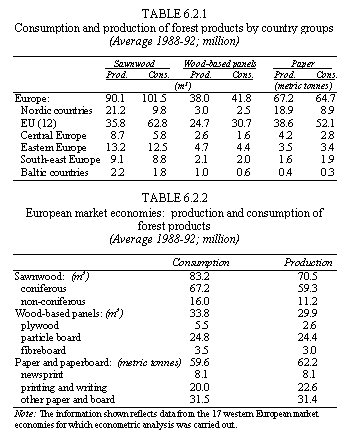
Sawnwood consumption grew strongly between 1964 (in fact from the early 1950s, but these data are not included in the data base) and 1973, but thereafter developments have been marked more by fluctuations in the business cycle than by sustained expansion. In only three years did consumption exceed that of 1973 (1979, 1980 and 1990), and there were periods of low consumption in the 1980s (1981-85) and the 1990s (1991-94). European production has consistently accounted for 85-95 per cent of consumption, and is supplemented by imports of coniferous sawnwood from Canada and Russia, and of non-coniferous sawnwood from south-east Asia and the USA. In 1994, however, imports of sawnwood from Canada and Russia fell, notably because of supply problems and the demand of the giant American market. At the same time, European exports by the Nordic countries and Austria to other regions grew. It remains to be seen whether this is a passing phase of the market or a genuine structural change.
FIGURE 6.2.1
European consumption of panels
(Average annual percent growth)
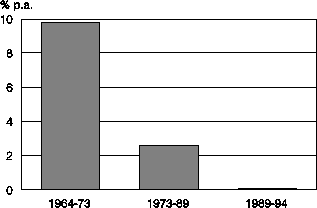
Consumption of wood-based panels more than doubled over the 30 year period, rising from 17 per cent of sawnwood consumption in 1964 to 44 per cent in 1994. However, the rate of growth has slowed down. Over the 30 year period as a whole it appears that panels have moved from an aggressively expanding phase, when they substituted for sawnwood in some markets and created new markets elsewhere (e.g. fitted kitchens), to a phase of consolidation and maturity, similar to sawnwood, where change is due essentially to fluctuations in the business cycle and competition between panels. Production is only a little below consumption. Imports of plywood from south-east Asia are the major flow from outside the region, although there is intensifying intra-regional trade in panels, as manufacturers specialise and build larger plants, creating more opportunities for "cross-hauling" between countries.
Consumption of paper and paperboard has also more than doubled between 1964 and 1994: the growth rate has been steadier for paper than for sawnwood and panels and there is no sign of a structural slowdown in growth at the end of the period. In most years, European production is slightly greater than consumption, because of exports to a wide range of other regions. (This does not mean that Europe is self sufficient in the raw material for paper, as Europe imports a very large volume of pulp, mostly from North America.)
6.3 End uses, competition and substitution
(i) Sawnwood and panels
Sawnwood and panels are semi-manufactures and are used in a large number of different markets, ranging from general high volume markets (e.g. house roofs) to the highly specialised (e.g. violins). In each of these markets, different factors determine the level of consumption. In almost all cases, the relative price of sawnwood and panels is important, but their technical suitability to the user needs and expectations (which change over time), and the price and suitability of competing materials are also very important.
Fashion also plays a role, as well as the image of wood (and its competitors). Is wood seen as a warm, natural material, and environmentally friendly, because of its renewability and origins in the forest? Or is it seen as old fashioned, environmentally harmful and technically inadequate? Both views are in fact widely held and the public relations specialists for wood (and its competitors), aware of the importance of these issues, are making great efforts to influence public perceptions.
Ideally therefore the consumption of wood should be analysed by individual market sector. This has been done in a few cases, notably a series of studies by Baudin, which have shown that the factors and trends vary widely between markets: in some markets, sawnwood and panels are "winners," and in others "losers". Unfortunately this approach requires a great deal of data and highly detailed analysis and is therefore not possible for ETTS V, which must depend on econometric analysis of trends at the national level, which can be carried out within the existing data base. However, it should always be borne in mind that the results presented below are the aggregation of trends in a number of different markets, each of which have their own characteristics and dynamics.
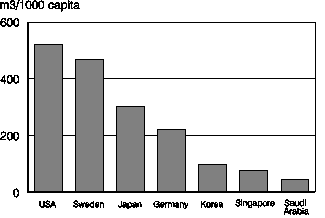
FIGURE 6.3.1
Consumption of sawnwood per head
There are two very general points which are often ignored by those analysing trends in consumption of forest products. The first is that sawnwood and panels may be substituted in practically all their markets.1 Thus, within the ETTS V projection period, if prices of sawnwood and panels rise to levels where competing materials are significantly cheaper, or if technical advances for competing materials are not matched by those for sawnwood and panels, then a steep decline in markets for sawnwood and panels cannot be ruled out. It is often implicitly assumed that "more housing means more consumption of sawnwood and panels": this is roughly true in the short term, but in the long-term perspective of ETTS V, this is conditional on their maintaining or improving their competitivity in all their markets, against increasingly aggressive competitors, who in many cases have the advantage of larger enterprise size. For this reason competing materials may often be better placed for efforts of promotion and marketing than the sawnwood and panels sector where the many small- and medium-size enterprises find it difficult to cooperate in this field and are much slower to respond to changes in the markets.2 To put matters in perspective with regard to loss of markets by wood, it is sufficient to visit any museum of rural life in earlier centuries and to note how many functions were performed in the past by wood, which are now performed by totally different materials.3
The second is that, by historical chance, the world's rich countries at present (north-west Europe, North America, Japan) have a strong tradition of wood use, which has been developed along with the rest of the economy. The structure of wood demand in these countries has been implicitly assumed to apply also to other parts of the world. Yet it is in fact unlikely that countries without a tradition of wood use will acquire one as they become richer, given that alternatives usually exist. This appears clearly from the per capita consumption of sawnwood in the sample of prosperous countries in figure 6.3.1. Thus, to take the two extremes, while the GDP per head in Saudi Arabia is roughly equivalent to that of the USA, its per capita consumption of sawnwood is 10 times less. This may be an extreme case, but it must be borne in mind that economic development is possible without high levels of consumption of forest products.
(ii) Paper and paperboard
As mentioned above, the consumption of paper and paperboard has grown at a similar rate to GDP over a very long period. Here too, positive developments in one market sector have been offset by negative developments elsewhere. Newsprint has maintained its position as a major provider of information and advertising medium, despite advances in electronic information transmission, which have tended to complement existing means rather than replace them. The consumption of other printing and writing has soared because of technical changes (copiers, PCs and faxes) which have demonstrated a synergy between paper and electronic information handling. Now most businesses in market economies are equipped with computers and most sales are replacements. Domestic use is not so well developed. In ten years, will most households have their own PC? However, some markets for paper are growing only slowly, if at all (e.g. household and sanitary, where the potential for expansion is limited to population growth). Elsewhere, there are unpredictable threats: concern is widely expressed about the volume of packaging (legal measures are being taken in some countries to limit this), and some would prefer to see fluff pulp based disposable nappies replaced by reusable nappies. For both of these the final outcome will depend on a complex mixture of technical factors, environmental policy objectives and public perceptions.
6.4 The European forest industries
The levels of production of forest products in Europe, as elsewhere, are influenced by the availability of raw material from domestic forest resources and by the size and proximity of markets; however, these factors, important though they are, are by no means sufficient to explain completely the level and trends of production. Production levels are strongly influenced by the competitivity of the European forest industries in increasingly global markets, where it is common for wood raw material or forest products to be transported half way around the world.4 The concept of "competitivity" however, although apparently simple, is difficult to define and even more difficult to measure.
This section attempts to present some relevant factors concerning the competitivity of the European forest industries, with some information by country group, by presenting information on the structure and capacity of the industries (size, number of units, location), and by summarizing analysis recently carried out for the ECE/FAO on trends in the productivity and profitability of these industries. The section is intended to provide a background to the projections for forest products production in Europe. The trends for production itself have been presented in the previous section.
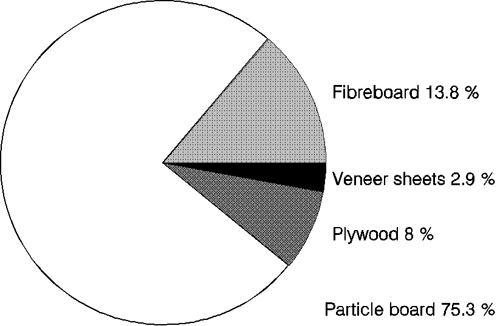
FIGURE 6.4.1
Capacity of the European panels industry, 1994
(Total: 47.2 million m3)
There are very large differences between the major sectors (sawmilling, panels and pulp and paper) regarding the size of units, capital intensity, ownership and technology. The difference is especially striking between sawmilling, which is a much more traditional, small-scale (even artisanal) industry in many countries, and the other two sectors which have become extremely capital intensive, high technology and global.
The sawmilling industry5 in most of Europe is marked by a large number of small units, often under-capitalised, and therefore unable to install the latest improvements in process technology (notably computer control), and often with weak or non-existent marketing services. Around 1990, it is estimated that in Europe there were about 30,000 sawmills, producing about 85 million m3 per year in total, an average of under 3,000 m3 per sawmill per year. However, a large part of this production is concentrated in a few large mills, while, in some countries, hundreds or even thousands of sawmills are run on a seasonal or occasional basis. For instance, there were about 1,000 mills producing less than 1,000 m3 per year in Austria, 6,000 in Finland, 2,000 in France, 3,000 in Italy, and 1,500 in Spain and Sweden. In most countries, there are some larger, more productive sawmills, but in only a few countries can one speak of a modern, productive and competitive sawmilling sector. There were about 80 mills in Europe producing over 100,000 m3 per year, of which 59 were located in three countries (11 in Austria, 27 in Finland and 21 in Sweden). In these three countries, the sawmilling sector is export oriented and competitive on global markets. In Germany, there are large, well-equipped mills near the centres of consumption (5 mills employ over 200 people each).
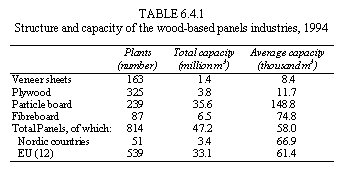
FIGURE 6.4.2
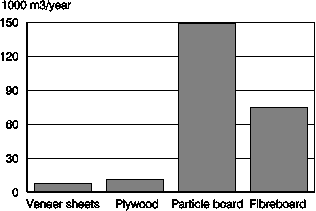
Average size of plants, 1994
Although the small sawmills may have regionally important niche markets and an important role in the rural economy (sometimes they are the only "industrial" employer in an area), their inability to innovate, notably in the development and marketing of products suited to consumers' changing needs, must be considered a brake on the expansion of forest products consumption.
In contrast, the wood-based panels sector has been marked by product innovation and development, moving towards an increasingly fine management of the technical qualities of wood, and to the ability to use raw material of ever-wider technical specifications. This has made it possible simultaneously to produce products with technical advantages over sawnwood and other materials, and to do so in many cases at lower cost. The average size of units has been rising steadily.
There are only just over 800 wood-based panel plants in Europe, with a total capacity of nearly 50 million m3. Over half the number of plants are producers of veneers or plywood, which are relatively small, compared to particle board plants. Three quarters of Europe's panel capacity is for particle board, almost all of which is in the EU (12). In recent years, there has been a rapid expansion in capacity of medium density fibreboard (MDF), as well as oriented strand board (OSB). More "value added" panels are being produced, as are more combinations of panels, so it is increasingly difficult to define meaningful categories of panels for long-term forecasts.
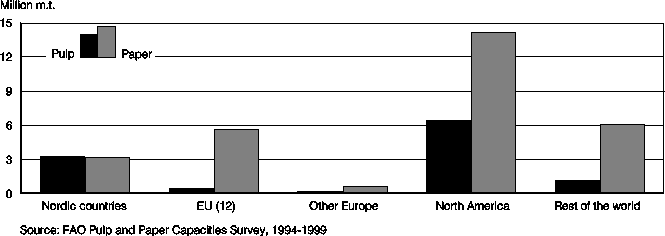
The largest units of all are in the pulp sector where economies of scale and international competition have pushed the size and cost of a "world class" Kraft pulp mill beyond half a million tons and half a billion dollars. Because of the economies of scale, pulp manufacturers need secure access to a very large, uniform source of competitively priced raw material. It is increasingly difficult to satisfy these conditions for new ("green field") plants in Europe outside the Nordic countries. Environmental limitations on emissions and effluent also restrict the choice of suitable sites for large pulp mills. Table 6.4.2 shows that nearly half the world's pulp capacity is in North America, and a third in Europe. There is about twice as much pulp capacity in the Nordic countries than in the EU. The forecasts collected by the FAO in its annual survey of the sector show that most of the expansion in pulp capacity over the next five years is expected in countries outside Europe and North America, principally in Asia.
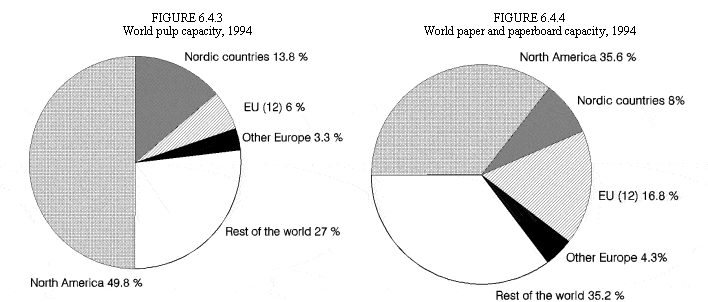
Although North America has more paper capacity than any other region, the dominance is not so marked as for pulp. In Europe, the relative importance of the EU and the Nordic counties is reversed, as the EU (12) capacity is roughly twice that of the Nordic countries. This is due to the importance of market access and transport costs, the smaller economies of scale and the many specialised paper grades which have been developed (the "bulk" grades are often produced in North America or the Nordic countries).
A study of profitability, productivity (total, and that of labour, capital, raw materials and energy) and prices in the forest industries of nine major countries of the ECE region6, prepared by a team led by Mr. M. Simula, examined trends from 1974 to 1990. It showed that for the mechanical wood industry (i.e. sawmilling and panels manufacture), profitability has been unstable and sensitive to business cycles. In most countries, gross margin on sales has tended to fall, as the relative price position of the industry deteriorated more rapidly than productivity increased. Changes in return on ca pital were much more volatile than those in gross margin on sales, with drastic falls in a few years as a consequence of recessions in the business cycle.
Total productivity in the mechanical wood industries showed no strong trend until the mid-1980s, but thereafter grew steadily in many countries, with the fastest increase in Germany. There was little improvement in raw material productivity, but significant growth in energy productivity, stimulated by the steep rises in energy prices during the period. Labour productivity increased faster than that of any other production factor, stimulated by a rapid general increase in the unit cost of labour and possibly also institutional rigidities of the labour market in some countries. However, labour productivity growth has been slower than the rate of increase in labour unit cost, contributing to the decline in profitability. Capital productivity in 1990 was in almost all countries below that of 1974 (admittedly an exceptionally good year from this point of view), and much influenced by the business cycle. Only Germany and Canada showed increases in productivity of capital.
The ratio of output prices to all input prices showed a declining trend in almost all countries. In order for the industry to survive in the long term, the effect of declining price ratios should be counterbalanced by increases in total productivity: this has been the case in Austria, Germany and, to some extent, Canada. Elsewhere, further adjustments will be necessary to avoid long-term deterioration in profitability, leading to increases in product prices and/or reduced demand or market share.
For the pulp and paper industry, profitability developed differently in different groups of countries. In Austria and Germany, there was modest profitability and small fluctuations. The export oriented group of Canada, Finland and Sweden, showed strong volatility, but no particular upward or downward trend. The Netherlands, Portugal, Spain and the USA showed strong increases in profitability over the period for a number of reasons, including strong domestic demand (USA), cheap raw material (Portugal and Spain) or closeness to markets and strong industrial groups (the Netherlands). The capital/labour ratio increased in all countries, sometimes very fast (e.g. 8.3 per cent per year in Austria). Total productivity increased in all countries except Canada. Energy and labour productivity increased everywhere, but in general, capital productivity declined, compared to 1974, but was roughly constant compared to 1975. An important factor may have been the heavy capital investment in pollution abatement, which is included as a cost, although the benefits (cleaner air and water) are not included as an output. If this aspect could have been included, the picture of total and capital productivity would have appeared more positive.
FIGURE 6.4.5
Forecast changes in capacity, 1994-99
The total price ratio in the pulp and paper industry (i.e. the ratio of output prices to prices of all inputs) declined from 1974 to the mid-1980s. Thereafter, it fell in the Nordic countries, Austria and Germany, probably because of unfavourable developments with regard to raw materials (chiefly pulpwood, but also, especially for Germany, imported pulp, as well as waste paper). This analysis did not have access to data on the indebtedness of the industries, which is a major element in the profitability equation.
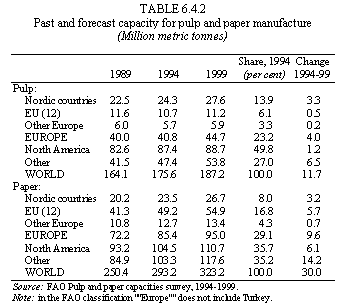
This analysis, for both sectors shows how the industries have been able to a large extent to compensate for higher prices, notably for labour and energy, by improving productivity, but that raw material and, especially, capital productivity have not developed so satisfactorily: the result being that their long-term profitability trends have not generally been upward. This must be borne in mind when considering the industries' ability to remain competitive in the future, compared to other regions and other products.
6.5 Demand and supply projections7
(i) Introduction
The outlook for forest products demand and supply has been developed using: statistical models of production and consumption; independent projections of macroeconomic activity (GDP); projections for factors directly affecting the consumption of sawnwood and panels (i.e. residential investment, manufacturing production and furniture production, combined in an "end use index"), derived from the GDP scenarios; and assumptions (scenarios) regarding trends in other factors that affect demand and supply. These other factors include product prices and raw material costs.
The projections of demand and supply are conditional forecasts; that is, they depend explicitly on assumptions made regarding exogenous factors, and implicitly on the assumption that the historical relationships in the European forest sector are stable.
(ii) Demand and supply modelling: general approach
Nine countries account for a substantial majority of European production and consumption of forest products. Therefore, as was done in ETTS IV, the quantitative analysis conducted focused particular attention on these countries. To aid in the analysis, a special effort was made to expand and improve the ETTS database; because this effort was at least partially successful, it was possible to intensify the statistical analysis and utilize new approaches. For the remaining countries of western Europe, a simpler, less data-demanding approach was used.
(iii) Demand and supply models for major producers and consumers8
For the largest markets and the major forest products producing countries in Europe, the ETTS database was expanded to support the development of more detailed models of consumption, and the development of models of product supply. In previous timber trends studies, as in most other studies of forest products demand, total (apparent) consumption was modeled as a function of product price and a demand shifter, such as GDP.9 For the present study, the model of demand was expanded in two ways.
First, consumption was divided into two parts: consumption of domestically produced products, and consumption of imported products. Separate sets of elasticities were estimated for each of these components of consumption. This approach appears justified as, in many countries, imported goods have different qualities and different distribution circuits than domestic products.
Second, both domestic price and import price, when available, were included as explanatory factors in the two demand equations. Not only are the two price series at different levels, but they each follow rather different courses. As a result, it was possible to examine an important type of substitution behaviour: the substitution between imports and domestic production.
In addition, in the present study, all countries are analyzed separately, while in other studies, most countries were included in a time-series cross-section approach. In the individual country approach, demand, supply and trade are considered simultaneously.
Product supply models also were estimated for each of these countries. The approach to supply modelling was similar to the approach used for demand modelling: total supply was divided into supply to domestic markets and supply to export markets. Here, too - within the limits of the data - it was possible to examine the dynamics of producer behaviour and the allocation of production between domestic markets and export markets. Along with domestic market price and export price, the factors used to explain supply include raw material costs (e.g. log prices for sawnwood supply, pulp prices for paper supply), an index of exchange rates, and levels of economic activity in export markets.
The general considerations for the two demand equations are:
Domestic demand: Domestic demand is the quantity consumed that has been produced domestically. This quantity is obtained as apparent consumption less imports. The hypothesis is that domestic demand variation is determined by variation, both in the unit price of the domestically produced quantities and in the unit prices of imported quantities. Also, domestic demand is expected to be determined by factors that are more or less directly associated with the end-use of the product, and measure, by proxy, the level of activity in the user sectors. For solid wood products an end-use indicator is used (see below), while gross domestic product (GDP) is used for paper products.
Import demand: The same factors appear in the domestic demand model are expected to apply in the import demand model. The expectations of the signs of coefficients for prices are, however, opposite to those in the domestic demand model.
The end-use index for sawnwood and panels is constructed from three indicators of activity in sectors which use forest products: construction activity (defined as "investment in dwelling construction", or residential investment, from the OECD national accounts data set), furniture production, and industrial production. The end-use index is a weighted average of the three components, where the weights sum to unity. The weights are the share of sawnwood consumption used in construction, furniture and other uses (mainly packaging). This is the same approach as was used in ETTS IV.
The two supply equations are:
Domestic supply: This quantity is by definition identical to domestic demand. The variation of domestic supply is expected to depend on unit domestic and export prices as well as raw material cost. Raw material cost is log price in the case of sawnwood and plywood, residue price in the case of particle board and fibreboard and pulp price for paper and paperboard.
Export supply: The supply for export (only modelled for a few country/product combinations) is expected to depend on the same prices as in the domestic supply model, but with reversed signs. Also, an index of the exchange value of the country's currency compared to that of major markets is included, as well as a weighted average index of the major markets' GDP in Europe. Because the export price series measures only the price received by exporters, and not the price paid by importers, the trade-weighted exchange rate index is used as a general indicator of the competitiveness of exports. Prices paid by importers are in local currencies; competitiveness in these markets depends in part on the exchange value of a country's currency. The index of European GDP is included as an indicator of trends in external markets.10
For both the demand and the supply equations, all prices are in the country's currency, and are deflated by the country's consumer or producer price index. This is a change from many previous international studies in which all prices were expressed in US dollars.
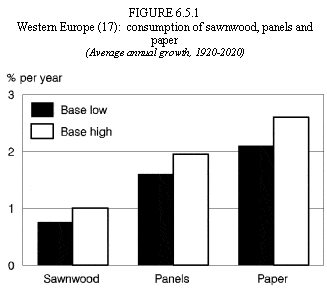
FIGURE 6.5.2
Western Europe (17): consumption of forest products
(Average annual growth, Base Low scenario 1920-2020)
A detailed description of model development and a complete display of results from the statistical analysis is available in the ETTS V working paper (ECE/TIM/DP/5). In general terms, the results can be summarized as follows.
FIGURE 6.5.3
Production scenarios for sawnwood, panels and paper
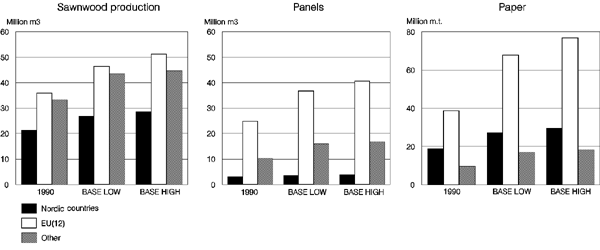
Where it was possible to include both a domestic and an import price, imports and domestic production were found to be substitutes in the consumption equations. In addition, elasticities for import demand equations were generally higher (in absolute value) than elasticities for demand from domestic sources. In other words, for any change in exogenous factors, such as the index of end-use activity, the change in import demand will be greater than the change for domestic demand.
Similar results were found in the supply equations. Where both a domestic and an export price were available, the two markets were, more often than not, substitutes. It was also the case, as in the demand equations, that elasticities for export supply were generally greater in absolute value than elasticities for domestic supply.
(iv) Demand models for other west European countries11
The model of demand for other west European countries is similar to the GDP elasticities model estimated in ETTS IV, and is a familiar model in the forest products literature. Total consumption is modeled as a function of a single price and GDP; the lagged dependent variable accounts for a time lag in the speed with which consumption adjusts to changes in price or GDP. The model is a time-series cross section model for the countries included in this group. Instead of splitting demand into two components, only one is analyzed here: total (apparent) consumption as a function of product price and GDP. Because these countries are, for the most part, net importers, the average value of imports was used as the price variable. Price and income were expressed in each country's own currency, and then converted to an index; data series for total consumption were also converted to an index. This handling of the data allows the use of a pooled time-series, cross-section approach while avoiding the need to convert all values to a common currency.
Elasticities were estimated for two groups of countries based on per capita income; a single price and income elasticity was estimated for each group. Detailed results are shown in the ETTS V working paper. Due to data limitations, product supply equations were not estimated for these countries; for forecasts, supply is calculated on the basis of consumption forecasts with an assumption about future self-sufficiency ratios.
(v) Projection methods
The models are used for projections where the model structure is assumed to remain constant in the projection period. The independent (exogenous) variables of the model system must themselves be forecast to obtain projections for the dependent (endogenous) variables of the system. This means that forecasts - or scenarios - must be available for the end-use index (solid wood products), for GDP (paper), prices and costs (all products).
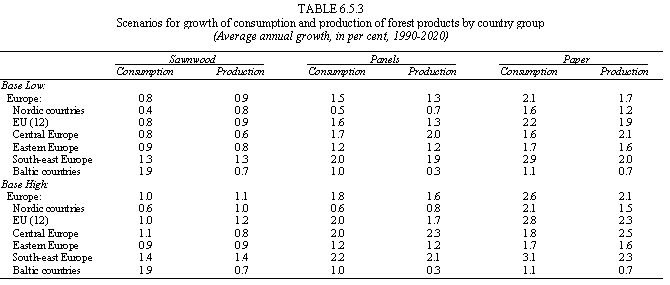
Two base scenarios were constructed: Base Low and Base High, which differ only in the assumptions for GDP. The following assumptions were used for the independent variables:
- GDP projections are those in chapter 3, i.e. of 2.0 per cent (Base Low) or 2.9 per cent (Base High) until 2005 and of about 1.7 per cent from 2005 to 2020 (see table 3.2.1);
- the end-use index for solid wood products is projected, on a country by country basis, using its relationship to GDP. For residential investment, which is expected to grow rather more slowly than GDP, see table 3.3.1;
- in the base scenarios prices and costs are set constant for the projection period.
- estimated time trends in the models are assumed to continue in the projection period.
The model system generates projections for domestic demand, import demand, domestic supply and supply for export. From these are calculated projections for consumption (import demand plus domestic demand) and production (domestic supply, which is equal to domestic demand, plus supply for export). The difference between production and consumption is net trade, although it must be stressed that this model system does not analyse trade volumes or patterns as such, but generates net trade projections as the "by-product" of the other projections.
Projections are given in ETTS V in ten-year intervals (although the working paper provides them at 5-year intervals), where quantities obtained should be interpreted as average levels over ten-year periods centred around the mid-year of the period. The projections reflect only long-term aspects and do not cover business cycle variation. The conditional aspects of the forecasts should be stressed again; projections are obtained from econometric models where the estimated coefficients of the models are assumed to remain constant over the forecasting period. Also, the projections are conditional upon the input forecasts of the end-use index, GDP, prices and cost.
For the period 1990 to 2020, the models and the GDP assumptions are used directly to give projections. There is, however, one major exception. For paper products, proposed capacity expansions to year 2000 are available by country (and even by mill) from the FAO. In countries where paper production increase is projected to exceed capacity expansion for this period, production growth is set equal to capacity increase. This applies to one third of the countries analysed and the assumption is that new capacity will be fully utilized while old capacity will, on the average, be used as before. After 2000, the projections are not constrained.
(vi) Summary of results
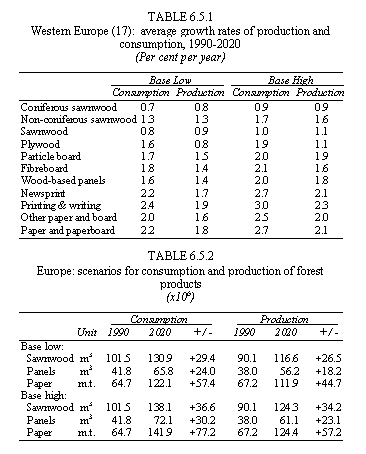
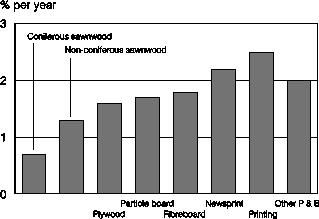
On the assumptions set out above, both consumption and production of forest products in western Europe (i.e. the 17 market economies for which econometric analysis was carried out) are projected to continue to grow over the long term, but at a modest rate. Consumption of paper and paperboard is expected to grow rather faster than that of panels, and that of sawnwood the slowest of all. For panels and paper, European production is expected to grow slower than consumption, causing net imports to rise, while the opposite is true for sawnwood. The fastest growth will be for printing and writing paper, which has seen very rapid expansion in recent years.
Although the annual growth rates appear relatively modest, over the projection period, for Europe as a whole (including the transition economies) they accumulate to quite large volume increases: 29-37 million m3 for sawnwood consumption, 24-30 million m3 for panels consumption and 57-77 million m.t. for paper consumption; increases over the thirty year period of respectively a third, a half, and around 100 per cent of the 1990 figure. The question of where the raw material can be found for this increase in consumption is discussed in chapter 11.
By country group, the highest rates of growth are forecast for south-east Europe and the lowest for the transition economies and the Nordic countries, although there is only a rather small variation in growth rates between the fastest and the slowest.
This chapter has presented only the base scenarios, which assume constant prices and costs and a constant relationship between residential investment and GDP. Alternative scenarios, with different assumptions for these are presented and discussed in chapter 12, in the context of the supply/demand balance for the sector as a whole.
1
As an anecdotal example, the ETTS V coordinator's three-year old daughter was recently given a box of non-wood colour pencils, claimed to be stronger than wood and environmentally friendly. In use and appearance they are practically indistinguishable from wood pencils.2
There has been progress on this point in recent years, but not enough.3
Examples are mugs and plates, wheels and transport in general, many tools, drainage, weapons, ropes (from bark), machinery for milling, in addition to the whole hous ing structure, including the roof (structure and outside covering), walls, floors, etc.4
To take two extreme examples, the flow of logs and chips from the Pacific coast of the US and Canada to Japan, and the flow of pulpwood from Chile or Argentina to the Nordic countries.5
Source of data: Survey of the Structure of the Sawmilling Industry, Volume XLIV, No.2 of the Timber Bulletin. All data regarding sawmilling capacity must be considered rough estimates because of the difficulties of measurement and comparability.6
ECE/TIM/72.7
For market economies only, as transition economies are addressed in chapter 10.8
Austria, Finland, France, Germany, Italy, Norway, Spain, Sweden, and the United Kingdom.9
Other examples of this approach include the FAO Outlook studies.10
Including a demand variable (GDP) makes this equation, in effect, the reduced form of a more complex system of equations that would model demand in external markets.11
Belgium, Luxembourg, Denmark, Greece, Ireland, the Netherlands, Portugal, Switzerland, Turkey.
