


Chapter 11 BASE SCENARIOS FOR THE FOREST AND FOREST PRODUCTS SECTOR TO 2020
Previous chapters addressed the outlook for various parts of the sector separately. This chapter brings together these separate scenarios into two base scenarios for the sector as a whole, which are internally consistent and cover all the major aspects of the sector.
The major tool used to produce these base scenarios is a material balance model, which brings together the scenarios for the different parts of the sector and checks their internal consistency by the use of a simple flow chart and input/output conversion factors. This model includes country-by-country data, at ten-year intervals from 1990 to 2020. The country-by-country data are published in an ETTS V working paper.
After a brief discussion of the methods used, this chapter presents the two base scenarios. A selection of alternative scenarios, which are of interest because they address either areas of major uncertainty or areas where there are significant long-term policy choices to be made, is presented in chapter 12.
This section only presents an overview of the methodology of the model; the detailed structure will be presented in the ETTS V Working paper. Country data for the base scenario have been checked by country correspondents.
The base scenarios have been constructed from the following elements: removals data based on national forecasts, presented in chapter 4; consumption and production of forest products, in all countries except the transition economies, are projected using the methods presented in chapter 6. For transition economies, national forecasts have been used, as presented in chapter 10; and net trade of forest products is, by definition, the difference between production and consumption, as discussed in chapter 8. Net trade in raw material was estimated in consultation with national correspondents, in the light of the initial results of the model: the use of wood for energy is estimated on the basis of national forecasts (chapter 9); and the rates of recovery of waste paper and use of wood residues have been estimated by the secretariat in accordance with the thinking set out in chapter 7.
The consistency analysis model calculates demand for roundwood by country on the basis of scenarios for consumption, trade and production of forest products, using input/output conversion factors supplied to FAO/ECE as part of a regular enquiry. Flows of waste paper and of residues, as well as use of wood for energy are discussed explicitly. This derived demand for roundwood is compared to national forecasts of roundwood supply. In the few cases where the gap between the two in the initial run was unacceptably large, adjustments were made in consultation with national correspondents, so that in the base scenarios, the "gap" between derived and forecast removals is quite small.
The only difference in assumptions between the two base scenarios (Base Low and Base High) is that referring to the speed of growth of the overall economy, as set out in chapter 3.
Although the model is expressed in purely physical terms, it has a foundation of economic theory. All the parts of the initial scenario assume constant real prices for roundwood and for all forest products.
(i) Underlying assumptions
Like all scenarios, the base scenarios are based on specific assumptions, which must be kept in mind when evaluating the results. For the two base scenarios, the most important assumptions are as follows:
- west European GDP will grow by about 1.8 per cent per annum (Base Low) or 2.8 per cent per annum (Base High) to 2005, and about 1.5 per cent per annum thereafter (both scenarios);
- the transition economies will recover 1990 income levels by 2000, and show steady, but not spectacular economic growth thereafter;
- residential investment is expected to expand only slowly, and probably considerably slower than the economy as a whole;
- costs and prices in real terms in general for roundwood and forest products will remain constant in the future as they have in the past;
- there will be no fundamental changes for forest policy in Europe, which includes a continuation of the trend to increased emphasis on non-wood management objectives;
- policies on environmental protection, biodiversity, waste management and sustainable development will be further strengthened;
- there will be no major disruption of energy supply or substantial rise in general energy price;
- there will be a continuing free trade regime;
- there will be further cut backs of public spending, despite the maintenance of social and environmental objectives.
Underlying the econometric analysis of the supply and demand of forest products, is the implicit assumption for all econometric projections that the functional relationships between the dependent variables (levels of consumption and production of forest products) and the independent variables (economic growth, relative prices), calculated from rigorous analysis of long data series (1964-92), will also remain constant in the future and will not be disrupted, for instance, by major changes in consumer behaviour or technological development. Stochastic changes in behaviour or technology are impossible to encompass in the econometric analytical framework of ETTS V except by sensitivity analysis, of the type used to generate the alternative scenarios, which will be presented in chapter 12.
(ii) Overview of the base scenarios
In this section, the paragraphs in normal typeface present the direction and magnitude of trends. Those in italics contain more qualitative comment, describing the circumstances which might accompany the scenarios.
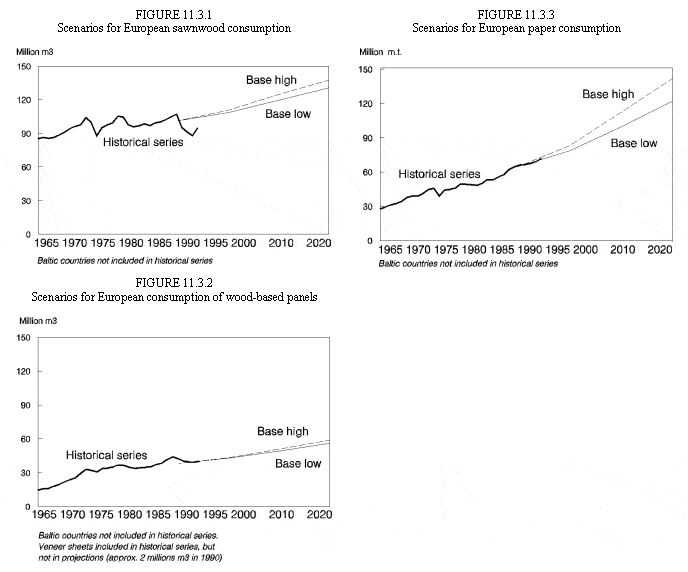
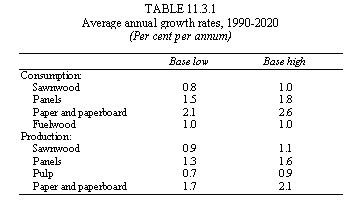
Consumption of sawnwood and panels is expected to continue to grow over the whole period 1990-2020, although more slowly than the economy as a whole, largely because the main user sector, construction, will grow more slowly than other parts of the economy. Consumption of paper and paperboard, however, will continue to grow at about the same rate as the economy as a whole.
Forest products are exposed to competition in their various markets, but are able to maintain their position through the development of new products, by controlling costs and adapting distribution and marketing circuits. They may have an advantage over other raw materials because they are renewable and recyclable; other products may start to have to bear the true costs of disposal, non-renewability and energy intensity. The main reason for the fact that consumption of forest products grows more slowly than the economy as a whole is that the main use sectors, notably construction, but also paper using sectors, grow more slowly than services or "high tech" sectors. The distinction between sawnwood and panels may become increasingly hard to make as new composite products, with mixtures of panels and various variations of glulam and fingerjointing, providing economic, engineered materials from small-sized wood, become the norm. The growth rates for paper assume that the long-feared (by the paper industry) replacement of paper-based communication by other, electronic means does not, in fact, take place.
European production of sawnwood and panels is expected to grow at about the same speed as consumption, but production of paper and paperboard rather slower than consumption, causing European producers to lose market share. Pulp production (and consumption) would grow slowly as waste paper recovery rises.
Europe will remain attractive for established industries, especially where there is a large and/or uniform forest resource, or in the proximity of major markets, or where there is a sophisticated infrastructure of know-how and institutions to support a modern industry. However, as costs will be higher than in other regions with better growing conditions or cheaper labour (the cost of capital, an increasingly important factor of production in all parts of the sector, will be increasingly uniform, as capital markets become more global), competition will remain strong, leading to loss of market share.
Even though no significant energy price shock is expected, the consumption of wood for energy is expected to continue to grow steadily as wood's advantages as a renewable, decentralised, CO2 neutral, energy source (which also solves major waste disposal problems for the wood-using industries) are more widely recognised and the necessary investment carried out.
This may be considered a reasonable scenario if there are no strong measures to raise the price of fossil fuels or nuclear power. If there were significant rises in general energy prices, this scenario would certainly be an underestimate. The use of wood residues as an energy source, primarily in the forest industries, will also continue to expand. The main wood energy consumers will continue to be rural households, the forest industries, and "intermediate" users such as communal buildings (schools, barracks, etc.) or district heating plants where the economic and social circumstances allow.
The European average recovery rate of waste paper (for re-use as raw material) is expected to rise from about 37 per cent in 1990 to over 48 per cent in 2020. The volume recovered for re-use in 2020 would be double (Base Low) or triple (Base High) that of 1990. Likewise, an ever smaller share of wood processing residues will be wasted than at present, with most being used as raw material for pulp or panels, as an energy source or for other uses (e.g. horticulture). In 1990, about 60 per cent of the processing residues generated were used as raw material (mostly for pulp or particle board): this share is expected to rise to 72 per cent in 2020.
Although the waste paper recovery rate forecast for 2020 is still well below the theoretical maximum (which may be around 60 per cent) it is still high, considering that in many south and east European countries recovery rates at present are below 20 per cent. In 1990, the amount of waste paper recovered in Europe was about 66 per cent of European pulp production, but in 2020, it will be over 95 per cent. It is highly likely that ever-increasing volumes of residues from the secondary wood processing industries, including furniture and joinery, as well as used wood (such as broken or one-way pallets, packaging, demolition waste) will be used as raw material or as source of energy.
Under present forest policies, removals of roundwood from Europe's forests are expected to rise slowly, from about 390 million m3 to about 480-490 million m3 in 2020. Most national correspondents felt that this level of supply was chiefly determined by factors such as silvicultural methods and age-class structures rather than roundwood prices (i.e. that roundwood supply in most parts of Europe is price inelastic). This rate of felling would still, however, be only around 70 per cent of net annual increment, and the growing stock would increase, from an average of 143 m3 per hectare in 1990 to 173 m3 per hectare in 2020, and 197 m3 per hectare in 2040. Average growing stock per hectare is expected to reach unheard-of levels in certain central European countries. The removals forecasts do not assume any significant expansion of the forest area, for instance by the transfer of agricultural land to forestry.
The significance of this "under-use" of the European forest resource varies from region to region. In some areas, it is something of a statistical fiction as there is no realistic likelihood of expanding production, for instance, because of small size of holdings or difficulty of access. Elsewhere, it may be the result of an uneven age-class structure of the resource, e.g. with a preponderance of young stands. In a few cases, notably the major European exporters, it may be a real reserve of wood supply which could be developed if the demand is present. Economically however, one effect is clear: if there were a "shortage" of wood, due for instance to strong demand and/or supply interruptions in other parts of the world, the physical potential exists to expand substantially Europe's domestic production of roundwood. If the price of standing timber were to rise significantly over a long period (i.e. discounting temporary price "spikes"), this potential could be realised relatively fast using existing stocks, and without enormous investments and without imperilling sustained yield. Chapter 4 estimated the realistic maximum level of removals in 2020, without depleting the forest resource, at 530 million m3, 140 million m3 more than in 1990 and 50 million m3 more than the level forecast by countries for 2020. The supplementary increase, if there were one, would come essentially from the three major exporting countries, Austria, Finland and Sweden.
As a result of growth in consumption, combined with loss of market share by European producers and a limited increase in Europe's removals, Europe's net imports of forest products (excluding wood in the rough) from other regions are expected to increase, particularly for paper. In the Base Low scenario, total net imports from other regions would rise by about 55 million m3 EQ by 2020. In the Base High scenario, this increase would be of the order of 80 million m3 EQ.
In the authors' view, the rest of the world has the potential to supply this extra volume, despite the forecast economic growth in Asia and the likely reduction of wood supply from natural forests, tropical, temperate or boreal. Economic growth in wood-poor regions may well not generate as strong a demand for forest products as it has in the relatively wood-rich regions of Europe and above all, North America. Furthermore, there is considerable potential to increase supply at competitive prices of products based on the highly productive areas of fast-growing, export-oriented plantations, especially of pine and eucalyptus (already productive in New Zealand, Chile, Brazil and Argentina and elsewhere, while Indonesia and other countries are developing their potential). The major uncertainty concerns the level of price at which this volume would be available: if higher prices were necessary to stimulate this supply from producing regions outside Europe, European prices would be pushed upward. At present, no scientific evidence is available on the global supply/demand balance, so the initial assumption of constant real prices has been accepted for the base scenarios. However, alternative scenarios, with different price assumptions are presented in chapter 12.
In the base scenarios, net imports of wood in the rough are forecast to rise, from 14 million m3 in 1990 to 36-42 million m3, an increase of 22-27 million m3. However, in the base scenarios, the figure for net imports of wood in the rough, although endorsed by national correspondents, is essentially a residual figure, being the difference between the projected demand for wood raw material (based on the production projections), and the national removals forecasts. As such, it is more an indicator of a potential need for supplementary raw material than a forecast of a trade flow. According to the internal logic of the consistency analysis, these requirements could be met either from raw material imports or from higher removals than forecast by national correspondents. Furthermore, it is entirely accounted for by the particular situations of five countries: Poland, Sweden, Germany, Finland and Austria.1
(iii) The policy context of the base scenarios
This section compares chapter 2, which presented the expected policy context for ETTS V, with the base scenario in order to ascertain whether the two are in harmony or not. A summary of the chapter 2 policy context is in plain type, with a commentary on the relation between it and the base scenario in italics.
Economic policy would be targeted to reinforce growth and reduce unemployment, at least in the 1990s and the first years of the twenty-first century.
This is fully compatible with the GDP growth rates for the market economies used for the projections.
Continued ample energy supply will continue to inhibit policy changes in the energy sector. There will be no major disruptions to supply and new energy taxes will not raise prices substantially.
The forecast rise in consumption of fuelwood and other types of energy wood may be considered a natural extension of present trends. If prices of non-renewable energy sources were to rise significantly, there would be a corresponding increase in the consumption of energy wood (see alternative scenario in chapter 12).
Policy on environmental protection, biodiversity and sustainable development will be further strengthened, and as a consequence, there would be more areas of forest removed from wood production, more environmental guidelines, encouragement of recycling, imposition of real costs of disposal on waste generators and increased energy generation from wood residues and used products.
It appears quite feasible, given the level of removals well below annual increment, to reach the levels of removals proposed in the base scenario while at the same time setting aside larger areas for the conservation of biodiversity and applying more ambitious environmental guidelines. The increased policy insistence on recycling and renewable energy is quite compatible with ETTS V scenarios for these fields.
Considerable areas of agricultural land are expected to be withdrawn from food production, and that alternative land uses, including forestry, will be actively sought and financially supported.
This appears at first sight to be in contradiction with the expectation of national correspondents that the area of exploitable forest will expand only slightly. However, this contradiction may be more apparent than real, as withdrawal of land from agriculture does not necessarily lead to an increase of exploitable closed forest. National reports for the OECD workshop on agriculture forestry and the environment in October 1994 indicated that, in many countries, millions of hectares of agricultural land will indeed be taken out of intensive food production and the incentive systems will be changed, to favour direct payments at the expense of market support measures. However, not all this land, or even much of it, will go into forestry regimes oriented toward wood production. The expansion of forestry will be small scale, for the enhancement of landscape and biotopes as w ell as for recreation, while much of the agricultural land will continue to be used for food production, but in a less-intensive way (the new incentive systems will not encourage the intensive, high-input/high-yield measures which are at the root of many present problems), or for other uses, such as recreation. The increase in wood supply which might result from the withdrawal of millions of hectares of land from intensive agriculture would therefore be small.
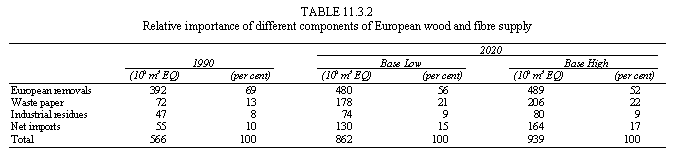
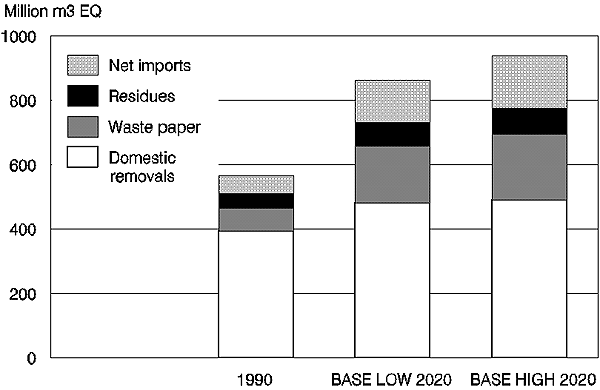
FIGURE 11.3.4
European wood and fibre supply
The trade policy scenario foresaw a continuing free trade regime, increased volume of trade and binding agreements on trade and environment.
This is largely in line with the base scenario, notably the increased net imports to Europe. The implementation of agreements on trade and the environment could have significant consequences for the forest sector, through the institution of a system of certification of forest products.
With regard to the transition economies, the income level of 1989 was expected to be recovered by 2000, and steady growth to occur thereafter.
The scenarios for the forest sector are in accordance with the policy scenario.
Policy for the public sector is expected to continue to cut back on public spending, while maintaining social and environmental objectives.
This has no direct link with the ETTS V base scenario itself, except for the implicit assumption underlying the removals forecasts, that the economics of wood harvesting and silviculture, including the ability of public forest services to function at a loss, will not be significantly modified. However it will have a major influence on how the questions raised by ETTS V are resolved. For instance, how much public funds would be available to stimulate more environmentally conscious and possibly non-economic2 forestry practices? How important to public budgets (national, regional and local) is the income from wood sales by public forest services?
(iv) Outlook for the balance between supply and demand in the base scenarios
The first of the major objectives of ETTS V, and the most challenging, is to explore the outlook for the balance between supply and demand for roundwood and forest products. Of course, supply and demand will, by definition, be in balance: however, there is a more dynamic question of the nature (direction and strength) of the many factors influencing supply and demand, and of their interactions. The most eloquent indicator of the relative strength of the various forces are trends in price levels, which are also, of course, of immediate practical importance to all policy makers and decision takers. The methodology chosen for ETTS V specifically addresses price in the econometric analysis of supply and demand of forest products in western Europe, but not in the consistency analysis, which only contains quantity data. This section attempts to summarise what can be deduced about the outlook for the supply-demand balance and for prices from the base scenarios.
At this juncture it is useful to get the magnitude of the different components of the supply of forest products to Europe in proportion.
Table 11.3.2 shows clearly that the largest supply element is now, and will remain, European removals, although their relative importance will decline quite substantially, from two-thirds to just over one-half of supply. The second most important, and the sector showing the strongest relative growth, is waste paper, which is expected to account for over a fifth of European supply of wood and fibre by 2020, as compared to 13 per cent in 1990. Net imports, which accounted for about 10 per cent of fibre supply in 1990, are expected to rise to 15-17 per cent by 2020. The relative share of industrial wood residues would remain constant at around 10 per cent.
What are the implications of the base scenario and the relative weights given above for the outlook for the balance between supply and demand at the regional level and for prices? One approach is to examine the supply/demand balance sector by sector, identifying those factors tending to create "oversupply" and those tending to create "shortage".
Although the market behaviour of European forest owners, in particular, their likely reaction to significantly higher or lower roundwood prices, is little investigated and poorly understood, it is clear that the largest supply element, domestic removals, is characterised by a situation of structural over-supply, due to the continued difference between real and potential supply (which may be considered very roughly measured by removals and net annual increment).
The element which is certain (in all conceivable scenarios) to show the most significant growth is the recovery of waste paper: as discussed in chapter 7, in many respects the waste paper markets are supply driven, essentially because of municipalities' need to dispose of all waste in the most economic way possible. Put crudely, the paper will be recovered and used in ever-larger quantities, whatever the level of prices for papermaking fibre on regional or global markets. The supply of wood residues is essentially determined by levels of sawnwood production and by technical constraints on sawmilling and wood use by panel and pulp manufacturers. Thus, at least three quarters of Europe's supply of wood and forest products (i.e. domestic removals, waste paper recovery and supply of residues) will be affected by tendencies towards over-supply, or factors mostly driven by supply side mechanisms
However at the global level there are undeniable upward pressures on forest product prices, which could be transmitted to Europe by net imports. These are essentially: the expected growth in demand for forest products driven by population pressures and rapid economic growth in some major, mostly Asian economies; and the cutback in supplies of wood from some traditional supply areas, including the natural forests of Canada and the US, Siberia and several tropical countries, especially in south-east Asia.
These two global market factors have led many analysts to assume that the world is now in a phase of structural upward adjustment of forest products prices. This belief was reinforced by the sharp price rises on many markets in 1993-94 (which were, however, corrected in many markets in 1994-95). However, the long-term outlook is more complex than is sometimes admitted. Two aspects in particular might mitigate or counteract the upward price pressure and the trend to scarcity:
- the demand projections may be too high: effective demand may be low in poor countries, even countries with large populations. Furthermore, the rapidly expanding economies may experience "wood-free growth" (see section 8.6). The possible consequences of scarcity induced price rises on projected consumption levels have also not been sufficiently explored;
- the potential of low-cost, fast-growing plantations, e.g. of pine, Gmelina or Eucalyptus to satisfy demand for fibre has been underestimated. Experience in a number of countries, including Argentina, Brazil, Indonesia, New Zealand and South Africa, has shown that investment in large-scale industrial wood plantations may be technically feasible and economically viable (see section 8.4.ii).
In circumstances of wood "scarcity" and rising prices, demand for forest products would be lower than projected and supply from plantations would be higher (in the medium term, say five to ten years), thus limiting world-wide price rises, especially in relatively self sufficient areas like Europe.
On the demand side, in Europe itself and in other regions, there is fierce competition for sawnwood and panels from other construction and packaging materials, notably on cost grounds, and for paper, on grounds of both cost and convenience, from electronic means of communication (which include not only telephone and e-mail communications, but also radio, conventional, satellite and cable television, and electronic newspapers, all of which compete with paper-based media for advertising expenditure). Forest products have every chance to maintain their market share (indeed, this is the conclusion of the econometric analysis) but this would be difficult to attain if there were significant price rises. If prices of forest products increase, for instance because of "shortages" on global markets or failure to control costs in other ways, then consumption levels will be lower than in the base scenarios. This hypothesis is quantified in the alternative scenarios in chapter 12.
In general therefore, there are two major factors encouraging scarcity: the steadily rising levels of European consumption, and supply cutbacks and growing demand in some other regions; and two tending towards over-supply: the large increase of waste paper supply and the potential to increase European removals significantly without endangering sustainable wood supply, or indeed sustainable forest management in the broader sense.
Taken together, in the secretariat's judgement, these will ensure that supply and demand, both for roundwood and for forest products, remain roughly in balance and that competition will continue to be fierce between forest products and with other materials. There is therefore no reason to reject, on the grounds of the results of the consistency analysis, the hypothesis of constant real prices for forest products.
It is clear from the above argument that there is considerable uncertainty about some important areas, notably the outlook for forest products supply and demand in other regions. This should be borne in mind during the discussion which follows.
1
In Sweden, Finland and Austria, raw material requirements are higher than forecast removals by 5, 4 and 2 million m3 respectively. In each of these countries, if plentiful supplies of cheap wood are not available on world or European markets, removals could be increased by these volumes or more, without threatening sustainability. In Poland, the production levels forecast (without econometric techniques) imply raw material requirements nearly 7 million m3 over the forecast removals level, which is already near the maximum allowable level: either raw material must be imported, or production or consumption must be lower than forecast. Finally, German net exports of wood raw material, which were about 4 million m3 in the exceptional period around 1990 (influenced by the windblow), would have to fall to insignificant levels if the projected raw material requirements of German industries are to be met from domestic removals (which are acknowledged to be well below the potential, even, according to some, desirable, level).2
With the present accounting practice, whereby measures to improve environmental quality are considered costs with no corresponding benefits, improvements in environmental quality are not quantified in monetary terms.
