Abiye Astatke and Ferew Kelemu
Introduction
The traditional implement - "Maresha"
Traditional practices followed for growing crops on Vertisols
General criteria considered in designing the BBM and attachments
The broadbed maker and its evolution
BBM attachments and their significance
The evaluation of the broadbed maker
Crop production on Vertisols is often constrained by their physical and hydrologic properties. The main aim of land preparation is to modify and manipulate the land features and soil properties so as to create a favourable environment for seedling establishment and crop growth. The research and development in this field must take into account the practices used by the farming community and the experiences gained from previous research. This chapter provides a brief description of relevant farmers' practices, the traditional implements used and the experience of the Joint Vertisols Project (1986-91) in developing simple and low-cost implements for Vertisols in a highland agricultural system.
Historical background
Agriculture in Ethiopia is believed to have started 7000 or more years ago. It is not certain when, during this period, the use of animal-drawn tillage implements began. It has been conjectured that Ethiopians inhabiting the northern cereal growing highland areas of the country were introduced to the ard between 1000 to 400 BC by Semitic-speaking invaders from South Arabia (Goe, 1987). A more recent hypothesis, based on available archaelogical evidence, suggests that the use of the ard may have been developed previous to the Semitic invasion by Cushitic-speaking peoples from an ancient region called Nubia in north-eastern Sudan (Goe, 1987). The use of the maresha might not 'have' been associated with one specific group of people. It may have probably been dependent on the physical environment of a particular region that could support animals capable of pulling the implement. Regardless of who introduced the maresha or its prototype into Ethiopia, the acceptance and utilisation of an implement which was powered by animals has contributed towards developing crop-livestock integration currently existing in the country.
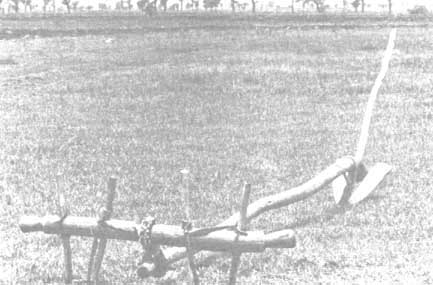
Figure 1. The traditional plough - maresha.
Description
There are certain areas in the highlands where hoe-cultivation is still practiced But by and large, cultivations are carried out by oxen, pulling the traditional plough the maresha Again in certain small pockets of the country, horses and mules are occasionally used to pull the maresha, but generally, oxen provide the main tractive force.
The traditional plough consists of a metal point or tine, fastened on a wooden arm, to the pole, which in turn is fastened to a wooden neck yoke as shown in Figure 1. At each side of the metal point are two wooden wings which push the soil aside. The traditional plough is a light implement ranging from 17 to 26 kg with the yoke (Goe, 1987) and makes it possible to be transported together to and from the field over different terrain by one person. Except for the metal tine which the farmer has to buy from the blacksmith at about US$ 1.00, the rest is home-made. Depending on the crop types, three to five cultivations are required by the maresha before a field could be ready for planting (Table 1).
Each cultivation pass is made perpendicular to the previous one so as to disturb the whole soil. The depth of the first ploughing ranges from 5 to 8 cm while with the last pass up to 20 cm depth could be attained. The time required for land preparation also varies from 100 hrs/ha to 150 hrs/ha for Vertisols and light soils, respectively (Abiye Astatke and Matthews, 1982). The maresha has the advantage of being handled by a pair of indigenous oxen each weighing not more than 300 kg. The power developed by a pair of local zebu oxen pulling the maresha ranges between 050 to 0.90-kw (Abiye Astatke and Matthews, 1980).
Table 1. Average annual input of animal power (pair of oxen) for cultivation and seed covering for different crops at Ada and Baso and Worena weredas (hours/ha).
|
Crop type |
Ada Wereda |
Baso and Worena Wereda |
|
Teff |
165 |
n.a.p. |
|
Wheat |
144 |
148 |
|
Barley |
n.a.p. |
119 |
|
Horse beans |
112 |
120 |
|
Chickpeas/field peas |
103 |
79 |
n.a.p. = crops not grown in the area.
Source: Adapted from Gryseels and Anderson (1983).
The power developed is dependent on the soil type, soil moisture, soil compaction status, depth of ploughing and the pulling power of the animals.
A serious disadvantage of the maresha is that it is a cultivating implement rather than a plough. The soil is not inverted and there is no cutting action. It will be seen therefore, that whilst the maresha is an ideal cultivating implement, it is of very little use in burying stubble and weeds. It is significant to note that weeding out grass-type weeds from cereal crops is a major activity in the agricultural calendar making it probably the most serious bottleneck.
The other problem using the maresha occurs during seed covering. In the traditional cultivation method, all the cereal crops and pulses after being broadcast will be covered by a pass with the maresha. The exception is Eragrostis tef which is broadcast and left. Thus the depth of coverage varies from seeds not covered at all to the maximum depth which the maresha tine penetrates. This might be the reason why farmers tend to double or sometimes triple the seed rates recommended by research institutes, as germination rates would be low otherwise.
Previous modifications
The development of a suitable mouldboard plough as a replacement for the maresha continued to prove difficult up through 1980, with major obstacles being cost, weight, durability and difficulties in getting repairs made at the artisanal level. Past attempts to modify the maresha have included the "Jimma plough" in which the wooden soles and share were substituted with flat iron strips and a vertical knife, the "Vita plough" in which the complete ard head of the maresha was replaced with a metal mouldboard assembly, and the "ARDU plough" which is a modified version of the "Vita" design (ARDU, 1980; Goe, 1987).
The Jimma plough was found to function poorly with respect to angle adjustment of the vertical wedge, and because the flat iron strips were stronger than the wooden soles there was a greater tendency for the beam to break at its base. Trials demonstrated that while the Jimma plough provided a better tillage than the maresha on loose soil, it had no advantages when used on fallow plots or clay soils (Goe, 1987). It was also more costly than the maresha.
Tests with the "Vita" prototype indicated that design changes in the moulboard assembly and angle of the handle were necessary to improve its tillage performance. These and other modifications were subsequently incorporated into what later became known as the 'ARDU plough'. However, this plough was rejected both by farmers and extension agents because it was too heavy to be easily transported to and from the field. The metal frame which was attached to the beam to support the mouldboard assembly did not provide adequate stability and the durability of the share and mouldboard were poor due to the high cost of the plough. It also had a higher draught requirement (10-40%) than the maresha, thereby causing the oxen to become more easily fatigued (ARDU, 1980). Overall, adoption of these three implements has not been successful.
During the main growing period, waterlogging is one of the major constraints for crop production in the Ethiopian highland Vertisol areas. The severity of the constraint varies from area to area depending on the clay content of the soil, rainfall (during that period) and the soil temperature which also depends on the moisture content of the soil. Farmers of the Vertisol areas realise the adverse effects of waterlogging on crop productivity and have developed traditional methods for overcoming it.
One of the traditional methods practiced for overcoming the waterlogging problem is planting crops late in the season after the excess water has naturally drained away to grow on the residual moisture. The varieties of these crops like wheat, chickpea, rough pea etc have a short growing period of not more than three months. Eragrostis tef which mildly tolerates waterlogging is planted during the middle of the rainy season. Traditional practice does not fully exploit the growing period. Hence crop yields are low averaging 0.8 t/ha (Berhanu Debele, 1985).
In the high-altitude areas of Ethiopia, ie. above 2400 m asl, a unique practice called 'guie' is adopted for growing barley on Vertisols after leaving the area fallow from 5-8 years (Tesfaye Tessema and Dagnatchew Yirgou, 1973). The farmers plough the land three to four times during the dry season, heap the soil at irregular spacing and burn it with dry manure, grass and weeds. The soil is then spread back on the fields (Berhanu Debele, 1985). After the onset of the following rains in mid-June, the fields are ploughed again and barley is grown. The planting of barley continues for two to three seasons and the land is then left for fallow. The burning of the soil 'guie' changes the top soil structure producing more coarse texture which facilitate better water movement and drainage.
Different cultivation techniques are also practiced using the maresha to minimise the waterlogging problem on Vertisols Flat seedbed preparation is common on gentle slopes except for the fact that outside ditches are sometimes dug to control flooding. This method is common in drier regions and crops such as horse bean, field peas, barley, linseed and sorghum are planted (Abate Tedla and Mohamed-Saleem, 1992).
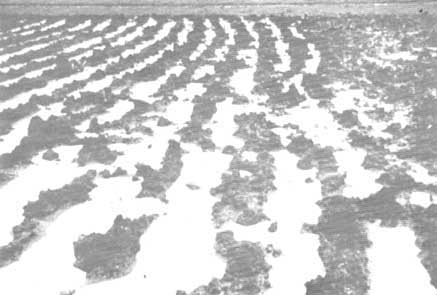
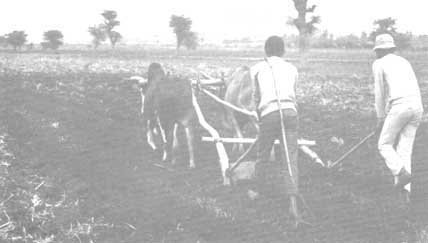
In some parts of the central highlands of Ethiopia (Shewa and Gojam), drainage furrows are made with the maresha on the flat seedbed after planting These furrows are made across the contour at distances ranging from three to seven metres. These drainage furrows have an average of 15 cm and depths of 20 cm. The area taken by the drainage furrows from the crop areas can be 10-15% (Westphal, 1975). In areas with high rainfall, it is common practice in the traditional system to make ridges and furrows using the maresha. The ridges and furrows are made after broadcasting the seeds on the traditionally prepared seedbed. The ridges and furrows are again constructed by the maresha at an interval ranging from 40 to 60 cm. The height of ridges from the bottom of the furrows varies from 10 to 15 cm. The major problem with this traditional system has been that no outside drainage is constructed to take the field water. On very low slopes, this practice does not drain out the water from the field. The water thus forms ponds in the furrows (Fig. 2). On moderate and higher slopes, the flow of water from the fields accelerates erosion.
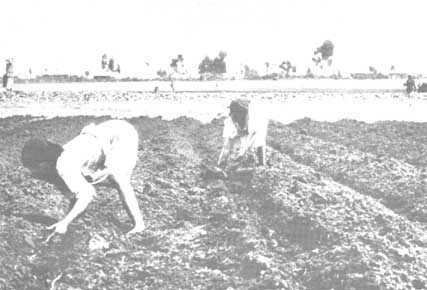
At Inewari which is found in the central highlands of Ethiopia, surface drainage of Vertisols is facilitated with the use of manually formed broadbeds and furrows (Fig. 3). The seedbed is prepared by making 3 - 4 passes with the maresha. In the middle of the rainy season, the seeds are broadcast and furrows made with the maresha at an interval of 0.8 to 1 m. Using family labour, the soil is then scooped up from the furrows and dumped on the beds. By using this method, they not only form the broadbed and furrow but they also cover the seeds. In the traditional system, grass drainage channels are also constructed to carry the water coming from the crop fields. This practice of constructing broadbeds and furrows manually involves hard work for the farm family.
Figure 2. Ponding of water in the furrow tillage system.
Figure 3. Broadbed and furrow construction using manual labour at Inewari.
General criteria considered in the design of the broadbed maker and attachments are soils, the resources available to the farmer, traditional farming systems and manufacturing and repair facilities locally.
Soils
Vertisols are comparatively fertile soils found mainly on land with a slope not exceeding 8%. These soils have clay contents between 35 and 80%, which largely determine their physical properties. Due to the high clay content, the water-holding capacity is high, the infiltration rate low, and the internal drainage slow. This often leads to waterlogging during the main rainy season. At low soil-moisture levels, Vertisols shrink forming cracks up to 10 cm wide and become hard whine wet; they also swell and become plastic and cohesive. This characteristic allows only partial exploitation of the potential of these soils by using traditional cropping practices, especially in high rainfall areas.
The changes required in the farming system need the tillage to be undertaken earlier when the soils are dry and hard. Shallow, rather than deep, tillage is desirable so as to allow for better weed control on Vertisols (Willcocks, 1984). This will minimise draught and reduce the amount of secondary tillage needed to break down large hard clods. The ability of Vertisols to loosen and regenerate their structure makes deep tillage unnecessary.
The Vertisols of the Ethiopian highlands are generally considered to have low available N and P (Asnakew Woldeab, 1988; Desta Beyene, 1988). Vertisols are not abrasive and for items of limited use mild steel should be adequate.
Farmers' resources
The limited cash income estimated at US$ 155 per annum (Gryseels and Anderson, 1983) for subsistence farmers of the Ethiopian high ends will be a major constraint to the dissemination of improved tools and farming methods. Implement designs should aim at low costs in order to be accepted by the majority of farmers. Farm sizes are about 2.5 ha but they split into smaller plots and are often at a great distance from the farmstead (Gryseels and Anderson, 1983). Therefore, implements will need to be light enough to transport and manoeuver easily
Traditional farming systems
The traditional systems use only the maresha and a pair of oxen for seedbed preparation and seed covering. The ground is left fallow throughout the dry season, providing little grazing for cattle. At the start of the small rains (February/March), the maresha is used to break the land for weed control. It is also used in incorporating trash with severe passes when soil moisture is suitable and until the crop is broadcast late in the main rains (August/September). Most crops are covered by using the maresha again.
The major crops grown on Vertisols are wheat, sorghum, teff, faba bean, chickpea, rough pea, lentils, noug, fenugreek and linseed. Weeding is done by hand.
Animal power seems to have a direct effect on production in the highlands with farmers who own a pair of oxen producing 62 - 82% more than farmers with no oxen (Gryseels, 1988). There also appears to be an effect on the cropping pattern as farmers with no oxen sow more pulses than ox-owning farmers. Pulses grow with lower labour inputs and rougher seedbeds than cereals. They also have lower gross margin and may, therefore, lead to lower income (Gryseels, 1988).
Manufacturing and repair facilities
Many materials are available but since most of the small rural cooperative workshops or blacksmiths find it more convenient to build the implements, it would be better to design the implements based on materials available there. Wood in the highlands is often scarce and of poor quality. The more sophisticated equipment might be built at a large centralised workshop which could possibly use other materials.
It would seem appropriate to use traditional blacksmithing techniques as far as possible in the design of the equipment. This would reduce the need for skilled training and the purchasing of special materials. It could also allow an informal dissemination of the equipment if they prove popular.
The International Crops Research Institute for the Semi-Arid Tropics (ICRISAT) developed an animal-drawn tool carrier in the mid-1970s for forming broadbeds and furrows to improve surface soil drainage of Vertisols (ICRISAT, 1985). The ICRISAT wheel-tool carrier is effective but there are several drawbacks that can hinder its easy acceptance by farmers. The power requirement of the wheel-tool carrier is higher than a pair of local zebu oxen could produce. It is also expensive as it is beyond what the subsistence farmers, who make up the majority of the farming population in Ethiopia, could afford. The International Livestock Centre for Africa (ILCA), with the collaboration of other national and international institutions started work on developing low-cost land-shaping implements based on local materials in 1986. From the beginning of the implement-development programme, farmers in the on-farm verification were invited to test the implement and their suggestions were incorporated in the design-refinement undertaking.
The first land-shaping implement had a wooden wing of mouldboard shape, replacing the traditional flat wings of the maresha. After loosening the soil (3-4 passes with the maresha), the implement was used to shift the soil. The time it took to form raised beds of one metre was equivalent to that of the maresha which took about 40 hrs/ha but the quality of the raised beds depended on the skill of the operators. Better quality bed formation was attained where the shift lines of the soil were close to each other. But where the shift lines of the soil were wide apart, they left depressions on the raised beds allowing water accumulation which reduced crop yields. With this modification it was found that making uniform beds was difficult to attain by farmers working on the on-farm verification. They also rejected the system on the basis that it was time-consuming.
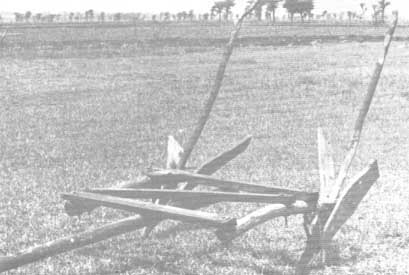
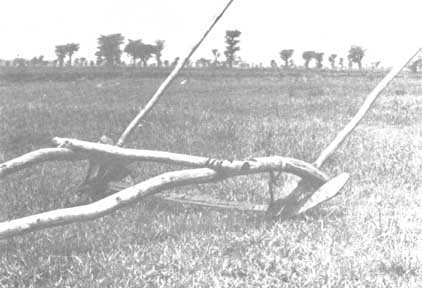
The second version was a broadbed maker (REM) made from the mareshas (Fig. 4). The main beams of the mareshas were shortened to about 90 cm and were connected with a simple wooden frame. The two flat wings were replaced by mouldboard-shaped wings, two bigger ones throwing the soil to the centre and two smaller wings throwing it outside. Like its predecessor, this implement could only be used for land-shaping and therefore the field had to be ploughed with the maresha three to four times prior to its use. This implement weighed about 35 kg depending on the type of wood used. The average power consumption of 0.7 kw was about the same as the first ploughing required with the maresha (Jutzi et al, 1986). From on-farm verification trials, farmers found this BBM too heavy and bulky to transport to and from the field. They also expressed difficulty in finding the needed 12 bolts in the rural areas for making the frame of the BBM and the spanners required to tighten the bolts.
Figure 4. The broadbed maker was made from two shortened mareshas framed together.
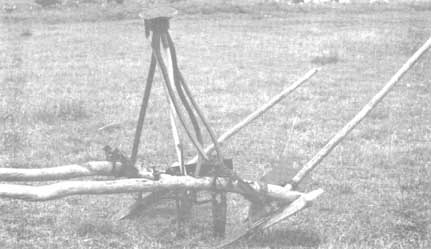
This led to developing another version of the BBM which is in use today. It was made out of two mareshas connected in a triangular structure (Figure 5). The top ends of the maresha beams are tied together and connected to the yoke as the traditional method. For maintaining the distance of 1.2 m between the maresha tips, a crossbeam was tied between the two poles of the mareshas at around a metre from the lower edges of the poles. A steel wing of mouldboard shape is then attached on each of the inner flat wings of the maresha to push the soil inside and form the broadbed and furrow (BBF). The chain attached at the edge of the metal wings not only shapes the beds evenly but it also covers the seeds as the previous BBM. The power requirement for this new BBM is lower (0.62 kw) than the previous one and can be attributed to the metal wings which have lower frictional force through the soil than wood. The area constructed into BBF in six working hours by a pair of oxen ranges from 0.4 ha to 1.2 ha for this and the previous BBM. The rate of work depends on the number of passes applied to make each BBF, the filth status of the top soil and the condition of the working oxen. On-farm verification with the latest version of the BBM has continued until 1990 and the farmers seem to be satisfied with it. However, the farmers observed greater weed infestation on the BBF plots than on the traditional flat seedbed.
Figure 5. The last version of the broadbed maker: two mareshas connected in a triangular shape.
The work described in this section, would be the attachments for the BBM designed for reduced tillage, weeding and seeding to allow permanent broadbed system to be developed. The potential benefit of post-harvest cultivation with the aim of reducing tillage requirements is obvious; the seedbed preparation time on broadbed can be reduced drastically. Better control of weeds and stubble incorporation could be possible and it can also partially fill the cracks thus reducing moisture loss which can help for the following crop.
The traditional method of planting most crops is broadcasting and covering by using the maresha. This method of covering has been shown to mix 15.3% of broadcast wheat seed to a depth of 10 to 20 cms yet leaving 25.3% within the top 2.5 cm (Tinker, 1989). Due to this variation of coverage depth emergence of crops is lower and might be the main reason why farmers use high seed rates. The Institute of Agricultural Research recommends most sorghum varieties to be planted at a rate of 7-10 kg/ha while farmers use up to 30 kg/ha.
The broadcasting method of planting also makes it impossible for mechanical weeders to be used. Hand weeding is probably the most time-consuming operation in the traditional system. The labour requirement for weeding teff was 300 man-hours/ha while for wheat it was half of what was required for teff (Abiye Astatke and Matthews, 1980).
The planter attachment developed is similar to the traditional planters used in India and other countries in the region. The attachment is a simple hand-metered seeder that mounts on the BBM (Figure 6).
The construction materials consist of sheet metal (1.3 mm thick) which are used for constructing the funnel and steel pipes. They are also used for connecting the funnel to the transparent polythene hose which carries the seeds to the steel pipe thus leading the seeds into the furrows opened by the metal tines.
Figure 6. Hand-metered planter mounted on the broadbed maker.
The planter was tested with wheat and maize on half a hectare each. It took 6.5 hrs/ha to plant wheat and 5.3 hrs/ha for maize. The seed rates for wheat and maize using the planter were 74 kg/ha and 31 kg/ha, respectively, while in the traditional system the seed rates being used for wheat range from 85 kg/ha to 110 kg/ha varying from area to area (Getachew Asamenew, 1991). The seed rate for maize in around 45 kg/ha. The tine attachment used for planting can also be used for weeding without causing major soil disturbance. Interrow cultivation of wheat was difficult by the tines because the row spacings were close to each other (10-cm space). For maize, which had row spacing of 50 cm, there was no difficulty in using tines for weeding.
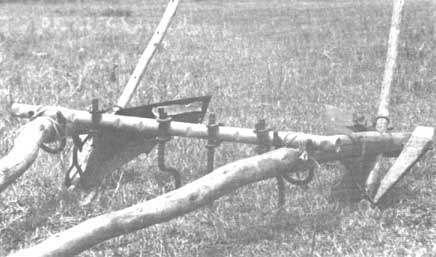
A blade harrow consisting of a metal blade 4 mm thick fixed on both sides of the maresha tines (Fig. 7) was tried for post-harvest cultivation. This blade harrow uniformly cuts the soil on the BBF at about 5-8 cm below the surface thus slicing weeds at the rooting level when the soil condition is moist. At this period, the implement drastically reduced power and time required for Vertisol cultivation, enabling long-term use of the BBF without having to do it again every year. However, most traditional crops have a long growing period stretching into December when the Vertisols have become very dry and hard and use of the blade harrow is difficult and not effective. Tests on the possibility of using tine attachments were carried out when soil moisture conditions were dry (Fig. 8). The purpose of the test was to reduce the number of tillage operations in order to enable the use of a broadbed over several seasons. A tine-bar attachment to the BBM enabled breaking up the surface crusts and remould the broadbeds.
Field preparations by using this method to uproot stubbles down to about 10 mm depth for half a hectare of broadbed and furrow plot without demolishing the beds took only 25 hrs/ha compared to 80 hrs/ha for the previous method of ploughing and making the BBF's.
Figure 7. Blade harrow attached to the broadbed maker.
Figure 8. Tine harrow fixed on the cross-beam of the broadbed maker.
Background
Agricultural production could be increased either by direct physical inputs like fertiliser and improved seeds or by increasing the area of land which could be cultivated at any one time. The latter requires improved agricultural implements which enhance labour productivity by reducing drudgery. Improvement on agricultural equipment should be undertaken by taking the target group into account. The majority of the Ethiopian farming sector being the small farmer with small fragments of land, the situation limits us to give priority to hand-tool technology and animal-drawn equipment. In the case of hand tools, the power that could be generated by human labour is low and is limited to light work. The case of land preparation specially on Vertisols requires high draft power and the alternative for smallholders is to use animal power. It was with this understanding that ILCA and institutions that collaborate with it developed the animal- drawn broadbed and furrow maker for Vertisol areas. They have been conducting trial on farmers' fields and modifications have been made based on feedback obtained from farmers.
The equipment is now very close to being distributed to the end-user in large numbers. If the implement is to reach the end-user on a wider scale, it has to satisfy two clients simultaneously. One is the direct user, the farmer, and the other is the manufacturer. The manufacturer requires the availability of raw material and the ease of manufacturing to be incorporated in the design process of the equipment. The farmer requires the equipment to meet the purpose it is designed for and that its price is within the range of his economic ability. To confirm this, tests should conducted at representative agroecological sites.
To test an equipment, a standard test procedure which is interpretable (no matter where it is conducted) is required. At the moment in Ethiopia there is no standard test procedure.
The agricultural implements specification and performance standard which is a cutoff line for certification is not set yet. In the absence of all these, the Agricultural Implements Research and Improvement Center (AIRIC), based on the mandate given to it to test all kinds of agricultural equipment and based on its testing experience, has done a preliminary observation on the ILCA broadbed-and-furrow maker. The objective of the observation was to see its technical feasibility in terms of the construction material and skill requirement as well as the ease in operating it. Another purpose was to examine the agricultural feasibility in terms of meeting the purpose it has been designed for. The test was conducted at Debre Zeit on June 6, 1990 in a 12 x 50 m2 plot size in four replications with wheat as a test crop. Data on the construction features, draft requirement, bed stability and yields were collected. Table 2 shows the construction features of the BBM while Table 3 shows the soil property and performance of the BBM. Measurements of furrow configuration after 50 and 71 days are shown in Tables 4 and 5, respectively, while the crop performance is given in Table 6.
Test results
Looking at the specification and construction material of the BBM, the construction material and the skill requirement are within the technical capability of the rural blacksmith who manufactures maresha. It is also within the economic reach of the user.
The BBM is very easy to adjust and assemble and it requires almost the same skill as that of the traditional plough. But it takes more time to set up and is less manoeuvrable in the field. Between the flat wooden wings and the metal wing soil flows down to the furrow and this limits the height of the bed. Before working with the BBM the field has to be well prepared. The clod size has to be reduced considerably since bigger clods tend to flow back to the furrow and result in uneven bed configuration.
The draught requirement of BBM will be high as shown in Table 2 if the BBM is not used at the proper moisture content. The draught increased with an increase in moisture content. The proper time for using the BBM must be specified.
A decrease in the cross-sectional area of the furrow and furrow depth as shown in Tables 3, 4 and S shows that the bed-configuration changes with time during the growth period of the crop. This could be attributed to a build-up of the soil in the furrows caused by erosion of the bed surface.
The draught requirement of the BBM was recorded as high as 140 kgf. which is higher than the capability of a pair of local oxen for sustained operation. This could be minimised by using the broadbed maker in a well-pulverised soil at moisture regime.
Since a performance level standard for the broadbed maker is not set, it is advisable to make a comparative test against the traditional practice of broadbed-making.
Table 2. Construction features of the broadbed maker.
|
1. Specifications: Overall dimension (measured) |
|||
|
Length |
384 cm |
||
|
Width |
154 cm |
||
|
Height (in working position) |
77.5 cm |
||
|
Overall weight |
42 kg |
||
|
2. Construction materials and dimension of components (measured): |
|||
|
Component |
Construction material |
Dimension |
(cm) |
|
Handles (2 pieces) |
Wood |
Length |
165 |
|
Chain |
Mild steel |
Length |
111 |
|
Round bar diam |
12 |
||
|
Metal wings (2 pieces) |
Mild steel |
Thickness |
3.25 |
|
Width |
20 |
||
|
Length |
51.5 |
||
|
Crossbar |
Wood |
Length |
131 |
|
Diameter |
4.5 |
||
|
Wooden wings (4 pieces, tapered) |
Wood |
Length |
54 |
|
Max. width |
9 |
||
|
Min. width |
0 |
||
|
Metal tips (2 pieces) |
Mild steel |
Length |
40 |
|
Beam |
Wood |
Length |
300 |
|
Metal hook |
Mild steel |
Length |
20 |
Table 3. Soil property and performance of the broadbed maker.
|
Plot no. |
Soil moisture content (%) |
Furrow x-sectional area (cm2) |
Maximum furrow depth (cm) |
Average furrow depth (cm) |
Maximum furrow width (cm) |
Bed width (cm) |
Average speed (m/s) |
Draught (k.gf) |
|
1 |
20.90 |
340.80 |
12.55 |
6.55 |
48.00 |
70.50 |
0.67 |
120.69 |
|
2 |
26.53 |
331.78 |
11.53 |
5.95 |
48.50 |
73.17 |
0.68 |
136.75 |
|
3 |
23.99 |
283.34 |
11.42 |
5.69 |
47.08 |
71.00 |
0.67 |
123.70 |
|
4 |
26.10 |
357.29 |
11.92 |
6.38 |
48.89 |
69.84 |
0.79 |
140.13 |
|
x |
24.38 |
328.30 |
11.86 |
6.14 |
48.20 |
71.13 |
0.69 |
130.00 |
|
se |
2.23 |
27.52 |
0.44 |
0.34 |
0.73 |
1.25 |
0.06 |
8.30 |
|
cv (%) |
9.14 |
8.38 |
3.73 |
5.55 |
1.52 |
1.76 |
8.70 |
6.37 |
Table 4. Measurement of furrow configuration after 50 days of formation (July 27, 1990).
|
Plot no. |
Furrow x-sectional area (cm2) |
Maximum furrow depth (cm) |
Maximum furrow width (cm) |
Average furrow depth (cm) |
|
1 |
235.00 |
7.70 |
46.60 |
4.28 |
|
2 |
222.55 |
7.60 |
44.00 |
4.20 |
|
3 |
267.50 |
8.00 |
50.60 |
4.72 |
|
4 |
285.00 |
8.20 |
54.00 |
4.85 |
|
x |
252.51 |
7.88 |
48.89 |
4.51 |
|
se |
24.92 |
0.24 |
3.81 |
0.28 |
|
cv (%) |
9.87 |
3.03 |
7.81 |
6.16 |
Table 5. Measurement of furrow configuration after 71 days of formation (1990).
|
Plot no. |
Furrow x-sectional area (cm2) |
Maximum furrow depth (cm) |
Maximum furrow width (cm) |
Average furrow depth (cm) |
|
1 |
183.33 |
6.67 |
43.67 |
3.57 |
|
2 |
162.42 |
6.17 |
41.67 |
3.03 |
|
3 |
215.55 |
7.00 |
45.00 |
4.13 |
|
4 |
183.33 |
6.33 |
44.00 |
3.69 |
|
x |
186.16 |
6.54 |
43.59 |
3.61 |
|
se |
19.00 |
0.32 |
1.21 |
0.39 |
|
cv (%) |
10.20 |
4.89 |
2.77 |
10.86 |
Table 6. Test results indicating crop performance at Debre Zeit in 1990.
|
Plot no. |
Moisture content |
Grain & straw weight ratio (%) |
Grain yield (kg/ha) |
|
|
of grain (%) |
of straw (%) |
|||
|
1 |
11.39 |
20.04 |
1:1.74 |
2478.58 |
|
2 |
11.56 |
9.37 |
1:2.28 |
2686.75 |
|
3 |
11.58 |
9.49 |
1:2.19 |
2560.80 |
|
4 |
11.30 |
10.64 |
1:2.08 |
2455.14 |
|
x |
11.46 |
12.39 |
1:2.07 |
2545.32 |
|
se |
0.12 |
4.45 |
0.2 |
90.59 |
|
cv (%) |
1.02 |
35.89 |
9.88 |
3.56 |