Abate Tedla, MA Mohamed-Saleem, Tekalign Mamo, Alemu Tadesse and Miressa Duffera
Introduction
Native pastures
Crop residues as main animal feed and possibilities for increased production
Fodder improvement in the Ethiopian highland Vertisols
Traditional management, cropping patterns and calendar of highland Vertisols
Evaluation of improved wheat varieties for drained Vertisols
Highlights of completed work
Subsistence-oriented smallholder is the main mode of production in the highlands and, therefore, no special effort is made to grow feed for farm animals. Cattle are mainly kept for draught purposes but they also contribute meat and manure like the small ruminants in the system. Milk from dairy cows seems specialised in peri-urban areas or where there is quick access to milk collection outlets. All ruminants as well as the equines depend on two major feed resources, namely natural pasture and crop residues. Concentrates are well known but are seldom fed to livestock on a regular basis although there is severe feed shortage during the year. Examples can be cited of cultivated forages where there has been some extension effort. Growing oats and vetch by cooperative farmers in part of the crop land and Tagasasste (Chamaecytisus palmensis) fencing in the Selale Peasant Dairy Project are some of them.
Although this document is intended to report research on Vertisols, livestock do not respect this boundary as they graze communal land. Hence a general situation of the available feed resources in the highlands is also highlighted which is followed by specific efforts of collaborative partners of the Joint Vertisol Project.
Natural grasslands in the Ethiopian highlands are generally confined to degraded, shallow upland soils, fallowed crop land and to soils which cannot be successfully cropped because of physical constraints such as flooding and waterlogging. Thus natural grasslands occur in conditions presently considered adverse for cropping. However, in the future increased human population pressure will force farmers to push cropping onto these traditional grasslands.
Previous surveys in Ethiopia claim that in areas classified as intensively cropped, up to 40% of the surface is still under volunteer or permanent grassland vegetation, including roadsides and pathways, spaces between plots etc. This suggests that a considerable number of animals can be fed on this resource even in highly populated areas.
It has been estimated (Lulseged Gebre-Hiwot, 1985) that there are 73 million ha of native pasture land in the Ethiopian highlands receiving more than 700 mm annual rainfall, with 24 million livestock units (LU) in the same area. These figures indicate that native pastures are an important feed source. However, even when a high average dry matter production of three t/ha/year is assumed for this grassland, these areas could only contribute a maximum of 50% of the total feed required. The remainder, only partly met by crop residues, explains the need for improvement and management of feed resources for high livestock production.
Improvement of native pasture
ILCA's Highlands Programme devoted considerable effort to carry out research on native pasture improvement mainly on flat deep clay soils which exert less stringent constraints on plant growth than the shallow degraded upland soils.
Three interventions which seemed to be promising for increasing native pasture yield and quality were tested at three different altitudes (1900 m, 2400 m, 2800 m asl). These included plant nutrient supplies, forage legume oversowing and soil ripping to improve aeration and accelerate nutrient mineralisation. These treatments were partially successful in terms of increasing pasture yields or legume proportion of the swards.
Table 1 shows two-year results on an Andropogon longipes pasture in Debre Berhan (2800 m asl). No effect on yield or quality was recorded which is evidence of the ecological stability of these native pasture communities. Similar trends were recorded in Debre Zeit (1900 m asl) on Hyparrhenia pasture. Dry-matter yields in the warm ecosystem of Debre Zeit were about one and a half times higher than in Debre Berhan. The Hyparrhenia pasture in Addis Ababa (2400 m asl) reacted slightly differently in that the legume percentage in the dry matter was strongly increased by oversowing (Table 2). As Table 3 shows, however, this qualitative improvement is rather insignificant since it can not be acquired if the pasture is not properly managed, such as if it is cut too late.
All these yield figures have been recorded on plots which have been protected from animal access during the experiment. They are, therefore, only relevant for the assessment of the production of those few pocket areas in the highlands where hay is traditionally mace.
Table 1. Effects of legume oversowing1 soil ripping2 on the dry-matter production of a native Andropogon longipes pasture at Debre Berhan (2800 m asl), 1983 and 1984.
|
Treatment3 |
Total DM (t/ha) |
Legume DM (%) |
||
|
1983 |
1984 |
1983 |
1984 |
|
|
No ripping; no oversowing |
4.17a |
3.62 |
0.51 |
1.12 |
|
No ripping; oversowing |
4.23a |
3.62 |
0.50 |
0.82 |
|
Ripping; oversowing |
3.52b |
3.85 |
0.59 |
0.91 |
|
se of treatment means |
0.32 |
0.19 |
0.23 |
0.56 |
|
Significance of treatment effects4 |
s |
ns |
ns |
ns |
1. Five kg/ha each of Trifolium tembense and Trifolium rueppellianum.
2. 15-cm-deep ripping of soil with animal-drawn metal tine attached to the ox-plough (30-cm distance between lines).
3. Means of 0 and 30 kg/ha P.
4. s = significant; ns = not significant; means followed by the same letter are not significantly different at the 5% probability level.
Table 2. Influence of soil ripping1 and oversowing2 of legumes on dry-matter (DM) yield, crude protein, plant phosphorus, dry-matter digestibility and botanical composition of a native Hyparrhenia pasture at Addis Ababa (2400 m asl), 1984.
|
Treatment | ||||
|
Parameter |
Control |
No ripping; oversowing |
Ripping; oversowing |
LSD (0.05) |
|
Dry matter (t/ha) |
2.5 |
2.2 |
2.9 |
ns |
|
Crude protein (%) |
8.0 |
9.2 |
10.2 |
ns |
|
Plant - P (%) |
0.19 |
0.18 |
0.20 |
ns |
|
Dry-matter digest. (%) |
51.0 |
53.2 |
55.3 |
ns |
|
Legume in DM (%) |
13.0 |
27.0 |
32.2 |
11.4 |
1. Soil ripping to 15-cm depth at 30-cm distance between ripping lines with metal tine attached to animal-drawn plough.
2. Five kg/ha each of Trifolium pratense, Trifolium tembense and Trifolium rueppellianum.
Table3. Influence of harvest date on dry-matter (DM) production, crude protein, plant phosphorus, dry-matter digestibility and botanical composition of a native Hyparrhenia pasture at Addis Ababa (2400 m asl) with partial soil ripping1, legume oversowing2 and P fertilisation3, 1984.
|
Parameter |
Harvest date |
|||
|
End Sept. |
End Oct. |
End Nov. |
LSD (0.05) |
|
|
DM yield (t/ha) |
1.7 |
3.3 |
2.6 |
0.5 |
|
Crude protein (%) |
11.9 |
11.0 |
5.2 |
1.5 |
|
Plant - P (%) |
0.23 |
0.19 |
0.16 |
0.03 |
|
DM - digestibility (%) |
58.7 |
53.6 |
47.3 |
2.2 |
|
Legume in DM (%) |
25.8 |
38.3 |
8.0 |
9.4 |
1. Soil ripping with metal tine attached to ox-plough, 30-cm distance between rows, 15-cm deep.
2. Five kg/ha each of Trifolium pratense, Trifolium tembense and Trifolium rueppellianum.
3. No P: Control; plus P: 30 kg/ha.
Reference is often made to the heavy overstocking of many highland areas. The consequent overgrazing has negative effects on the overall pasture yield although the extent is difficult to assess under field conditions. A pot experiment was, therefore, carried out where overgrazing was simulated (frequent compared with less frequent offtake). Andropogon longipes is the dominant grass species in the central Ethiopian highlands above 2600 m asl on deep black soils which are generally communal grazing areas with heavy overstocking. This grass was compared in the experiment with an exotic grass (Festuca rubra cv Cascade) which is similar in its growth habit to Andropogon.
Table 4 summarises the results of the pot trial and shows at least two striking results:
· An offtake which is too frequent (a two-week interval is to simulate the overgrazing situation) drastically reduces total dry-matter production to about half of that observed at a harvest interval of four weeks.· Input of fertiliser N cannot be transformed into higher biomass production by the grasses once they are too heavily exploited. Thus even if the soil N level were sufficiently high e.g. supposing adequate legume share in the botanical composition, this N could not be effectively used.
Table 4 also suggests better persistence of Andropogon under heavy offtake pressure as compared with Festuca which is considered to be tolerant to grazing. There is also no evidence for a weaker response of the native grass to N fertilisation.
Table 4. Effects of defoliation frequency on dry-matter yield of Andropogon longipes and Festuca rubra as influenced by N supply, 1984.
|
Species |
Month of evaluation after beginning of differential treatment |
Yield (g) at different defoliation frequencies and N levels |
LSD (0.05) |
|||
|
4 weeks |
2 weeks |
|||||
|
No N |
Plus N |
No N |
Plus N |
|||
|
Andropogon longipes |
First |
0.93 |
1.83 |
0.48 |
0.50 |
0.20 |
|
|
Second |
0.98 |
1.72 |
0.59 |
0.50 |
0.37 |
|
Festuca rubra |
First |
0.88 |
1.72 |
0.42 |
0.66 |
0.10 |
|
|
Second |
0.84 |
1.60 |
0.17 |
0.26 |
0.15 |
1. N fertiliser was applied at a rate of 100 mg/pot of 2-litre at the beginning and one month after the beginning of the evaluation.
The results indicated that the dry-matter yields of heavily grazed grassland probably do not exceed 1500 kg/ha (half of that recorded under protected conditions) in the highland areas above 2600 m asl and will not exceed 2500 kg/ha below this altitude.
Assuming the highland natural grasslands (7.3 m ha with more than 700 mm annual rainfall) have an average production of two tonnes per ha per year and support some 24 million LU (Livestock Units), then they provide at the maximum one half of the animal feed even if allowance is made for some rangeland resources within the highlands. The remaining livestock feed is in the form of crop residues.
With approximately a million ha crop land in the highlands, this ratio between native pasture and crop residues is very likely to shift in favour of crop residues in the future as the human population continues to increase.
Native pasture is generally confined to soils with rather severe constraints for plant growth. The grassland vegetation that has been produced by ILCA and other research institutes indicates that exotic germplasm performs better than these highly specialised pasture communities unless major changes in the physical or chemical conditions of these soils are undertaken (such as drainage or heavy fertiliser inputs) and unless grassland management practices are changed.
Soil improvements imply capital investments which are more likely to be profitable if the improved soils are afterwards used for food crop production rather than for exclusive animal feed production (unless dairy or beef/smallstock fattening enterprises are considered).
As outlined above, about half or more of all animal feed in the Ethiopian highlands is in the form of crop residues (straws, stubble, chaff or weeds from crop plots). The dependence on this feed source is likely to strengthen along with increasing human population densities and corresponding extension of crop land into traditional grassland.
Twenty out of 28 sub-Saharan countries recorded falling agricultural productivity (per caput) between 1970 and 1981. Among the many factors which contributed to this most worrying development, two are of relevance in this context:
· Increasing population pressure increases the pressure on the available crop land and leads to the disturbance of traditional farming practices geared to preserving soil fertility and stability. In many highly populated areas, ancient soil fallowing practices have been replaced by continuous cropping. Since no or insufficient soil fertility inputs are made on these soils, average yields are tending to stagnate or even decline. This same pressure on land is leading to the dominance of cereals in the crop rotations to the detriment of grain legume crops which previously helped restore soil N levels.· Increasing population pressure is also forcing farmers to extend cropping onto marginal soils previously not cropped. This development not only contributes to low average yields but also to lower production stability and higher environmental risks (especially soil loss).
Nitrogen deficiency is the major soil-related constraint to increased food crop production in subsistence- oriented smallholder farming systems. Fertiliser N is expensive and often only erratically available. Thus the leguminous plant with its ability to fix atmospheric N through its symbiosis with bacteria is the only soil-N source of significance for these farming conditions. Nitrogen fixation figures between 62 and 290 kg N/ha per year have been recorded in sub-Saharan Africa for a wide range of temperate and tropical forage legumes (Haque and Jutzi, 1984). The legume as a N source in general cropping practices offers a unique possibility for increasing and sustaining food crop and fodder yields.
ILCA has initiated a two-stage research programme on legume germplasm. During the first phase, environmental, nutritional and biological factors limiting legume growth and N fixation were investigated and legumes which perform best in both biomass production and N-fixation under low levels of plant nutrient availability were selected (low input approach). The single most important plant nutrient limiting legume growth in Ethiopia appears to be phosphorus. Some results on the effect of improved P nutrition on growth and nodulation of African clovers have also been reported (Jutzi and Haque, 1985).
In the second phase strategies and technologies are developed for the integration of the 'best-bet' legumes into cropping systems. This requires studies on the agronomic behaviour and the physiological structure of the legume plant itself and on the possibilities for fitting it into the cropping cycles in a most appropriate way.
There are several different approaches for the integration of legumes in strategic uses depending upon local circumstances. The profiles of legumes and cereal crops will determine which of these techniques is most appropriate. These techniques include:
· legumes in rotation with cereals· legumes as intercrops
· relay cropping whereby normally a cereal crop is relieved by an undersown legume
· so-called sequential cropping whereby a crop follows another crop immediately in the same season
· alley-cropping
and these were adopted.
It is estimated that only 25% of the 7.6 million hectares of Vertisols are cultivated at present in the Ethiopian highlands. Despite their potential to support higher productivity, Vertisols are waterlogged, especially in higher rainfall and cooler temperature regimes where evaporative demands are low. As the water recedes native pasture grows luxuriously using the residue moisture in the bottom and Vertisols and provide valuable grazing when herbage growth in the uplands suffer from moisture stress.
In the food-deficient and land-constrained Ethiopian highlands, the Vertisols could contribute much more if only the seasonal waterlogging constraint is alleviated Land prepared into broadbeds and furrows (using animal-drawn broadbed makers) seems to provide satisfactory drainage and rooting medium. Crops can, therefore, be sown much earlier in the rainy season compared to the traditional practice of sowing late in the season after standing water in the field has drained naturally.
By improving drainage, the entire growing period is potentially available for growing food crops. Farmers would prefer this a so because there is an additional investment for land-shaping to improve drainage. There is a possibility of further increasing the length of the growing period in Vertisol areas by providing a small amount of irrigation to wet the surface as a supplement to the large amount of moisture held in reserve a few centimetres below the soil surface. This will be relevant in Vertisol areas closer to a ready source of water or where ponds have been dug to capture excess water during the early part of the rainy season in order to increase one's crop harvesting ability late in the season.
In most of the Vertisol areas crops are sown during late August early September and harvested during December/January. Harvested crop residues are stored and fed to livestock, most importantly to work-oxen which need to be in good condition before the onset of the next growing season. Yields of the crops that are traditionally grown on Vertisols are very low. The crop residue available at the end of the growing season will depend on many factors most importantly the crop variety, rainfall, soil fertility and the land are cultivated. But since fodder from the cropped area which is low quality is delivered at the end of the growing season, livestock in the Vertisol areas suffer from energy and protein shortages during most of the year. The problem becomes acute for dairy and fattening animals.
An extended growing period provides opportunities for different cropping alternatives. It allows growing two short duration crops or mixtures sequentially or as relay crops, compatible forages as companion crops in mixtures or in alleys and concentrated feed gardens. These options can be manipulated to deliver good-quality fodder in addition to grain but delivery of fodder can also be targeted to desired time and needs. Some of the options are summarised in Fig. 1 and discussed below.
The traditional management of Vertisols in the Ethiopian highlands varies from one place to another depending on the amount and duration of rainfall, extent of drainage problems, soil fertility and slope and farm size. Land preparation techniques include:
- Flat-bed planting
- Drainage furrows
- Ridges and furrows
- Hand-made broadbeds and furrows
- Post-rainy season planting
- Soil burning (guie).
These techniques and their applications for cropping have been discussed by various researchers (Mesfin Abebe, 1981; Tesfaye Tessema end Dagnatchew Yirgou, 1973; Berhanu Debele, 1985; Abate Tedla and Mohamed-Saleem, 1991).
The major cropping calendar is presented in Figure 2. Crops like barley, noug, field pea and horse bean are sown at the start of the rains on higher slopes. The crops are also common in areas with low rainfall or well-drained fields. Crops such as teff, durum wheat and lentils are sown during the second half of the rainy season while other crops, namely chickpea and rough pea are sown at the end of the rains.
Most crops are low-yielding under traditional management in the central highlands of Ethiopia (Table 5).
The general rotation practice on Vertisols involves planting a pulse crop after each cereal. However, this varies across the highlands. In some areas, 3-4 consecutive cereal crops, such as teff or durum wheat, follow every pulse crop. Monocropping is common on Vertisols. Broadcasting is the most widely used practice for establishing crops (Figure 3). There are instances of mixed cropping with two or more crops, without distinct rows. The most common mixtures are:
- horse bean and field peas
- teff and safflower
- sorghum and chickpeas wheat and barley
- sorghum and finger millet
- wheat and rape-seed
- horse bean and rape-seed.
Figure 2. Cropping calendar of highland Vertisols.
Table 5. Grain yields of food crops on Vertisols under traditional management in the central highlands of Ethiopia.
|
Crop |
Grain yield (kg/ha) |
|
Teff (Eragrostis tef) |
530 |
|
Barley (Hordeum vulgare) |
860 |
|
Emmer wheat (Triticum dicoccum) |
680 |
|
Durum wheat (Triticum durum) |
610 |
|
Horse bean (Vicia faba) |
750 |
|
Linseed (Linum usitatissimum) |
300 |
|
Lentils (Lens culinaris) |
500 |
|
Chickpeas (Cicer arietinum) |
600 |
|
Field peas (Pisum sativum) |
730 |
|
Noug (Guizotia abyssinica) |
290 |
|
Grass peas (Lathyrus sativus) |
690 |
Source: Berhanu Debele (1985).
In the Fogera plains, farmers grow two crops sequentially each year. Common crops include teff followed by rough peas and teff followed by chickpeas. Where supplementary irrigation is available durum wheat and maize follow teff as late season crops.
Farmers in highland Ethiopia have traditionally been practicing soil burning (guie) to improve crop productivity in highland Vertisol areas of northern Shewa. In order to create wider management options for use by farmers, assessment of the soil management practices in comparison with the recommended packages have been performed. In a recent study conducted on a Vertisol in order to investigate the chemical changes taking place due to soil burning, it was found that it takes more years before the pH and organic matter of the soil come to equilibrium with the initial levels (Table 6). On the other hand, available P was at its lowest even after 25 years of soil burning. In general the results prove that the practice of soil burning leaves the soil in a less productive state and should be avoided. The productivity of the land may be revived by introducing improved drainage practices.
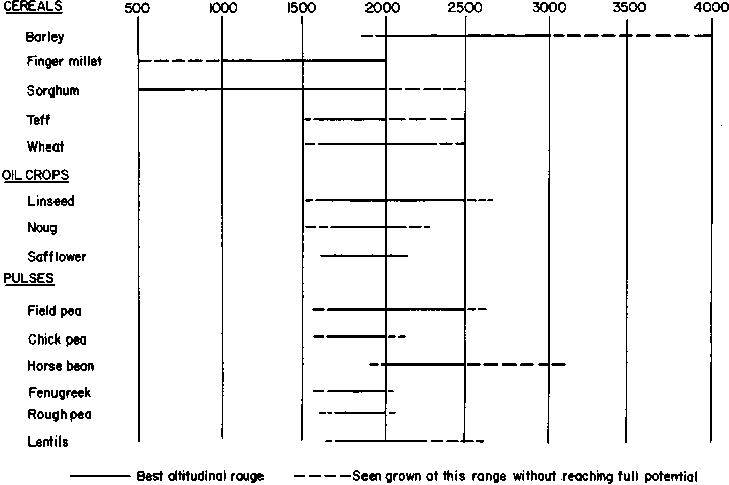
Figure 3. Altitudinal range (m) of commonly grown crops on highland Vertisols.
Source: Westphal (1975).
In collaboration with the Institute of Agricultural Research (IAR) and Alemaya University of Agriculture (AUA), improved bread wheat (Triticum aestivum L.) and durum wheat (Triticum durum Desf.) varieties for the high and medium altitudes were tested. The objectives of the study were:
· To examine the possibility of early planting of improved wheat varieties on drained Vertisols as opposed to the traditional late planting, towards the end of the rainy season, and· To evaluate wheat varieties in terms of grain and straw yields and quality across highland drained Vertisol sites.
Table 6. Chemical properties of guied surface soil samples from Sheno as influenced by length of years after burning (guie).
|
Years after guie |
pH (1:1) |
% organic matter |
Available P (ppm) |
NH4-N (ppm) |
Total releasable N |
|
0.5 |
5.5 |
3.32 |
14.00 |
83.9 |
155.7 |
|
2 |
5.4 |
6.50 |
2.33 |
9.9 |
4.8 |
|
3 |
5.3 |
6.95 |
3.79 |
8.5 |
12.7 |
|
5 |
5.5 |
3.70 |
3.21 |
9.3 |
14.4 |
|
8 |
6.1 |
5.93 |
8.71 |
9.8 |
16.9 |
|
10 |
5.8 |
4.22 |
1.75 |
9.3 |
12.7 |
|
15 |
5.8 |
7.71 |
2.33 |
15.3 |
20.9 |
|
20 |
6.2 |
7.64 |
1.47 |
12.1 |
14.7 |
|
25 |
6.2 |
5.13 |
1.17 |
20.8 |
22.5 |
Source: Ali Yimer (1992).
Separate field studies have been conducted on several highland Vertisol sites since the 1988-90 cropping seasons.
The first study with improved bread wheat varieties took place in the high altitude (2400 m asl) at Bichena, Inewari and Were Ilu and the second study in the medium altitude (1500-2400 m asl) were at Akaki, Debre Zeit and Ginchi. For both studies local durum wheat varieties were included as check. Details of the treatments/varieties, their year of release and origin are given in Table 7.
Table 7. Name of treatments/varieties and their year of release and origin used in the study.
|
Treatment/variety |
Year of release |
Origin |
|
Study 1 for high-altitude sites | ||
|
Local durum wheat (check) |
|
Ethiopia |
|
Bread wheat var HAR 407 |
1987 |
|
|
Bread var Enkoy |
1974 |
Kenya/Ethiopia |
|
Bread var ET 13 |
-1980 |
Ethiopia |
|
Study 2 for medium-altitude sites | ||
|
Local durum wheat (check) |
|
Ethiopia |
|
Durum wheat var Boohai |
1982 |
CIMMYT/Ethiopia |
|
Durum var Cocorit 71 |
1976 |
CIMMYT/Ethiopia |
|
Durum CIT 71/Candeal II |
in the process of release |
|
Study 1 at high-altitude sites
Low temperature coupled with poor drainage set a limit to crop productivity at Bichena, Inewari and Were Ilu than the mid- altitude highland sites.
Crops also matured late in the high altitudes in comparison to the mid-altitudes.
Grain and straw yields for the four wheat varieties meaned over sites for each year are given in Table 8. The mean grain yield ranged from 805 kg/ha to 1641 kg/ha in 1989 cropping season. However, the mean grain yield in 1990 cropping season were found to be lower than that of the 1988 and 1989 for the same varieties due to hail-storm damage.
In all cropping seasons, there were statistically significant differences among varieties in grain yield. Bread wheat var ET 13 was found to be the highest yielder. Similarly, the strew yield ranged from 1951 kg/ha to 4391 kg/ha in 1989 season and 1806 kg/ha to 3279 kg/ha in 1990 cropping period. For all three years, variety differences in straw yield were significant (Table 8).
The chemical composition and straw quality harvested from the high and medium altitude Vertisol sites are presented in Tables 10 and 11, respectively.
Table 8. The mean grain and straw yields (kg/ha) of bread wheat varieties grown on drained Vertisols at Bichena, Inewari and Were Ilu* high altitude highland sites, Ethiopia.
|
Variety |
Year |
|||||
|
1988 |
1989 |
1990 |
||||
|
Grain |
Straw |
Grain |
Straw |
Grain |
Straw |
|
|
Local check |
956 |
2629 |
831 |
3456 |
710 |
2622 |
|
Bread wheat var HAR 407 |
1177 |
2167 |
805 |
1951 |
637 |
1806 |
|
Bread wheat var Enkoy |
1268 |
2906 |
1203 |
3751 |
857 |
3279 |
|
Bread wheat var ET 13 |
1728 |
3256 |
1641 |
4391 |
975 |
2775 |
|
LSD (5%) |
195 |
576 |
122 |
332 |
229 |
521 |
* Were Ilu site was used only in 1988 crop season.
Study 2 at medium-altitude sites
Mean wheat yields across the three medium-altitude sites for 1988-90 is given in Table 9.
It is evident from the grain and straw figures that durum wheat var CIT 71/Candeal II yielded significantly higher than the other varieties.
With the exception of straw in 1990, significant differences were observed among varieties for grain and straw yields.
Table 9. The mean grain and straw yields (kg/ha) of durum wheat varieties grown on drained Vertisol at Akaki,1 Debre Zeit, and Ginchi mid-altitude highland sites, Ethiopia.
|
Year |
1988 |
1989 |
1990 |
||||
|
Grain |
Straw |
Grain |
Straw |
Grain |
Straw |
||
|
Local check |
672 |
2962 |
1358 |
3245 |
1224 |
3307 |
|
|
Durum wheat var Boohai |
1076 |
3103 |
1446 |
3781 |
1232 |
3039 |
|
|
Durum Cocorit 71 |
1433 |
3613 |
1227 |
3391 |
1120 |
2526 |
|
|
Durum var CIT 71/Candeal II |
1422 |
3578 |
1571 |
4096 |
1430 |
3430 |
|
|
LSD (5%) |
651 |
1096 |
245 |
318 |
122 |
756 |
|
1. Akaki site was used only in 1988 and 1989 crop seasons.
Table 10. Wheat straw chemical composition and quality of four varieties grown on drained Vertisols of high-altitude sites (Bichena and Inewari).
|
Site |
Wheat variety |
Ash % |
CP % |
NDF % |
ADF % |
IVDMD % |
|
Bichena
|
Local check |
12.84 |
2.50 |
69.87 |
45.40 |
48.42 |
|
ET 13 |
12.87 |
1.81 |
69.12 |
47.72 |
44.98 |
|
|
HAR, 407 |
13.63 |
1.50 |
69.96 |
45.23 |
47.44 |
|
|
Enkoy |
12.02 |
1.60 |
70.14 |
46.74 |
47.61 |
|
|
Inewan
|
Local check |
15.70 |
2.44 |
65.83 |
38.29 |
54.75 |
|
ET 13 |
14.74 |
2.00 |
68.43 |
40.21 |
49.78 |
|
|
HAR 407 |
13.18 |
2.25 |
65.35 |
37.60 |
54.16 |
|
|
Enkoy |
8.75 |
2.00 |
77.60 |
49.36 |
45.53 |
|
|
Mean |
12.97 |
2.01 |
69.54 |
43.82 |
49.08 |
|
|
SD |
2.06 |
0.37 |
3.75 |
4.49 |
3.65 |
Table 11. Wheat straw chemical composition and quality of four varieties grown on drained Vertisol of mid-altitude highland sites (Akaki, Debre Zeit and Ginchi).
|
Site |
Wheat variety |
Ash % |
CP % |
NDF % |
ADF % |
IVDMD % |
|
Akaki
|
Local check |
6.90 |
2.69 |
75.80 |
50.89 |
57.09 |
|
Boohai |
7.42 |
3.31 |
68.44 |
44.65 |
60.02 |
|
|
Garardo |
6.70 |
1.62 |
78.06 |
51.87 |
56.35 |
|
|
CIT 71/Candeal |
6.30 |
1.75 |
74.71 |
50.51 |
58.40 |
|
|
Debre Zeit
|
Local check |
13.03 |
2.63 |
71.34 |
51.26 |
42.72 |
|
Boohai |
12.34 |
2.44 |
75.62 |
51.23 |
43.34 |
|
|
Garardo |
13.66 |
2.88 |
72.24 |
49.79 |
42.17 |
|
|
CIT 71/Candeal |
14.62 |
3.31 |
70.85 |
44.85 |
46.72 |
|
|
Ginchi
|
Local check |
11.52 |
2.31 |
73.20 |
47.11 |
49.71 |
|
Boohai |
11.49 |
2.38 |
74.93 |
49.96 |
43.17 |
|
|
Garardo |
11.14 |
1.81 |
75.95 |
48.64 |
42.35 |
|
|
Mean |
10.55 |
2.48 |
73.91 |
49.43 |
48.71 |
|
|
SD |
2.93 |
0.58 |
2.73 |
2.60 |
7.22 |
Comparative yield advantages of improved drainage
Several studies have shown that productivity of Vertisols improve through surface drainage. Of the various methods of surface drainage, the broadbed and furrows (BBF) are effective to improve drainage from plants to durum wheat, chickpea and lentils, which are traditional Vertisol crops. In all the trials BBF-planted crops gave superior yield compared to ridge and furrow or flat planting (Tables 12,13 and 14).
Table 12. Mean grain and straw yield (kg/ha) of durum wheat as influenced by three seedbed preparation method.1
|
Seedbed |
Grain2 yield |
% increase over flat |
Straw2 yield |
% increase over flat |
|
BBF |
1632a |
58 |
3597a |
36 |
|
Ridge/furrow |
1325b |
28 |
3042b |
15 |
|
Flat |
l034c |
2652c |
|
|
1. Pooled from yield data for three seasons and three locations.
2. Means in a column followed by the same letter are not statistically different at P<0.05.
Drainage influence on fertiliser-use efficiency
In a separate study, the effect of improved drainage on fertiliser-N-use efficiency of two wheat varieties was investigated. From the data given in Table 15 it was found that improved drainage enhanced better utilisation of N by wheat. The response ratios of the two durum wheat varieties were also comparatively better on broadbeds; maximum mean grain yield was also obtained from improved variety Boohai on broad beds.
From the foregoing results, it may be generalised that high returns from improved drainage of Vertisols are evident if the practice is accompanied with additional improved practices such as variety, fertilisation etc.
.
Table 13. Mean gain and straw yield (kg/ha) of chickpea as influenced by three seedbed preparation methods.1
|
Seedbed |
Grain2 yield |
% increase over flat |
Straw2 yield |
% increase over flat |
|
BBF |
2101a |
106 |
3104a |
78 |
|
Hat |
1021b |
28 |
1743b |
|
|
LSD |
255 |
353 | ||
|
CV (%) |
17.3 |
15.5 | ||
1. Pooled from yield data for two seasons and two locations.
2. Means in a column followed by the same letter are not statistically different at P<0.05.
Table 14. Mean grain and straw yield (kg/ha) of lentils as influenced by two seedbed preparation methods.1
|
Seedbed |
Grain2 yield |
% increase over flat |
Straw2 yield |
% increase over flat |
|
BBF |
1944a |
106 |
4685a |
78 |
|
Flat |
1065b |
28 |
2284b |
|
|
LSD |
96.2 |
445.2 | ||
|
CV (%) |
8.8 |
15.2 | ||
1. Data are pooled from yield data for two seasons and two locations.
2. Means in a column followed by the same letter are not statistically different at P < 0.05.
Table 15. Effects of N fertilisation and method of seedbed preparation of the grain yield (kg/ha) of two durums grown on Akaki Vertisol.
|
N (kg/ha) |
Local variety (DZ-04-118) |
Improved variety (Boohai) |
||||||
|
Flat |
RR1 |
BBF |
RR1 |
Flat |
RR1 |
BBF |
RR1 |
|
|
0 |
1659 |
|
2326 |
|
2284 |
|
2564 |
|
|
30 |
2037 |
13.8 |
2826 |
16.7 |
2311 |
0.9 |
3084 |
17.3 |
|
60 |
2183 |
8.7 |
3156 |
13.8 |
2934 |
10.8 |
3450 |
14.8 |
|
90 |
2320 |
7.3 |
2442 |
1.3 |
2516 |
2.6 |
3206 |
7.1 |
|
Mean2 |
2059 |
|
2688 |
|
2511 |
|
3076 |
|
1. RR = Response ratio (kg grain/kg N).
2. Yield difference between the two seedbed preparation methods weighted for both varieties is significant at the 5% probability level.
Moisture conservation
It is not always true that all Vertisol locations receive adequate rainfall. Some receive less or rainfall is erratic with uneven distribution during the year. Appropriate management practices are therefore required to conserve moisture. Yearly average rainfall data at Alemaya University campus, eastern Ethiopia, indicate occurrence of rainfall quantity fluctuation from year to year. Table 16 shows that maize yield was significantly increased when planted in furrows of tied ridges as compared to planting on top of open ridges or flat.
Table 16. Grain yield of maize (variety EAH-75) grown on a Vertisol under different soil and water conservation (tied-ridging) practices (Alemaya, Ethiopia).
|
Treatment |
Yield (kg/ha) |
|
|
Unfertilised |
N/P fertilised |
|
|
Flat planting |
4623ab |
7083ab |
|
Open end, planting on ridges |
4325ab |
6624a |
|
Open end, planting in furrows |
5101b |
7851c |
|
Closed end, planting on ridges |
4722ab |
7176abc |
|
Closed end, planting in furrows |
4937b |
7515bc |
Means followed by the same letter within a column are not statistically different at P<0.05.
Sequential cropping
Sequential cropping is defined as growing more than one crop on the same piece of land with each crop during a different time of the year.
In an experiment which has been in progress fast growing oats and oats/vetch mixture were established in June as first crop, which was harvested as forage for livestock. Chickpea and rough pea were established late as second crop for grain and straw. The first crop was sown in June and harvested at the end of August. Chickpea and rough pea were sown on the same plots beginning August and harvested in January-February (Figure 4) and the results are shown in Table 17.
Introducing a rainy season oats and oats/vetch mixture in areas where feed is an acute shortage during the rainy season due to shortage of communal grazing appears to be a viable alternative, but further large plot studies are needed to determine farmer adoption. Furthermore, utilisation of forages from the sequential cropping needs investigation as hay making is impractical in the wet season. In years with short rainy season or early cessation of rains, the second crops may go into dry periods. Hence crops that can grow on residual moisture and tolerate some moisture stress are required. However, if supplementary irrigation is available most of the highland crops can be grown (Abiye et al, 1989).
In the very high altitudes, low temperature and low solar radiation may limit rate of growth and thus sequential cropping may not be practicable.
Figure 4. Cropping options on highland Vertisols of Ethiopia.
Table 17. The mean yield (kg/ha) of sequential cropping experiment on Vertisols in the medium-altitude highland of Ethiopia.
|
Year |
Location |
First crop |
DM kg/ha |
Second crop |
Grain yield |
|
1988 |
Debre Zeit |
Oats in pure |
4820 |
Chickpea |
966 |
|
Oats/vetch (mixture) |
4716 |
Rough pea |
1588 |
||
|
LSD (0.05%) |
NS |
324 |
|
||
|
1989 |
Debre Zeit Ginchi |
Oats in pure |
4305 |
Chickpea |
516 |
|
Oats/vetch (mixture) |
4445 |
Rough pea |
1057 |
||
|
LSD (0.05%) |
NS |
179 |
|
As large quantities of forage in excess of the household livestock requirement become available, there is need to develop storage capability at the farm level. However, in an intense small-scale dairy or fattening-oriented livestock enterprise herbage from early sown oats/vetch can be cut and carried periodically.
Mixed cropping
Mixed cropping is defined as growing more than one species on the same piece of land at the same time or with a short interval (Beets, 1982). The different species are either mixed in an organised manner with a fixed pattern of spacings (row intercropping) or are planted in an unorganized manner, where species are unevenly distributed.
A combination of wheat/clovers mixture was established by broadcasting them together at the beginning of the rains in 1988 and 1989 cropping seasons. The sites were selected in the medium (1500-2400 m asl) and high (> 2400 m asl) altitudes of central Ethiopian highlands on Vertisols. The medium-altitude sites were Debre Zeit, Ginchi and Akaki and the high-altitude sites included Inewari, Bichena and Were Ilu.
For the medium altitudes Trifolium steudneri, and T. rueppellianum were used in a 1:1 mixture. For the high altitudes, a mixture of T. decorum, T. tembense, T. quartinianum and T. steudneri were in equal proportions. The wheat varieties were Enkoy (Triticum aestivum), Boohai and Gerardo (T. durum) for medium altitudes and for the high altitudes bread wheat varieties ET-13, Dashen and HAR 407 were used. Clovers and wheat where sown at the rate of 10 kg/ha and 150 kg/ha, respectively. Diammonium phosphate (DAP) was applied at the rate of 100 kg/ha at planting. Seeds were manually broadcast in late June of each year after land was prepared as broadbeds and furrows using the broadbed maker. Wheat was sown first and covered with soil, followed by broadcasting clovers mixture on the same day. The plots were selectively handweeded, leaving the clovers under the wheat. Harvesting was done starting at the end of October and continued till November. Wheat was first cut to 0.4 m to separate the grains and then to ground level and separated into clovers stubble end wheat straw. Wheat strew from belong end above the 0.4 m height together determined wheat straw yield.
Tables 18 and 19 show the results of mixed cropping experiments in 1988 for the medium- and high-altitude sites. In the medium altitudes wheat varieties differed significantly in both grain and straw yield, but the association of clover mixture caused no reduction in wheat grain and straw.
The 1989 results from the same experiment in the medium- altitude sites are also shown in Table 20.
In general, wheat varieties grown alone produced less straw compared with those grown in association with annual clovers. It proved that mixture of clovers can grow together with improved wheat varieties on drained Vertisols, without adversely affecting wheat grain yield. This seems, therefore, a good way of enhancing the quality of crop residue in smallholder situations.
Row intercropping
Sorghum and maize are important crops in the mid-altitudes. They are planted in rows. As a way of improving the fodder quality for legume types, namely cowpea (Vigna unguiculata), clover (Trifolium steudneri) and Lablab (Lablab purpureus), they were sown under between the crop rows during 1990 and 1991 season.
Grain and fodder yields and fodder quality of the crop/forage mixture were compared for a similar land unit with sole crop stands. Harvest for grain from sole maize, sorghum and wheat and of the mixture was carried out on the same day.
The fodder from the sole crop was the total of the dry matter from two weedings and the crop residue. The fodder from the mixture was composed of crop residue, weeds from the two weeding operations and herbage cut from the different forages sown in the mixture three times (August/October/January), twice (September/December)/or once. Table 21a and 21b presents a situation where forage was cut twice.
Results suggest that different legumes can be manipulated to take advantage of their growing habits and livestock feed requirements without substantially reducing the anticipated food grain yields. In situations where food crops are grown with forages of indeterminate habits or perennial tree alleys (such as Sesbania), growth of these forages can continue after harvest of the food crop using the residual moisture stored in the Vertisols.
Table 18. The overall mean wheat grain, straw and total crop residue yield (kg/ha) for mixed intercropping experiments at Akaki and Ginchi (medium altitude), 1988.
|
Cropping |
Wheat yield |
Total crop residue yield |
||
|
Grain |
Straw |
|||
|
Variety Enkoy |
1350 |
2988 |
3853 |
|
|
Gerardo |
1057 |
2490 |
3485 |
|
|
Boohai |
970 |
2518 |
3690 |
|
|
|
LSD (0.05) |
167 |
414 |
486 |
|
No clovers |
1176 |
2799 |
2799 |
|
|
With clovers1 |
1066 |
2532 |
4553 |
|
|
|
LSD (0.05) |
136 |
338 |
396 |
|
F-test probabilities |
||||
|
Variety |
P <0.05 |
P <0.01 |
ns |
|
|
Clovers |
ns |
ns |
P <0.01 |
|
1. Referred to an equal mixture of Trifolium steudneri and Trifolium rueppellianum.
Source: Abate Tedla et al (1992).
Table 19. The overall mean wheat grain, straw and total crop residue yield (kg/ha) for mixed cropping experiments at Bichena, Inewari and Were Ilu (high altitude), 1988.
|
Cropping |
Wheat yield |
Total crop residue yield |
||
|
Grain |
Straw |
|||
|
Variety ET |
742 |
2029 |
3279 |
|
|
Dashen |
592 |
1464 |
2790 |
|
|
HAR 407 |
489 |
1319 |
2822 |
|
|
|
LSD (0.05) |
408 |
313 |
422 |
|
No clovers |
696 |
1892 |
1892 |
|
|
With clovers1 |
1522 |
1316 |
2753 |
|
|
|
LSD (0.05) |
279 |
915 |
601 |
|
F-test probabilities |
||||
|
Variety |
ns |
P<0.01 |
P<0.01 |
|
|
Clovers |
ns |
P<0.01 |
P<0.01 |
|
1. Clover is referred to an equal mixture of Trifolium decorum, Trifolium quartinianum, Trifolium steudneri and Trifolium tembense.
Source: Abate Tedla et al (1992).
Table 20. The overall mean wheat grain, straw and total crop residue yield (kg/ha) for mixed cropping experiments at Debre Zeit, Ginchi and Akaki (medium altitude), 1989.
|
Cropping |
Wheat yield |
Total crop residue yield |
||
|
Grain |
Straw |
|||
|
Variety |
||||
|
Enkoy |
1007 |
2839 |
5335 |
|
|
Gerardo |
919 |
2539 |
5783 |
|
|
Boohai |
818 |
2580 |
5312 |
|
|
|
LSD (0.05) |
108 |
181 |
543 |
|
No clovers |
916 |
2744 |
2744 |
|
|
With clovers1 |
913 |
2562 |
8208 |
|
|
|
LSD (0.05) |
88 |
147 |
444 |
|
F-test probabilities |
||||
|
Variety |
P<0.01 |
P<0.05 |
ns |
|
|
Clovers |
ns |
P<0.05 |
P<0.01 |
|
1. Clover is referred to an equal mixture of Trifolium steudneri and Trifolium rueppellianum.
Source: Abate Tedla et al (1992).
Table 21a. Grain yield (kg/ha) of sorghum and maize as affected by forages intersown cut twice during the year.
|
Cereal |
Fertiliser level (kg/ha) |
Sole cereal |
Legume |
|||
|
Vetch |
Clover |
Cowpea |
Lablab |
|||
|
Sorghum |
0 |
2021 |
2330 |
1420 |
2920 |
1830 |
|
100 |
2406 |
3080 |
1750 |
3170 |
2580 |
|
|
Maize |
0 |
4073 |
1870 |
2580 |
2500 |
3420 |
|
100 |
4417 |
3170 |
3580 |
3508 |
3920 |
|
Table 21b. Straw yield (t/ha) of sorghum and maize as affected by intersown forages cut twice during the year.
|
Cereal |
Fertiliser level (kg/ha) |
Sole cereal |
Legume |
|||
|
Vetch |
Clover |
Cowpea |
Lablab |
|||
|
Sorghum |
0 |
8.70 |
8.50 |
6.94 |
8.59 |
9.15 |
|
100 |
0.29 |
8.85 |
16.65 |
13.59 |
12.17 |
|
|
Maize |
0 |
8.00 |
3.69 |
7.75 |
736 |
4.94 |
|
100 |
9.19 |
4.67 |
1834 |
1453 |
1339 |
|
Evaluation of forage crops on Vertisols
Avena Sativa Vigna unguiculata, Lablab purpureus, Vicia dasycarpa, Trifolium steudneri and Sesbania sesban have shown good potential for the medium-altitude highlands of Ethiopia (Lulseged Gebrehiwot and Alemu Taddesse, 1985; Jutzi et al, 1987d). These forage crops can provide a high-quality feed either as cut and carry during the rainy season or as hay for the dry season feed when seasonal shortage becomes a serious problem to meet livestock requirements. Moreover, these forage crops are high-yielding (Abate Tedla, 1984) compared with native pastures which are low yielding up to 3-4 t/ha of dry matter annually (Jutzi et al, 1987d). Native pastures are poor in quality resulting in low livestock performance in the dry season. One approach to improve the situation is the use of forage legumes to enhance animal performance (Straw, 1961 and 1978; Tothill, 1974). However, the yield and quality of these forage legumes are influenced by many factors in a given climatic and soil conditions.
Research emphasis at Debre Zeit was, therefore, to assess the yield and nutritive value of potential forage crops when planted early under traditional and improved drainage systems on Vertisol and under different times of harvest over the growing season.
The dry-matter yield in the 1989 crop season of three forage crops with different times of harvest over the growing season on Vertisol is shown in Table 22.
There was no significant dry-matter yield difference between flat and BBF seedbed methods at a 6-week period of harvest. However, when harvested at 12 and 18 weeks time, there were significant dry-matter yield differences (P < 0.05) between the two seedbed methods. Among the forage crops, there were statistically significant dry-matter yield differences at 6-week (P<0.05), 12-week (P<0.05) and 18-week (P < 0.01) times of harvest.
Lablab purpureus was the most productive species. It was followed by Vigna unguiculata. Seedbed method by forage crop interaction on dry-matter yield was significant at harvest week 6 (P < 0.05) and 12 (P < 0.05) whereas harvest at 18 weeks was insignificant. Table 23 shows the quality of the forages at different times of harvest.
Table 22. The mean dry-matter yields (kg/ha) of three forage crops planted on Vertisol and harvested at different times of the growing season at Debre Zeit, 1989.
|
Seedbeds |
Forage crop |
Time of harvest (week after plant emergence) |
||
|
6 |
12 |
18 |
||
|
Flat |
Sesbania sesban |
250 |
1980 |
2500 |
|
Lablab purpureus |
650 |
4450 |
6410 |
|
|
Vigna unguiculata |
830 |
4780 |
6010 |
|
|
BBF
|
Sesbania sesban |
540 |
2490 |
3650 |
|
Lablab purpureus |
470 |
3360 |
7140 |
|
|
Vigna unguiculata |
1040 |
4000 |
5930 |
|
|
LSD (5%) |
150 |
1230 |
1320 |
|
|
F-test probability |
||||
|
Seedbed method |
ns |
P<0.05 |
P<0.05 |
|
|
Forage crops |
P<0.001 |
P<0.05 |
P<0.01 |
|
|
Interaction (SM x FC) |
P<0.05 |
P<0.05 |
ns |
|
Review of Vertisol work at IAR Sites (Ginchi and Sheno)
Numerous experiments have been carried out at Ginchi and Sheno. It is evident that crop yields can be increased if excessive surface soil water is drained off and if appropriate cropping and soil fertility practices are used.
This paper reports on crop improvement, crop/forage agronomy trials in two highland Vertisol sites of IAR. The major objective was to replace the traditional practices of crop production with improved drainage, fertiliser and crop management techniques.
Ginchi
The sub-centre was established for research on drainage and fertiliser management and on the selection of high yielding crops and cultivars for early sowing on vertisols. Improved drainage had a significant effect on grain yields of crops, especially of wheat, whose yields increased by more than 100% compared to the yields from undrained plots. Fertiliser efficiency was also highest with wheat with improved drainage (Hiruy Belayneh, 1986). The major direction in cereal breeding is to select high yielding varieties for the area. For bread wheat, advanced observation nursery, pre-national variety trials and national variety trials are carried out. On the basis of yield, disease resistance and agronomic characters from nurseries promising lines are advanced to pre-national and national variety trials. These programmes are continuously undertaken until varieties that are tolerant to waterlogging are developed. For the Ethiopian subsistence wheat farmer, cultivars are the easiest technology to adapt. However, it seems that cultivars alone can do little to increase the yields on farmers' fields. Therefore, the complementary contribution for improved agronomic and tillage practice is highly essential, particularly if the genetic potential for high yield in improved exotic varieties is to be exploited.
Table 23. The mean1 of the chemical composition of forage crops harvested at different times on Vertisol at Debre Zeit, 1989.
|
Harvest time (week) |
Forage crop |
Ash % |
CP % |
NDF % |
ADF % |
Lignin % |
ADF-Ash % |
|
6 |
Sesbania sesban |
11.2 |
20.3 |
37.9 |
28.0 |
4.8 |
0.4 |
|
|
Lablab purpureus |
14.7 |
18.2 |
36.4 |
29.6 |
4.7 |
2.2 |
|
|
Vigna unguiculata |
22.1 |
19.2 |
40.5 |
29.1 |
5.1 |
4.4 |
|
12 |
Sesbania sesban |
8.9 |
12.6 |
45.6 |
34.6 |
6.1 |
0.4 |
|
|
Lablab purpureus |
13.3 |
20.7 |
42.5 |
35.8 |
7.0 |
1.9 |
|
|
Vigna unguiculata |
10.4 |
11.8 |
48.1 |
40.3 |
6.7 |
0.7 |
|
18 |
Sesbania sesban |
7.8 |
11.0 |
48.5 |
37.2 |
5.9 |
|
|
|
Lablab purpureus |
9.0 |
12.3 |
48.0 |
39.4 |
6.9 |
0.3 |
|
|
Vigna unguiculata |
9.9 |
14.7 |
45.9 |
37.0 |
6.7 |
0.7 |
1. The mean value was taken from flat and BBF seedbed methods.
Sheno
Sheno agricultural research sub-center is found in the central highland Vertisol areas of Ethiopia. Thus Sheno farmers have been practicing double-cropping by using belg and meher seasons rainfall. Moreover, farmers plant lentils, chickpea, rough pea and different local cultivars of wheat by using the residual moisture of the black soil. Poor soil fertility and drainage problems have been identified to be the prominent yield factors for meher season production of major crops such as barley and faba bean.
The major objective for agronomy research was to replace the inefficient traditional practice of "guie" crop culture with improved drainage, fertiliser and crop management techniques for continuous crop production. In the early years, research on soil and fertiliser management was directed towards comparing the crop yields obtained from plots prepared by tractor-drawn ploughs (such as disc, mouldboard, and chisel) with those from narrow and wide cambered beds (prepared with mechanised operation), using different rates of application of N and P fertilisers.
The research activities are grouped into three broad categories, namely
(a) Integrated cultural practice study,
(b) fertiliser studies, and
(c) cropping systems studies.
Monthly clipping of natural pasture was done for three years to identify the optimum harvesting time of pasture for hay. Harvesting in October consistently gave higher dry-matter forage yield as shown in Table 24. However, samples of the pasture have not been analysed for quality due to lack of facilities.
Table 24. Dry-matter yield of natural pasture harvested at different months of 1989/90, Sheno.
|
Month |
t/ha |
|
October |
2.19 |
|
November |
1.47 |
|
December |
1.67 |
|
January |
1.11 |
|
February |
1.69 |
|
March |
1.89 |
|
April |
1.73 |
|
May |
2.09 |
|
June |
1.72 |
|
July |
2.05 |
|
August |
1.20 |
|
September |
1.44 |
|
Mean |
1.71 |
|
se |
10.18 |
|
cv (%) |
21 |
|
LSD (0.05) |
0.51 |
In another trial involving fodder oats, a total of 15 oat varieties were evaluated for four years and among them Jassari from the late sets and 805A95, 80 Ab 2764 and 805A94 from the early-set varieties were selected based on grain and anthesis cut dry-matter production (Tables 25 and 26). These varieties significantly outyielded both the local and standard checks.
Table 25. Grain and forage yields of late-set oat varieties at Sheno (1986-1989).
|
Varieties |
Grain yield (q/ha) |
DM forage yield (t/ha) |
|
Jassari |
31.3 |
6.6 |
|
80 Ab 2291 |
26.7 |
5.7 |
|
80 Ab 2252 |
25.4 |
5.7 |
|
60 MN 16016 |
22.8 |
5.0 |
|
CI-8237 |
22.8 |
6.7 |
|
CI-8237 |
24.3 |
6.2 |
|
Sheno local + |
20.3 |
5.7 |
+ Average of two years, hence not included in the analysis.
Table 26. Grain and forage production of early-set oat varieties at Sheno (1987-89).
|
Varieties |
Grain yield (q/ha) |
DM forage yield (t/ha) |
|
80 Ab 2764 |
30.3* |
7.6 |
|
80 SA 94 |
30.2* |
7.1 |
|
80 SA 95 |
27.9 |
9.2* |
|
Kyto-w78394 Landa |
27.9 |
7.6 |
|
80 Ab 2806 |
26.9 |
7.5 |
|
80 Ab 2267 |
25.3 |
7.6 |
|
808A 130 |
24.5 |
8.0 |
|
Lampton |
21.4 |
6.6 |
|
Sheno Local + |
21.3 |
4.9 |
* Significantly (P < 0.05) different from the check.
+ Mean of two years, so not included in the analysis.
In an attempt to investigate forage production potential of annual forage legumes during the short rains, 15 varieties of herbage legumes were tested for two years (1989 and 1990). The additional purpose of the test was to screen suitable species for sequential cropping with cereals and at the same time to find out which could alleviate the existing feed shortage. Based on the performance of the species during the short rains, the following annual legumes have been selected for further evaluation: Medicago alba, Barrel medics, M. polymorpha and V. saliva (Table 27).
Table 27. Yields of forage legumes sown during the short rains (1990) at Sheno.
|
Species/varieties |
DM (t/ha) |
|
1. Trifolium ruppellianum |
4.66 + |
|
2. T. tembense |
1.39 + |
|
3. T. subterraneum |
0.24 |
|
4. T. quartinianum |
2.90 + |
|
5. Medicago polymorph |
0.17 + |
|
6. M. scutellata |
0.21 + |
|
7. Barrel medics |
1.77 + |
|
8. M. altismus |
3.70 |
|
9. M. alba |
5.25 + |
|
10. Vicia dasycarpa |
0.73 + |
|
11. V. sativa |
- |
|
12. V. villosa |
2.33 + |
+ 2 cuts.
Yields of items no. 3,5, 6, 10 and 11 are either low or nil due to heavy grazing of the plants by rabbit.
In the cool and seasonally waterlogged region of the highland a study was conducted from 1988 to 1990 to assess the carrying capacity of unimproved natural pasture. Results obtained in 1989/90 are presented in Table 28.
In the heavier stocking rates, considerable weight losses were observed (Table 28) during the 9-month grazing period of which most months were dry. This was so probably because the treatments were too far from the optimum for year round grazing. However, during the last three months of the pasture growing season, results indicated that the highest rate (15 sheep/ha) gave the largest gain per ha though no significant differences were detected among the stocking rates (Table 28).
Table 28. Carrying capacity of unimproved natural pasture.
|
Sheep/ha |
Gain/sheep |
Gain/ha |
|
6 |
2.93 a* |
17.55 a |
|
9 |
0.72 b |
6.45 a |
|
12 |
-2.27 c |
-27.24 b |
|
15 |
-4.15 d |
-62.22 c |
* Means followed by different letters in the same column are different significantly (P < 0.05).
From the results obtained so far, the optimum stocking rate appeared to lie between six and nine sheep/ha for year-round grazing of unimproved native pasture.
It might be suggested that in future studies, it would be essential to develop an economical and acceptable package which could arrest the weight losses during the dry season.
Implications
The Ethiopian farmer adopts an escape strategy to utilise Vertisols by planting late in the season. Even where manually made BBF is common to alleviate waterlogging problems, only a single crop is harvested. In the majority of cases in the highlands where rainfall is high and evaporative demands are low Vertisols are sparingly utilised or left idle. In years of exceedingly high rainfall, waterlogging problem is acute and crop damages are commonplace.
Improvement of drainage can potentially open up vast land areas for cropping and the alternatives that have been described offer ample flexibility to meet the demands of the resource-poor farmer. As livestock are intimately associated with smallholder-farming systems, the cropping provides an opportunity to increase feed output from a unit area of land.
Inputs such as fertilisers can be strategically used to improve productivity of grain and fodder yields. Significant yield improvements could be obtained during a given year due to multiple cropping or improved management compared to yields from traditional cropping practices. This is important to a food-deficient country like Ethiopia.
The potential of improved Vertisol management on food and feed production is substantially high. The popularisation of this intervention could support the rising population in the Ethiopian highlands.