More

1945-1965

The race is on to bolster agriculture amid government-led development plans

FAO

FAO’s inaugural period was marked by a focus on stepping up food production and agricultural productivity, and on eliminating the factors that hindered growth: the hunger crisis experienced by a fast-expanding world population demanded no less. Agriculture is expansively defined in the Organization’s Constitution as encompassing fisheries, marine products, and forestry and primary forestry products, as well as farming on land. Programmes developed in the earlier years thus set out to maximize output across multiple dimensions. Boosted by the greater measure of international consultation and cooperation facilitated by FAO, and availing themselves of the Organization’s advice, large numbers of countries adopted agricultural development plans.

A young Fijian woman in a lab coat pours liquid into a test tube
info
close
From Fiji to the University of Otago, New Zealand on an FAO scholarship
©FAO
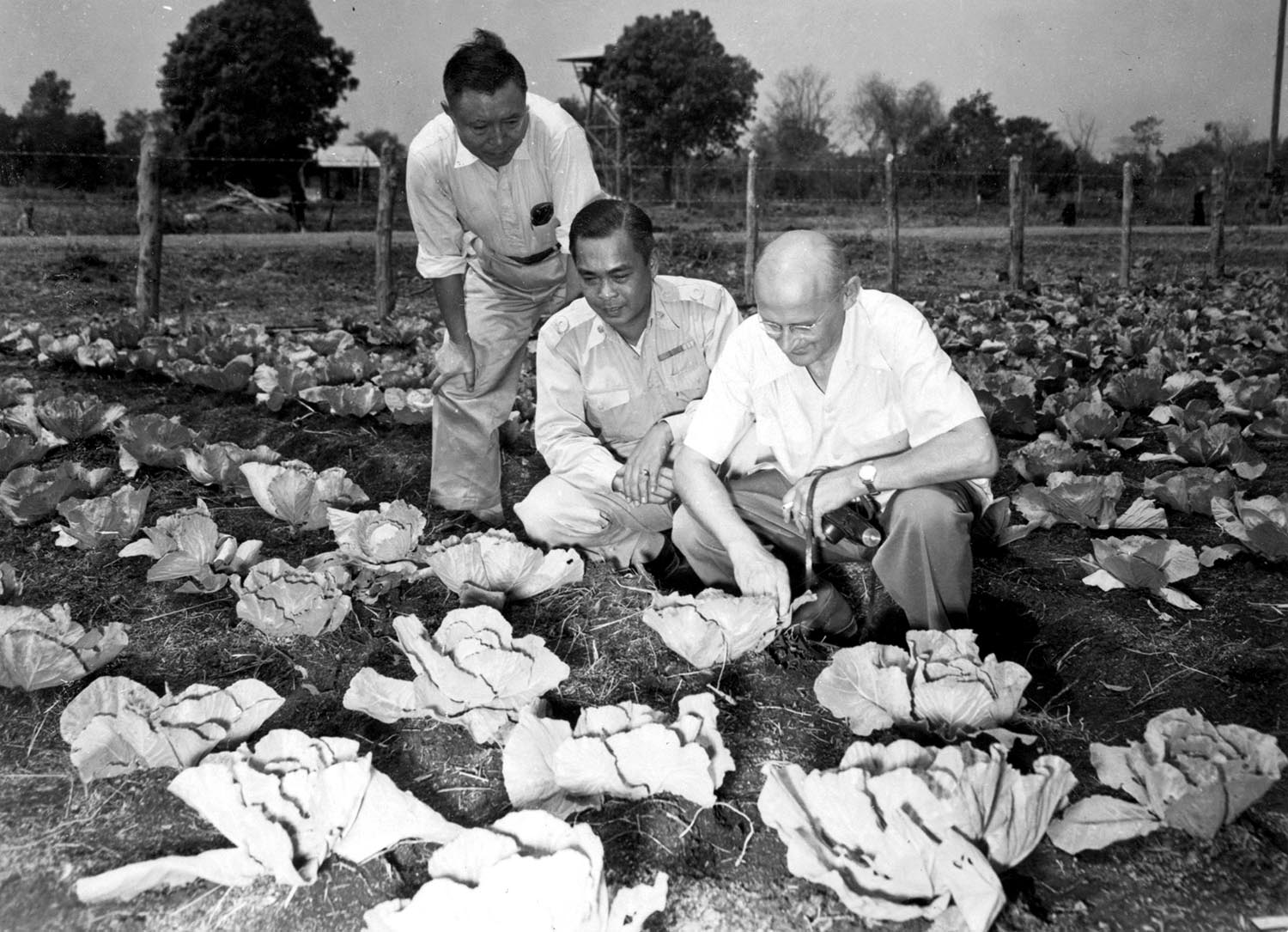
Three men, one a FAO expert, kneel to examine a cabbage field
info
close
Empowering farmers through land resettlement in 1950s Southeast Asia
©FAO

Private capital was short, that said, and access to technology limited. This required extensive public financing schemes, particularly in less developed countries. Although by far the greater share of investment came from domestic resources, international and foreign funding was crucial in some areas of acute need, such as the purchase of imported equipment.

Credit expanded dramatically – even if in parts of the world, excessive interest rates put it beyond the reach of many small farmers. (A decade after the end of the Second World War, some 90 percent of agricultural credit in India was still being supplied by moneylenders, generally at high interest rates.) By the 1950s, in South and East Asia in particular, a slew of legislative reforms was dismantling institutional barriers to the efficient use of land by transferring ownership to cultivators and encouraging the consolidation of fragmented holdings. There was broad progress towards the formal registration of titles. Various countries also rationalized their agricultural taxation systems.

info
close
Inspecting the rye fields of Sri Lanka
©FAO/Woodbridge Williams

Parts of what would come to be known as the developing world improved their use and management of water, with progress most notable in Thailand and in newly independent India and Pakistan. Many other countries undertook the first systematic surveys of their water resources. Irrigation schemes took off.

The Soviet Union and China, which had collectivized agriculture or were busy doing so, were also reporting progress on administering water resources and other aspects of farming. By the 1950s, however, the Korean War and the Cold War had corroded much of the spirit of cooperation of the very early post-war era. In the process, the flow of information between rival powers had dwindled. Poorer nations, meanwhile, lacked comprehensive reporting capacities.

Gaps in the data notwithstanding, there was evidence of significant agricultural advancement across much of the globe. By the mid-1950s, there had been a conspicuous leap in the prevalence of agricultural machinery. The number of registered tractors went up threefold, releasing for cultivation vast expanses of land previously used to grow feed for traction animals.

Plant breeding too underwent considerable development. In parts of Europe, hybrid maize was greatly boosting yields. Developing nations saw the productivity of basic crops soar thanks to new synthetic pesticides and selective weedkillers. By the 1960s, improved, high-yielding varieties of rice, as well as new strains, had spread across Asia. The continent is seen as having reaped the biggest rewards from the Green Revolution: over thirty years or so, high-yielding varieties of rice came to comprise two-thirds of all plantings, while nearly 90 percent of wheat fields were planted with modern varieties.

One main sprays a coconut tee as another an engineer watches
info
close
Combating coconut tree disease in Southeast Asia
©UN photo
A young Filipino man studies shrimp under the microscope as a FAO expert guides him and a young Filipina student takes notes
info
close
Supporting research in marine fisheries biology in the Philippines
©FAO/S. Bunnag

From the 1950s onwards, livestock and animal husbandry benefited from the more systematic registration of herds and the spread of artificial insemination. Poorer nations set up state veterinary services. Europe, North America and Oceania witnessed big jumps in yields per hectare per animal.

Overall, within a decade of FAO’s creation, food production was a quarter greater than at the end of the war, and higher also in per capita terms.

Foreword to FAO’s The State of Food
and Agriculture 1955
[excerpt] 

The same years [1945–1955] have seen more rapid and widespread advances in the technical methods of agriculture, forestry and fisheries than in any previous decade. They have seen also remarkable changes in the social and economic approach to agriculture. Largescale schemes of land reform have been carried through. A beginning has been made in many countries towards the co-ordinated planning and programming of agricultural development and of forest policy. Extensive attempts have been made to limit the fluctuations of farm prices and to give the cultivator a measure of economic security he has never before enjoyed. The findings of nutrition science have been more widely applied, particularly to secure minimum levels of nutrition for children and mothers. International schemes of investment and technical assistance have been put in hand, aimed primarily in the agricultural field at tackling the deep-seated problems of low productivity, undernourishment and rural poverty in the less developed countries of the world. These are only a few of the striking developments of the past decade.

Even so, progress was far from even, sufficient or irreversible. On the whole, agricultural expansion, solid as it was, was dwarfed by the scale of growth in the industrial sector, the main engine of post-war prosperity in Western nations. Sub-Saharan Africa, on the other hand, had failed to make the most of the Green Revolution: capital in the region was scarce; landownership largely informal; agricultural inputs basic; and access to credit and technology limited. For decades to come, the region would remain the focus of international development efforts.

Throughout the first two decades of FAO’s existence, the fragility of agricultural supply chains and the persistent difficulty in securing universal access to food (even in nations that had largely benefited from the Green Revolution) were sharply illustrated by sudden-onset crises, both human-caused and natural.

The earthquake that struck Buin Zahra in the northern area of Iran (now the Islamic Republic of) on 1 September 1962 killed more than 12 000 people. Cataclysmic in human terms, the tremor was also a trial by fire for the new humanitarian organization, the World Food Programme (WFP). The body, founded as a joint UN–FAO undertaking less than a year earlier, quickly mobilized to deliver 1 500 tonnes of wheat, 270 tonnes of sugar and 27 tonnes of tea. In the decades since, WFP has shaped up as the world’s largest humanitarian structure, providing food assistance in half of all nations.

Construction workers at a building site in the aftermath of the 1964 earthquake in Skopje, Yugoslavia (now North Macedonia)
info
close
May 1964: An earthquake devastates Skopje, Yugoslavia (now North Macedonia). The UN/FAO World Food Programme sends in USD 1.2 million worth of protein-rich food
©WFP/FAO T. Tricerri
A man from Mexico's Otomi Indigenous group offers his young son a tatste of dried milk as a woman and girl watch over the scene
info
close
A nutritious taste of dried milk for a young Indigenous Mexican boy
©FAO

Between 1945 and well into the 1960s, agricultural production grew uninterruptedly. Yet the world also learned that while more food was essential to prevent starvation, even enough food was not, on its own, enough to end hunger. Throughout the period, in fact, ending hunger remained within dreaming distance: President Roosevelt’s fourth freedom lay in an ever-shifting “beyond the hills”, along a path that was never straight, rarely open to all, and frequently blocked by the debris of conflict, the legacy of injustice and the weight of neglect.

back to top

Back to top