Abstract
Introduction
Research Programmes
Conclusion
Résumé
References
Abiye Astatke*
(* Agricultural Engineering/Highlands Programme, ILCA, P.O. Box 5689, Addis Ababa, Ethiopia.)
In Ethiopia animal traction has been an integral part of agricultural production for centuries. Pairs- of oxen have been employed to pull an ard plough ('maresha') for seedbed preparation. Implement development for primary and secondary cultivation was the main focus until the end of the 70s. Some work on transport, earth movement and land shaping started in the mid-80s. But there has been little adoption by farmers of the new implements developed. This might be partly due to researchers not addressing the pertinent issues, to inadequacy of the extension system and to the reluctance of farmers to change traditional practices.
Use of draught animal power for cultivation in most parts of Ethiopia dates back to before recorded history. Domestic animals were used to increase cultivated areas to feed a growing population.
At present, over 80% of Ethiopia's 42 million people are engaged in agriculture. The majority of the farming community live in the highlands. Crop-livestock mixed farming is the common practice and farmers use pairs of oxen for land cultivation. Horses and mules are used as work animals in some areas but oxen provide the main traction power.
Traditional Cultivation Techniques
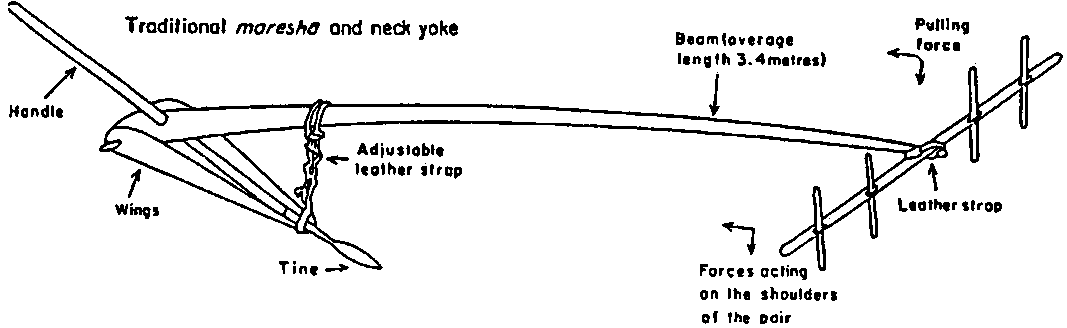
The traditional cattle economy of the highlands is directed to raising ploughing oxen. Meat and milk are by-products from it. The only implement used for land preparation and planting is the traditional plough or 'maresha' which is a pointed, steel-tipped, tine attached to a draught pole at an adjustable shallow angle. Narrow wooden wings attached on each side of the tine push soil to either side but do not invert it (Fig. 1).
The maresha has certain advantages. Apart from the metal point and the hook it is entirely home made. It is light, not exceeding 25 kg (Goe 1987), and can easily be carried to and from fields. The power requirement can be adjusted by the depth control and does not normally exceed the power developed by a pair of local Zebu oxen.
About 2 to 5 passes will have to be made by the maresha before the land is ready for sowing. Each pass is made perpendicular to the previous one. Time required for land preparation is 90-150 h/ha depending on the soil type. After being broadcast seeds are unevenly covered by a final pass with the maresha and germination is poor. It is to overcome this problem that farmers generally use higher seed rates (Abiye Astatke and Matthews 1983).
The use of oxen in the traditional farming system of Ethiopia is limited to seedbed preparation and threshing. Gryseels et al. (1984) have shown that farmers in highland Ethiopia work their oxen for some 450 pair-hours. This is equivalent to 2 months per year although the work potential of draught cattle can be 8-10 months as is estimated in India (Pathak and Gill 1984). Possible reasons for this low use in Ethiopia might include feed inadequacy over the working periods and the non-use of oxen for transport or other tasks during the long non-cultivation period.
Tillage Equipment Development
In 1968 the Implement Research Section Chilalo Agricultural Developmental Unit (previously CADU, now ARDU) began work on the designing and testing of tillage implements and carts. Developing an implement to replace the maresha continued to prove difficult, major obstacles being cost weight, durability and difficulty in getting the implements repaired locally.
Results from soil preparation studies comparing the use of the maresha and improved mouldboard ploughs with harrows showed that there was no significant difference in crop yields between the traditional and improved methods, although working time was reduced by 50% with the improved implements (CADU 1970; 1971).
Figure 1. Traditional Ethiopian plough (maresha) and neck yoke.
Evaluation of the 9'' mouldboard plough with the maresha by ILCA also showed comparable results except on waterlogged soils. The mouldboard plough was capable of forming raised beds which improved drainage and gave better crop yields than the traditional implement (Abiye Astatke and Matthews 1983).
The Agricultural Engineering Department of Institute of Agricultural Research (IAR) began in 1976 to develop appropriate farm tools for smallholders. However, due to financial constraints, staff shortage and lack of facilities many of the projects initially planned were not implemented or discontinued. Recently through support from the FAO, the section has been strengthened and its activities expanded. The Farm Implement Division of the Ministry of Agriculture (MoA), established in 1982, has now taken up responsibility for the country, including all attachments for the use of draught animals. The division's mandate extends also to upgrading the local workshops (200) throughout the country so that they will be able to produce and service the farmers' agricultural implement needs.
Modifications to the maresha for landshaping and surface drainage of clay soils
Waterlogging is a serious constraint on plant growth on deep black clay soils known as Vertisols, especially in high rainfall areas (Getachew et al. 1988). There are 8 million ha of agriculturally important Vertisols in the Ethiopian highlands but because of waterlogging crops are not grown during the major part of the rainy season. In a small part of the Central Ethiopian highlands (Inewari Vertisol plateau) broadbeds and furrows (BBF) are traditionally made by human labour to drain off the excess rain water. The development of animal-drawn implements for the construction of BBF by the International Crops Research Institute for the Semi-Arid Tropics (ICRISAT) led to the invention of a tool carrier in the mid 1970s (ICRISAT 1986). This, however, proved too expensive for Ethiopian farmers. ILCA later developed a broadbed-maker (BBM) based on the maresha to meet the needs of the resource-poor farmers of Ethiopia (Jutzi et al. 1986).
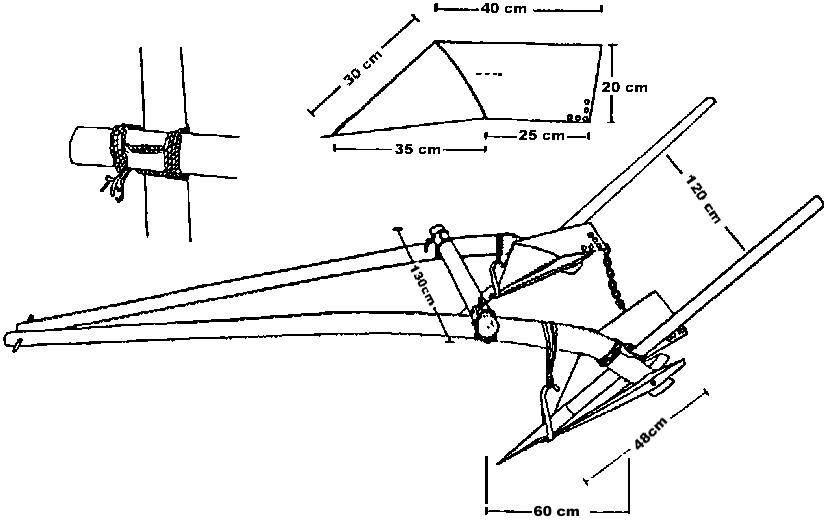
The BBM is made of two local ploughs connected in a triangular structure. The top ends of the maresha poles are tied together and connected to the yoke as in the traditional method while the maresha tips are separated by a 1.2 m long crossbeam which is also tied. A steel wing of mouldboard shape is also attached on each inner flat wings of the maresha (Fig. 2) to push the soil inside and form the BBF.
The chain attached at the edge of the metal wings not only shapes the beds evenly but also covers the seeds. Use of the BBM for land shaping is delayed until the last pass with the maresha. The BBM can cover between 0.4-1.2 ha per day with a pair of oxen (Jutzi et al. 1986) depending on the number of passes prior to making BBF, the filth status of the top soil and the condition of the working oxen. The effects of the enhanced drainage on crop growth, are substantial. Three years results from Were Ilu clearly show the impact of BBF planting crop on grain and straw production (Tables 1 and 2).
Table 1. Yields from Wheat on BBF and Ridge and Furrow at Degolo, 1987, on farmers' fields.
|
Land preparation |
n |
Grain |
CV |
Straw |
|
A. BBF made by BBF cv. ET-13 (1) |
13 |
1634 |
26 |
1990* |
|
B. Ridge and Furrow Local wheat |
17 |
157 |
98 |
563* |
|
C. Ridge-and-Furrow ET-13 |
10 |
1175 |
43 |
1401* |
Notes: ET-13 is an improved bread wheat variety
A. and C. early planted; B. late planted (as traditional)
* Differences between land preparation methods significant at P<0.05
Source: ILCA, 1989.
Table 2. Effects of improved surface drainage on N fertilizer efficiency in wheat (cv. Et-13) at Degolo, 1988.
|
Yield Kg/ha |
Seedbed preparation |
0 |
50 |
100 |
200 |
|
Grain |
Tradition |
664 |
1289 |
1528 |
1840 |
|
BBF |
1232*** |
1990*** |
2917*** |
2917*** |
|
|
Straw |
Tradition |
1417 |
2257 |
2808 |
4653 |
|
BBF |
2552*** |
3703*** |
4696*** |
4792 |
*** Differences between seedbed preparation methods significant at P<0.0001
Soil Excavation Using Scoops
Dry season water supplies are inadequate for both domestic needs and livestock in Ethiopia. Even in the highlands where there are more permanent water points than in the lower areas, most of the rural people have to walk for 3 to 4 hours to fetch water for domestic use. It is also common for animals to trek for many hours to get to watering points. ILCA also developed an ox-drawn metal scoop for excavating surface ponds. Testing of the scoops started in 1983, with the construction of a 7000 m3 pond on the ILCA Debre Berhan Station. In the following 2 years farmers in the neighbourhood constructed 2 ponds each having a capacity of 9000 m3 (Anderson and Abiye 1985). The average excavation rates using scoop capacity of 0.15 m3 from the 3 different sites for a pair of local oxen was 6.5 m3 per day.
The draught requirement for the full scoops was approximately 0.90 kN which is comparable to that required by the maresha (Abiye 1984).
Such technology is needed to improve self-reliant water resources in the rural areas and around 2000 scoops where distributed to the different regions by MoA. The major problems with this technology are proper selection and appraisal of pond sites, the timing of the work and the organisation of the work teams.
Scoops have also been employed for desilting ponds in Sidamo province in southern Ethiopia, where pastoral groups rely on ponds for watering livestock (Abiye Haile Selassie and Cossins 1985). On average, a pair of oxen were able to excavate 13m3 of silt per 5 hrs working day. Seven ponds were desilted in 81 days at a cost of 0.30 to 0.40 US$/m3 as compared to 2-3 US$ per m3 for earthmoving machinery.
Carts and Sledges
Sledges are used in the central highlands of the country (Arssi and some pockets of Shoa regions) to transport crops from fields to threshing areas. They are locally constructed of wood and are pulled by a pair of oxen. Within the vicinity of Lake Zeway, firewood and water are frequently transported on locally-constructed wooden carts pulled by a donkey. The carts have small flat metal wheels and are attached to the bed of the cart by a wooden axle.
Investigations on cart design and construction was initiated in 1969, when CADU began building several prototypes of 2-wheeled carts for single horses, donkeys and pairs of oxen. The axles were forged in the country, while the iron-rimmed wooden wheels with metal bushings were imported. Trials showed that steel-wheeled carts outperformed those with iron-rimmed wooden wheels (CADU 1971). At present most of the ox-carts are found in Arssi (mandated extension area for ARDU previously CADU) and resettlement areas organised by the government.
The Use of Single Animals for Traction
Figures are not available for Ethiopia, but work in other areas of Africa suggests that anything from 8 to 16 head (i.e. breeding and young stock) are needed to maintain one pair of ploughing oxen in the field (FAO/CEEMAT 1972). Even if the lower figure is accepted, it is obvious that the system has serious drawbacks in today's situation of rapidly increasing human food requirements. Encroachment of cropping into grazing areas and the increasing number of animals for draught purposes and their followers on restricted areas results in overgrazing and soil erosion.
The research on the use of a single local Zebu ox for cultivation with the modified maresha was started at ILCA in 1983 and was intended to benefit the large number of smallholder farmers with one animal. Because of the improvement in operational efficiency it was possible to reduce the oxen number and keep only more productive animals in good condition. Unfortunately the spread of technology in the farming community was minimal due to the problems associated with the modified maresha, the terrain of the target area and the negative attitude of the society towards using single animals.
Options for using pairs of cows
At Debre Berhan, preliminary investigations into using crossbed cows (Friesian × Boran) as draught animals in addition to producing milk were undertaken. Results showed that using these cows for draught purposes had no significant effect on reproductive and productive performance (Agyemang et al. 1983). Following this, a detailed study with the collaboration of ILCA and IAR has been started to find the level of nutritional requirements for work, milk and reproduction by working the crossbred cows singly.
It is hoped that the results of this study will help farmers, especially ones living around towns, to use the crossbred cows for draught as well as for milk production.
Nutritional and physiological studies of working animals
With the introduction of new equipment, farmers could complain that the work would subject their animals to great stress, thus reducing their overall efficiency. Studies are therefore necessary into the animals' nutritional and physiological response with the development and use of new equipment.
On-farm studies made at Debre Berhan based on nutritional quality of feeds stuffs and estimated daily intakes of oxen show that the energy needs of a pair for maintenance were adequately met throughout the year (Goe 1987). Another ILCA study has provided information on the relationship between feed intake and work output for both local and crossbred oxen. Results indicate that feed restriction has no measurable effect on work performance (Abiye et al. 1986). A strategy may be to allow oxen to lose weight during working periods and recondition them during the non-working periods; farmers in some Ethiopian highlands probably already use this strategy. But this might not work if other slack periods tasks e.g. transport, pond construction etc. are undertaken. Again, detailed investigations into the nutritional and physiological aspects of working animals are needed.
Draught animal use has and will continue to play a major role in agricultural production at smallholder level in Ethiopia. If agricultural production is to grow in the country, a more efficient and productive method of animal traction should be developed and extended to the fanning community at large. Moderate research on the different aspects of animal traction has been carried out but little has extended to taking the farming community into account. The rejection of new research development might be because researchers have not had adequate time to address these issues or because the technology through the established chains has been inadequate.
En Ethiopie, la traction animale occupe une place séculaire dans la production agricole. Des araires en bois (maresha) tractés par des paires de boeufs sont utilisés pour ameublir le sot Jusque vers la fin des années 70, les instruments conçus étaient essentiellement destinés aux opérations culturales primaires et secondaires. Vers le milieu des années 80, des travaux sur le transport et le terrassement ont été entrepris, mais les instruments mis au point ont fait très peu d'adeptes. Les raisons à cela tiennent au fait que les problèmes abordés par les chercheurs sortent du cadre des préoccupations des paysans, aux insuffisances du système de vulgarisation et à la réticence des paysans lorsqu'il s'agit de changer leurs pratiques traditionnelles.
Abiye Astatke and Matthews, M.D.P. 1983, 1982. Progress report of the cultivation trials and related cultivation work at Debre Zeit and Debre Berhan Highlands Programme. ILCA, Addis Ababa, Ethiopia.
Abiye Astatke and Matthews, M.D.P. 1981. Cultivation research in the Highlands Programme of ILCA. ILCA, Addis Ababa, Ethiopia.
Abiye Astatke. 1984. The use of animal power in water conservation work. M.Sc. Dissertation, Ganfield Institute of Technology Silsoe College, Bedford, U.K. Unpublished.
Abiye Astatke, Reed, J.D. and Butterworth, M.H. 1986. Effect of diet restriction on work performance and weight loss of Highland Zebu and Friesian × Boran oxen. ILCA Bulleting 23, 11-14. ILCA, Addis Ababa, Ethiopia.
Abiye, H. S. and Cossins, N. 1985. Use of ox-drawn scoop for pond maintenance in southern Ethiopia range lands. ILCA Newsletter 4 (1), 5-6. ILCA, Addis Ababa, Ethiopia.
Agyemang, K., Abiye Astatke, Anderson, F.M. and Woldeab, W.M. 1985. Early indications of effects of work on reproductive and productive performance of cross-bred dairy cows in the Ethiopian highlands. Highlands Programme Working Document. ILCA, Addis Ababa.
Anderson, F. and Abiye Astatke. 1985. Pond excavation using ox-drawn scoops in rural Ethiopia: The experience of two Peasant Associations in Debre Berhan area. Highlands Programme Working Document, ILCA, Addis Ababa, Ethiopia.
CADU. 1970. Progress Report No. 2. Implement Research Section Publication 52. Chilalo Agricultural Development Unit, Addis Ababa, Ethiopia.
CADU. 1971. Progress Report No. 3. Implement Research Section Publication 79. Chilalo Agricultural Development Unit. Addis Ababa, Ethiopia.
FAO/CEEMAT. 1972. The employment of draught animals in agriculture. Food and Agriculture Organisation of the United Nations (FAO), Rome, Italy.
Getachew, A., Jutzi, S.C., Abate, T. and McIntire, J. 1988. Economic evaluation of improved Vertisol for food crop production in the Ethiopian highlands. In Jutzi, S.C. et al. (ed.), Management of Vertisols in sub-Saharan Africa. Proceedings of a conference held at ILCA, Addis Ababa, Ethiopia, 31 August - 4 September, 1987. ILCA, Addis Ababa. p. 263-283.
Goe, M.R. 1987. Animal traction on smallholder farms in the Ethiopian highlands, Ph.D Dissertation. Department of Animal Science, Cornell University, Ithaca, New York.
Gryseels, G., Abiye Astatke, Anderson, F. M. and Getachew, A. 1984. The use of single oxen for crop cultivation in Ethiopia- Point 4. Ethiopia - U.S. Cooperative Agricultural Program Annual Report.
Hendrick, I. 1963 (ed.). The Agriculture of Ethiopia. Vol. 10. Imperial Ethiopian College of Agriculture and Mechanical Arts Jimma Agricultural Technical School. U.S.A. Operations Missions to Ethiopia - Point 4. Ethiopia - U.S. Co-operative Agricultural Program Annual Report.
ICRISAT. 1986. Farming Systems Research (FSR), 17-21 February, 1986, Patancheru, A.P. 502-324, ICRISAT, India.
ILCA. 1989. Animal Power of improved management of Vertisols in high rainfall areas of Highland Ethiopia - Report on phase 1 (1986-1988) and programme far phase 2 (1989-1991). Highlands Programme, ILCA, Addis Ababa, Ethiopia.
Jutzi, S., Anderson, F.M. and Abiye Astatke. 1986. Low cost modifications of the traditional Ethiopian tine plough for land shaping and surface drainage of heavy clay soils. Preliminary results from on-farm verification. In Starkey, P. and Ndiame, F. (ed.), Animal power in farming systems. GTZ, Eschborn, Federal Republic of Germany. pp. 127-132.
Pathak, B. S. and Gill, S. 1982. Management and utilization for work. Paper presented to the Expert Consultation of Appropriate Use of Animal Energy in Africa and Asia. 15-19 Nov., 1982, FAO, Rome.