5. Designation and management
Forests can be designated for various purposes, from “production” (usually of wood and non-wood products), to biodiversity conservation, to social services. For FRA 2025, countries were asked to report on the status of, and trends in, their forests according to the primary designated management objective – that is, the main intended purpose for which a forest is managed and used. To be considered “primary”, the management objective must be significantly more important than other management objectives, and the forest area reported under a given primary management objective may not be reported under any other primary management objective – that is, the designations are mutually exclusive. Note, however, that the primary management objective does not exclude provisions for other benefits or values. For example, sustainably managed natural production forests – for which the primary objective might be wood production – can typically also contribute to the protection of soil and water, biodiversity conservation, and the provision of social services. Similarly, forests managed primarily for the protection of soil and water might also contribute to wood production, biodiversity conservation, and other management objectives.
Six broad management objectives were identified for FRA 2025:
Production – of timber, fibre, bioenergy and/or non-wood forest products (NWFPs).
Protection of soil and water.
Conservation of biodiversity – this category includes but is not limited to areas designated for biodiversity conservation in protected areas.
Social services – such as recreation, tourism, education, research and the conservation of cultural or spiritual sites.
Multiple use – a combination of purposes, none of which is significantly more important than another. Thus, a designation of multiple use indicates that the forest is managed for any combination of production, soil and water protection, biodiversity conservation and the provision of social services.
Other – that is, purposes other than production, the protection of soil and water, biodiversity conservation, social services and multiple use.
Forest area that was not reported under any of these six categories was designated as “unknown”.
This chapter provides a global overview of the status of forest management designation in all 236 countries and areas covered by the assessment and an analysis of the status of, and trends in, each designation category. Note that values for the primary designated management objectives given in the global overview may differ from those shown in the analysis by designation category, which were calculated for reporting countries only. In the global overview, the values were calculated for total world forest area, with forests in non-reporting countries assigned to the “unknown” primary management objective.
In addition to the primary designated management objective, information was collected on the area of forest in legally established protected areas and under long-term management plans. The area and proportion of forests under formal protection is an indicator of how countries are addressing the need to conserve and protect forest ecosystems and the services those ecosystems provide. In FRA 2025, countries were requested to provide information on the area of forest in legally established protected areas corresponding to International Union for Conservation of Nature protected-area categories I–IV (IUCN, n.d.).
The area and proportion of forests with long-term management plans that are documented and periodically revised is an important indicator of the intention to sustainably manage forest resources. The area of forests in protected areas and the area of forests with long-term management plans are also components of SDG indicator 15.2.1 (“progress towards sustainable forest management”), which is reported annually by FAO to the United Nations Statistics Division.
The Kunming–Montreal Global Biodiversity Framework (CBD, 2022), the SDGs of the 2030 Agenda for Sustainable Development (United Nations General Assembly, 2015), the Global Forest Goals and targets of the UNSPF (United Nations, 2017), and other global processes have highlighted the need for forest restoration efforts to address the extensive deforestation and degradation of critical ecosystems, ensure the continued provision of ecosystem services, mitigate biodiversity loss and increase climate resilience. The United Nations declared 2021–2030 as the Decade on Ecosystem Restoration to halt the degradation of ecosystems and promote their restoration. Therefore, to better understand global forest restoration efforts, FRA 2025 collected data on existing restoration commitments and their underlying legal mandates, national definitions, areas identified as needing forest restoration, restoration targets, and the status of implementation of forest restoration.
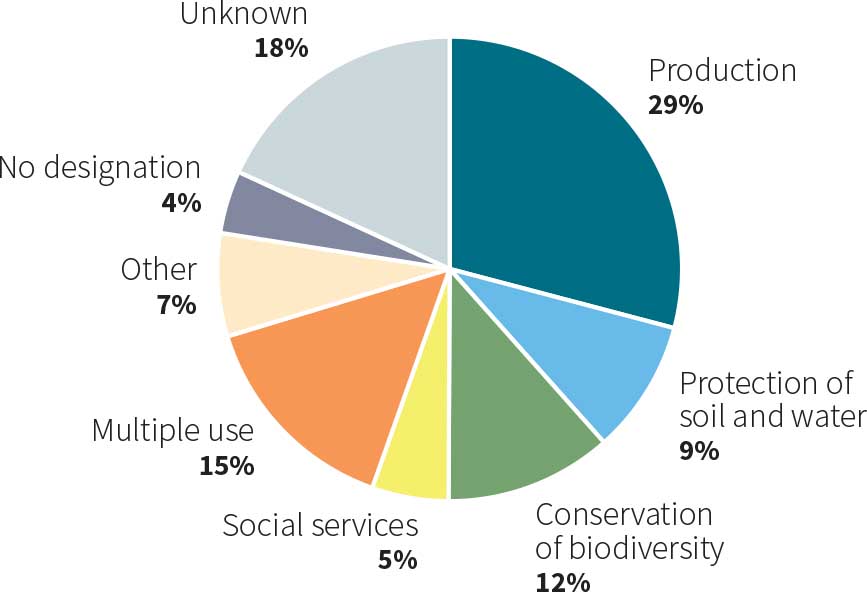
Analysis of primary designated management objectives for the 236 countries and areas covered by FRA 2025 shows that production has the most coverage, accounting for 29 percent of the total world forest area, followed by multiple use (15 percent), biodiversity conservation (12 percent), the protection of soil and water (9 percent), and the provision of social services (5 percent) (Figure 29). Management for “other” purposes – a category that mainly comprises country-specific management objectives, such as combinations of military, conservation, research, protection (e.g. against industrial or climate-related damage) and development – covers 7 percent of the world forest area. Four percent of the world forest area has no primary designated management objective, and the primary designated management objective is unknown for the remaining 18 percent of the world’s forests.
Of the regions, the largest share of forest area designated for production is in Europe, at 53 percent. Europe also reported the lowest share of forest area designated for biodiversity conservation, at 4 percent (Figure 30). If data for the Russian Federation are subtracted, however, the proportion of forest area designated for production in Europe is about 40 percent of the forest area, which is still the highest share among the regions, and the proportion of forest designated for biodiversity conservation is on par with the global average of 12 percent.
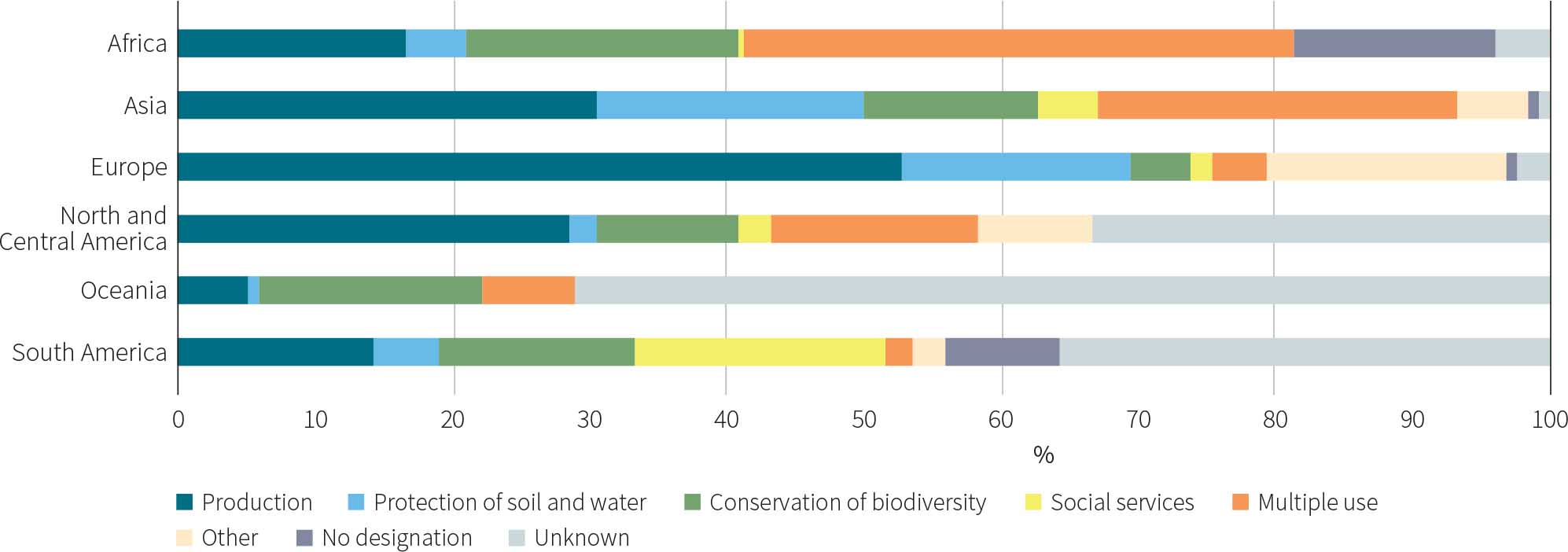
Africa has the largest proportion of forest area designated for multiple use and biodiversity conservation, at 40 percent and 20 percent, respectively. The Democratic Republic of the Congo and Zambia reported the region’s largest areas of forest designated for biodiversity conservation.
Asia has the largest proportion of forest area designated primarily for soil and water protection, at 20 percent of the total forest area, but the predominant management objective in the region is production, at 31 percent; China and Indonesia account for the largest areas in the region designated for both these management objectives. The provision of social services is the main known designated management objective in South America (where the biggest proportion is assigned to “unknown”), at 18 percent, which is also the highest share among the regions of forest area designated primarily for social services. Brazil reported the largest area of forest designated for social services, at almost one-third of the country’s total forest area.
Oceania has the highest share of forest in the “unknown” category, due mainly to a lack of data on management objectives for Australia.
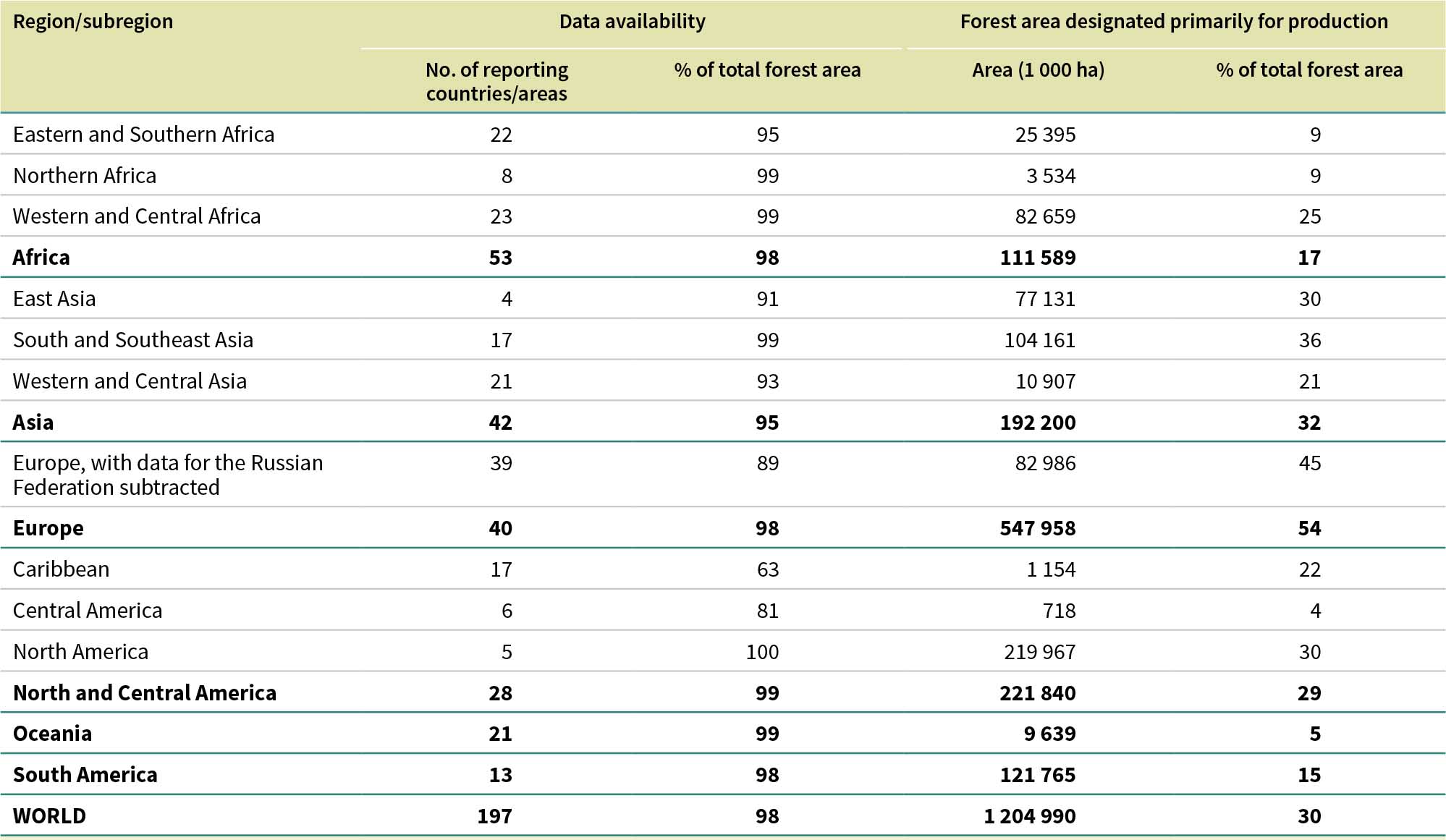
Status. FRA 2025 received information on the area of forest designated primarily for production in 2025 from 197 countries and areas representing 98 percent of the world’s forest area. Globally, the area of forest so designated is estimated at 1.20 billion ha, which is equivalent to 30 percent of the forest area of reporting countries and areas (Table 56). Europe has the largest area of forest in this category, at 548 million ha. If data for the Russian Federation are subtracted, an estimated 83 million ha is designated for production in Europe. The region with the second-largest area of forest designated primarily for production is North and Central America, at 222 million ha (29 percent of the forest area), followed by Asia, at 192 million ha (32 percent).
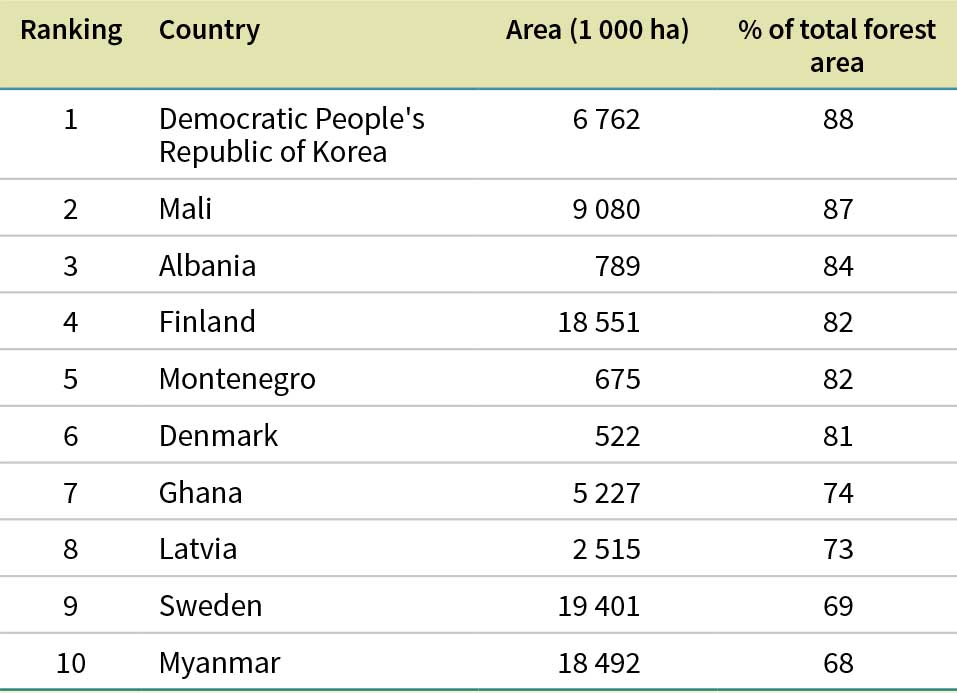
Six countries and areas reported that 80 percent or more of their forest areas is designated primarily for production; six of the top ten countries and areas for share of forest area designated primarily for production are in Europe (Table 57).
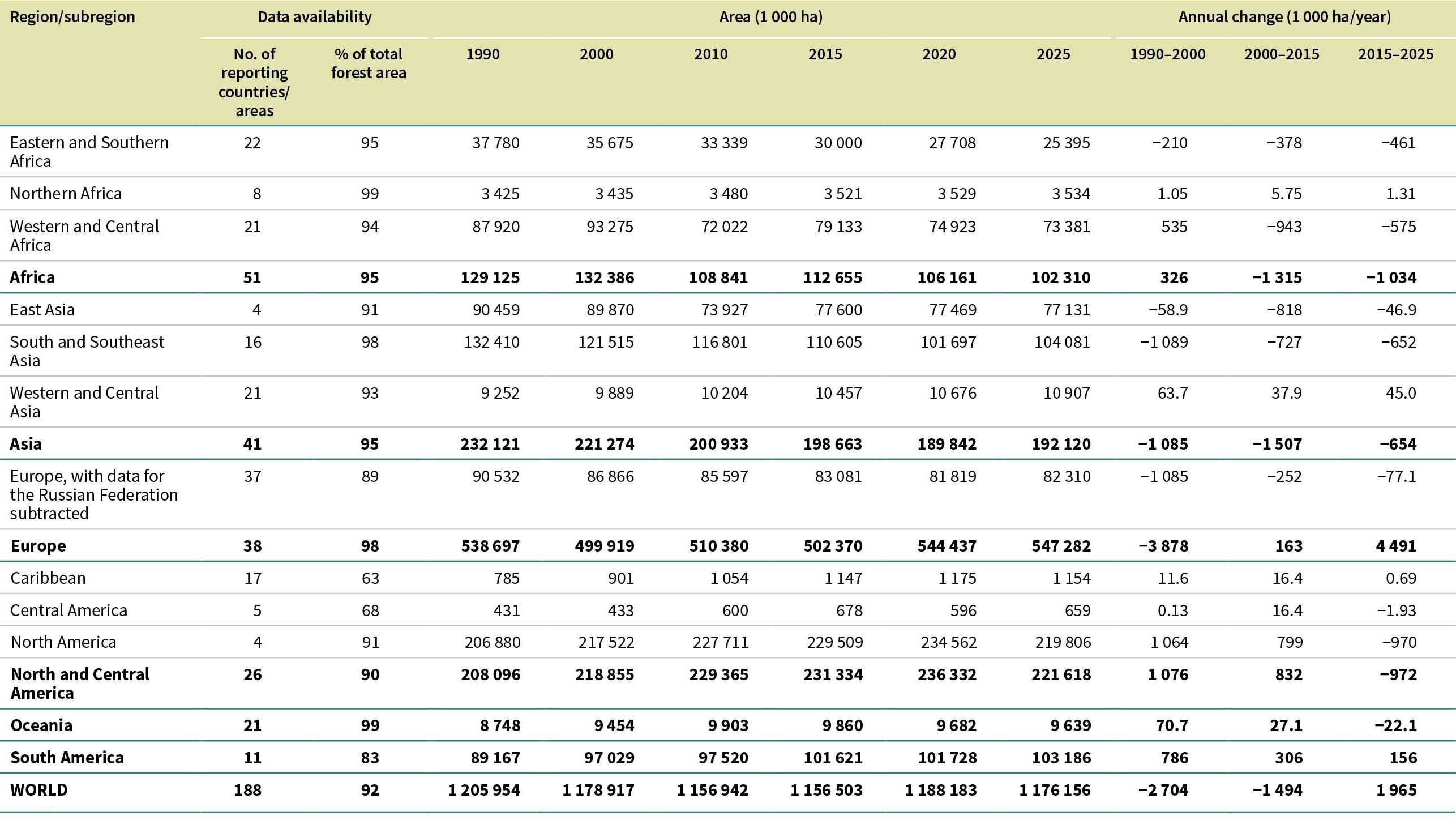
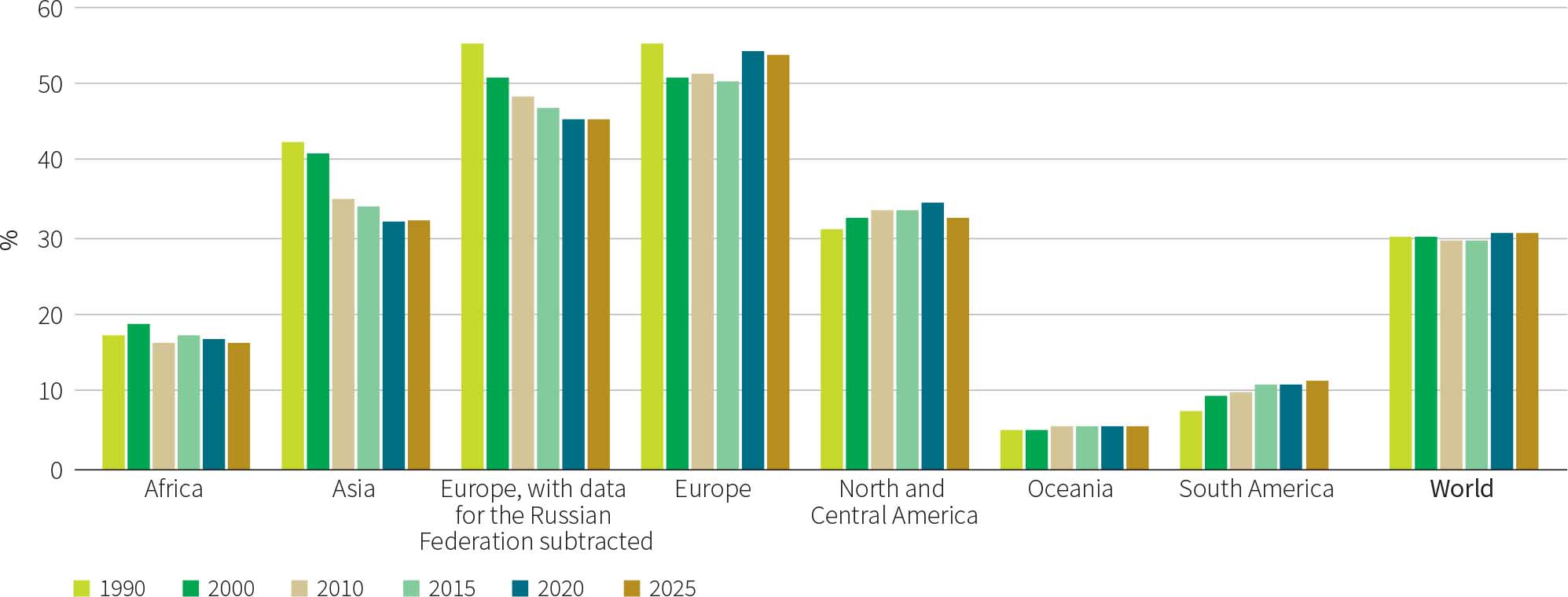
Trends. FRA 2025 received time-series data on the area of forest designated for production from 188 countries and areas representing 92 percent of the world’s forest area. The area of forest so designated decreased by 29.8 million ha between 1990 and 2025, with diverse patterns across the analysed periods and among regions (Table 58). The area of forest designated primarily for production decreased by 2.70 million ha per year in 1990–2000 and by 1.49 million ha per year in 2000–2015, before increasing by 1.97 million ha per year in 2015–2025. The shift to an increasing trend was driven mainly by Europe and especially the Russian Federation, which reported an annual increase in the area of forest designated primarily for production of 4.57 million ha in 2015–2025. Overall in Europe, the area of forest so designated decreased from 55 percent to 54 percent between 1990 and 2025. The share of forest designated primarily for production decreased substantially in Asia, from 42 percent in 1990 to 32 percent in 2025. The share decreased slightly in Africa over the period and was steady in Oceania. The proportion of forest designated primarily for production increased in South America over the 35-year period, from 8 percent in 1990 to 11 percent in 2025. North and Central America reported a slight increase since 1990 in the share of forest area designated primarily for production (Figure 31).
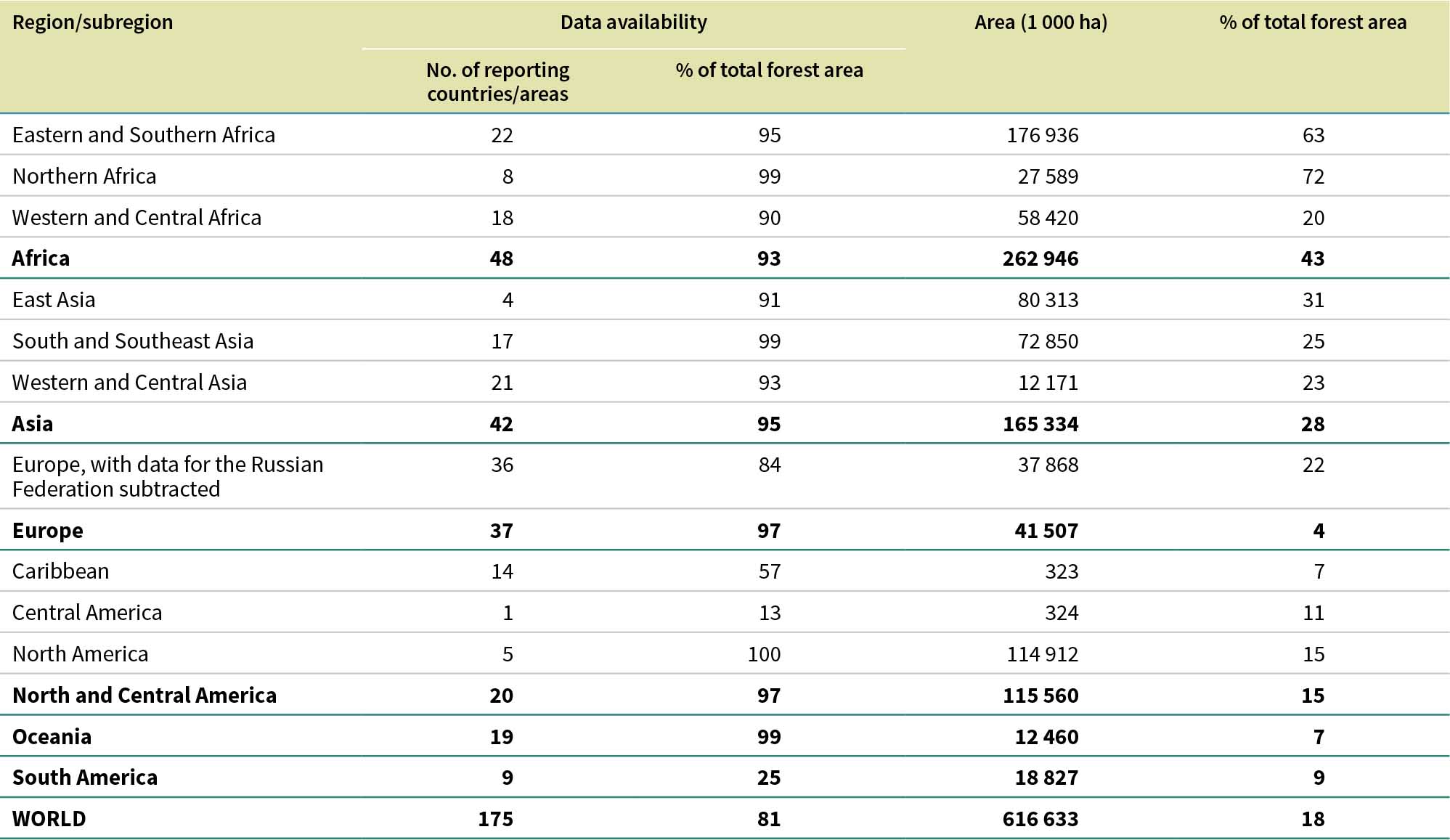
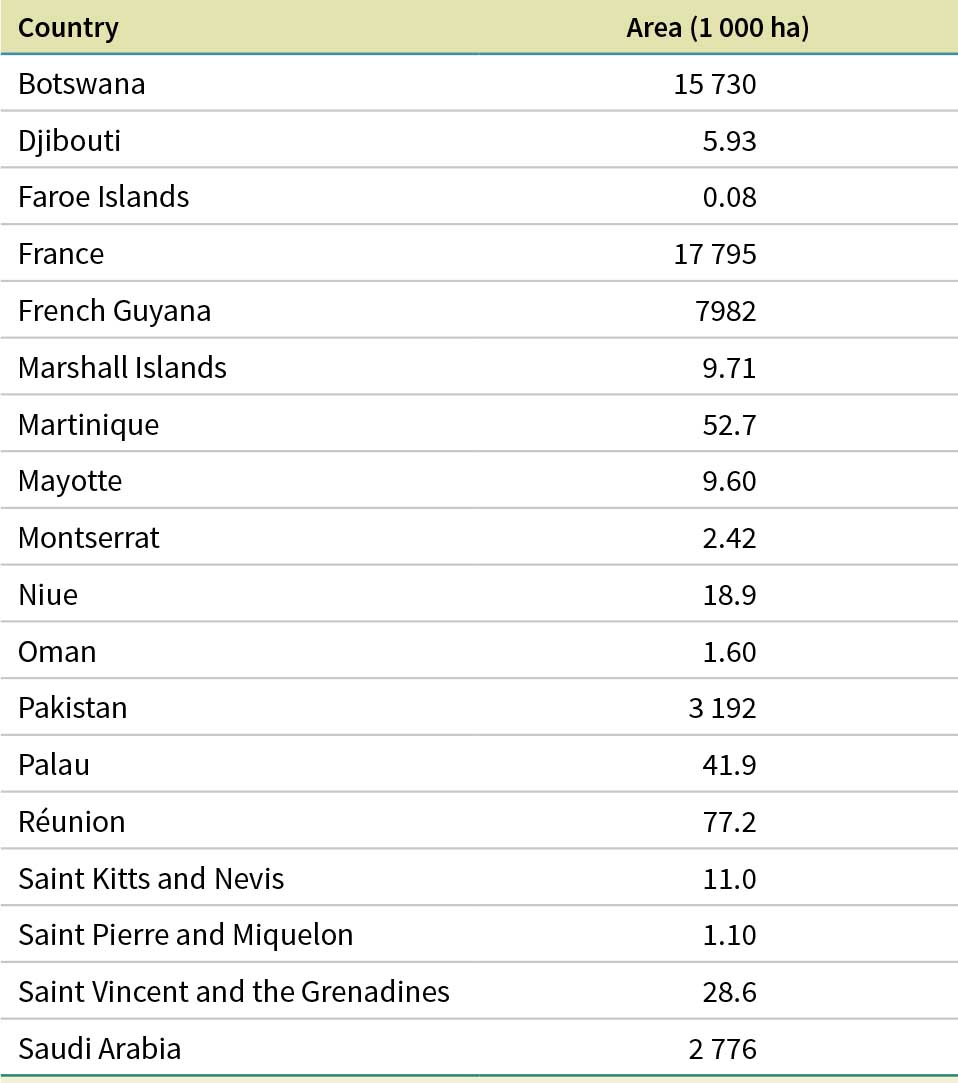
Status. FRA 2025 received information on the area of forest designated primarily for multiple use in 2025 from 175 countries and areas representing 81 percent of the world’s forest area. The area so designated is estimated at 617 million ha, which is 18 percent of the total forest area of the reporting countries and areas (Table 59). The largest area of forest designated for multiple use is in Africa, at 263 million ha, which is 43 percent of the forest area of the reporting countries and areas in the region and the biggest share among the regions. Northern Africa has an even larger proportion, at 72 percent, with Libya, Mauritania, Morocco, South Sudan and the Sudan all reporting values for their total forest area designated for multiple use of 72 percent or higher (including 99 percent, for Egypt). Worldwide, 18 countries and areas indicated that 100 percent of their forests is designated for multiple use (Table 60).
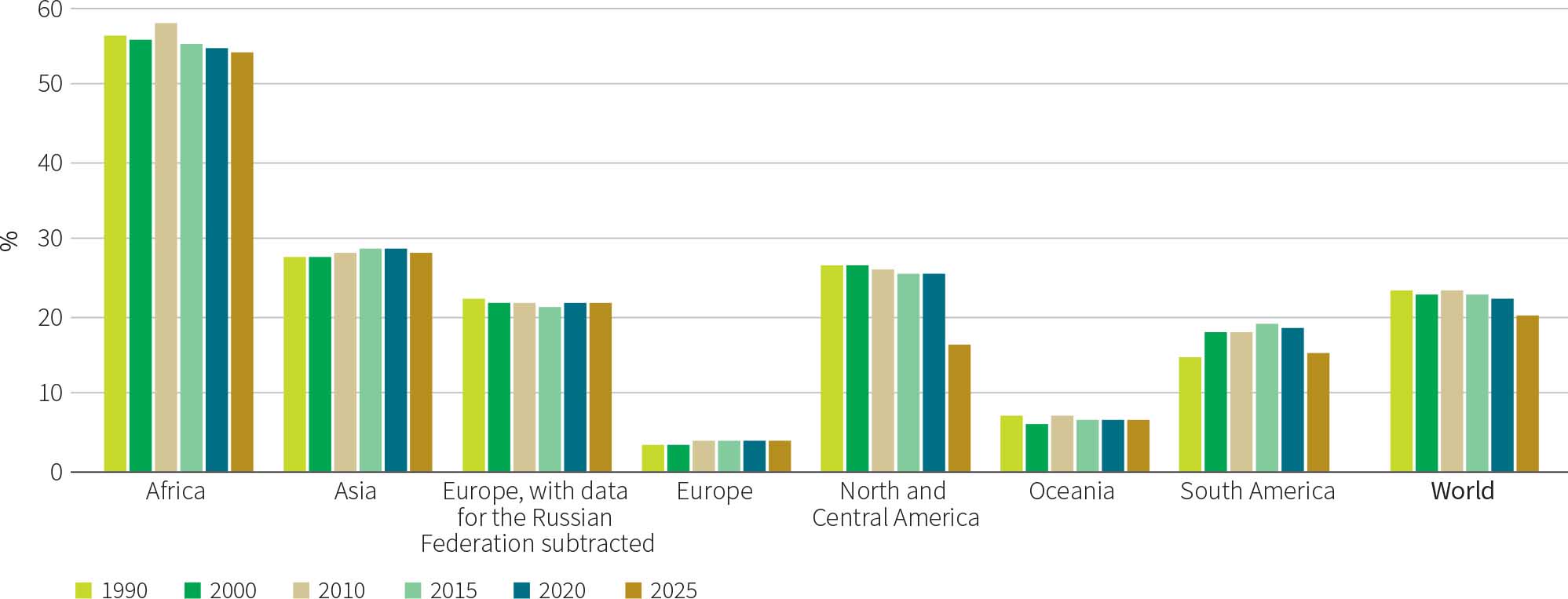
Trends. FRA 2025 received time-series data on the area of forest designated for multiple use from 167 countries and areas representing 73 percent of the world’s forest area. The area of forest so designated decreased by 97.5 million ha between 1990 and 2025, with the highest rate of decrease occurring in the most recent decade (Table 61). The average annual rate of decrease was 1.36 million ha in 1990–2000, 268 000 ha in 2000–2015 and 7.99 million ha in 2015–2025. The big decrease in the most recent period was due mainly to Canada, where the area designated for multiple use more than halved, with some forest areas previously in the multiple-use category now designated for biodiversity conservation or other management objectives.

The area of forest designated for multiple use declined between 1990 and 2025 in Africa, North and Central America and Oceania and increased in Asia, Europe and South America (Figure 32). The share in each region was relatively stable over the period except in North and Central America, where it decreased from 27 percent to 17 percent, mainly reflecting the change in Canada (as indicated above).
Status. FRA 2025 received information on the area of forest designated primarily for the protection of soil and water in 2025 from 175 countries and areas representing 90 percent of the world’s forest area. The area of forest so designated is estimated at 386 million ha, which is 10 percent of the total forest area of the reporting countries and areas (Table 62). Europe has the largest area of forest designated primarily for soil and water protection, at 173 million ha (17 percent of the region’s total forest area), due mainly to the Russian Federation, which, with 153 million ha of forest in this category, accounts for 40 percent of the world total. The second-largest area of forest designated for the protection of soil and water is in Asia, at 124 million ha, which is 21 percent of the forest area of the reporting countries and areas in that region – the largest proportion in this category of any region.
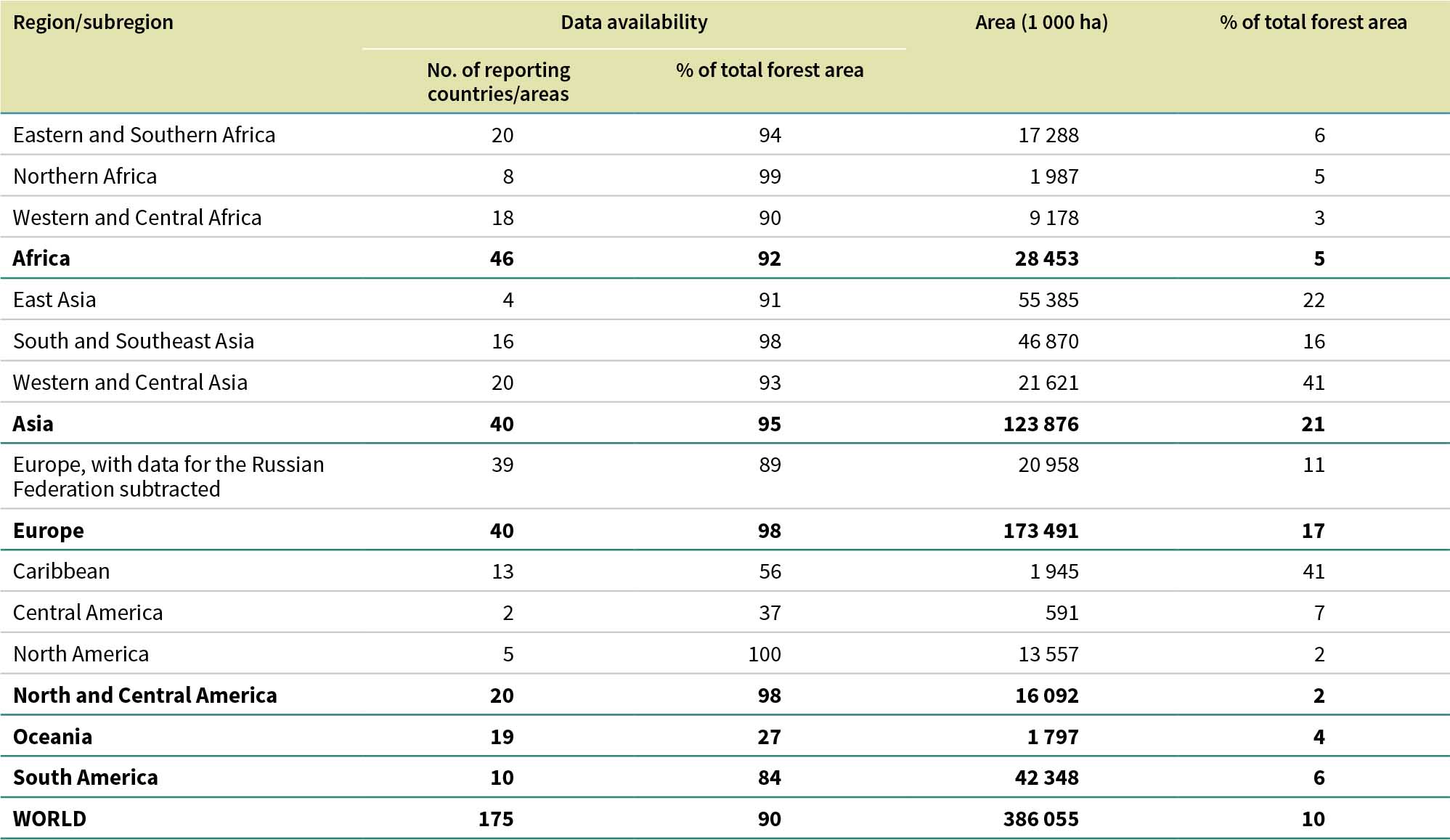
Among the subregions, the Caribbean and Western and Central Asia have the highest share of forest designated primarily for the protection of soil and water, both at 41 percent. In the Caribbean, Cuba reported that more than half (51 percent) of its forest area is designated for this management objective; in Western and Central Asia, Armenia, Kazakhstan, Kyrgyzstan and Uzbekistan reported among the highest shares worldwide of forest designated primarily for the protection of soil and water (54 percent or above) (Table 63). The proportion of the total forest area designated primarily for soil and water protection is higher than 90 percent in three countries and areas – Kiribati, Tunisia, and the Wallis and Futuna Islands.

Trends. FRA 2025 received time-series data on the area of forest designated primarily for soil and water protection from 168 countries and areas representing 85 percent of the world’s forest area. The area of forest so designated increased by 123 million ha between 1990 and 2025 (Table 64). The biggest increase was in 2015–2025, at an average annual rate of 6.39 million ha, up from 2.28 million ha per year in 2000–2015 and 2.53 million ha per year in 1990–2000. The steep increase in the decade to 2025 was due mainly to the Russian Federation, where the average annual increase in the area designated primarily for soil and water protection grew from 1.10 million ha in 2000–2015 to 6.53 million ha in 2015–2025.
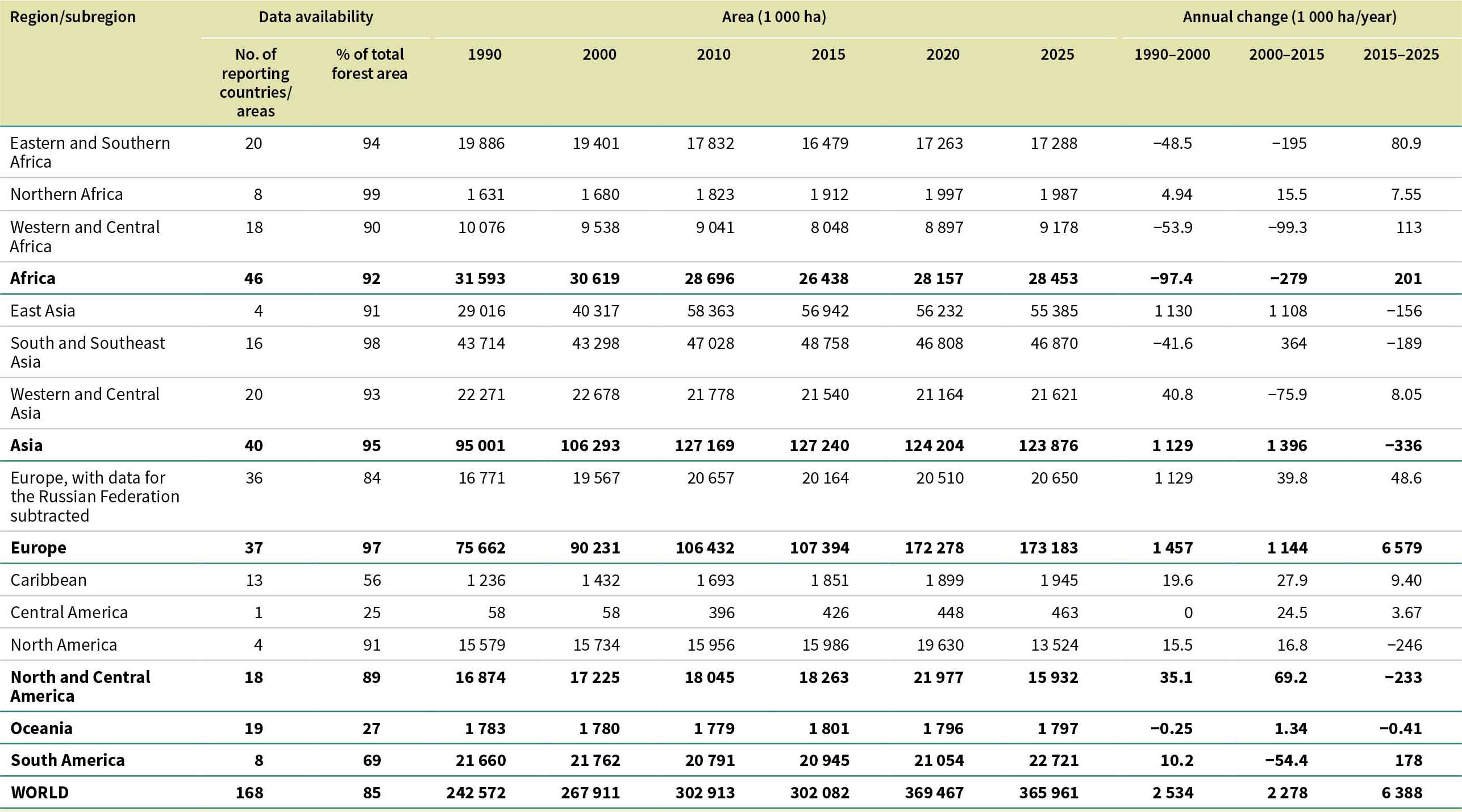
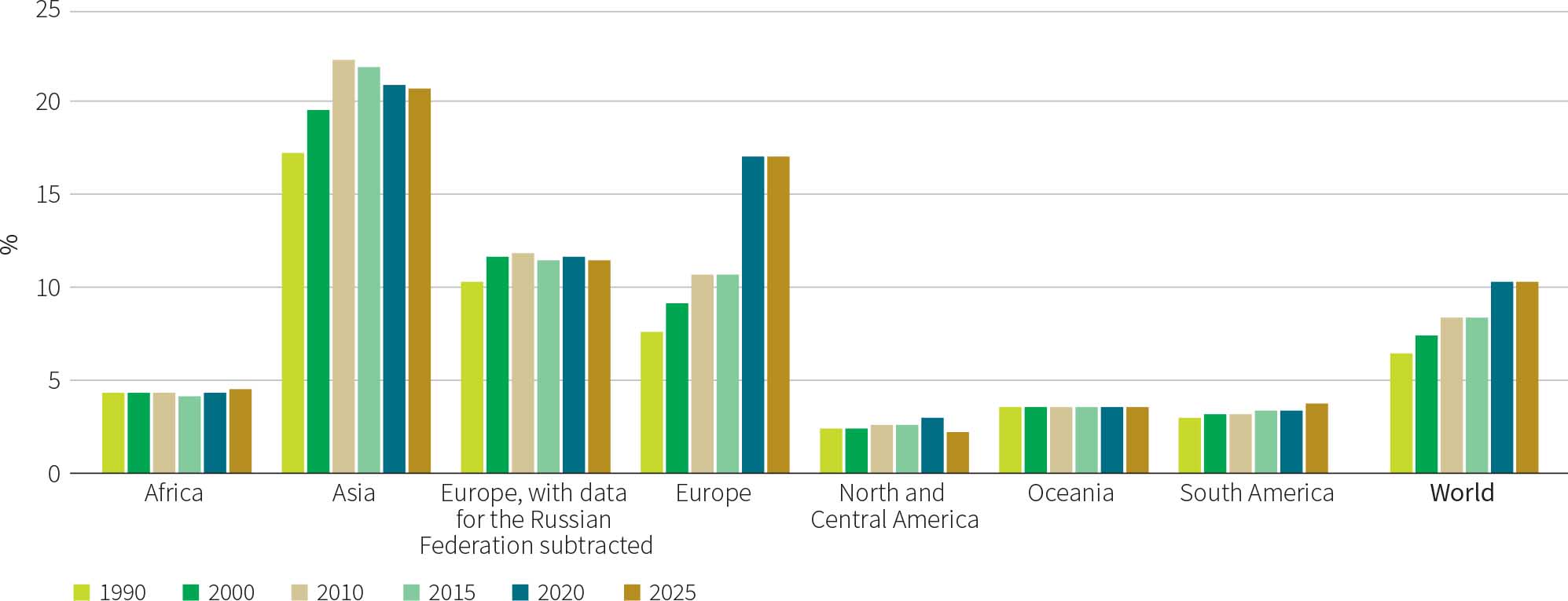
All regions except Africa and North and Central America reported increases between 1990 and 2025 in the area of forest designated primarily for soil and water protection. In Africa, the relative share of forest for the protection of soil and water increased from 4 percent in 1990 to 5 percent in 2025, despite an absolute decrease in area in this designation category (Figure 33). There was almost no change in Oceania over the 35-year period.
Status. FRA 2025 received information on the area of forest designated primarily for biodiversity conservation in 2025 from 200 countries and areas representing 98 percent of the world’s forest area. The area so designated is estimated at 482 million ha, which is 12 percent of the forest area of the reporting countries and areas (Table 65).
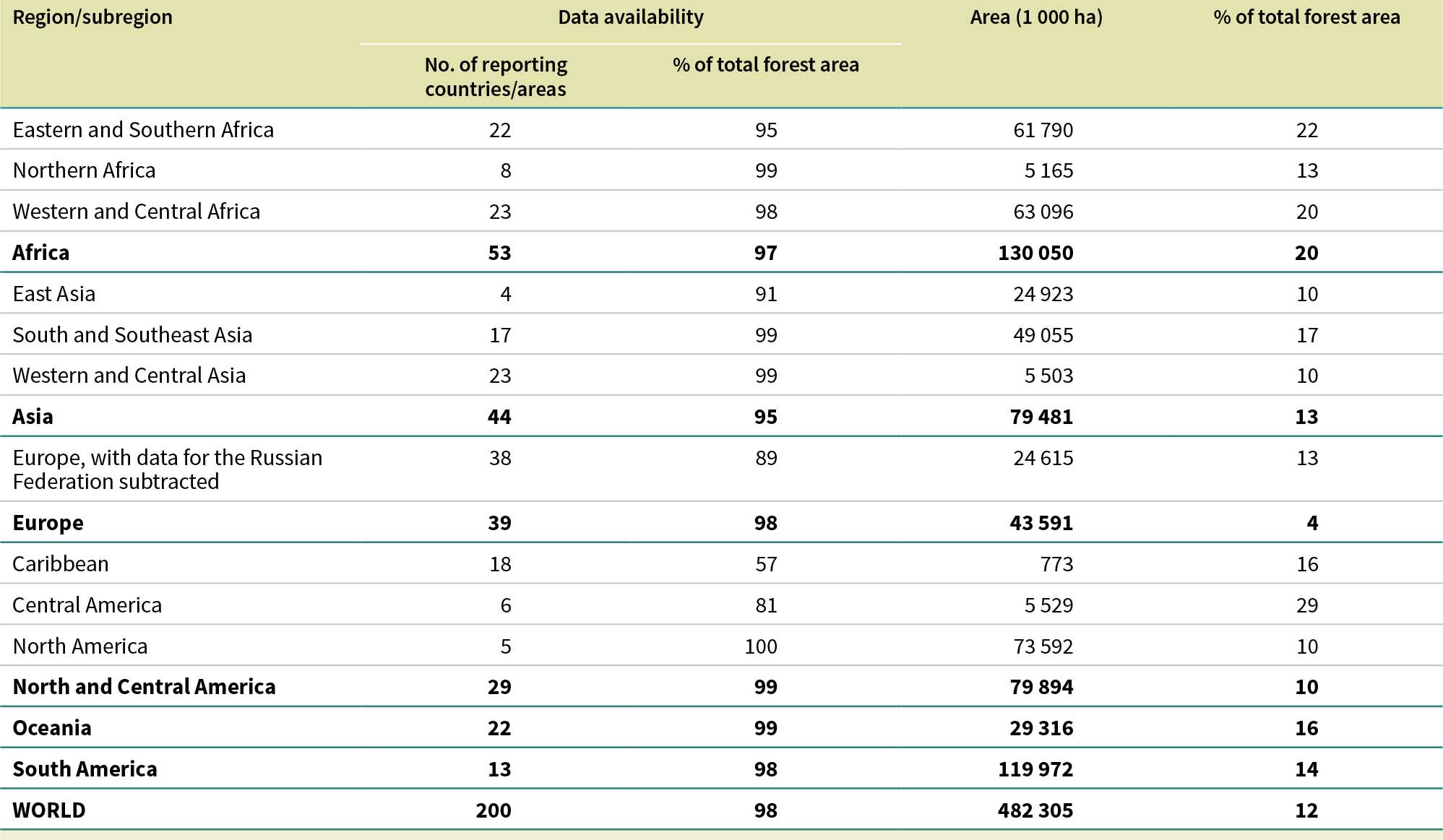
The largest area of forest designated for biodiversity conservation is in Africa, at 130 million ha. This is 20 percent of the forest area of reporting countries and areas in the region, which is the highest proportion among the regions. The lowest proportion is in Europe, at 4 percent (although this increases to 13 percent if data for the Russian Federation are subtracted).
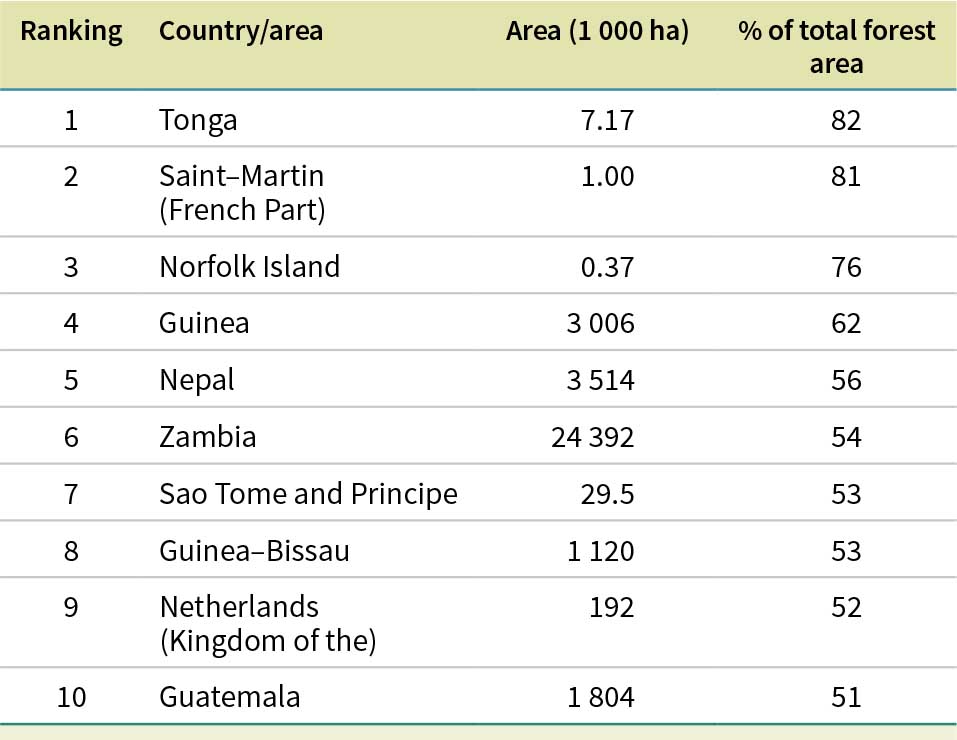
Three countries and areas – Norfolk Island, Saint-Martin (French part) and Tonga – reported that more than 75 percent of their forest area is designated primarily for biodiversity conservation (Table 66).
Trends. FRA 2025 received time-series data on the area of forest designated primarily for biodiversity conservation from 190 countries and areas representing 95 percent of the world’s forest area. The area of forest so designated increased by 118 million ha between 1990 and 2025, with the largest increase occurring between 2000 and 2015 (Table 67). The average rate of annual increase grew from 1.79 million ha in 1990–2000 to 4.19 million ha in 2000–2015 before dropping to 3.75 million ha in 2015–2025. Globally, the proportion of forest designated primarily for the conservation of biodiversity increased from 7 percent in 1990 to 12 percent in 2025.
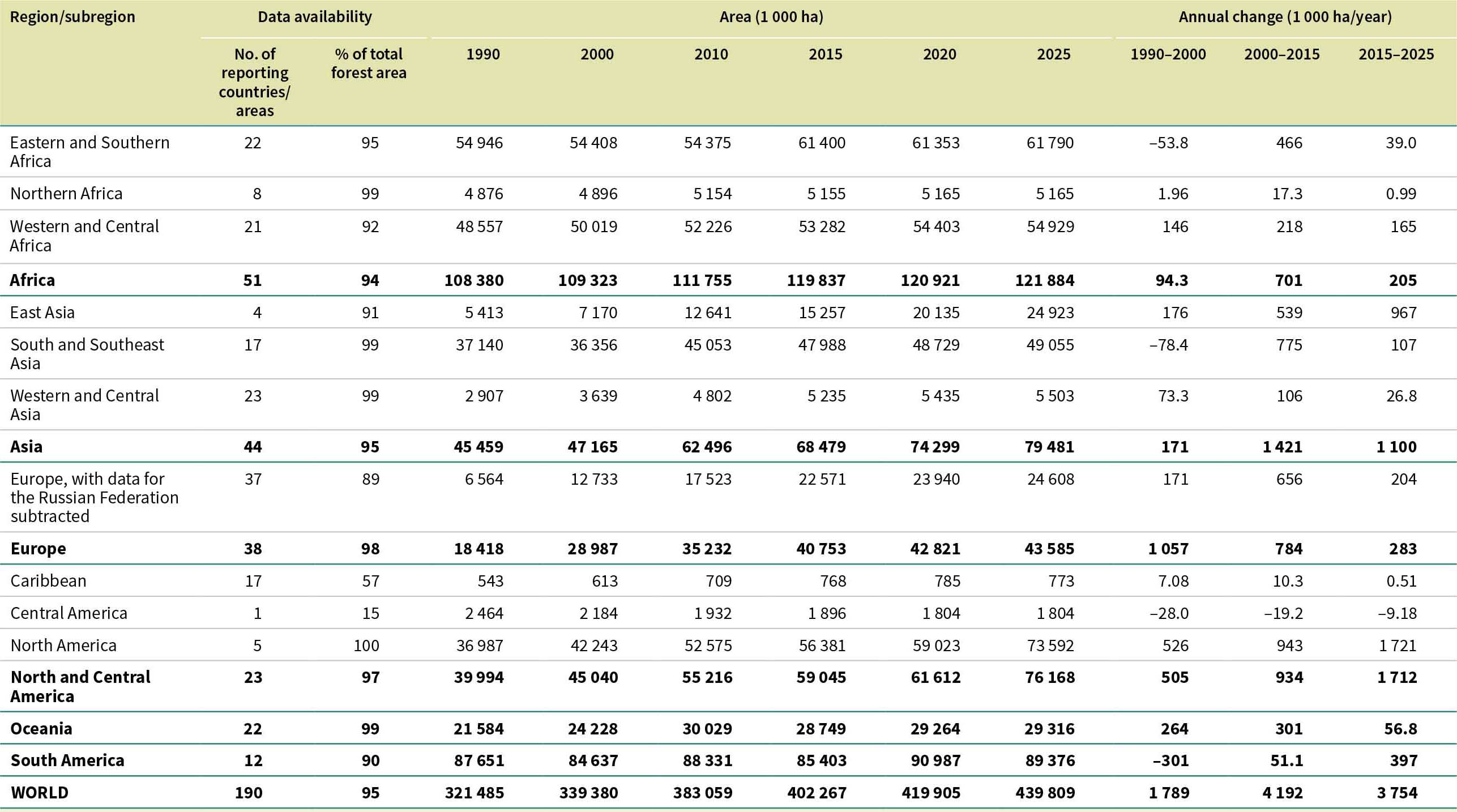
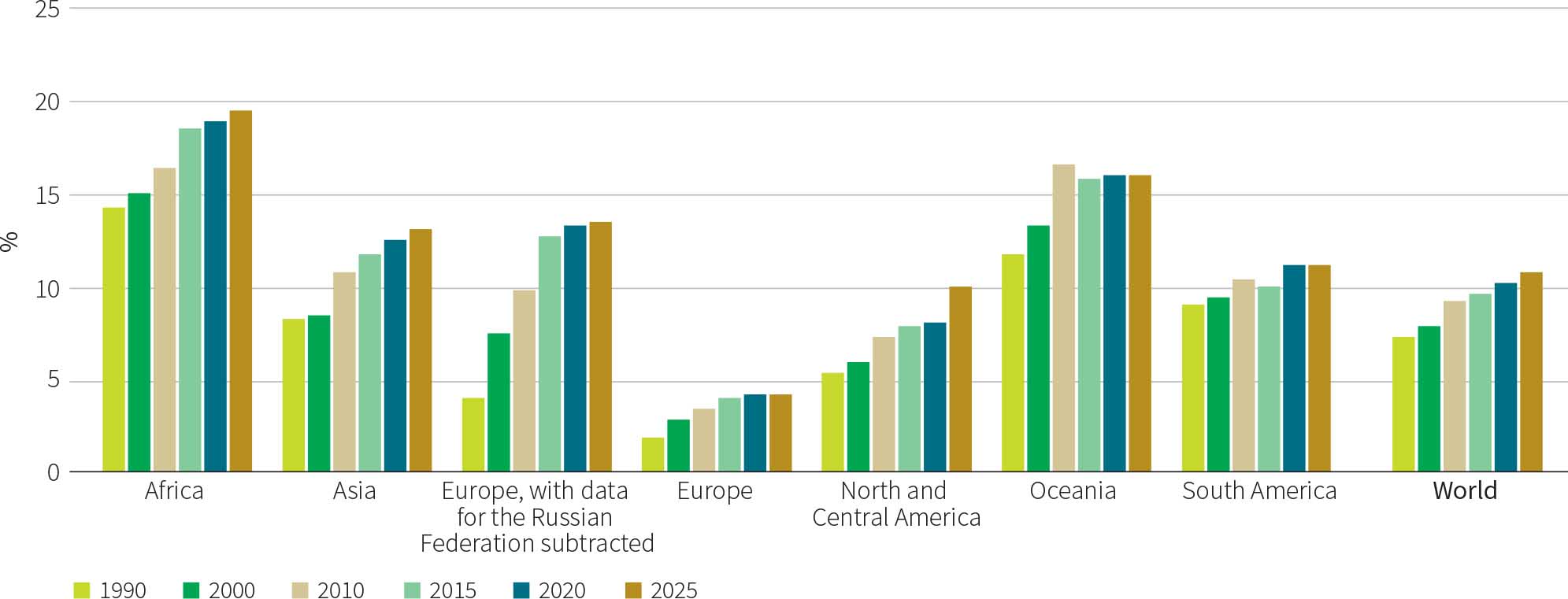
The area of forest designated for biodiversity conservation increased in all regions between 1990 and 2025. It almost doubled in North and Central America over the period and more than doubled (from 18.4 million ha to 43.6 million ha) in Europe (data for the Russian Federation subtracted). There was a significant increase in the proportion of total forest designated for biodiversity conservation in Africa, from 14 percent in 1990 to almost 20 percent in 2025 (Figure 34).
In Asia, the increase in the forest area designated for biodiversity conservation mainly reflects data reported by China, where the area so designated expanded almost sevenfold between 1990 and 2025. In South America, the forest area designated for biodiversity conservation decreased by 301 000 ha per year between 1990 and 2000 but then increased by 51 100 ha per year in 2000–2015 and by 397 000 ha per year in 2015–2025. This mainly reflects decreases in the area of forest managed for biodiversity conservation in Brazil in each of the three analysed periods and a significant increase in the Bolivarian Republic of Venezuela in 2015–2025.
Status. FRA 2025 received information on the area of forest designated primarily for social services in 2025 from 170 countries and areas representing 89 percent of the world’s forest area. The total area so designated is estimated at 221 million ha – 6 percent of the forest area of the reporting countries and areas (Table 68).
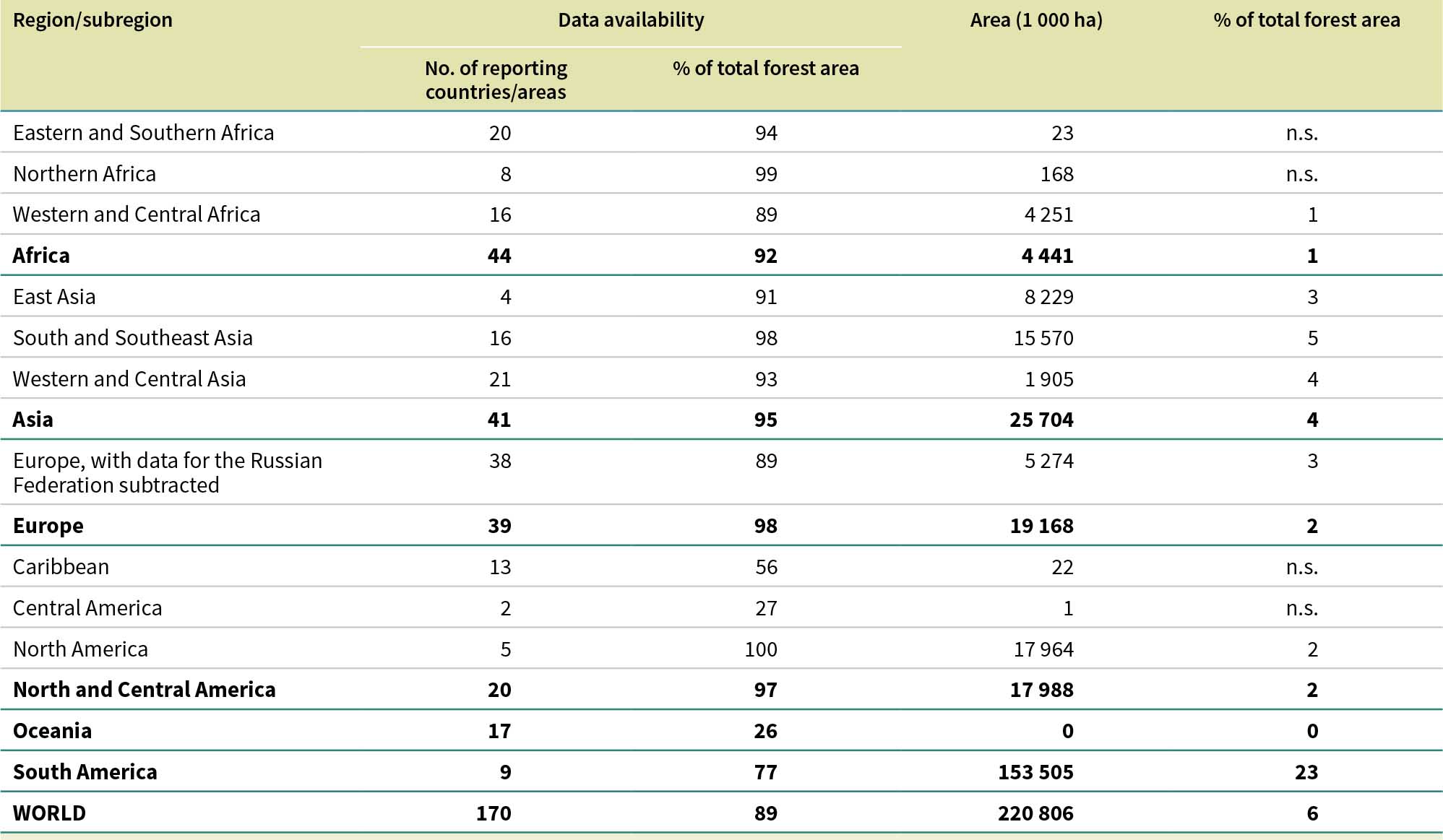
South America has both the largest absolute area of forest designated primarily for social services, at 154 million ha, and by far the largest proportion of total forest area so designated, at 23 percent. This area is composed almost entirely of forests reported by Brazil, at 153 million ha, which is almost one-third of that country’s total forest area and 69 percent of the world’s forest area designated for social services.
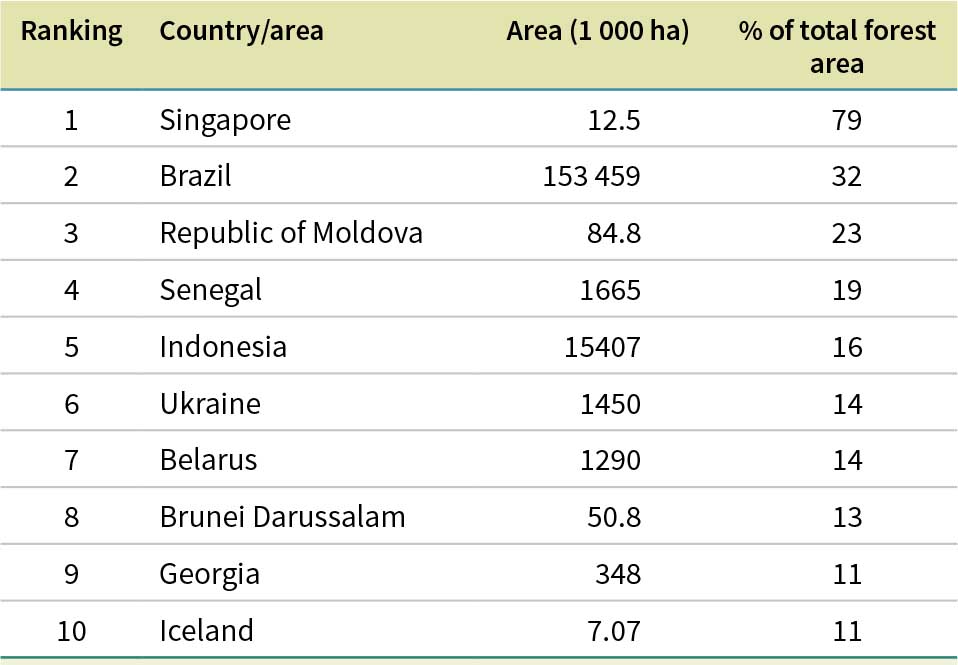
The area designated primarily for social services exceeds 10 percent of the total forest area in ten countries and areas, led by Singapore, at 79 percent of the country’s forest area (Table 69).
Trends. FRA 2025 received time-series data on the area of forest designated primarily for social services from 163 countries and areas representing 83 percent of the world’s forest area. The area so designated increased by 79.2 million ha between 1990 and 2025, with the highest rate of increase occurring in the most recent decade (Table 70).
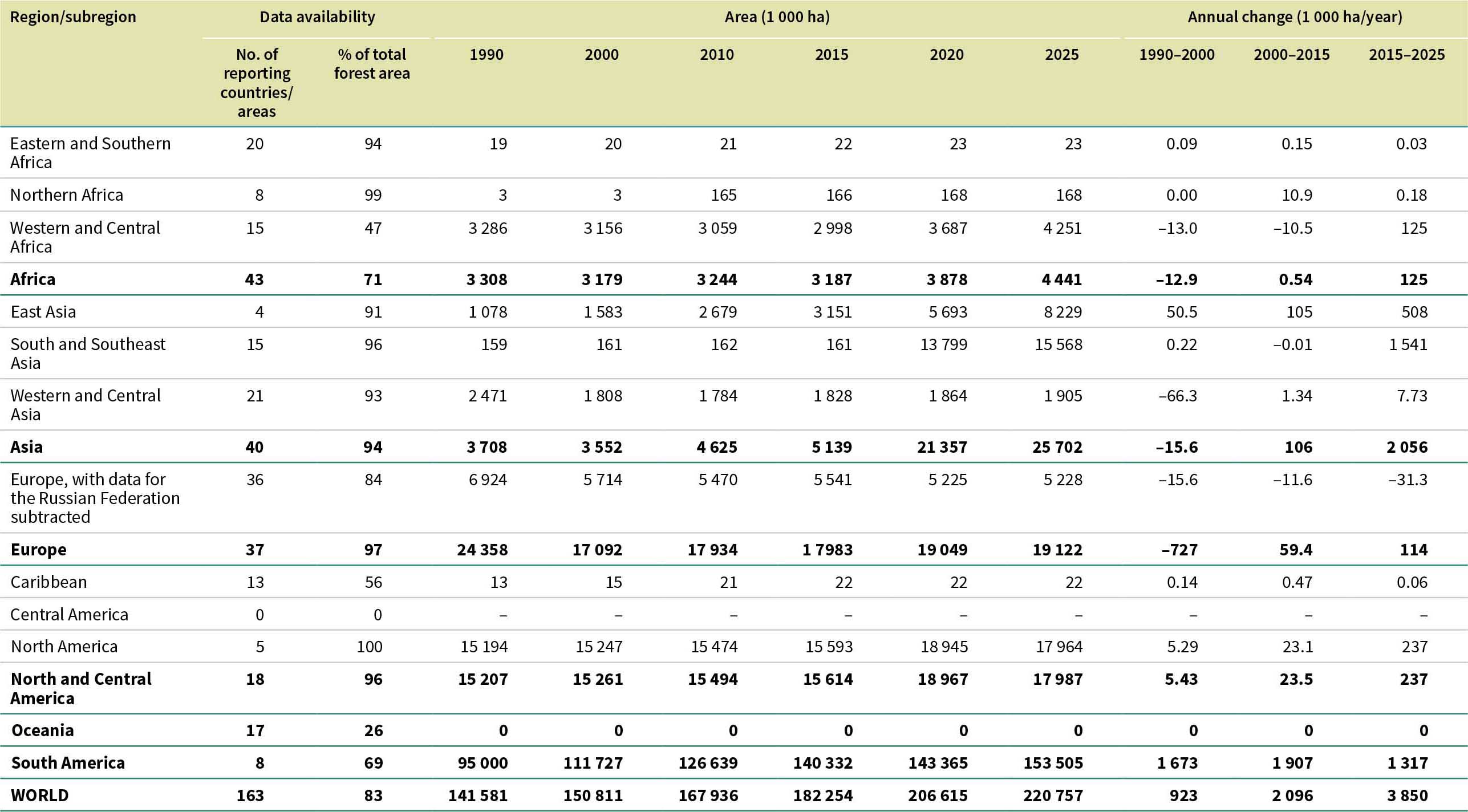
The area of forest designated primarily for social services increased in all regions except Europe and Oceania between 1990 and 2025. The increase was particularly evident in percentage terms in South America, where the area doubled from 13 percent of the total forest area in 1990 to 26 percent in 2025, and in Asia, where the share increased from 1 percent to 4 percent (Figure 35). The 17 countries and areas in Oceania that reported on this aspect all indicated that no forest is designated primarily for social services.
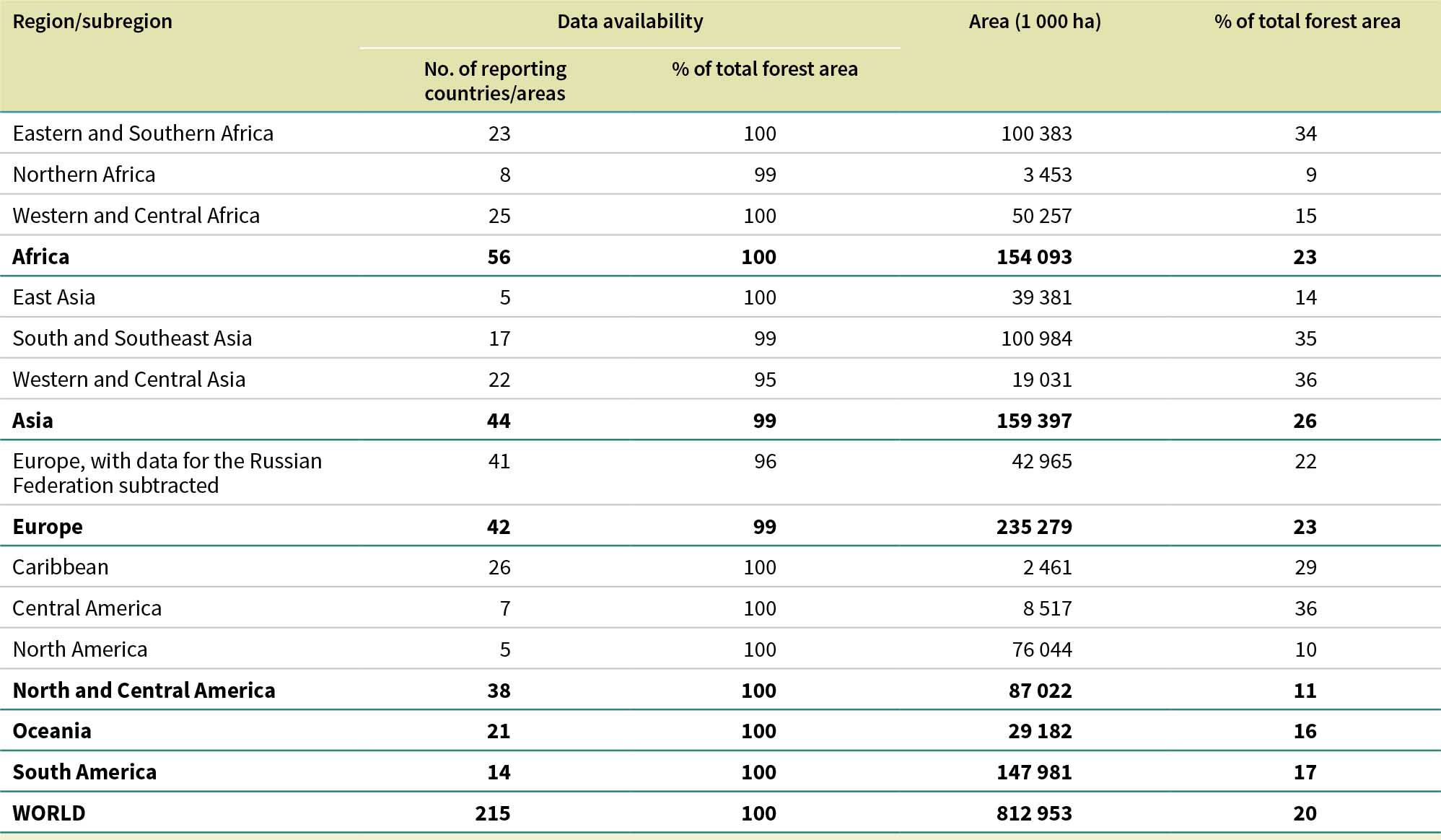
Status. FRA 2025 received information on the area of forest in legally protected areas in 2025 from 215 countries and areas accounting for nearly 100 percent of the world’s forest area. The total area of forest in protected areas is estimated at 813 million ha, which is 20 percent of the global forest area (Table 71). Figure 36 provides a global overview of the share of forest in protected areas.
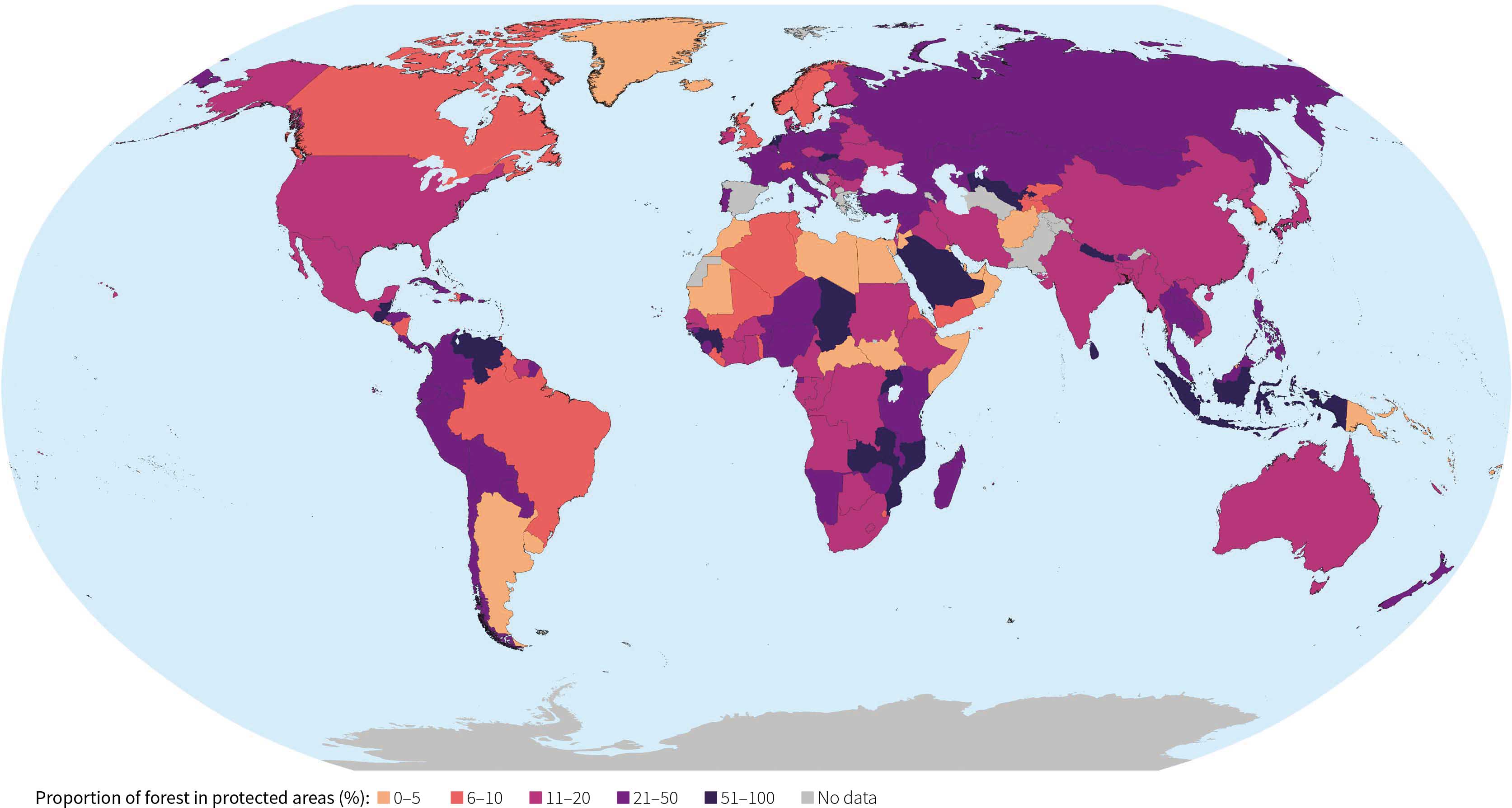
Note: Refer to the disclaimer on page ii for the names and boundaries used in this map. Dotted line represents approximately the Line of Control in Jammu and Kashmir agreed upon by India and Pakistan. The final status of Jammu and Kashmir has not yet been agreed upon by the parties. Final boundary between the Republic of Sudan and the Republic of South Sudan has not yet been determined. Final status of the Abyei area is not yet determined.
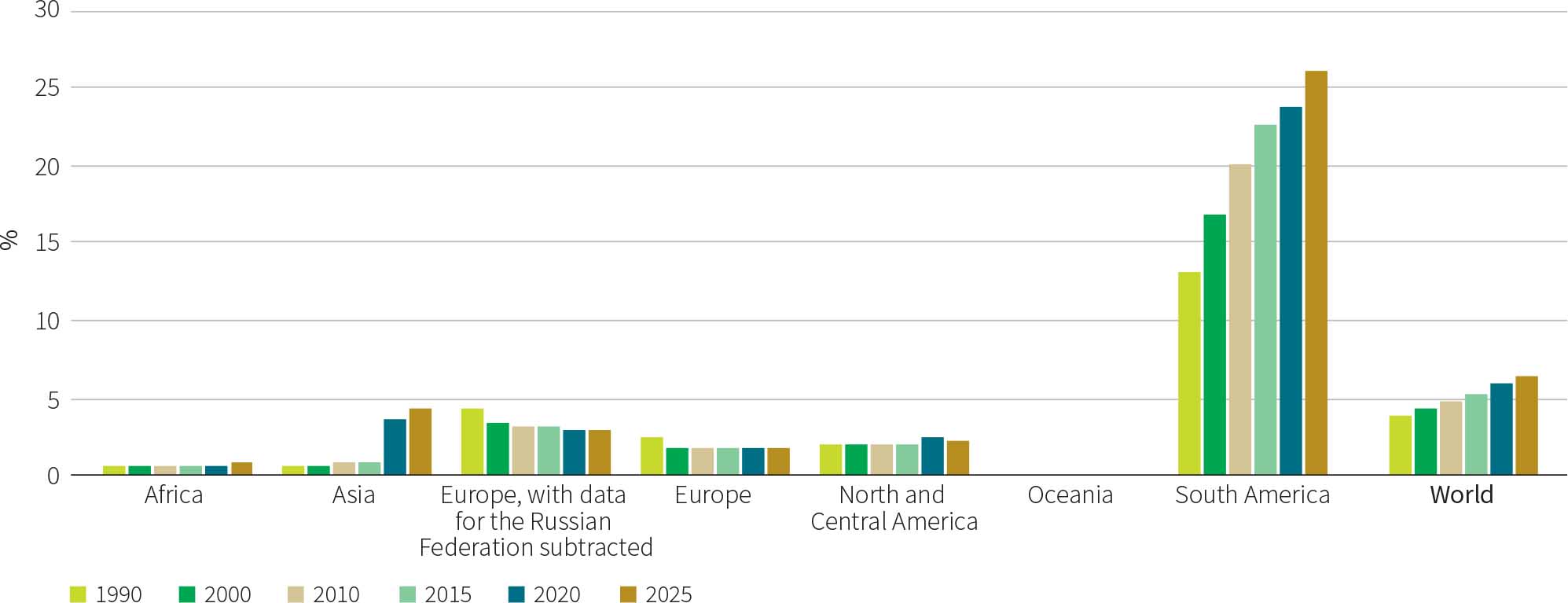
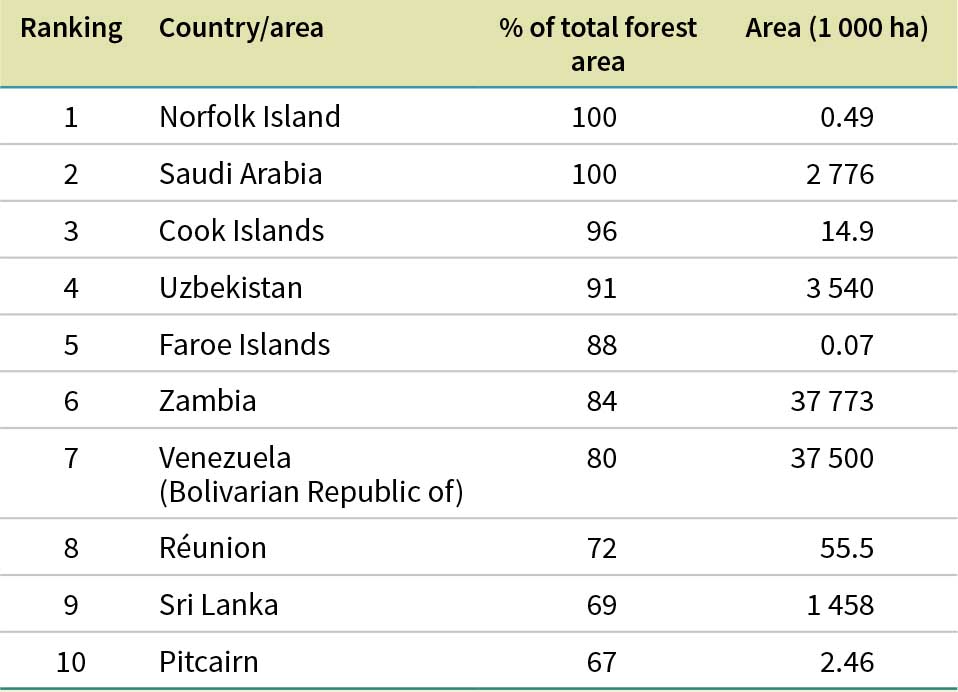
Among the regions, the largest area of forest in protected areas is in Europe, at 235 million ha, which is 23 percent of the region’s forest area. The proportion of forest area in protected areas is highest in Asia, at 26 percent (Figure 37), due mostly to Indonesia, which has the world’s second-largest area of legally protected forest (after the Russian Federation), and China. Four countries and areas reported that 90 percent or more of their forest area is in legally established protected areas (Table 72).
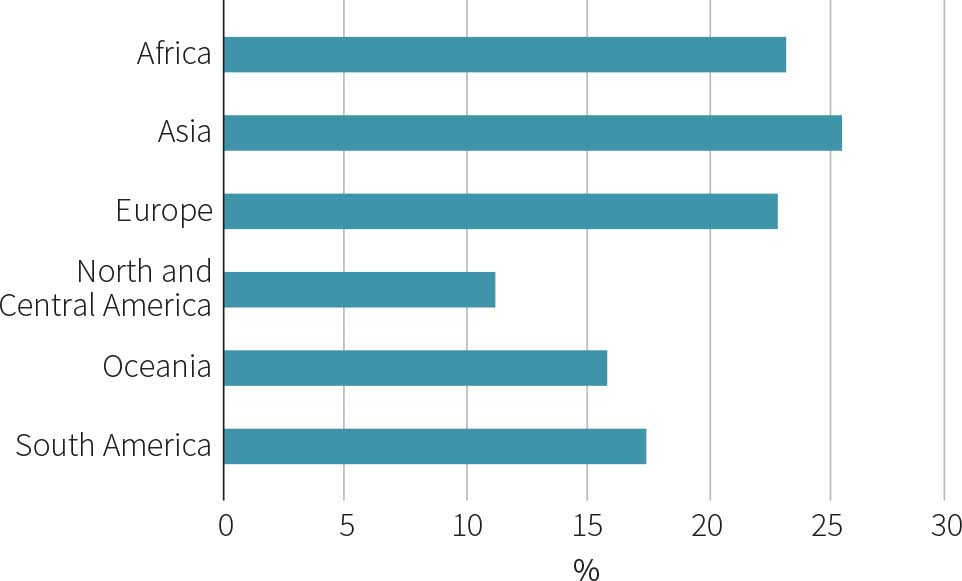
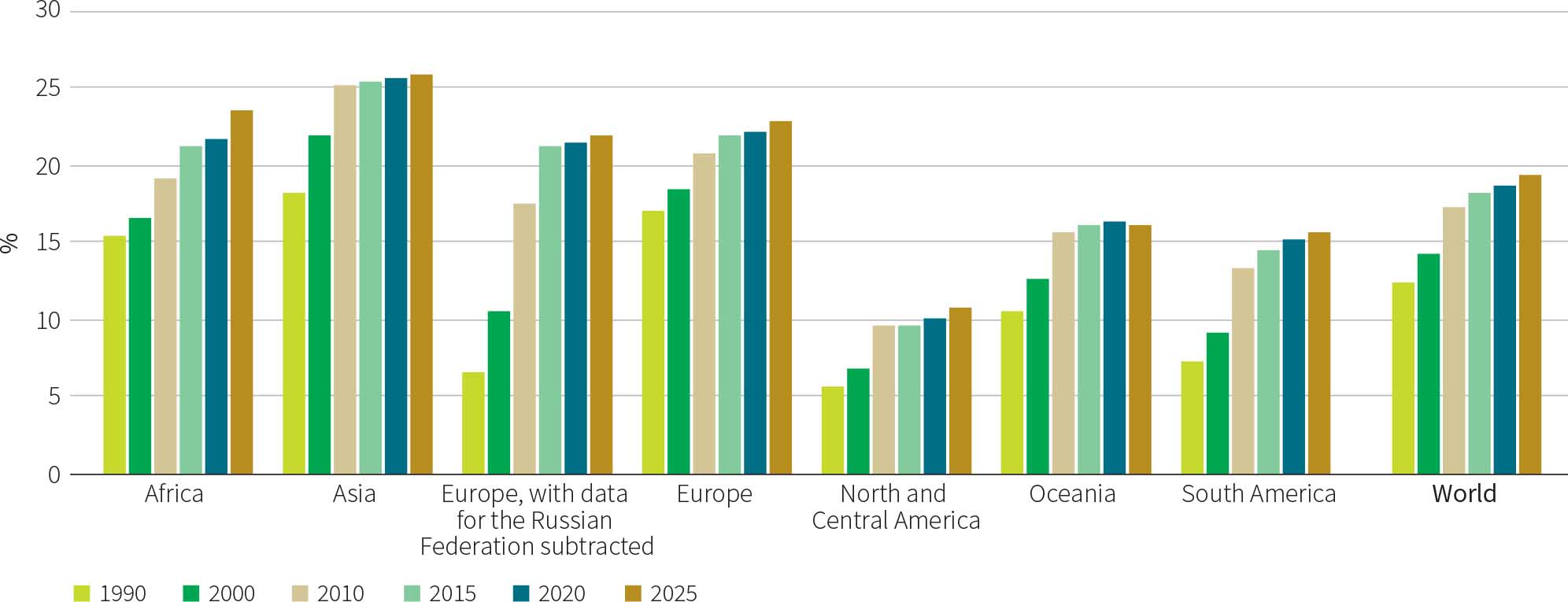
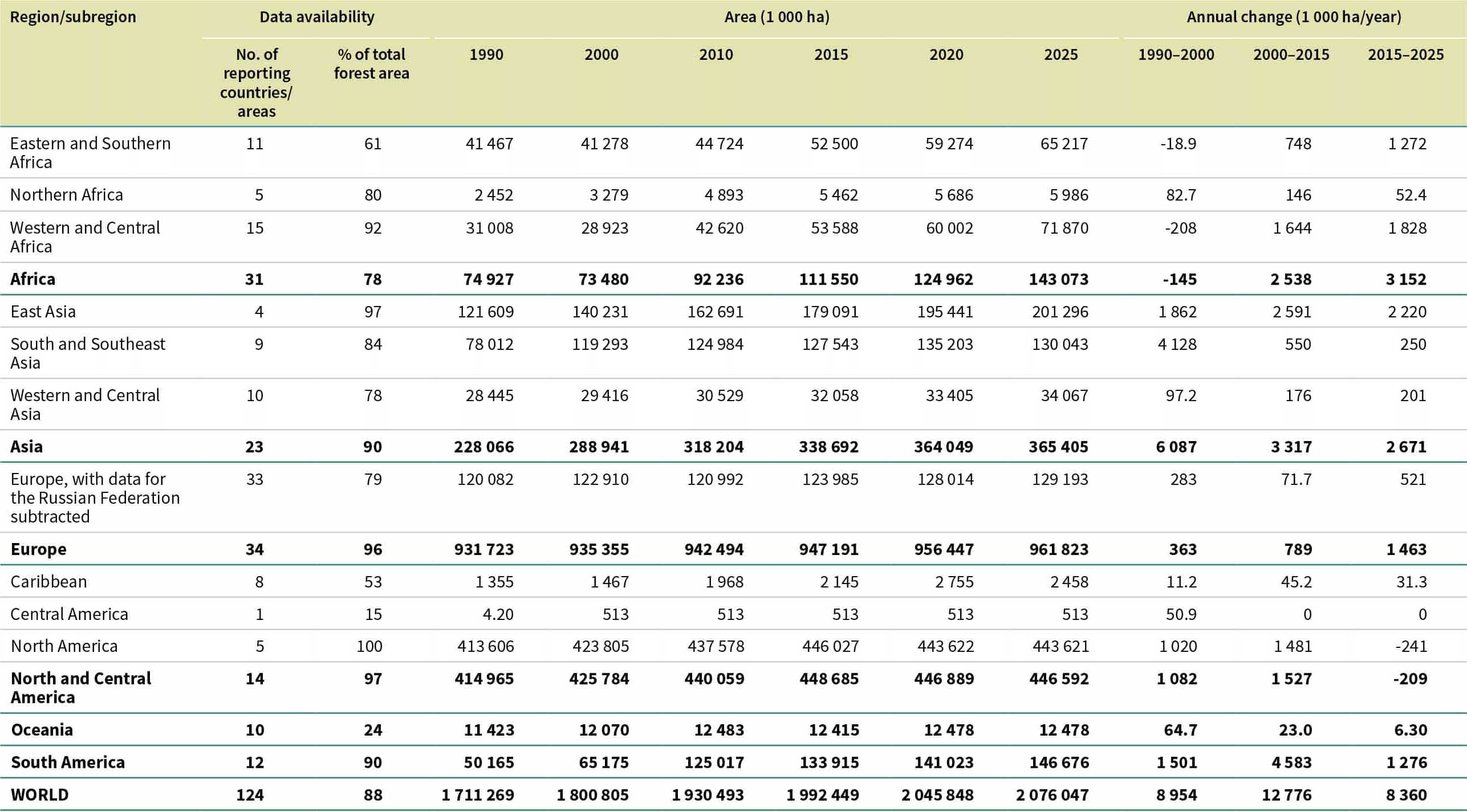
Trends. FRA 2025 received time-series data on the area of forest in protected areas from 188 countries and areas accounting for 94 percent of the global forest area. The area so designated increased by 251 million ha between 1990 and 2025, although the average annual rate of increase more than halved between 2000–2015 and 2015–2025, from 9.99 million ha to 4.11 million ha (Table 73). The area of forest in legally protected areas increased in all regions between 1990 and 2025 – it almost doubled in North and Central America, mainly because of increases reported by Canada and the United States of America, and in South America (Figure 38). The proportion of forest in legally protected areas increased threefold (from 7 percent to 22 percent) in Europe (Russian Federation subtracted) between 1990 and 2025.

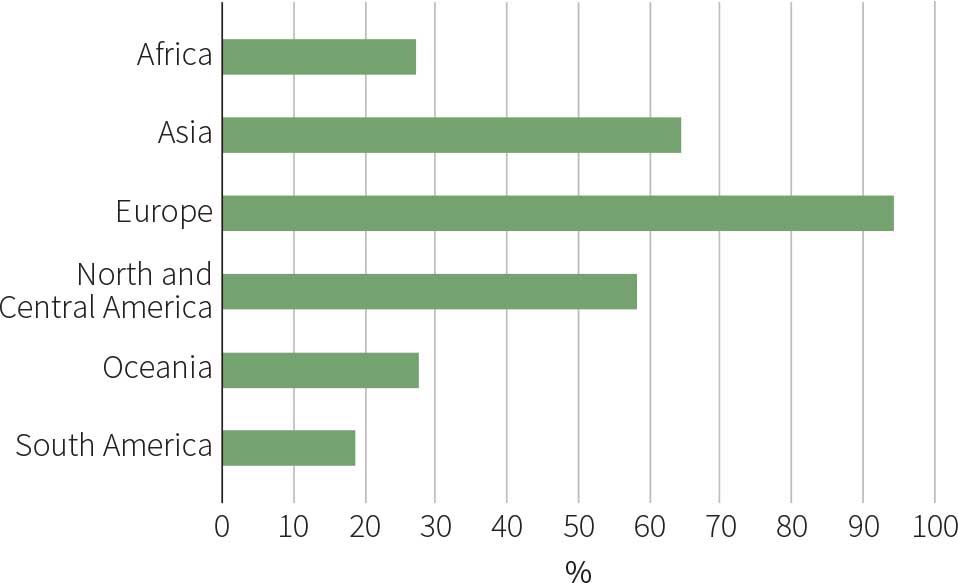
Status. FRA 2025 received information on the area of forest subject to long-term management plans in 2025 from 149 countries and areas representing 93 percent of the world’s forest area. More than 2 billion ha of forest is subject to management plans in those countries and areas (about 55 percent of the total forest area of reporting countries and areas), but with considerable differences between regions (Table 74). Almost half (46 percent) of the total forest area with long-term management plans is in Europe and particularly in the Russian Federation. Europe also has the highest share of forest area with long-term management plans, at 94 percent, and South America has the lowest share, at 19 percent (Figure 39).
Trends. FRA 2025 received information on trends in forest area with long-term management plans from 124 countries and areas representing 88 percent of the world’s forest area. According to these data, the area of forest subject to management plans increased by 365 million ha between 1990 and 2025 (Table 75).
FRA 2025 collected data on the forest restoration commitments of countries and areas and their underlying legal mandates, as well as on national definitions, areas identified as in need of forest restoration, restoration targets, and the status of implementation of forest restoration.
Analysis of the submitted data shows a complex picture of commitments, forest restoration targets and achievements. Forest restoration commitments were indicated by 153 countries and areas representing 94 percent of the global forest area. Of these, 128 – representing 90 percent of the global forest area – reported that they have legislative frameworks in place to support forest restoration; thus, the majority of forest restoration commitments is backed by legal mandates. Nevertheless, 28 countries and areas that have made commitments on forest restoration lack a formal legal basis for forest restoration, and many of these countries and areas indicated that they rely on donor-supported projects or community-driven strategies.
Fifty-five countries and areas covering 62 percent of the global forest area indicated that they have national definitions of forest restoration. The most common words in the provided national definitions are linked to activities and objectives associated with different types of forest restoration. Terms include ecological restoration, reforestation, regeneration, improving forest functionality, afforestation, structural gains, natural regeneration, rehabilitation and increasing forest cover. Definitions also refer to promoting human well-being, species reproduction, protection, ecosystem services, economic benefits, goods, native species recovery, landscape management, long-term restoration efforts, forest management, enhancing forest biomass and maintaining forest integrity.
The lack of international definitions for forest restoration and forest degradation hampers the reliable measurement and analysis of forest restoration. Further complications arise from the differing geographical, economic, social and environmental contexts in which the terms are applied.
Ninety-one countries and areas representing 69 percent of the global forest area collectively reported forest restoration pledges of more than 190 million ha (Table 76).14 Of these 91 countries and areas, 55 reported achievements in forest restoration linked to their pledges; 36 countries and areas – which, combined, pledged more than 69 million ha for forest restoration – did not report quantified progress.
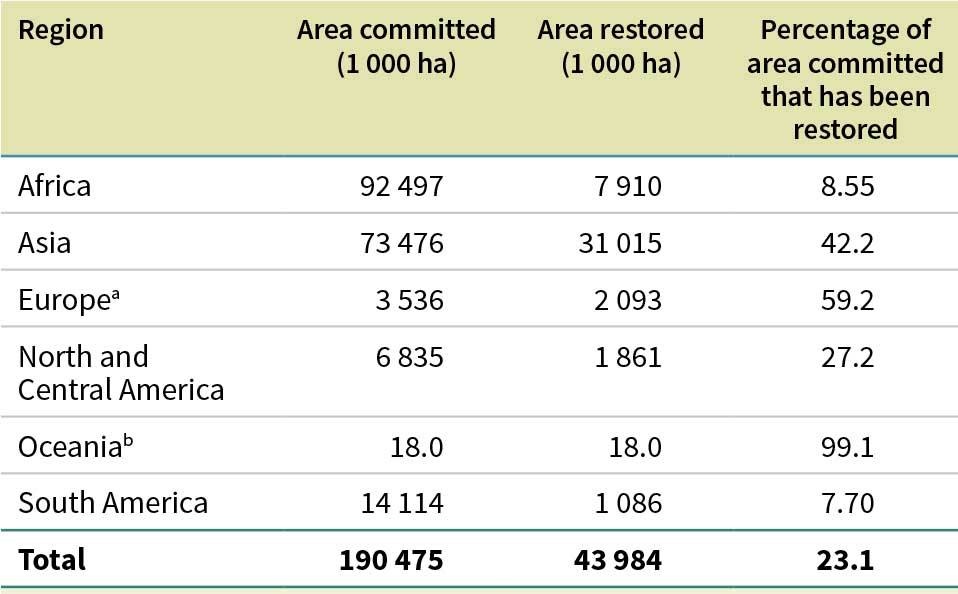
The actual restored forest area in 2025, reported by 70 countries and areas representing 42 percent (1.75 billion ha) of the global forest area, is estimated at 44 million ha, amounting to 23 percent of the 190 million ha pledged.
The implementation rate of forest restoration commitments varies significantly among regions, reflecting differences in forest restoration targets, their timing, and the progress made in implementation. Note, however, that the data presented here should be viewed with caution because they may not be representative for all regions.
Forty-nine countries and areas reported forest restoration targets for 2030, in alignment with targets of the Kunming–Montreal Global Biodiversity Framework and the United Nations Decade on Ecosystem Restoration 2021–2030. This temporal concentration reflects a global consensus on the urgency of forest restoration and encompasses about 177 million ha pledged, of which an estimated 27 million ha has been restored.
Four countries and areas indicated longer-term restoration commitments (e.g. to 2045 and 2050), but most countries and areas reported forest restoration goals between 2020 and 2030. Eleven countries reported area-based restoration targets without indicating a year for their achievement.