“The acute food insecurity and malnutrition experienced by women and girls is due to socioeconomic inequalities, cultural norms, limited decision-making autonomy, insufficient sharing of child care or household responsibilities, [and] difficulties in accessing resources, finance or land. A comprehensive approach is essential if we want to see real change.”Salina Grenet-Catalano
Director for Global Affairs, Ministry for Europe and Foreign Affairs, French Republic (high-level CGE event, New York, 24 September 2024)
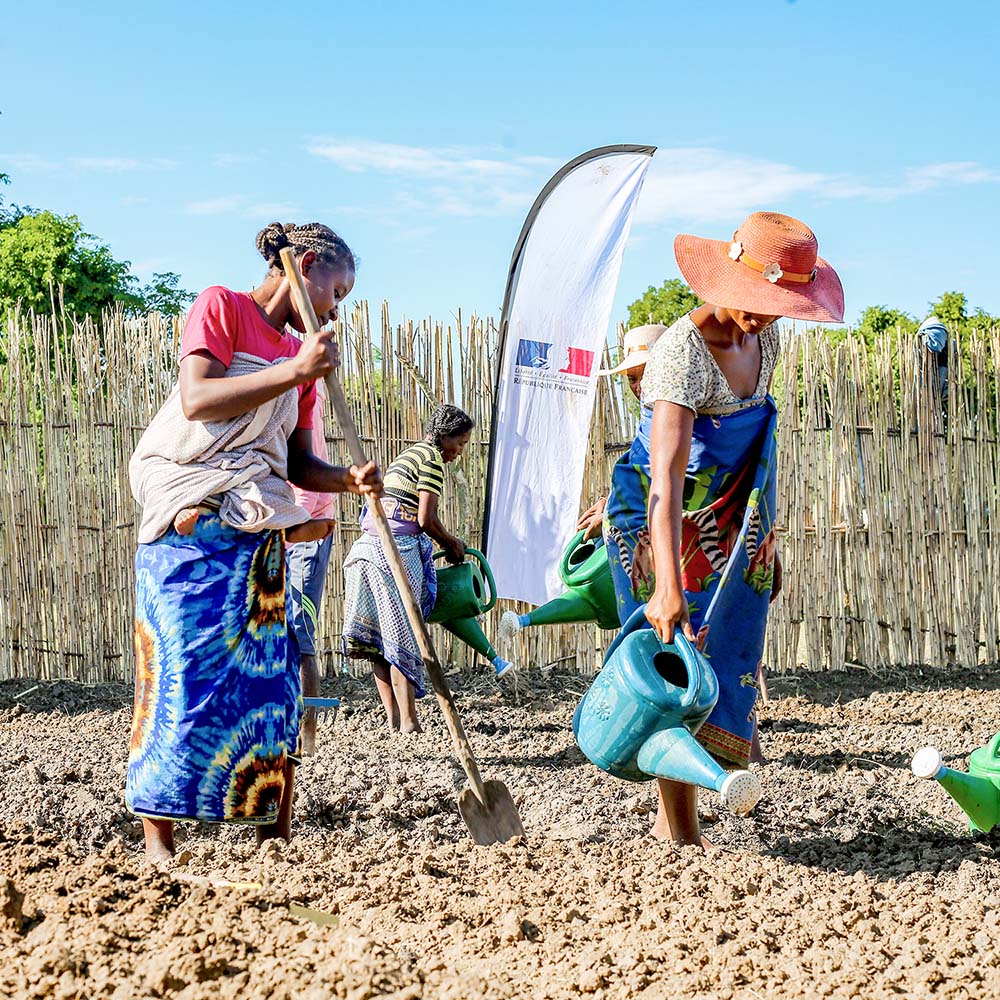

[A4.5] In 2025, France will allocate 50 percent of its food assistance programme to nutrition, including women's nutrition, and 15 percent to school meals, recognizing their central role in strengthening gender equality in the context of food security and nutrition. Politically, France will participate as co-chair of the School Feeding Coalition at its second global meeting in Fortaleza, Brazil, on 18–19 September 2025. Additionally, gender equality will be a top priority at the Paris Nutrition for Growth Summit, hosted by France on 27–28 March 2025.
n/a
In 2025, at least 50 percent of French food assistance programmes will be allocated to nutrition (with a nutrition policy marker score of 1 or 2 from the Organisation for Economic Co-operation and Development), and at least 15 percent will be allocated to support school feeding programmes.
Nutrition is a cornerstone of health, productivity and sustainable development. Yet malnutrition remains a global challenge, disproportionately affecting women and girls. While women are central to food production and preparation, they often eat last and least, a direct consequence of gender inequalities in agrifood systems that restrict their access to resources, education and decision-making power. Ensuring adequate nutrition is not just a health priority, but a fundamental driver of gender equality, food security and economic resilience.
Scaling up commitments to nutrition is critical, particularly through school feeding programmes, which have proven to improve educational outcomes for girls, enhance household food security, and expand long-term economic opportunities. France has demonstrated strong leadership in advancing gender equality in nutrition programmes, particularly through food assistance and school meal initiatives.
Domestically, policies such as the EGalim law emphasize sustainable and equitable access to school meals, while social pricing mechanisms ensure that all children, including those from vulnerable households, can benefit. Internationally, France has consistently supported school feeding programmes that improve nutrition and education outcomes for girls, recognizing their role in breaking cycles of poverty and food insecurity.
Beyond programmatic interventions, strengthening commitments to gender-responsive nutrition policies is crucial for building more inclusive and resilient agrifood systems. France has been at the forefront of global advocacy efforts, using its political leadership to mobilize resources, shape international policy agendas, and drive multilateral action on gender and nutrition. As co-chair of the School Meals Coalition, the country will take part in the second Global Summit of the School Meals Coalition in September 2025 in Brazil. France will also host the Paris Nutrition for Growth Summit in March 2025, demonstrating its commitment to scaling up financial and political support for nutrition-focused gender equality initiatives.
By reinforcing its domestic and international commitments, France is leveraging its experience and influence to ensure that gender-transformative nutrition policies become a key pillar of food security strategies worldwide, helping to create a future where women and girls are no longer the most vulnerable to malnutrition, but are empowered as key drivers of sustainable development and agrifood systems transformation.
Towards Real Gender Equality in France: Key Figures – 2023 Edition (infographic)
Gender Equality: Our Activity 2023 (infographic)
Required citation:
FAO. 2025. Commit to Grow Equality: investing in the future of women in agrifood systems – Progress report 2025. Rome. https://doi.org/10.4060/cd4123en
The designations employed and the presentation of material in this information product do not imply the expression of any opinion whatsoever on the part of the Food and Agriculture Organization of the United Nations (FAO) concerning the legal or development status of any country, territory, city or area or of its authorities, or concerning the delimitation of its frontiers or boundaries. The mention of specific companies or products of manufacturers, whether or not these have been patented, does not imply that these have been endorsed or recommended by FAO in preference to others of a similar nature that are not mentioned.
The views expressed in this information product are those of the author(s) and do not necessarily reflect the views or policies of FAO.
© FAO, 2025
Some rights reserved. This work is made available under the Creative Commons Attribution-NonCommercial-ShareAlike 3.0 IGO licence (CC BY 4.0: https://creativecommons.org/licenses/by/4.0/legalcode.en).
Some rights reserved. This work is made available under the Creative Commons Attribution- 4.0 International licence (CC BY 4.0: https://creativecommons.org/licenses/by/4.0/legalcode.en).
Under the terms of this licence, this work may be copied, redistributed and adapted, provided that the work is appropriately cited. In any use of this work, there should be no suggestion that FAO endorses any specific organization, products or services. The use of the FAO logo is not permitted. If a translation or adaptation of this work is created, it must include the following disclaimer along with the required citation: “This translation [or adaptation] was not created by the Food and Agriculture Organization of the United Nations (FAO). FAO is not responsible for the content or accuracy of this translation [or adaptation]. The original [Language] edition shall be the authoritative edition.”
Any dispute arising under this licence that cannot be settled amicably shall be referred to arbitration in accordance with the Arbitration Rules of the United Nations Commission on International Trade Law (UNCITRAL). The parties shall be bound by any arbitration award rendered as a result of such arbitration as the final adjudication of such a dispute.
Third-party materials. This Creative Commons licence CC BY 4.0 does not apply to non-FAO copyright materials included in this publication. Users wishing to reuse material from this work that is attributed to a third party, such as tables, figures or images, are responsible for determining whether permission is needed for that reuse and for obtaining permission from the copyright holder. The risk of claims resulting from infringement of any third-party-owned component in the work rests solely with the user.
FAO photographs. FAO photographs that may appear in this work are not subject to the above-mentioned Creative Commons licence. Queries for the use of any FAO photographs should be submitted to: photo-library@fao.org.
Sales, rights and licensing. FAO information products are available on the FAO website (www.fao.org/publications) and print copies can be purchased through the distributors listed there. For general enquiries about FAO publications please contact: publications@fao.org. Queries regarding rights and licensing of publications should be submitted to: copyright@fao.org.
Cover photograph: © FAO/Peter Safari; © Patrick Zachmann/Magnum Photo for FAO; © FAO/ Jafaar Al Merei; © FAO/Gilles Sabrie; © FAO/Javid Gurbano