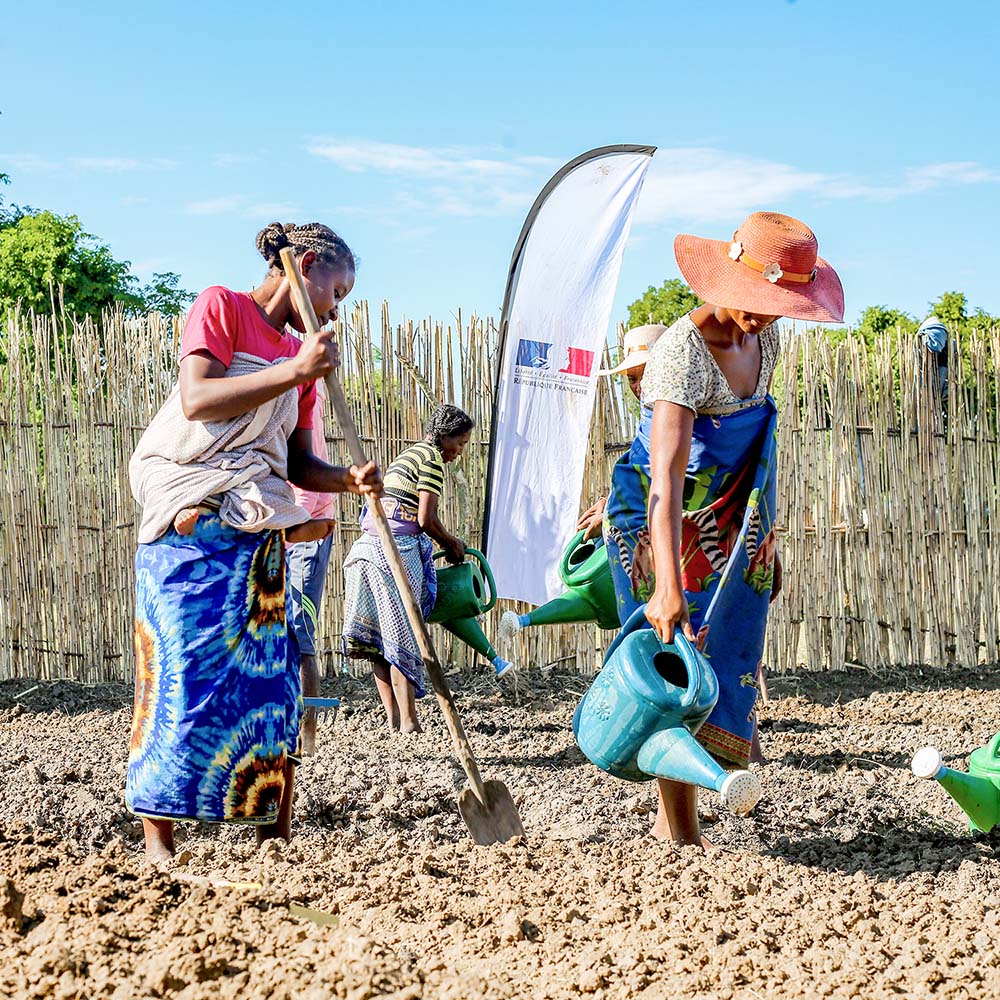
THEMATICA AREA 4
Women’s empowerment is important in and of itself, but empowerment can also deliver a variety of other benefits linked to agrifood system livelihoods: when women report greater decision-making power, children’s nutrition, household dietary diversity and household-level food security all improve, and agricultural productivity also increases. 14
Discriminatory social norms are at the heart of gender inequality, creating power imbalances between women and men in agrifood systems. Informal social norms and practices, as well as gender-blind policies and institutions, can create barriers to women’s empowerment and socioeconomic well-being. Gender-transformative approaches go beyond inclusion and seek to address the underlying constraints to equality by working on social norms and institutions at both the community and policy level. These approaches are cost-effective and also have a positive impact on local norms, delivering high returns.15 However, they require additional, dedicated investment in order to have a more systematic impact at scale.
Additionally, women play a crucial role in ensuring food security and building resilient agrifood systems, yet they are disproportionately affected by crises, whether caused by climate change, economic shocks, conflict or food price volatility. Structural gender inequalities often limit women’s ability to prepare for and recover from disruptions, as they face weaker access to financial resources, land ownership, social protection and decision-making spaces that shape resilience planning. As crises disrupt essential systems that support access to nutritious foods and services, evidence shows that these disruptions disproportionately affect the nutritional status of women and children, exacerbating existing vulnerabilities (particularly in protracted crises).16 Moreover, research suggests that climate change also has an unequal economic impact on women: every year, female-headed households lose 8 percent more income from extreme heat events than those led by men, and 3 percent more during floods. Additionally, women’s unpaid domestic work and care burden increases in response to climate shocks.17
When external shocks occur, women’s limited access to finance and safety nets makes them less able to invest in adaptive agricultural techniques, diversified income strategies or post-crisis recovery.18 Evidence shows that livestock plays a key role in women’s resilience building and response to emergencies: not only is it an economic asset that is easier to accumulate and a key source of household nutrition, it can also be exchanged quickly for cash to cover essential expenses in times of crisis. 19
Social protection is one important tool to increase the resilience of women and their families and communities. More broadly, projects which intentionally focus on women’s empowerment as an outcome have been shown to significantly improve the resilience of families facing shocks. Employing these approaches at scale could increase the resilience of 235 million people.20
“We demand responsibility and commitment to build together the path towards a world of abundant and high-quality food, equality for rural women and men, healthy lives and food – produced in an agroecological way.”Maria da Conceição Dantas Moura
former Undersecretary of Rural Women, Ministry of Agrarian Development and Family Agriculture, Federative Republic of Brazil
CGE launch event, New York, 13 March 2024
Commitments in this thematic area address these multiple challenges and opportunities in a comprehensive way, with a view to removing barriers to women’s empowerment and resilience. It is critical to take up methods, tools and policies which have demonstrated their potential for improving these outcomes at scale, in order to ensure that women, communities and economies can all benefit.
The CGE initiative strengthens women’s empowerment and resilience in agrifood systems by advancing gender-transformative approaches and strategies that enhance women’s adaptive capacity and economic security in the face of crises. With a commitment to expanding financial inclusion, access to climate-smart agriculture practices and social protection systems, CGE partners promote actions that enable women to better sustain livelihoods during disruptions. Aiming to bridge the gender gap in food security and nutrition, particularly during crises, the CGE initiative offers a way forward for creating more inclusive and resilient agrifood systems, recognizing women’s economic empowerment as central to these efforts.

For bilateral development agencies, foundations, multilaterals, non-governmental organizations
For Members, producer organizations, local authorities, etc.
For businesses


Required citation:
FAO. 2025. Commit to Grow Equality: investing in the future of women in agrifood systems – Progress report 2025. Rome. https://doi.org/10.4060/cd4123en
The designations employed and the presentation of material in this information product do not imply the expression of any opinion whatsoever on the part of the Food and Agriculture Organization of the United Nations (FAO) concerning the legal or development status of any country, territory, city or area or of its authorities, or concerning the delimitation of its frontiers or boundaries. The mention of specific companies or products of manufacturers, whether or not these have been patented, does not imply that these have been endorsed or recommended by FAO in preference to others of a similar nature that are not mentioned.
The views expressed in this information product are those of the author(s) and do not necessarily reflect the views or policies of FAO.
© FAO, 2025
Some rights reserved. This work is made available under the Creative Commons Attribution-NonCommercial-ShareAlike 3.0 IGO licence (CC BY 4.0: https://creativecommons.org/licenses/by/4.0/legalcode.en).
Some rights reserved. This work is made available under the Creative Commons Attribution- 4.0 International licence (CC BY 4.0: https://creativecommons.org/licenses/by/4.0/legalcode.en).
Under the terms of this licence, this work may be copied, redistributed and adapted, provided that the work is appropriately cited. In any use of this work, there should be no suggestion that FAO endorses any specific organization, products or services. The use of the FAO logo is not permitted. If a translation or adaptation of this work is created, it must include the following disclaimer along with the required citation: “This translation [or adaptation] was not created by the Food and Agriculture Organization of the United Nations (FAO). FAO is not responsible for the content or accuracy of this translation [or adaptation]. The original [Language] edition shall be the authoritative edition.”
Any dispute arising under this licence that cannot be settled amicably shall be referred to arbitration in accordance with the Arbitration Rules of the United Nations Commission on International Trade Law (UNCITRAL). The parties shall be bound by any arbitration award rendered as a result of such arbitration as the final adjudication of such a dispute.
Third-party materials. This Creative Commons licence CC BY 4.0 does not apply to non-FAO copyright materials included in this publication. Users wishing to reuse material from this work that is attributed to a third party, such as tables, figures or images, are responsible for determining whether permission is needed for that reuse and for obtaining permission from the copyright holder. The risk of claims resulting from infringement of any third-party-owned component in the work rests solely with the user.
FAO photographs. FAO photographs that may appear in this work are not subject to the above-mentioned Creative Commons licence. Queries for the use of any FAO photographs should be submitted to: photo-library@fao.org.
Sales, rights and licensing. FAO information products are available on the FAO website (www.fao.org/publications) and print copies can be purchased through the distributors listed there. For general enquiries about FAO publications please contact: publications@fao.org. Queries regarding rights and licensing of publications should be submitted to: copyright@fao.org.
Cover photograph: © FAO/Peter Safari; © Patrick Zachmann/Magnum Photo for FAO; © FAO/ Jafaar Al Merei; © FAO/Gilles Sabrie; © FAO/Javid Gurbano