"South Sudan is a proud partner of the Commit to Grow Equality initiative and pledges to make a bold push to protect women’s land rights in the country and revamp its National Gender Policy to boost the livelihoods of women in agrifood systems."H.E. Michael Changjiek Gei
Minister of Lands, Housing and Urban Development, Republic of South Sudan
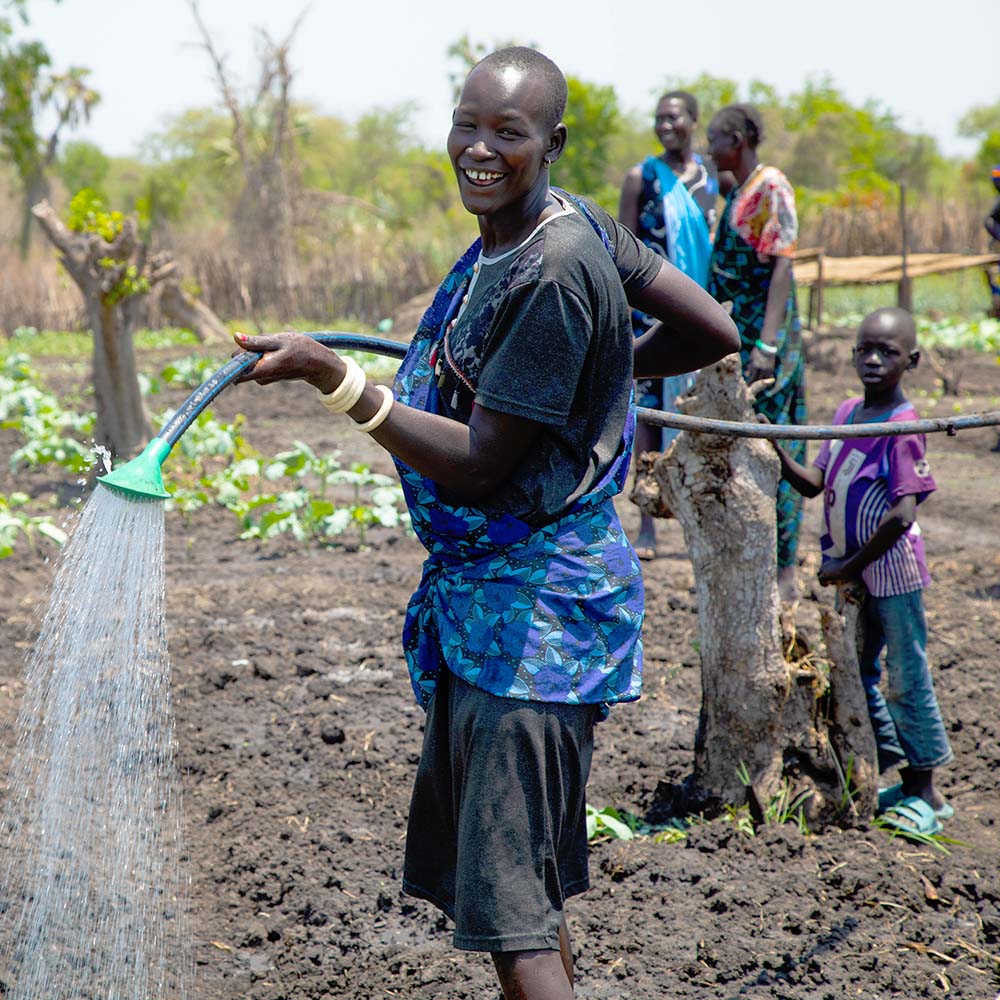

[B3.1] South Sudan will develop a comprehensive package of initiatives to ensure the gender-responsive implementation of the National Land Policy.
Women in South Sudan continue to experience unsecure tenure rights, limited participation in land governance and insufficient access to dispute resolution mechanisms. While the country has made progress on land tenure rights with the NLP and partial protections under the Land Act (2009), legal gaps remain. Data availability, legal pluralism and weak institutional capacity compound these challenges, which are also augmented by fragmented land laws as well as the lack of comprehensive land governance implementation frameworks.
An implementation framework will be developed to guide the rollout of the NLP. To this end, a Land Reform Unit will be established; a Capacity Building, Communication Plan, Resource Mobilization Strategy and Monitoring Framework will be developed and implemented; a Land Rights Education and Awareness Creation Strategy will be crafted and launched; and periodic updates of the policy will be carried out.
South Sudan is committed to regional and global frameworks that safeguard women’s land rights, including the Convention on the Elimination of All Forms of Discrimination against Women, Agenda 2063 of the African Union, and SDG 5. Recognizing the critical role of land tenure security for gender equality and food security, the government has undertaken land policy reforms since 2006 to strengthen women’s ownership and control over land, including integrating land rights in the Transitional Constitution (2011) and the Revitalized Peace Agreement. These efforts culminated in the National Land Policy (NLP), approved by the Council of Ministers in October 2023, which prioritizes women’s land tenure rights. The NLP aligns with land degradation neutrality strategies, emphasizing equitable land access as a key pathway to sustainable land management.
Despite these efforts, significant challenges persist. South Sudan faces governance deficits, economic fragility and climate vulnerabilities, ranking among the most at-risk countries for climate shocks globally. Land governance remains fragmented, with customary, religious and statutory laws often conflicting with women’s rights. Women frequently access land only through male relatives, limiting their security in cases of widowhood or divorce. Additional barriers include insufficient legal enforcement, lack of land-related data, weak institutional capacity, and the exclusion of women from land governance structures. Incomplete legal frameworks and limited investment in women’s access to productive resources, such as land, credit and extension services, further restrict their economic potential.
The land tenure system consists of public, private and community land, with customary tenure arrangements often governing land access. While customary systems provide a level of tenure security, they primarily grant women access through male kinship, reinforcing gender inequalities. Weak implementation mechanisms and limited awareness of statutory land rights further prevent women from fully exercising their legal entitlements.
As part of the CGE initiative, South Sudan is committed to ensuring the gender-responsive implementation of the NLP. This includes building the capacity of women’s organizations, strengthening legal and policy frameworks, improving justice mechanisms for land disputes, and enhancing government capacity to collect and use gender-disaggregated data. Additionally, the South Sudan Women’s Land Rights Agenda 2021–2030 outlines a roadmap for gender-responsive land governance, advocating for women’s leadership in policy processes, enhanced legal protections and gender-responsive budgeting.
South Sudan’s commitment to further scale up efforts in advancing women’s land rights will trigger improvements at social, economic and political levels, and contribute to establishing a more inclusive and conducive legal and policy environment for women to thrive across agrifood systems.
Required citation:
FAO. 2025. Commit to Grow Equality: investing in the future of women in agrifood systems – Progress report 2025. Rome. https://doi.org/10.4060/cd4123en
The designations employed and the presentation of material in this information product do not imply the expression of any opinion whatsoever on the part of the Food and Agriculture Organization of the United Nations (FAO) concerning the legal or development status of any country, territory, city or area or of its authorities, or concerning the delimitation of its frontiers or boundaries. The mention of specific companies or products of manufacturers, whether or not these have been patented, does not imply that these have been endorsed or recommended by FAO in preference to others of a similar nature that are not mentioned.
The views expressed in this information product are those of the author(s) and do not necessarily reflect the views or policies of FAO.
© FAO, 2025
Some rights reserved. This work is made available under the Creative Commons Attribution-NonCommercial-ShareAlike 3.0 IGO licence (CC BY 4.0: https://creativecommons.org/licenses/by/4.0/legalcode.en).
Some rights reserved. This work is made available under the Creative Commons Attribution- 4.0 International licence (CC BY 4.0: https://creativecommons.org/licenses/by/4.0/legalcode.en).
Under the terms of this licence, this work may be copied, redistributed and adapted, provided that the work is appropriately cited. In any use of this work, there should be no suggestion that FAO endorses any specific organization, products or services. The use of the FAO logo is not permitted. If a translation or adaptation of this work is created, it must include the following disclaimer along with the required citation: “This translation [or adaptation] was not created by the Food and Agriculture Organization of the United Nations (FAO). FAO is not responsible for the content or accuracy of this translation [or adaptation]. The original [Language] edition shall be the authoritative edition.”
Any dispute arising under this licence that cannot be settled amicably shall be referred to arbitration in accordance with the Arbitration Rules of the United Nations Commission on International Trade Law (UNCITRAL). The parties shall be bound by any arbitration award rendered as a result of such arbitration as the final adjudication of such a dispute.
Third-party materials. This Creative Commons licence CC BY 4.0 does not apply to non-FAO copyright materials included in this publication. Users wishing to reuse material from this work that is attributed to a third party, such as tables, figures or images, are responsible for determining whether permission is needed for that reuse and for obtaining permission from the copyright holder. The risk of claims resulting from infringement of any third-party-owned component in the work rests solely with the user.
FAO photographs. FAO photographs that may appear in this work are not subject to the above-mentioned Creative Commons licence. Queries for the use of any FAO photographs should be submitted to: photo-library@fao.org.
Sales, rights and licensing. FAO information products are available on the FAO website (www.fao.org/publications) and print copies can be purchased through the distributors listed there. For general enquiries about FAO publications please contact: publications@fao.org. Queries regarding rights and licensing of publications should be submitted to: copyright@fao.org.
Cover photograph: © FAO/Peter Safari; © Patrick Zachmann/Magnum Photo for FAO; © FAO/ Jafaar Al Merei; © FAO/Gilles Sabrie; © FAO/Javid Gurbano