


Part A: Purposes
Part B: Types of data
Part C: Methods of data collection
Appendix: Wealth ranking as a method for the identification of target groups or recommendation domains
References
Baseline information is largely descriptive and qualitative in nature. It is nevertheless crucial to the whole process of livestock systems research in that it provides the basis for:
· Better understanding, at the outset, of the component parts of the system and the manner in which they are related to one another.· Initial selection of the target group(s) for which the research is intended.
· Initial identification of the constraints which limit the output and income of farmers/pastoralists within the target group. This will facilitate the initial 'pre-screening' of appropriate technology.
· Design of diagnostic surveys to obtain more in-depth knowledge about particular aspects of a target group's production characteristics (e.g. labour use, animal performance and range condition).
The module draws mainly on the work of Gilbert et al (1980) and CIMMYT (1985). It also describes a technique used by ILCA field staff to identify target groups in livestock systems research. Part A outlines the purposes of the descriptive stage of livestock systems research. Part B describes the types of data the researcher will need to gather during this stage, and Part C discusses the methods used to obtain the information required.
The purposes/objectives of a proposed research activity should be carefully defined at the outset. Knowing the exact objectives of the study will help select the appropriate methods of data collection and suitable on-farm research techniques.
The main objectives of the descriptive stage of livestock systems research are to:
· define the boundaries of the study area· understand the characteristics of the study area
· identify target groups
· collect and interpret information about farmer/pastoralist circumstances, and
· screen potentially suitable technologies.
Boundaries of the study area. Systems research begins by selecting an area or region for study. The boundaries of this area/region may be set by one or more of the following considerations:
· recognised agro-ecological zones· administrative boundaries, e.g. provincial or district boundaries
· government priorities (governments may dictate research priorities and define the boundaries of the area to be studied)
· development programme or project boundaries (i.e. within the area prescribed for a donor or government-funded development project)
· cultural divisions (e.g. on the basis of ethnic differences)
· logistic (distance or a lack of infrastructure may set limits on the size of the area), and
· the manpower and/or financial resources of the research team.
Each of these aspects should be carefully considered prior to determining the boundaries of the target area. The area eventually selected may incorporate several of these considerations - e.g. it may be within one agro-ecological zone, confined to one district and limited in area (within that district) because of manpower, financial and/or logistic reasons.1 Since circumstances differ between and within countries, it is impossible to give general rules for the selection of study areas but the reasons for their selection should be clearly stated.
1 The area selected is likely to be part of a broader system and to be influenced by factors outside its own boundaries. An essential aspect of the descriptive stage of systems research is to define these influences and to understand their effects within the boundaries of the research area as a whole and, ultimately, on the target group(s) selected. A system is defined by Conway (1986) as "an assemblage of elements contained within a boundary such that the elements have strong functional relationships with each other but limited, weak or non-existent relationships with elements m other assemblages".
Characteristics of the study area Once the boundaries of the study area have been defined, the features of that area which influence the production patterns of farmers and pastoralists should be described. Such features include:
· political structure
· institutional structure
· historical background
· socio-cultural characteristics
· agro-economic conditions, and
· infrastructural developments.
The links between these factors2 should be specified and, where possible, the different farming subsystems within the area should be identified and their characteristics broadly defined.3 Factors outside the boundaries of the area which have a direct influence on its structure and activities should also be recognised and their effects stated (see footnote 1 below).
2 The relationship between different system components (e.g. between agricultural practices and agro-climatic conditions, culture, infrastructure and/or services, such as extension, education and health) can sometimes be more clearly identified by examining the effects of change over time (e.g. the effect of infrastructure on the marketed output of agricultural commodities).3 In this context, performance should be considered with respect to the productivity, sustainability and equity of the existing farming systems. However, data on these issues are scarce and often unreliable and may need to be verified during the diagnostic stage, after the target group(s) have been selected.
Target groups. Having obtained a broad overview of the study area, the focus narrows to preliminary selection of the target group (or groups) for which research is specifically intended.4 By focusing on a particular group of farmers or pastoralists, livestock systems research is said to become 'domain specific' in its emphasis.
4 Initial target groups may need to be adjusted as new information comes to light curing constraint diagnosis or on-farm trials, e.g. if important variations in management within a group are observed.
The conventional farming systems research approach involves subjective grouping of farmers/pastoralists into relatively homogeneous strata or 'recommendation domains' on the basis of their socio-cultural, agro-economic and/or institutional/infrastructural characteristics. This assumes that decisions about production and adoption of technological innovations within each identified stratum of farmers/pastoralists will be based on similar considerations and that the research approach used and the recommendations made will be uniform for each group (Gilbert et al, 1980) made will be uniform for each group (Gilbert et al, 1980; CIMMYT, 1985, p 15).5
5 A recommendation domain is a concept which explicitly takes account of socio-economic factors in the definition of groups within a community or area (Harrington and Tripp, n.d.).
However, this approach has been criticised on two grounds:
· Problems can occur if farming practices within the target area are highly variable and if groups are delineated using only one or two criteria (e.g. soil type and climate). The groups so identified may not be as uniform as first thought and the results of the research may have limited applicability. Rigid adherence to groups defined on the basis of one or two criteria may foreclose a wide range of research opportunities (Cornick and Alberti, 1986).· The initial identification of groups tends to be based on a subjective evaluation of information obtained from secondary data sources or informal interviews, which can be highly inaccurate. Jolly (1986) recommends the use of objective criteria, such as actual production levels, measured levels of input use, household structure and proximity of off-farm employment opportunities,6 which requires fairly comprehensive formal surveys (Module 2, Section 1). Target groups should, therefore, be identified only tentatively at the descriptive stage.
6 Sometimes, one single factor can be found which provides sufficient basis for initial (or even subsequent) identification of target groups. Categorising stock owners on the basis of recognised wealth ranking criteria is one of such factors which may incorporate socio-cultural, political, historical, infrastructural, institutional and economic characteristics of a target group Wealth ranking is particularly applicable to African production systems in which livestock constitute the major part of a producer's assets (Grandin, 1983; de Haan, 1983) (Appendix).
Producers' circumstances and constraints. This involves collecting information about the factors which influence the production decisions of farmers/pastoralists within each target group. Some of these factors may be external and largely beyond the control of the producer (i.e. exogenous factors) or, they may be internal and controlled by the producer or household (i.e. endogenous factors). In systems research literature, they are termed as farmer/pastoralist circumstances (CIMMYT, 1985, p. 19).
The information obtained about producers should be used to:
· improve understanding about the overall system and management strategies
· identify critical problem areas at the farmer/pastoral level, and
· provide directions for further research (e.g. diagnostic surveys) at the household level.
Understanding the manner in which external and internal factors interact and affect management practices will often point to constraints and indicate pathways for improvement via technological, policy or institutional change. An examination of management practices may provide insights about the constraints, priorities and attitudes which affect the potential for change. Understanding why a particular practice is not adopted can also be informative (data on herd structure can, for instance, provide useful information about management aspirations and performance levels - see Module 5, Part A).
An understanding of farmer/pastoralist circumstances is thus an essential starting point in livestock systems research. It implies the need to examine relationships/linkages at the farm level, which is usually not possible at the descriptive stage. However, simple intuitive assessments based on information gleaned from secondary data and/or informal interviews will often point to specific issues which can be examined in greater detail by using the diagnostic techniques outlined in Modules 2-10 of Section 1.
Technology pre-screening. Screening of potentially suitable technologies at the descriptive stage involves an initial identification of existing technologies which might be appropriate for a particular target group.7 It involves the isolation of constraints thought to affect production and income, followed by the selection of technologies which could be used to overcome these constraints or to exploit possibilities for improvement (Gilbert et al, 1980).
7 Existing technologies may be considered appropriate without adaptation or they may need to be altered by adaptive research to suit particular circumstances. The reasons for non-adoption or partial adoption should always be identified: for instance, a technology is technically feasible, but its wide adoption will depend on institutional and/or policy reforms. They can sometimes be isolated during the descriptive stage but usually further research will be required (e.g. by diagnosis and on-farm teals).
For each technological possibility, the chances, rate and effects of adoption should assessed.
When assessing the chances of adoption, it should be determined whether:
· The farmer/pastoralist can, in fact, adopt the new technology. This is known as the necessary condition of adoption and will involve the consideration of such aspects as infrastructural support, accessibility of inputs etc.· The farmer/pastoralist will adopt the new technology. This is known as the sufficient condition of adoption and will involve the consideration of social and economic factors influencing farmer/pastoralist decisions (Caldwell, 1984).
When assessing the rate of adoption, it should be borne in mind that the credibility of the research largely depends on how fast it produces results. For this reason, it is often better to opt for technologies which have the potential to achieve modest gains in production quickly, rather than for those which might achieve larger gains over a longer time period. Furthermore, the early introduction of some improvements, even if they are modest, can help to sustain the interest in and support of the research by governments, donors and/or producers, while more long-term and possibly more important improvements are still being worked on (Sandford et al, 1983).
When assessing the effects of adoption, one should consider:
· Effects at the producer levelFor instance, production effects, income effects, the risks of adoption, and effects at the household level in terms of resource control.
· Effects on the whole community
For instance, the effects of adoption on the environment, on social structure and the distribution Of wealth (i.e. who benefits from the technology?)
At both levels, adoption can have both direct and indirect effects. While the direct effects may be fairly obvious (e.g. an increase in production), indirect effects are often unforeseen, unintended and difficult to measure. Each will determine the potential for and desirability of technological adoption on a wide scale.
In general, the technologies recommended should be compatible with both individual and social objectives but this can be difficult to achieve in practice (Sandford et al, 1983).
For instance, artificial insemination of dairy cows is likely to result in increased milk production. However, if only the larger, more progressive producers can afford to adopt the technology, income disparity within the target group may widen as a result of its use. Indirect effects may thus outweigh the direct effects of adoption.
General characteristics of the study area
Specific characteristics of farmers/pastoralists
Available technology
In order to meet the objectives of the descriptive stage of livestock systems research, three types of data will need to be collected (CIMMYT, 1985). They include data on:
· the general characteristics of the study area
· the specific characteristics of farmers/pastoralists within each target group, and
· available technologies which might be applicable to the problems identified.
The information gathered about the study area will include:
· political information
· institutional information
· historical information
· socio-cultural information
· information on infrastructure development, and
· data on agro-economic conditions.
Political information. Background information about the organisational structure of government is useful because the formal political hierarchy affects the manner in which government policies are implemented.8 The policies of government can, in turn, have important effects on the socio-economic characteristics of the study area and the producers within it.
8 A distinction between formal and informal (traditional) types of government may also need to be made. Often, it is the traditional political hierarchy which has the most significant impact on producer decisions. If so, background information about, for instance, the chiefdom, headman and lower levels of this hierarchy would need to be obtained.
The broad objectives of government at the national, regional, subregional and the relevant subsector levels (e.g. the livestock subsector) should also be recognised at the outset. These objectives are not always explicitly stated (e.g. in policy documents) but can often be gleaned from statements made by politicians or by the priorities evident in development and/or individual sector policies. Apparent conflicts or inconsistencies in government objectives should also be noted.
Institutional information. Background information on the following types of institutional arrangements and structures should be collected:
· land tenure regulations, both formal and informal/traditional· agricultural institutions such as the extension service (structure, farmer contact/coverage, emphasis), animal health services, credit, cooperative and marketing agencies, farmer organisations development programmes, and
· other institutions affecting agriculture, e.g. local governments, water development, land development, education and health agencies.
Historical information. Historical events in the study area often determine its present production patterns and socio-cultural characteristics. Interest should focus on the effects of change over time in:
· political and institutional structures
· government policies/priorities
· land tenure arrangements
· infrastructures (markets, roads etc.)
· agricultural production and land use patterns
· off-farm economic developments (e.g. off-farm employment)
· population density and distribution, and
· ethnic/cultural groupings.
Socio-cultural information. Background information about the characteristics of individual cultural groupings within the study area can be obtained from sociological survey reports or by interviewing people from the different groups about their:
· attitudes, preferences and beliefs, e.g. with respect to ownership of livestock, land, trees and grazing rights and the control of social and household resources.· social obligations and linkages, e.g. with respect to different social units within the same cultural group and between different groups.
Infrastructure development. Since availability or lack of particular infrastructure may affect production patterns and attitudes to technological adoption in traditional agriculture, information should be obtained about the following types of infrastructure within the study area:
· marketing facilities/outlets (type and frequency of use)
· road network (condition, accessibility, relationship to markets and other facilities)
· water (dams, stock watering points, their number and dispersion, communities serviced)
· research facilities (type, location, emphasis)
· educational facilities (type, number and dispersion, groups serviced)
· health facilities (type, number and dispersion, groups serviced)
· other rural facilities (e.g. electricity, post, telecommunications, private businesses), and
· urban centres (location, employment, support services, industries).
Agro-economic conditions. Under this category, three types of data should be collected:
· physical data
· biological data, and
· economic data.
Physical data include data on climatic conditions and ecological zones, particularly:
- rainfall (total, seasonal9 and regional distribution patterns, effects on stock movement, crops grown and other agricultural practices)- temperature (maximum, mean, minimum, by ecological region, effects on agricultural practices)
- topography and geology, and
- soils (types, distribution, effects on agricultural practices).
9 Variability in climate, prices, costs etc. should be carefully considered because variation introduces risk and this can have important effects on production practices and attitudes to new technologies.
Biological data include data on:
- livestock (species, numbers, management practices, production performance, trends in numbers and production)- crops (types, areas, management practices, yields, trends in production)
- diseases (of economic importance for livestock and crops, incidence, effects on agricultural practices10)
- pests (for livestock and crops, incidence, effects on agricultural practices), and
- nutrition (feed quality and quantity over the year, alternative sources of feed, effects on management practices; soil fertility and availability of fertiliser).
10 The often strong linkages between crop and livestock production can only be understood if some attention is given to the collection of background data on the agro-economic characteristics of the study area during the initial stages of systems research.
Economic data include data on:
- livestock outputs (for the different species, sales and offtake rates, purchases, prices by grade, seasonal variations and trends in these variables)- crop outputs (for the different species, sales, prices, seasonal variations and trends)
- livestock inputs (inputs used, costs, availability, seasonal variations and trends)
- crop inputs (inputs used, costs, availability, seasonal variations and trends), and
- off-farm data (employment, wages, seasonal variations and trends; the effect of off-farm employment opportunities on the allocation of resources in agriculture, e.g. on the use of farm labour and inputs).
The opinions of farmers/pastoralists about their environment and the constraints which they face must be taken into account in systems research. This fundamental principle has often been ignored in the past, and technologies developed have tended to be inappropriate as a result (Introduction to this Manual) (Behnke, 1984; Bernsten et al, 1984; de Ridder and Wagenaar, 1986).
Within each selected target group, farmers/pastoralists should specifically be questioned about:
· Their major farm and non-farm activities (e.g. livestock and crop enterprises, other farm activities, off-farm employment). Information about yields, the relative importance of different enterprises/activities and the timing of farm/pastoral operations throughout the production year should be obtained.· Current practices/technologies, reasons for their use and reasons for change over time.
· Perceptions of the system in which the farmers/pastoralists operate. The exogenous factors (i.e. political, historical, institutional, infrastructural, socio-cultural and economic) which influence production patterns and the links between them should be considered in this context.
· Endogenous factors which influence production decisions at the household level (e.g. household resources and decisions, production aspirations or preferences) and the manner in which each affects the other. Reasons for the allocation of land, labour, capital and management resources to different activities should be determined. How household priorities are decided in terms of resource use should also be specified.
· The constraints which they perceive to be important and their attitudes to risk, particularly with respect to the adoption of new technologies.
· The manner in which each of the above affects individual objectives in respect to production, income and the adoption of new technologies. Such information will enable the researcher to form a preliminary idea of the objective function of farmers or pastoralists within each target group (Gilbert et al, 1980).
Information needs to be collected about the technologies available to meet the problems initially identified as important. An initial screening as to their applicability can then be carried out by contacting research stations, extension officers and farmers.
Use of secondary data
Types of informal survey
Technology pre-screening
At all stages in livestock systems research, it is important to ensure that the data collection method adopted is as practical and inexpensive as possible. The need to obtain reliable and useful information should be balanced against the need to complete operations in the shortest possible time. The following types of questions should always be asked before starting any data collection (Gilbert et al, 1980; Butler, 1984; Hart and Calixte, 1984):
What are the objectives of data collection?
Which types of data are needed and why are they needed?
Does the information required already exist?
Which data collection method is the most appropriate?
What quality of data is required?
How long11 will it take to obtain the information required?11 Drafting a timetable of expected operations (e.g. in the form of a simple bar chart) reinforces the need to continually consider the timing and efficiency of different activities at all stages in the LSR process. Collinson (1972) gives an example of this for a cropping systems research programme. The bar chart used separates the main activities and assigns a period for their completion. Adjustments can be made to the scheduling of operations as the need arises.
During the descriptive stage of livestock systems research, rapid survey techniques are normally used to obtain information from the producers and much of the data gathered is qualitative in nature. The techniques applied thus tend to be less rigorous than those used later in the LSR process. They should nevertheless be based on clearly defined principles relating to the:
· use of secondary data
· types of informal surveys, and
· pre-screening of technologies.
When using secondary data to obtain background information on the study area, one should be selective and check all data for accuracy.
Be selective. To ensure that only relevant data are used, a table should be compiled for each type of data needed which lists its source(s), the reason(s) for collection and the level of detail required (see example below). The responsibility for each type of data should be allocated to the team member most familiar with the topic concerned (e.g. livestock production data to a livestock specialist).
Example:
|
Type of data. |
cattle production data |
|
Sources: |
annual reports of the Ministry of Agriculture, farm-management survey reports, project documents, extension officers |
|
Detail required |
specific data on herd structures, reproduction rates, mortality rates, offtake rates etc |
|
Reasons for collection: |
to obtain livestock performance indicators for the study area |
|
Researcher(s) responsible: |
livestock specialist and agricultural economist |
Check the data. Secondary data in the Third World are notoriously unreliable (Cornick and Alberti, 1986) and should therefore be checked for accuracy. This can often be done by cross-checking information from different sources. Errors can, however, be compounded if one inaccurate report quotes another or if data are used in the wrong context.
It is always useful to cross-check secondary data with people who are familiar with the subject being researched, even if they were not involved in the preparation of reports/statistics.
For instance, extension officers can be interviewed to cross- check production statistics for an area; because of their experience, their information is often more reliable than that given in official reports. For socio-economic data, the most recent reports should be used as the socio-economic circumstances of an area can change significantly over a period of, say, five years. Reports which are more than five years old should be verified (CIMMYT, 1985).
Secondary data should also be checked for their adequacy - i.e. do they provide the level of detail required?
Informal interviews are used to confirm or complement the information obtained from secondary data sources and to get insights from producers and community members who are directly involved. They fall into three main categories:
· Individual interviews in which a small (non-random) sample of producers within each target group is selected for questioning.Individual interviews are relatively informal, the questions being specific for each respondent.12 Usually, several members of the multidisciplinary team will be involved in an interview, so that observations about the producer and the farming system can be compared.
· Group interviews are used to broaden perspectives about the farming system or to obtain insights about the farm/pastoral community itself.
Group interviews are informal and respondents are encouraged to participate in debates on particular issues affecting the members of the community (e.g. government policies, land tenure issues).
· Key informant interviews are directed towards individuals knowledgeable about particular subjects (e.g. the socio-economic characteristics of the target group, the activities of extension staff etc.).
12 This does not imply that only one individual should be interviewed in each selected household (e.g. the household head). Short interviews with several different individuals are often preferable, particularly when operations are allocated to specific sex or age groups (e.g. in pastoral communities, women may be questioned about milking; in mixed farming systems, women may be questioned about cropping practices).
The individuals chosen for this type of interview may be farmers, extension staff, district administrators, traditional leaders (e.g. chiefs, headmen) and traders. Key informant interviews can provide high-quality information on a wide range of topics in a relatively short time. The information obtained should always be cross-checked by interviewing more than one informant on the same subject or by comparing informants' responses with information from other sources (e.g. secondary data).
Principles
For each type of interview, it is necessary to make sure that:
· the right people are selected for the interview· the right language is used, and
· the right questions are asked so that the right information is obtained (for further details see CIMMYT, 1985, pp. 29-59).
The farmers or pastoralists selected for an interview should be representative of the target group. If selected by an extension officer or senior government official in the area, it is likely that the more progressive producers will be chosen and that the information obtained will not reflect the characteristics of the target group as a whole. Since general impressions of the target group are required at the descriptive stage, it is particularly important to obtain unbiased information about the subsystem and choose representative producers to interview (CIMMYT, 1985).
For group discussions, producers should be drawn from different segments of the target group and all should be encouraged to take part in the debate. Often, the most influential members of the community will dominate the discussion, giving information that is not representative of the views of the entire community. In such cases, the information obtained should be cross-checked by interviewing selected individuals privately or by conducting other group meetings with a different set of people.
For key-informant surveys, one should decide first which information is desired before selecting suitable individuals. If, for example, a farmer is chosen to discuss the farming system of the target group as a whole (not his own farm), then it is important to ensure that he has lived in the area for a number of years, is in farming at present, is knowledgeable about other farms in the area and is willing to give information.
The language and terminology used in informal interviews should be understood and correctly interpreted by all participants. Interviews should be conducted in the respondents' native language and if an interpreter is used, he/she must be fluent in that language and familiar with local concepts and terms.
For all types of informal interview, it is useful to draw up guidelines for discussion beforehand. The CIMMYT (1985) manual, which deals with the diagnosis of farming systems, provides an example of guidelines for cropping systems research in eastern and southern Africa.
Frankenberger and Lichte (1985) give another example of guidelines prepared for reconnaissance surveys in Liberia. The guidelines consisted of sets (categories) of specific topics and were called 'topics of enquiry'. Subtopics were identified within each set of topics to ensure that all necessary information is obtained.
|
Example: Set A may be concerned with the general characteristics of a production system and the subtopics to be covered may be: · enterprises/activities on and off the farm |
Interviews should normally last between 45 and 60 minutes and may be longer if the interviewed farmer/pastoralist is willing to continue. If the person is not cooperative, he may be interviewed for different information at a later date or, alternatively, a new interviewee may be chosen. At the end of each interview, the information obtained should be summarised in roughly the same format as the guideline itself. It should then be evaluated and gaps in knowledge should be identified to determine whether additional interviews are needed.
Guidelines will vary with the purpose of the interview, the system being studied, and the quantity and quality of information available from other sources. They will only be useful if different members of the multidisciplinary team contribute to their compilation and if there is already some background knowledge of the system.
Pre-screening of technologies during the descriptive stage is likely to consist of two steps:
1. constraint identification, and
2. selection of 'best-bet' technologies.
Step 1. Critical problems13 and constraints can be identified from secondary data and qualitative information obtained in informal surveys. A matrix or 'checklist table' which relates current management practices to the endogenous and exogenous factors thought to influence or to have the most profound effect on management and production is a useful graphical aid (Byerlee and Collinson, 1980).
For instance, the researcher may want to find out why farmers in the target group started ploughing operations later than expected. The factors indicated by respondents to be most important were availability of household labour for ploughing and herd structure (i.e. the number of oxen in the herd), but rainfall and land tenure also had an effect. The first two factors are endogenous and because of their major effect on ploughing, they can be marked on the matrix with a double asterisk (+*). The symbol for the two exogenous factors (rainfall and land tenure) could be one asterisk (*) to denote that they are thought to influence ploughing time to some extent.13 The problem identified may, for instance, be a low-calving or kidding percentage and the constraints which affect performance may be lack of disease control measures, poor grazing conditions and limited genetic potential of breeding stock.
Step 2. After the problems and constraints have been identified, technologies thought to be appropriate to deal with them are listed and the 'best-bet' technological options are selected. Reasons for their selection should be stated (Zandstra, 1980; Byerlee and Collinson, 1980; Gilbert et al, 1980; Bernsten et al, 1984), taking into account:
· the nature of the problem(s)/constraint(s) identified
· the suitability of the technology for the problem(s)/constraint(s) identified
· the compatibility of the technology with farmers' or pastoralists' circumstances and priorities
· the likely social effects of adoption
· the likely speed of adoption, and
· the resources of the research team itself (skills, time and finances).
Byerlee and Collinson (1980, p. 64) suggest that a table should be constructed which relates. The different characteristics of the technology to farmer/pastoralist circumstances which either favour or do not favour each technology characteristic.
|
Example: Assume that introduction of exotic breeds of cattle is identified a possible technological intervention for an agropastoral community in a semi-arid region. The effects/characteristics of this technological change can then be related to farmer circumstances to help researchers in the pre-screening process. A table similar to the one which follows might be drawn up: |
||
|
Assumed characteristic of technology |
Farmer's circumstances |
|
|
favouring |
not favouring |
|
|
Improved weight gain and carcass quality |
Inferior-grade animals usually sold now |
Long trekking distance to markets; over-grazing on communal lands |
|
Improved milk production |
Low levels of human nutrition |
Overgrazing on communal lands; lack of education |
|
Improved calving rates |
Low calving and weaning rates |
Overgrazing on communal lands; disease problems |
Alternatively, a decision matrix can be constructed relating the different technologies available to various criteria thought to influence adoption (Steiner, 1987). An example of a decision matrix and the criteria likely to affect technological adoption is given in Module 1 of Section 2, where screening during the design phase of livestock systems research is discussed. For the financial assessment of the different options, simple techniques such as partial budgeting and gross margin analysis can be used (Module 3, Section 2).
Two sets of hypotheses can be expected to result from the pre-screening process at the descriptive stage (Byerlee and Collinson, 1980). They will relate to:
· the reasons for the adoption of present practices, and
· the likely acceptability of changed practices.
Such hypotheses can be tested by examining the kinds of relationship discussed in Modules 2-10 of this Section or by conducting on-farm trials (Section 2).
14 This appendix is an abbreviation of the manual entitled Wealth ranking in smallholder communities: A field manual written by Grandin (1988). Minor changes in text order have been made, but the content remains essentially the same.
Introduction
Why wealth ranking is used
1. Background information
2. Selection of communities
3. Selection of informants
4. Definition of basic terms
5. List of household heads
6. Community ranking by wealth
Wealth ranking is a simple field research technique used to classify households within a community on the basis of their relative wealth or economic status. For a community of up to 100 households, this could be done in less than a day. The method requires only one assistant (who is fluent in the local language) and three or four villagers for the interviews. It has been used in Kenya for systems research work among the Maasai pastoralists.
Inequality exists in every human society, but the degree of inequality and the attributes upon which it is based may vary considerably. The most common and important inequalities are based on attributes such as race, religion, ethnic group, caste and wealth. They apply to both family units and individuals in society.
Wealth is defined in terms of access to or control over important economic resources and is often reflected in higher levels of income and expenditure. It is, however, more than an economic attribute, particularly in smallholder communities, where it has important social and political connotations. The relative wealth status of an individual or household will often determine vulnerability to famine, disease, political/social exploitation and access to government services (Chambers, 1983), and is, therefore, a very important determinant of producer behaviour and family well-being.
In terms of agricultural production, relative wealth status will, to a large extent, determine enterprise combinations, livestock ownership, management practices, overall levels of production and technologies adopted. Farmers and pastoralists in different wealth strata will therefore tend to have different needs and aspirations and will respond differently to technological proposals made by research and extension agencies.
The division of communities into wealth strata thus provides a sound basis for the identification of recommendation domains or target groups in livestock systems research. The following discussion shows how the wealth ranking method is used.
|
Procedure involved in wealth ranking: Step 1: Obtain background information |
While wealth ranking ensures that a representative sample is chosen within a given community, this is of little value if the community or communities chosen are themselves not representative of the wider target area. The method therefore begins with the choice of a target area and a review of available secondary data on it. Key informants can also be used to provide background information. From this information, it is normally possible to identify the production systems which exist in the area. Differences between neighbouring communities are likely to result from such things as:
· accessibility, i.e. distance to towns and markets, roads and other forms of communication population density· land tenure, including size of land holdings, rights of use, settlement distribution, and
· Ethnic and historical origins, which can have marked effects on social structure and agricultural production practices.
Once the major differences have been identified, local people can be asked whether and how these correspond with overall wealth differences between communities. On the basis of this information, and taking into account the resources of the research team, a number of representative communities within the target area can be chosen for wealth ranking.
In the early stages of exploratory research it is preferable to have as many communities as can reasonably be covered. Later, when research is narrowed to specific target groups and on-farm trials are conducted, the number of groups may have to be reduced due to financial, manpower and/or logistic considerations. The reasons for selecting particular communities for research should be recorded, since this may help to explain the results obtained during diagnostic research or on-farm trials.
In most areas, there are several levels of organisation from smaller to larger groups. Usually there are households, often residing jointly with other households which, in turn, are grouped into neighbourhoods, wards, villages, chiefdoms etc. The unit chosen in any given research site will depend on the number of households it contains.
Groups of 100 households or less are desirable for wealth ranking purposes, because the method relies on the use of informants with an intimate knowledge of all households within the community. If the selected community has too many households, the next level in the social hierarchy should be chosen (e.g. a neighbourhood within a ward, rather than the ward itself). The social unit finally chosen should always be representative of the community as a whole. If there is no recognised division into wards, neighbourhoods etc. an arbitrary division may need to be made on the basis of geographical location etc. The unit chosen should not be too small either, since this will result in a sampling bias in the results obtained.
Once the community has (or communities have) been identified, the ranking or grouping of individual households on the basis of wealth criteria can begin. To do this, however, it is necessary to select informants from each community.
The informants should be long-standing members of the community, who are trustworthy and have a good general knowledge of the area. They should be ordinary producers who represent a cross-section of the community. Community leaders and/or extension agents can often be used to suggest likely candidates. For a community of approximately 100 households, between three and five informants will need to be selected.15
15 Agreement between informants in community wealth ranking has been shown to be remarkably high, and this reduces the need to use large numbers of informants for the exercise (Grandin, 1983, p. 249; 1988, p. 10).
The chosen informants can then be asked to define important local terms and concepts and to draw up a list of households resident in the area.
The concept of wealth. If households are to be ranked (grouped) on the basis of wealth, it is imperative that the concept of wealth be clearly defined at the very beginning.
Most communities have a clear concept of wealth which should be used as the basis for ranking. It should be defined by the assistant(s) working with the research team and checked with local informants. Local terms should always be used, and the important components of the definition should be stated (e.g. land holdings, livestock holdings, wage employment etc). It should also be ascertained whether the concept of wealth can be applied to individuals as well as to households.
Because livestock constitute the single most important indicator of wealth in many African societies, informants will often opt to rank on the basis of livestock holdings alone. In the Maasai pastoral community, for example, the word used for wealth - emali - is a term most commonly applied to a household's holding of livestock (Grandin, 1983).
In mixed cropping situations, livestock holdings are also likely to be regarded as the key indicator of wealth, as the size and structure of the livestock enterprise may influence the ownership of crop assets, cropping practices, areas cropped, total crop production and yield (Gryseels and Anderson, 1983).
The definition of a household. A household is often defined as a group of people (normally related to one another) who live together and share the same resources and tasks of production (agricultural and non-agricultural). The output produced is also normally shared between its members.
It is not always easy to identify households precisely, particularly in societies where extended families are common. Nevertheless, through discussion with people familiar with the language and local concepts, it is generally possible to find a word or phrase which defines the term adequately and to get an idea of the different forms it may take.
The wealth ranking of households is normally possible, even when individual economic roles and/or control over resources are not clearly defined. Thus, in most livestock systems research, and in wealth ranking, it is normal to use the household as the basic unit for research.16
16 Intra-household differences in wealth (e.g. between men and women or between the head and other members of the unit) can also be explored with the wealth ranking technique.
To be able to rank households on the basis of wealth, a complete listing of all households within a community must be obtained. This task is rarely as simple as it seems. Sometimes land registration, taxation or census lists can be used, but because these are often incomplete and inaccurate, checks with community members will generally be needed. The reliability of these checks will depend on the nature of the system being studied.
|
Example: Once the boundaries of a sedentary community have properly been defined by the research team, it is usually easy to sit with a few people and have them "mentally walk through the area", giving names of household heads. Checks with other people familiar with the area should also be made. In more mobile communities, obtaining a complete list of households tends to be more difficult. One could make a list of all households using a particular watering point, if these are not too many in the area. If, as is the case with the Kenya Maasai, household heads have a neighbourhood which they consider to be 'home' (whether they are present or not), their names can be elicited from a few-residents. Some members of a household living in the area may consider that they belong elsewhere, but they should still be included in the list. In an ILCA Maasai study site of 1350 km2, for instance, a neighbourhood interview elicited the names of 206 household heads in less than 1 week. |
When the list has been checked, the name of each household head should be written on a small card (about 8 x 13 cm). Each name should also be given a number for subsequent ease of reference.17
17 Households in most African societies are normally named after the head. Therefore, the name of the household head is used for identification purposes in wealth ranking.
Informants are generally willing to rank community members on the basis of wealth, provided that sensitive information about individual assets (e.g. the number of cattle owned or held) is not required. The wealth ranking technique, therefore, emphasises the ranking or grouping of households only, not the provision of specific details. If an informant shows unwillingness to do even this, it is better to select a new one to ensure that the information obtained is reliable. The purposes of the survey should be explained to all informants before starting the exercise.
To ensure that the results are consistent, each informant should be asked to give examples of rich and poor households in the community and to define, in their own words, what wealth actually means in the local context. When the researcher is satisfied that there is consistency in the use of the concept and that all informants are happy to participate, actual ranking can commence. This involves:
· Card sortingCard sorting should be done in a quiet place. A table can be used but this is not necessary. Card sorting is quicker, if it is done by each informant separately. However, it is acceptable and very often informative, if two work together, provided that at least three different rankings are obtained. Before being distributed, cards should be shuffled so that they are again in random order.
Each informant is then asked to take a card and place it in a pile, each pile representing a household group in which wealth status is thought to be similar. The informant should decide on the number of piles he/she wants to use, but not less than three piles should be made (e.g. upper, middle and lower groups) to ensure accuracy in ranking.
At any point during this process, the informant can increase the number of piles by starting a new pile. Most informants appear to use four or five piles but some will use more. If there is some hesitation in placing a card, it is best for the informant to put that card aside and make the decision later. The researcher supervising the ranking should always be willing to answer questions during card sorting.
· Verification of the ranks made
After the cards have been sorted, each pile should be carefully reviewed. The informant should be told that this is necessary in order. to double-check his or her groupings. A pile at the upper or lower end of the grouping should be selected and each name read again to test the ranking given. This process should then be repeated for each pile, and the informant should be encouraged to re-rank individual households, if this is thought to be necessary.
Occasionally, even when an informant has used several piles, most households will be placed in one particular pile. As a rule of thumb, it is suggested that no more than 40% of the households should be in one group (Grandin, 1988). If more than 40% are grouped in one category, the informant should be asked if there are differences between those households, and if the answer is affirmative, he/she should be encouraged to subdivide the group into two or more piles (see example below).
Verification encourages informants to think about differences between households, so that, by the end of the exercise, they would have a clear picture of the nature of these differences and be able to define them precisely. The focus should always be on group differences, not on the differences of individual household within any group.
· Specification of group differences
To assist in the clear specification of group differences, the researcher should begin with the wealthiest group and ask the informant to specify what it is that all producers in the group have in common (e.g. large holdings of livestock). The characteristics of the group should then be noted down and another pile of households selected for discussion. At the end of the discussion, the researcher should have a clear picture of the factor (or one outstanding factor) which defines wealth within that community.
At this stage, informants may also be asked questions relating to the specific interests of the research unit. For instance, if animal health problems have been identified as important, it will be useful to ask whether obvious differences occur in animal health, and whether veterinary drugs are being used by the different groups.
· Recording the information obtained
Both actual rankings and comments about individuals or groups should be recorded (see example on page 25 from Grandin, 1988).
· Computation of average scores and grouping
The above procedure should be repeated for all informants used in the ranking exercise. Their individual scores should then be combined to obtain an average wealth rank score for each household. From the averages calculated, households can then be re-grouped into categories which reflect the overall opinions of all the informants selected.
The simplest way to obtain an informant's score for each household is to divide the pile number given by an informant by the total number of piles he/she has nominated. For ease of calculation, this number is then multiplied by 100 (see practical example on next page).
|
Example: If a household is in the first (wealthiest) pile and six piles have been nominated by the informant, then the score given to a household in that group is 1/6 x 100 or 17. If the household is in the fifth pile, the score given is 5/6 x 100 or 84. Wealthier households thus get a lower score than poorer households. Since each informant gives a ranking for each household, several scores for each household are calculated. To obtain the average score for a household, the scores are added and then divided by the total number of informants used. Thus, if three informants have been used for ranking and their scores for a household have been calculated as 25 (1/4 x 100), 17 (1/6 x 100) and 20 (1/5 x 100) the overall weighted average score for that household will be (25 + 17 + 20)/3 = 20.67.18 |
18 A household consistently ranked by all informants in the poorest group will have an average score of 100.
Example: Actual informant ranking
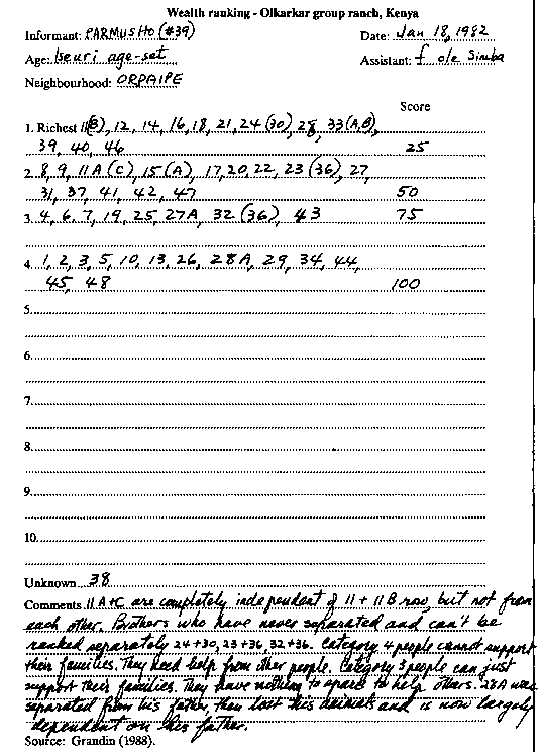
When calculating informants' scores, the data should be scanned to check for obvious inconsistencies, and the reasons for them should be determined. After all average scores have been computed, households can be grouped into different wealth strata which can then be used as a basis for the identification of target groups or recommendation domains.
As a rue of thumb, Grandin (1988) suggests that the number of groups should not be more than the average number of piles used by the informants and not less than three. In practice, the number finally identified will depend on the particular objectives of the research team. Normally, for ease of comparison, groups should be roughly equal in size. Natural breaks in the scores listed will often provide a basis for grouping.
Behnke R Jr. 1984. Measuring the benefits of subsistence versus commercial livestock production in Africa. In: Flora C B (ed), Animals in the farming system. Proceedings of Kansas State University's 1983 Farming Systems Research Symposium, Manhattan, Kansas, 31 October -2 November 1983. Farming Systems Research Paper 6. Kansas State University, Manhattan, Kansas, USA. pp. 564-592.
Bernsten R H. Fitzhugh H A and Knipscheer H C. 1984. Livestock in farming systems research. In: Flora C B (ed), Animals in the farming system. Proceedings of Kansas State University's 1983 Farming Systems Research Symposium, Manhattan, Kansas, 31 October - 2 November 1983. Farming Systems Research Paper Series 6. Kansas State University, Manhattan, Kansas, USA. pp. 64-109.
Butler L M. 1984. Putting farming systems data collection in perspective: Practicalities and realities. In: Flora C B (ed), Animals in the farming system. Proceedings of Kansas State University's 1983 Farming Systems Research Symposium, Manhattan, Kansas, 31 October - 2 November 1983. Farming Systems Research Paper Series 6. Kansas State University, Manhattan, Kansas, USA. pp. 525-555.
Byerlee D and Collinson M (eds). 1980. Planning technologies appropriate to farmers: Concepts and procedures. Economics Program, CIMMYT (Centro Internacional de Mejoramiento de Maiz y Trigo), Mexico, Mexico. pp. 10-11; 52-54.
Caldwell J S. 1984. An overview of farming systems research and development: Origins, applications and issues. In: Flora C B (ed), Animals in the farming system Proceedings of Kansas State University's 1983 Farming Systems Research Symposium, Manhattan, Kansas, 31 October - 2 November 1983. Farming Systems Research Paper Series 6. Kansas State University, Manhattan, Kansas, USA. pp. 25-54.
Chambers R. 1983. Rural development: Putting the last first. Longmans, London, UK 246 pp.
CIMMYT (Centro Internacional de Mejoramiento de Maiz y Trigo). 1985. Teaching notes on the diagnostic phase of OFR/FSP: Concepts, principles and procedure. CIMMYT Occasional Paper 14. Eastern African Economics Programme, CIMMYT (International Maize and Wheat Improvement Centre), Nairobi, Kenya. 121 pp.
Collinson M P. 1972. Farm management in peasant agriculture: A handbook for rural development planning in Africa. Praeger Publishers, New York, USA. 444 pp.
Conway G R. 1986. Agroecosystem analysis. Agricultural Administration 20(1):31-55.
Cornick T R and Alberti A M. 1986. Recommendation domains reconsidered. In: Flora C B and Tomecek M (eds). Farming systems research and extension: Management and methodology. Farming Systems Research Paper 11. Kansas State University, Manhattan, Kansas, USA. pp. 236-252.
Frankenberger T R and Lichte J L. 1985. A methodology for conducting reconnaissance surveys in Africa. Network Paper 10. FSSP (Farming Systems Support Project), University of Florida/USAID (United States Agency for International Development), Gainesville, Florida, USA. 21 pp.
Gilbert E H. Norman D W and Winch F E. 1980. Farming systems research: A critical appraisal MSU Rural Development Paper 6. Department of Agricultural Economics, Michigan State University, East Lansing, Michigan, USA. 135 + xiii pp.
Grandin B E. 1983. The importance of wealth effects on pastoral production: A rapid method for wealth ranking. In: Pastoral systems research in sub-Saharan Africa. Proceedings of the IDRC/ILCA workshop held at ILCA, Addis Ababa, Ethiopia, 21-24 March 1983. ILCA (International Livestock Centre for Africa), Addis Ababa, Ethiopia. pp. 237-256.
Grandin B E. 1988. Wealth ranking in smallholder communities: A field manual. Intermediate Technology Publications Ltd. London, UK 49 pp.
Gryseels G and Anderson F M. 1983. Research on farm and livestock productivity in the central Ethiopian highlands: Initial results, 1977-1980. ILCA Research Report 4. ILCA (International Livestock Centre for Africa), Addis Ababa, Ethiopia. 51 pp.
de Haan C. 1983. Towards a framework for pastoral systems research. In: Pastoral systems research in sub-Saharan Africa Proceedings of the IDRC/ILCA workshop held at ILCA, Addis Ababa, Ethiopia, 21-24 March 1983. ILCA (International Livestock Centre for Africa), Addis Ababa, Ethiopia. pp. 25-44.
Harrington L W and Tripp R. n.d. Recommendation domains: A framework for on-farm research. CIMMYT Economics Program Working Paper 02/84. CIMMYT (Centro Internacional de Mejoramiento de Maiz y Trigo), Mexico, Mexico. 29 pp.
Hart R D and Calixte G. 1984. A guideline for the design of farming systems projects: A case study from the eastern Caribbean. In: Flora C B (ed), Animals in the farming system. Proceedings of Kansas State University's 1983 Farming Systems Research Symposium, Manhattan, Kansas, 31 October - 2 November 1983. Farming Systems Research Paper Series 6. Kansas State University, Manhattan, Kansas, USA pp. 505-524.
Jolly C M. 1986. The use of action variables in determining recommendation domains. In: Flora C B and Tomecek M (eds), Farming systems research and extension: rood and feed. (Abstract). Farming Systems Research Paper Series 12. Kansas State University, Manhattan, Kansas, USA. v.p.
de Ridder N and Wagenaar K T. 1986. A comparison between the productivity of traditional livestock production systems and ranching in eastern Botswana. In: Joss P J. Lynch P W and Williams O B (eds), Rangelands: A resource under siege. Proceedings of the Second International Rangeland Congress held at Adelaide, South Australia, 13-18 May 1984. Australian Academy of Science, Canberra, Australia. pp. 404-405.
Sandford S. Anderson F and Addis Anteneh. 1983. The scope for improvement. In: Pastoral systems research in sub-Saharan Africa Proceedings of the IDRC/ILCA workshop held at ILCA, Addis Ababa, Ethiopia, 21-24 March 1983. ILCA (International Livestock Centre for Africa), Addis Ababa, Ethiopia. pp. 365-382.
Steiner K G. 1987. On-farm experimentation handbook for rural development projects: Guidelines for the development of ecological and socio-economic sound extension messages for small farmers. Special Publication 203. GTZ Deutsche Gesellschaft fuer Technische Zusammenarbeit), Eschborn, Federal Republic of Germany. 307 pp.
Zandstra H G. 1980. Methods to identify and evaluate improved cropping systems. In: H Ruthenberg (ed), Farming systems in the tropics. 3rd ed. Clarendon Press, Oxford, UK pp. 367-381.
