


Part A: Purposes
Part B: Types of data
Part C: Methods of data collection
References
Relationships between labour, livestock production and other farm and non-farm activities
Feasibility of new technology
The two main objectives of collecting data on household labour are to determine:
· How the amount of labour available, and its use throughout the year, affects livestock production and other farm and non-farm activities.· The suitability of technological interventions with respect to labour availability and use.
Labour is an essential household resource in most African livestock production systems. Its use is often closely related to the use of other resources (e.g. land and capital) by the household and production, thereby influencing management practices, enterprise combinations, labour hiring/sharing strategies and overall levels of technical and economic performance.
The amount of household labour available (by age and sex) and the manner in which that labour is allocated between critical farm and non-farm tasks will directly influence:
· the size and structure of the livestock enterprise.
· management techniques (e.g. herd splitting) and management performance, and
· levels of marketed and non-marketed offtake.
The size and structure of the livestock enterprise may, in turn, influence the performance of other farm activities such as cropping. The number of draft animals, for instance, may determine the amount of land that can be cropped, the types of crop grown, total crop production and yield (Gryseels and Anderson, 1983). Also, larger households usually have larger herds/flocks, market absolutely (though not necessarily proportionately) more stock and benefit from economies of scale in such operations as herding.
The user of this module is encouraged to examine these and other possible labour-related linkages (see examples) in the production system and test their significance by using the techniques outlined in Module 11.
|
Examples: When attempting to describe the role of labour in a livestock production system it is useful to examine the relationships between: · household size and the rate of marketed offtake (Doran, 1982), Zimbabwe Government, 1982a, by · household size and livestock holding per household member as an indicator of wealth status (Swift, 1985, p. 143). · household size and livestock enterprise composition, i.e. the ratio of cattle to smallstock etc. (Swift, 1985, p. 139). · household structure and livestock enterprise composition (Swift, 1985, p. 139). · herd size and labour time devoted to livestock management (Bailey, 1982). |
Without a knowledge of labour availability and allocation there is a danger that one may become preoccupied with technologies which may subsequently be found to be unacceptable to the target group (Grandin, 1983, p. 305).
Labour-related constraints on technology development may be determined by culturally accepted ways of doing things. For instance, they may be set by household goals and aspirations or, they may be a function of the amount of labour physically available on the farm at critical times of the year.
Information on the total amount of labour available during a year may not, therefore, be sufficient to determine the potential of a new technology for adoption. Rather, one has to examine how that labour is used throughout the year, and which tasks are allocated to different age and sex groups within the household. It is also necessary to know how households overcome labour shortages (e.g. by cooperative labour sharing or by hiring).
New technologies will often require significant changes in the amount of labour used or the pattern in which it is allocated. Therefore, for each new technology proposed, it will be necessary to determine whether:
· The technology is feasible in terms of the labour it uses, i.e. whether the demand for labour resulting from the use of the technology can be matched by the supply of household labour at the required time.· The adoption of the technology implies a shift in labour resources from one activity to another, and what are the opportunity costs of that shift (i.e. whether the additional profit resulting from using labour in the new technology is greater than the profit lost as a result of shifting away from the old).
· The proposed pattern of labour use (i.e. adult/child or male/female task allocation) is culturally acceptable.
To assess the effect of labour on farm and non-farm activities and on the adoption of new technology, data are required on:
· labour available to the household, and
· labour use over a period of time by age and sex category.
Information on the total amount of labour available to the household is needed to:
· Check the consistency of results of in-depth analyses of labour flows over time.· Determine whether the amount of labour available corresponds to the amount actually used at different times of the production year. If labour is scarce at particular times of the year, the manner in which households compensate for such shortages should be clarified.
· Test relationships between different variables which may help in the design of technological innovations.
This type of data can be collected during single- or multi-subject, single-visit surveys. To maintain consistency in the interpretation and presentation of results, it is helpful to define, at the outset, what constitutes "household labour' and in which unit labour is measured.
Household labour. When the intention is to measure labour productivity, a household will generally be defined in terms of those individual members who participate in its productive activities. The available household labour1 supply may therefore include:
· persons who are part of the family unit, reside at the household site and are actively involved in production2 (Solomon Bekure et al, 1987)· persons who live at the household site but are not related to the household members
· household members who are in off-farm employment but work on the farm on an occasional basis (e.g. by returning home to plough).
1 Focusing on the household as the unit of production may not be always appropriate (Grandin and Solomon Bekure, 1983) because different systems, and even the individuals within a particular production system, will vary in terms of their reliance on household and non-household labour. Pastoralists, for instance, tend to share communal labour more often than farmers2 Distinction should be made between those who are able to work and those who, although present, can not work because of sickness, old age etc. If any resident member is not available for work at particular times curing the year, this should also tee taken into account.
Measurement unit. Different types of labour make different contributions to production, depending on the nature of the task performed and the age and sex of the person performing it. Thus, before comparisons can be made between households (or between different tasks carried out by members of the same household), labour time must be expressed in terms of a common denominator.
Such a common denominator is the man-day equivalent. In general, a man-day of work is defined as the amount of work (of a particular kind) that can be carried out by an adult male in an 8-hour work period. A man-hour is one-eighth of this.3
3 The use of an 8-hour day to estimate man-day equivalents is only a guide. Different day lengths could be applied to different circumstances.
The man-day equivalent is based on the use of standard conversion factors (weights) applied to males and females in different age groups and carrying out different tasks.
For instance, a conversion factor of 1.0 means that an individual can perform a given task in the same time as a normal adult male, while a factor of 0.5 means that the task would take twice as long to perform as it would if done by an adult male.
Adult males and females are normally assumed to be different in terms of the amount of effective work they can do, though there may be some tasks (e.g. in cropping) where their work output will be equivalent. Children's work output will depend on their age and the nature of the task performed. For some tasks (e.g. herding), a child of 14 years, for example, can perform as effectively as an adult. For other tasks (e.g. weeding and carting water), a reduction should be applied for children.
|
Example: Let us calculate the total man-hours available for herding in a pastoral household consisting of eight persons belonging to three age categories: |
|||||
|
|
|||||
|
- Two adult males (between 15 and 65 years) for herding cattle |
|||||
|
- Two adult females (between 15 and 65 years) for herding smallstock and calves, and |
|||||
|
- Two children (male and female; between 6 and 14 years) for herding cattle and smallstock. |
|||||
|
|
|||||
|
Assuming that adult males and females contribute an average of 0.5 hours/day to herding, and children an average of 6 hours/day, then total man-hour equivalents are calculated by multiplying total labour days by the amount of time spent on herding and the relevant conversion factor. |
|||||
|
|
|||||
|
Labour category |
Number of persons |
Labour availability |
Conversion factor |
Total man-hours/year |
|
|
Total days |
Hours/day |
||||
|
Adult males |
2 |
730 |
0.5 |
1.0 |
365 |
|
Adult females |
2 |
730 |
0.5 |
1.0 |
365 |
|
Children |
2 |
730 |
6.0 |
1.0 |
4380 |
|
Total man-hours/year |
5110 |
||||
|
Total man-days/year1 |
640 |
||||
1 Calculated at 8 hours per average workday.
The above example gives an annual estimate of the labour available for one operation. However, labour shortages are seasonal, and annual estimates of labour supply may conceal them. It is, therefore, often useful to break down labour supply estimates on a seasonal or monthly basis and relate them to the man-day needs of each operation.
The conversion factor used in estimating man-day or man-hour equivalents will vary according to circumstances, and no general standards can be recommended. (An example of age-sex-task conversion factors used in a study of mixed cropping practices in northern Ghana is given in the Appendix.) The same applies to the definition of an 'adult'. Most commonly, adults are defined as those individuals between 15 and 65 years, but this definition will also vary with the circumstances4 (Swift, 1985; Panin, 1986).
4 If individuals are uncertain about how old they actually are, guesstimates can be made by relating date of birth to important events in the life of the individual (e.g. religious ceremonies, weddings, deaths, droughts and wars). Alternatively, local concepts of age division can be used. The guesstimates should then be converted to year equivalents, whenever possible.
The user of this manual should be very cautious about using conversion coefficients calculated for one task to estimate the amount of work allocated to other tasks.
When the crucial farm and non-farm tasks have been identified, and the labour allocated to these tasks by permanent and absentee household members has been determined (along with the extent of the use of shared or hired labour), then labour use/availability profiles can be constructed for different household activities and related to the labour requirements of proposed interventions.
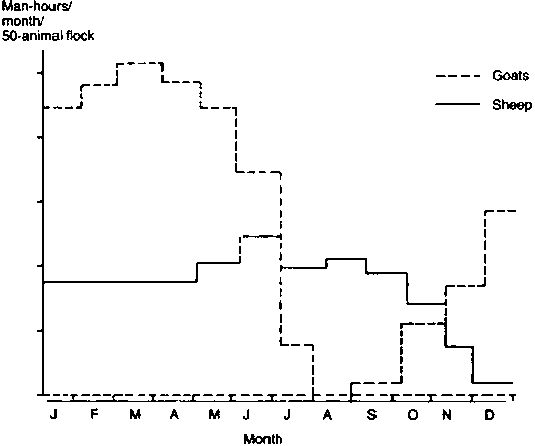
An example of labour-use profiles for two 50-animal flocks (one of sheep and the other of goats) in West Africa is given in Figure 1. The profiles show the amount of labour needed for watering and milking, but do not give the time spent on these operations by age and sex category.
Figure 1. Labour spent by the Twareg of Adrar N If ores to water and milk two 50-animal flocks, Mali
Source: J Swift, ILCA, Bamako, Mali, unpublished data.
|
Summary To estimate the supply and use of household labour, information will be needed on: · age, sex and education of individuals residing in the household, and the relationship of these individuals to the household head · occupation of resident household members (e.g. farming, working off-farm, schooling) · availability of household members for work on the farm · age, sex, occupation and location of non-resident household members who contribute to production on an intermittent basis · sources and uses of hired and shared labour · an-day or man-hour conversion weights for different tasks and different age/sex groups, · allocation of labour by age and sex group to different tasks in different seasons of the year. |
Time-allocation method
Critical task analysis
Continuous recall survey
Appendix
The method adopted to collect data on labour use will depend on the complexity of the information required which, in turn, will depend on the objectives of the study. As in all forms of data collection, different methods may be applicable to different stages of the collection process.
For instance, the first stage in labour data collection may be to collect general information on the structure of the household, the availability of individual members for farm work, the hiring or sharing arrangements used, the major production tasks carried out during different seasons of the year etc. Such information is best collected by single-visit surveys.Subsequently, it may be decided that labour is a critical constraint and that more detailed information on labour use is needed. However, extensive recall methods are usually too costly, so a less costly method confined to measuring the amount of labour allocated to the most important production tasks might be used (see 'Critical task analysis, on next page).
If detailed labour data for all production tasks are necessary, and keeping costs down is desirable, then the 'Time-allocation method' described below may be applicable.
This is a type of direct-observation method based on randomly timed short visits to measure/observe all activities carried out by all members of the household at the particular time of the visit. Records produced after a series of visits (each scheduled for different times of the day) can give "a thorough description of activities by such parameters as age, sex and season" (Grandin, 1983, p. 311).
Advantages. The advantages of the time-allocation method are that all potential workers can be surveyed, recall problems are minimal and there is little respondent fatigue, as visits of five to 10 minutes are usually sufficient for a household of up to 10 people. The method covers not only the complete range of activities, but also tasks performed simultaneously. If sufficiently large samples are chosen, households can be compared on the basis of available labour supply, wealth, neighbourhood or other variables which might affect the use of labour. Another advantage of the method is that it is relatively cheap considering the amount of information it can provide.
Disadvantages. If some household members are absent at the time of the interview (because they are out herding or performing some other tasks off the farm), the data obtained with this method may be inaccurate. Also, since the method does not distinguish between critical and non-critical tasks, there is the possibility that the labour requirements of a production system could be overestimated. Finally, if access to a computer or its capacity are limiting factors, it may be unwise to use the time-allocation method because of the high costs of data coding involved.
|
Summary The steps involved in carrying out a labour time-allocation study are: · decide whether the overall allocation of labour to farm and non-farm activities requires in-depth study · determine the resources available for study (e.g. manpower and financial resources and computer facilities) · ascertain whether the time allocation method is appropriate · design questionnaire, train enumerators and pre-test questionnaire · select sample groups and individual households within each sample group for study · determine the frequency of visits to the selected households · select, at random, the days and times when individual households will be visited · collect labour use data and check for inconsistencies and errors, and · analyse data and draw conclusions related to the overall objectives of the systems research carried out. |
The critical task analysis relies on the use of recall to collect information on critical tasks from carefully chosen informants, but it may also involve direct observation and measurement. The recall method usually relies on average household estimates, but analysis on the basis of wealth class may sometimes be more useful (Module 1, Section 1).
The chief objectives in a critical task analysis based on RECALL are to:
· Identify the tasks which appear to be critical in terms of the consequences for the household if enough labour is not allocated to them. These tasks may or may not be the tasks which require the most labour.· Determine whether the household has sufficient labour to meet the demands (i.e. whether there is a 'labour-sufficiency' problem).
· Determine how households overcome deficiencies in the labour required to perform critical tasks (e.g. by labour-sharing or truing).
Advantages. The method makes it possible to identify rapidly the critical tasks performed and the extent of labour shortages for such tasks (see example below). It is low-cost and interviews can be conducted within a relatively short period of time. Critical task analysis is often the first step in identifying labour constraints in livestock systems research, after which more in-depth analysis may be required.
|
Example: In a study of the Samburu by Sperling (1987), informants identified herding and watering as the critical tasks performed by the average household. They estimated that between five and nine workers were required for these tasks in the wet season, and between eight and 14 in the dry season. An estimate of the average household size was then obtained from other sources and adjusted by deducting the number of children too young, and of adults too old, to work. This gave an average available work force of 5.2 persons. The conclusion was that the average household could not perform herding and watering adequately without access to alternative labour sources. A study of the methods used to overcome labour shortages showed that the average household provided only 14% of the overall labour requirement for herding. Households used complex hiring and labour-sharing arrangements, yet many continued to experience problems with getting enough labour for herding. |
Disadvantage. If the tasks which are critical for given households are incorrectly or inadequately specified, or if their selection or the interview approach adopted are biased by preconceived notions, then there is danger that the data collected will be irrelevant.
|
Summary The steps involved in a critical task analysis are: · identifying informants fully acquainted with the livestock operations carried out in the study area (Module 1, Section 1) · asking the informants to estimate: - the average livestock holding in the area - livestock production tasks critical in terms of labour use, and - the number of workers needed to carry out critical tasks. (If there are large seasonal differences, then the number of workers required for the tasks in different seasons should also be estimated.) · estimating the average household size in the area, using survey or census data if these are available · relating average household size to the worker requirements estimated by the informants for each critical task · determining whether there is a labour sufficiency problem or not, and · investigating the methods used by an average household to deal with labour deficiencies for a critical task(s) and ascertain whether they are considered adequate to overcome the problem. |
When DIRECT OBSERVATION is used (e.g. Torry, 1977), the tasks critical to household production are identified in a rapid survey of selected informants (as above). This is followed by direct measurement of the amount of time spent on these tasks. Measurements are conducted over a relatively short period of time, on the assumption that the labour patterns observed are not seasonal (Collinson, 1972, p. 226). If, however, seasonal differences are suspected, several measurements will be required.
The labour requirements measured for particular critical tasks are then related to data on household labour supply to determine whether there is a labour sufficiency problem for these tasks. If labour shortages are apparent, the extent and nature of labour sharing or hiring is assessed (e.g. Gryseels et al, 1988).
Advantage. The technique provides detailed information about time spent on critical tasks during short periods of the production year, thereby complementing rapid surveys on labour use and availability and enabling in-depth analyses of other crucial aspects of labour use.
Continuous recall surveys can be single- or multiple-subject and involve frequent visits to selected households on a regular and pre-arranged basis (e.g. twice weekly). They are often used to estimate the amount of time spent on particular tasks performed between two consecutive visits.
Three factors should be taken into account when designing continuous recall surveys of labour inputs:
· labour time
· frequency of data collection, and
· respondent selection.
Estimation of labour time. When estimating the amount of time spent on a given job, the time spent working and that spent resting are normally lumped together, because it may be cliff cult to distinguish between them (Norman, 1973). Use local concepts of time to improve the accuracy of recall.
Frequency of data collection. This largely depends on the characteristics of the system studied and on the overall objectives of the survey. Sample size, the geographic dispersion of selected households and financial considerations will also influence the frequency of enumerator visits.
When a production system is complex or when the work to be done changes from day to day, interviews conducted more than two to three days apart lead to increasingly inaccurate recall (Collinson, 1972, p. 229). For less complex systems (e.g. pastoral) where labour inputs tend to be fairly regular, the periods between interviews can be longer without markedly affecting recall. In general, recall for regular tasks such as herding or watering will be longer than for operations such as milking. Twice-weekly interviews are, therefore, commonly used for pastoral as well as mixed farming systems (Grandin, 1983, p. 310).
Increasing sample size may mean that the visiting frequency will have to be reduced. However, as the recall period increases, the accuracy of the data obtained tends to decline because farmers are more likely to forget details about the work they have done. Conflicts between accuracy and the statistical usefulness of the data collected are common in continuous recall surveys (Norman, 1973; Coleman, 1982).
Because of these conflicts there may be a tendency to concentrate on fewer tasks, which, in turn, may mean that information on other important activities is missed. Estimating the returns to labour is then more difficult, the consequence being that the suitability of proposed interventions cannot be fully assessed. The same applies to other variables surveyed by continuous recall.
Another problem is that the longer the time spent in collecting detailed information on labour use, the more difficult it is to maintain a high standard of accuracy. This is because enumerators and respondents tend to become fatigued in long surveys, especially if the desired amount of cooperation from respondents is lacking. However, if there is cooperation, and if enumerator/respondent fatigue can be avoided, recall may improve with time due to better understanding by both the respondent and the enumerator of what is required (Grandin, 1983).
Long survey periods may also entail difficulties with enumerator supervision. Thorough supervision adds to costs, thereby often curtailing the budget available for actual data collection.
Respondent selection. Ideally, the person(s) involved in each particular operation should be interviewed. This may, however, be costly or impractical, and conflicts between the amount of detail, the level of data accuracy and the statistical usefulness of results may arise. General principles applicable to enumerator selection and questionnaire design for labour input surveys are outlined in Module 2 (Part C) of Section 1.
|
Summary The steps involved in collecting labour data using a continuous recall method are: · decide whether the method is appropriate i.e. whether data on labour flows over time are required · if so, decide whether labour data should be collected separately or with data on other, related variables (e.g. income and expenditure) · design the questionnaire, select sample households, train enumerators, pre-test questionnaire and correct if necessary (Part C of Module 2, Section 1) · decide on the frequency of visits given the required data accuracy and cost/manpower constraints · collect data and review them for errors/inconsistencies, and · analyse results and draw conclusions related to the original objectives of livestock systems research. |
Task conversion factors used in a study of mixed farming systems in northern Ghana.
|
Labour category |
Task |
|||||
|
Clearing |
Hoe-ridging |
Leading bullocks |
Planting |
Weeding |
Harvesting |
|
|
adult-male equivalent |
||||||
|
Males |
||||||
|
6-9 years |
0.10 |
0.10 |
0.35 |
0.41 |
0.10 |
0.35 |
|
10-15 years |
0.75 |
0.75 |
0.95 |
0.90 |
0.85 |
0.85 |
|
15-55 years |
1.00 |
1.00 |
1.00 |
1.00 |
1.00 |
1.00 |
|
> 55 years |
0.50 |
0.50 |
0.70 |
0.65 |
0.65 |
0.65 |
|
Females |
||||||
|
6-9 years |
0.00 |
0.00 |
0.25 |
0.41 |
0.10 |
0.35 |
|
10-15 years |
0.40 |
0.35 |
0.75 |
0.90 |
0.65 |
0.90 |
|
15-55 years |
0.75 |
0.65 |
0.85 |
1.00 |
0.80 |
1.00 |
|
> 55 years |
0.45 |
0.25 |
0.00 |
0.81 |
0.45 |
0.85 |
Source: Panin (1986).
Bailey C R. 1982. Cattle husbandry in the communal areas of eastern Botswana PhD thesis, Cornell University, Ithaca, New York, USA. 367 pp.
Coleman G. 1982. Labour data collection in African traditional agricultural systems: A methodological review and examination of some Nigerian data Occasional Paper 18. School of Development Studies, East Anglia University, Norwich, UK 48 pp.
Collinson M P. 1972. Farm management in peasant agriculture: A handbook for rural development planning in Africa Praeger Publishers, New York, USA. 444 pp.
Doran M H. 1982. Communal Area Development Report 4: Matabeleland South Project proposal for integrated development of livestock wildlife and crop farming: Matabeleland South ARDA (Agricultural and Rural Development Authority), Bulawayo, Zimbabwe. 24 pp.
Grandin B E. 1983. Labour data collection. In. Pastoral systems research in sub-Saharan Africa. Proceedings of the IDRC/ILCA workshop held at ILCA, Addis Ababa, Ethiopia, 21-24 March 1983. ILCA (International Livestock Centre for Africa), Addis Ababa, Ethiopia. pp. 305-319.
Grandin B E and Solomon Bekure. 1983. Household studies in pastoral systems research. In: Pastoral systems research in sub-Saharan Africa Proceedings of the IDRC/ILCA workshop held at ILCA, Addis Ababa, Ethiopia, 21-24 March 1983. ILCA, Addis Ababa, Ethiopia. pp. 263-275.
Gryseels G and Anderson FM. 1983. Research on farm and livestock productivity in the central Ethiopian highlands: Initial results, 1977-1980. ILCA Research Report 4. ILCA (International Livestock Centre for Africa), Addis Ababa, Ethiopia. 52 pp.
Gryseels G. Getachew Assamenew, Anderson F. Abebe Misgina, Berhanu W Kidane, Sayers R and Woldeab Wolde Mariam. 1988. Role of livestock on mixed smallholder farms in the Ethiopian highlands: A case study from the Baso and Worena Woredda near Debre Berhan. Highlands Programme, ILCA (International Livestock Centre for Africa), Addis Ababa, Ethiopia. 246 pp. [ILCA library accession number 40389]
Norman D W. 1973. Methodology and problems of farm management investigations: Experiences from northern Nigeria African Rural Employment Paper 8. Department of Agricultural Economics, Michigan State University, East Lansing, Michigan. USA. 47 pp.
Panin A. 1986. A comparative socio-economic analysis of hoe and bullock farming systems in northern Ghana. PhD dissertation, Department of Agricultural Economics, University of Gottingen, Gottingen. 190 pp.
Solomon Bekure, de Leeuw P N and Grandin B E (eds). 1987. Maasai herding: An investigation of pastoral production on group ranches in Kenya. Working Document. ILCA (International Livestock Centre for Africa), Nairobi, Kenya. 457 pp. [ILCA library accession number 85360]
Sperling L. 1987. The labour organisation of Samburu pastoralism. Thesis, McGill University, Montreal, Canada.
Swift J (ed). 1985. Pastoral and agropastoral production systems in central Mali.: Three case studies. ILCA (International Livestock Centre for Africa), Bamako, Mali. 96 pp. [ILCA library accession number 35840]
Torry W I. 1977. Labour requirements among the Gabra. Paper presented at the ILCA Conference on Pastoralism in Kenya, Nairobi, Kenya, 22-26 August 1977. 17 pp. [ILCA library accession number 06824]
Zimbabwe Government. 1982a. Communal Area Development Report 3: South Matabeleland. South Gwanda Baseline Survey, 1982 ARDA (Agricultural and Rural Development Authority), Harare, Zimbabwe. 81 pp.
Zimbabwe Government. 1982b. Communal Area Development Report 5: South Matabeleland. North Gwanda Baseline Survey, 1982 ARDA (Agricultural and Rural Development Authority), Harare, Zimbabwe. 65 pp.
