


Part A: Purposes
Part B: Types of data
Part C: Methods of data collection
References
The effect of income, expenditure and asset ownership on livestock production and other farm and non-farm activities
Determining the suitability of new technology
When collecting household budget data, attention will be given to assets, sources of income and patterns of expenditure. Data of this type are collected to determine the effect of income, expenditure and asset ownership on livestock investment decisions, livestock management practices and the allocation of resources to other farm and non-farm activities by households.
In most communities, a household's relative wealth will be determined by its access to resources such as capital, land and labour. This, in turn, will determine how that household invests, obtains its income and spends cash on items such as food, clothing and farm inputs.
The same general principle holds in an African context where livestock holdings often represent the best approximation of the relative wealth of a household (Grandin, 1983, p. 231). The household's wealth influences livestock management practices and sales levels, as well as consumption behaviour and allocation of resources (Table 1). It thus influences the household's interactions with the cash economy.
For instance, households with larger herds tend to market absolutely more stock (e.g. Doran, 1982; Zimbabwe Government, 1982a, b; 1983; Grandin, 1983, Table 2), own more oxen, plough more land, achieve higher crop yields and sell greater amounts of crop products (e.g. Norman, 1973, p. 135; Gryseels and Anderson, 1983). Their greater wealth and income-generating capacities have also been shown to influence their access to external sources of capital, i.e. credit (Grandin, 1983, p. 238), which, in turn, influences their willingness to adopt new technologies.
An understanding of these linkages is therefore an important aspect of the descriptive/diagnostic phase of livestock systems research. It may also be necessary to determine how expenditure patterns affect the need for cash since this will often determine when particular transactions take place. The sale of cattle will often be dictated by the need to pay school fees or to buy food, for example (Swaziland Government, 1980, Ch. 2).
The user of this manual is encouraged to explore cause-and-effect relationships between livestock holdings and such variables as:
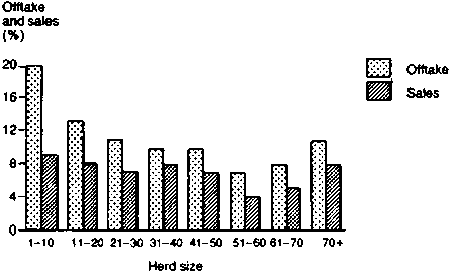
· Livestock offtake rates. An example from eastern Botswana is given in Figure 1.· Crop income and livestock sales and purchases. For instance, how does crop income affect the sale or purchase of livestock and the number of livestock held by a household?
· Off-farm remittances and livestock sales and purchases. For instance, how does the level of remittances affect the sale or purchase of livestock and the number of livestock held by a household?
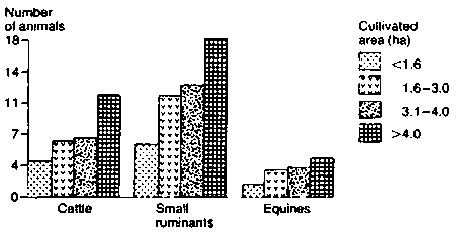
· Cultivated area. In the Ethiopian highlands, for instance, larger holdings of oxen permit a greater area of land to be cultivated (Gryseels et al, 1988; Figure 2).
· Expenditure on livestock and other farm inputs, e.g. veterinary supplies and fertiliser.
· Cash needs (e.g. school fees, food expenses) and sale of livestock
The different methods of analysis used to assess the significance of results are outlined in Module 11 of this manual.
Table 1. The effect of wealth on livestock offtake, management practices, household income, labour use and expenditure patterns in a Maasai group ranch, Kenya, 1983.
|
Item |
Household |
|||
|
Poor |
Rich |
|||
|
Livestock holdings |
||||
|
|
- number of cattle |
31 |
302 |
|
|
|
- number of smallstock |
42 |
213 |
|
|
|
- smallstock: cattle ratio |
1.35:1.00 |
0.7:1.00 |
|
|
Net livestock offtake (%) |
||||
|
|
- cattle |
20 |
7 |
|
|
|
- smallstock |
23 |
6 |
|
|
Livestock herding |
||||
|
|
- cattle herded alone (% of HH1) |
0 |
57 |
|
|
|
- smallstock herded alone (% of HH) |
29 |
57 |
|
|
|
- mean cattle-holding group size |
160 |
372 |
|
|
Labour inputs |
||||
|
|
- total number of workers |
6.3 |
9.8 |
|
|
|
- number of adult men |
0.9 |
1.5 |
|
|
|
- number of women |
1.7 |
3.4 |
|
|
|
- children at school (%) |
38 |
15 |
|
|
|
- ratio of cattle/worker |
5 |
31 |
|
|
|
- hours/day/worker given to livestock |
3 9 |
5.2 |
|
|
Income and expenditure (KSh2) |
||||
|
|
- income from livestock |
657 |
1420 |
|
|
|
- livestock income per worker |
104 |
145 |
|
|
|
- mean value of cattle sold |
577 |
971 |
|
|
|
- per caput expenditure on: |
|
|
|
|
|
|
food |
195 |
460 |
|
|
|
other household necessities |
165 |
238 |
1 HH = household.
2 KSh = Kenya shilling.
Source: B E Grandin, International Laboratory for Research on Animal Diseases, Nairobi, Kenya, personal communication.
The potential for introducing new technology is determined during the descriptive/diagnostic phase of livestock systems research. This will depend on the economic and social circumstances of households, which constrain or motivate responses to new opportunities.
The potential of a new technology to increase productivity and income at the farmer's (or pastoralist's) level may not, by itself, be adequate to induce adoption. Two considerations will always need to be borne in mind:
· Whether the farmer/pastoralist can in fact adopt the new technology, which is known as the necessary condition of adoption; and· Whether the farmer will adopt the new technology, which is known as the sufficient condition of adoption (Caldwell, 1984).
Figure 1. Livestock holdings and sales and offtake rates, Botswana, 1981.
Source: Bailey (1982).
With respect to wealth, income and expenditure, the following issues will need to be considered already in the design of diagnostic surveys:
· Will the household have the financial and labour resources to make the change?For instance, if the technology involves additional capital expenditure, it may favour those who are relatively wealthy. Such equity considerations can be important in the design of new technologies.
· Will the technology affect sources of income and/or expenditure patterns by shifting resources to different activities? How will this affect household cash flows, control over household resources and labour, risk and uncertainty?
For instance, the subdivision of communally owned grazing lands into fenced ranching enterprises is likely to release child-herding labour for other activities, such as school, cropping etc. If the labour released to cropping activities improves crop yield, for instance, such an effect should also be taken into account when evaluating a new livestock technology.
· Will the new technology involve investment in assets which are less easily converted to cash during times of need? Will this increase the risk for the household?
Figure 2. Livestock holdings by cultivated area, Ethiopian highlands.
Source: Gryseels and Getachew Assamenew (1985).
For all types of data, the objectives of the survey must be decided at the outset since these will influence the design of questionnaires and the amount of detail required. The approach to data collection must be both systematic (to ensure that what is wanted is in fact obtained) and selective (to make sure that only the necessary data are collected). The latter is true particularly for household expenditure data. Precise information may be difficult to obtain, and too much emphasis on detail is often counterproductive, not to mention costly in terms of manpower and financial resources.
Data collected will normally fall into three broad groups:
· assets inventory data
· income data, and
· expenditure data.
The assets which a household owns or holds will determine its income generating capacity. An inventory of household assets also gives a good indication of its investment and production patterns. Depending on the farming system, physical assets data will include information on any of the following:
|
Livestock |
- cattle, sheep, goats, donkeys, camels etc. |
|
Cropping equipment |
- ploughs, harrows, planters, tractors |
|
Transport equipment |
- carts, vehicles |
|
Other equipment |
- wire fencing, water points, fixed housing structures. |
The collection of livestock data is dealt with in Module 10 of his manual. It requires special consideration because it is often difficult to obtain reliable information, particularly for cattle, and because distinction must be made between the number of animals owned and held on loan by a household. Other assets data are, however, relatively simple to collect in a once-off, single-subject or multi-subject survey.
In the valuation of assets, livestock will normally be valued at current market price and other assets at their depreciated value. A simple formula for estimating the depreciated value of an asset is:
Depreciated value of asset = original value of asset - (annual depreciation x current life of asset)
|
Example: The purchase price for a plough with an expected useful life of 10 years is US$ 200. The depreciated value of the plough at the end of the fifth year of use is: Original value - (annual depreciation x 5) = 200 - [(200 -1/10) x 5] = US$ 100. |
Before designing income data questionnaires, it will often be useful to conduct an informal survey to determine the main sources of income in the area. When measuring income, distinction must be made between cash and non-cash transactions, since in pastoral communities, for instance, the exchange of livestock between households has important economic as well as social functions. Separating sources of income into these two categories helps to ensure that all major items of income are included by informants.
Depending on the system being studied and the purposes of the study, the following types of income data may need to be collected:
· Cash transactions· livestock and livestock products(animals, meat, milk, ghee, eggs, hides, skins and manure)· agroforestry products
(crops, wood, charcoal, fruit and honey)· handicrafts and brewing products · off-farm employment
(remittances, hire of labour and trading operations)· other sources of cash
(borrowings, gifts in cash).· Non-cash transactions
· livestock products(exchanges or gifts, bride wealth, livestock products consumed directly, e.g. milk, meat and eggs)· agroforestry products
(exchanges or gifts of crop products and wood, home consumption of food crops)· other non-cash transactions
(e.g. labour exchanges).
The valuation of items sold involves recording the amounts sold and multiplying these by the relevant market price. For most non-cash transactions, the valuation procedure is the same: the amount exchanged is recorded and this is multiplied by the prevailing market price.
Products produced on the farm which are retained for household consumption must also be valued. The price used to value this output will depend on whether the household normally sells or buys the product, i.e. whether there is a deficit or surplus of that commodity in the household.
For households which are deficit producers, any output consumed at home is valued at the price paid to buy the equivalent amount of product. For surplus producers, output consumed at home means that sales opportunities have been foregone, and the value to use is the price which the producer could have obtained if the item had been sold at the market, minus marketing costs.
When valuing the output of intermediate livestock products which directly contribute to crop production,1 such as manure, these should be given an imputed value. If the manure can be sold within the area, the appropriate value is the price which can be obtained on the seller's farm. If it cannot be sold, its value can be estimated by converting the dry-matter nutrient content of the manure to the equivalent fertiliser market price per unit of N. P and K,2 provided that fertiliser is used in the area.
1 Techniques for estimating crop production and income are adequately described in the literature on crop farming systems research (e.g. Collinson, 1972).2 One tonne of wet manure is equivalent to about 0.25 t of dry manure, but the plant nutrient value will vary. For example, in a study in the Ethiopian highlands, the N and P contents of dry manure were estimated at 1.46 and 1.3%, respectively (Newcombe, 1983). Jones and Wild (1975) quoted 1.4% for N sad 0.26% for P.
When valuing total farm income, the value of the manure applied to a crop is reflected in the value of crop produced.
Similar principles apply in the valuation of animal traction. Animal power can be valued at the price paid in the area to hire draft. Alternatively, if hiring of draft animals is not common, it can be valued at the cost of hiring labour to do an equivalent job. When valuing total farm income, the value of draft provided is reflected in the value of the crop produced.
The accuracy of the data obtained on production and income will depend on:
· The importance of the commodity to the household.For instance, in pastoral and agropastoral households, information on cattle sales will tend to be fairly reliable because of the importance attached to cattle in these households.
· The regularity of sales or exchanges.
For instance, for commodities which are produced and consumed regularly and in small amounts, recall after a relatively short period of time becomes unreliable. For commodities which are sold less regularly and in significant amounts, recall will usually be quite reliable even after a considerable time lapse.
The appropriate method of data collection will therefore depend on the type of income data being collected (see Part C).
The collection of reliable data on household expenditure patterns can be difficult, so care should be taken that the data to be collected are essential to the overall objectives of the study.
Expenditure on food, clothing and transport tends to occur fairly regularly and in small amounts. Recall of the precise amounts purchased or of the timing of those purchases tends to be poor, and frequent visits are necessary to obtain reliable information. It is usually advisable to avoid unnecessary detail, but if there is strong evidence that particular items in the budget will influence production decisions, sales levels and/or the uptake of new technologies, then data on these items will need to be collected.
For instance, when livestock are sold to buy food, as is common in pastoral and agropastoral systems, data on total food expenditure will be relevant but a detailed breakdown of food quantities purchased, and of costs by individual item, is not likely to be important.
The same general principle applies to the collection of most types of household expenditure data: rather than collecting data on individual expenditures, it is sufficient to concentrate on broad categories of household expenditure. However, data on the use of livestock production inputs are often essential since these reflect livestock management practices and may indicate possibilities for technological intervention.
The frequency of expenditure on livestock inputs will vary with the production system, and this will influence the method of data collection. Thus, for extensive production systems, expenditures will tend to be irregular, but for more intensive systems (e.g. dairying) there will be regular outlays on feed supplements, drugs and other items, so that more frequent visits will be required to obtain reliable data.
Livestock purchases tend to be irregular in most systems, and the collection of such data is discussed in Module 9. The collection of data on crop production inputs may be important, particularly when attempting to understand the linkages between crop and livestock activities in livestock systems research. Methods suitable to collect such data are described in Collinson (1972) and elsewhere.
|
Summary When collecting expenditure data, it is useful to begin by categorising expenditures into broader groups: · Livestock purchases · Livestock inputs - veterinary inputs, water, dip fees, drugs, feed supplements (salt licks, concentrates) · Crop inputs - seed, fertiliser, insecticides · Purchased food · Clothing · Transport · Durable household goods · Health and hygiene · Other items - loans, labour hire. Then, you will decide which categories need to be broken down into specific items or which can be left as they are, and which could be deleted from the survey questionnaire. |
Once-off recall methods
Intermittent recall methods
Continuous recall methods
An inventory of assets can be obtained from once-off, single- or multi-subject surveys, while income and expenditure data may have to be collected using intermittent or continuous recall visits. The important issues which determine the approach to data collection and must, therefore, be considered at the outset are:
· types of income and expenditure data needed
· common patterns of income and expenditure
· level of accuracy required
· frequency of visits needed to obtain the desired level of accuracy, and
· financial and manpower resources required to meet set objectives.
When an accurate recall of income and expenditures is possible over a long period, reliable data can be collected from once-off surveys. To ensure that recall is related to a specific time period, the reference point must be clearly deemed. Useful reference points are local events, such as important ceremonies, the dates of previous harvests or special market occasions, since these tend to be more easily remembered by respondents than, for example, calendar years.
Notes: In mixed crop-livestock production systems where herd sizes are relatively small, and the sale of an animal is, therefore, a significant event, the recall period may be as long as one year without substantial loss of accuracy. For such systems, the collection of data on livestock sales and purchase can be incorporated into once-off multi-subject surveys which include information on household size and structure, the occupation of household members, assets ownership and livestock holdings.
Similarly, where expenditures on livestock inputs are infrequent, once-off questionnaires will often give a reasonable approximation of the timing of expenditures and the amount of cash spent. Depending on the system and the objectives of the study, rough orders of magnitude in the estimation of income and expenditure levels may be sufficient.
Once-off surveys are relatively cheap, require minimal enumerator supervision, and the costs of data processing are low. They will often provide guidelines for subsequent in-depth studies on particular aspects of the system, bearing in mind that when income or expenditure patterns are regular and recall is short, the data obtained through them are likely to be inaccurate. If greater detail is needed and the type of data required is unsuitable for long recall periods, multiple visits would be more appropriate.
If more detailed information on income and expenditure is required than can be obtained from once-off recall surveys, but cost or manpower constraints make continuous visits impossible, then intermittent visits may be appropriate during which receipts and expenditures occurring in the period immediately before the visit are recorded.
The period of recall is relatively short (e.g. 1 week) and return visits are scheduled in such a way that recall relates to a different week of the month on each occasion. After a series of visits, 'typical' patterns of household income and expenditure can be obtained and the results extrapolated for the entire season or year.
|
Example: To obtain information on household budgets for a 'typical' month of the year, four visits with a recall period of 1 week would be required, but not necessarily within the same month. The procedure could then be repeated at a later date to check whether the patterns first observed are consistent throughout the year or whether marked differences occur with time. |
|||||||||||||||||
|
|
|||||||||||||||||
|
An example of a data collection based on 1-week recall is given below. The data were collected in two series of visits (four visits in each) over a 6-month period. |
|||||||||||||||||
|
|
First series |
|
Second series |
||||||||||||||
|
Month |
1 |
2 |
....... |
8 |
9 |
||||||||||||
|
Week |
1 |
2 |
3 |
4 |
1 |
2 |
3 |
4 |
|
1 |
2 |
3 |
4 |
1 |
2 |
3 |
4 |
|
Visit No. |
1 |
|
|
2 |
|
3 |
4 |
|
|
|
5 |
6 |
|
7 |
|
|
8 |
|
Recall period |
x |
|
x |
|
x |
x |
|
|
|
x |
x |
|
x |
|
|
x |
|
Intermittent recall methods are relatively cheaper than continuous recall methods, supervision of enumerators is less, and the data obtained by intermittent visits can be as reliable as for continuous recall, particularly if patterns of income and expenditure remain relatively constant throughout the year. In addition, problems of respondent fatigue, which is common to methods relying on more numerous visits, are reduced.
The danger with intermittent visits is that important differences in seasonal income and expenditure might be missed if visits are spread too widely apart, and, as a result, extrapolations of monthly cash flows might be very inaccurate. Where differences between seasons are expected (e.g. because of observed sale patterns for livestock), it will be advisable to plan visits on a seasonal basis and extrapolate accordingly.
Certain types of data require frequent visits and short recall periods, if a high level of accuracy is to be achieved.
Notes: Receipts from remittances and outlays on food and clothing tend to be fairly regular and often in varying amounts, so that recall over long periods tends to be poor. Similarly, production information for systems in which output is produced regularly or where inputs are used frequently, be unreliable if the recall period is longer than 2-4 days (Solomon Bekure, 1983, p. 294).In a study of the Maasai pastoralists in Kenya, the use of monthly recall for this type of data greatly affected the accuracy of results. A comparison of results from the monthly recall survey with those of a simultaneous, detailed survey of income and expenditure patterns in the area, showed that respondents of the monthly survey recalled only 70% of their actual cash receipts and 73% of their expenditure outlays (Solomon Bekure, 1983, p. 293).
Continuous recall surveys are costly and suffer from such problems as enumerator boredom and lack of farmer cooperation (Module 2, Section 1). Moreover, frequent data collection does not necessarily guarantee accuracy. Swift (1980), for instance, reports only partial success in obtaining household budget data through continuous recall. He says, "There was inevitably some resistance to such detailed questioning and at times, clearly false information was given or important transactions were concealed. Regular checking of data is, therefore, necessary to ensure that inconsistencies are detected early". This adds to the costs of data coding and enumerator supervision.
Nevertheless, continuous recall methods may be essential for some types of data. The approach to be adopted will depend on the objectives of the study, which should be carefully formulated at the outset, and on the resources available.
Careful examination of the types of data needed and of the patterns of income and expenditure in the survey area may mean that simpler and less costly methods of collecting budget data can be employed. It is therefore useful to gather as much information as possible on income and expenditure patterns through pre-survey inquiries or more formal questionnaires before commencing in-depth continuous recall surveys on household budget data.
|
Summary The procedure for collecting household budget data is: · Establish a register of the main farming operations and items of income and expenditure by interviewing local farmers, shops, extension staff and traders or by conducting preliminary formal surveys. Determine whether further budget information is needed. · Determine the type of budget data required and the methods of recall needed to obtain them. Relate these methods to the requirements of accuracy and available financial/manpower resources. · When the appropriate method(s) of recall is identified, decide on the frequency of visits required. · Design questionnaire and train enumerators on methods of data collection and pre-test survey, if necessary. · Collect data and review for consistency. For continuous recall methods, check data at regular intervals. · Analyse results and draw conclusions related to original objectives of the systems research. |
Bailey C R. 1982. Cattle husbandry in the communal area of eastern Botswana PhD thesis, Cornell University, Ithaca, New York, USA. 367 pp.
Caldwell J S. 1984. An overview of farming systems research and development: Origins, applications and issues. In: Flora C B (ed), Animals in the farming system Proceedings of Kansas State University's 1983 Farming Systems Research Symposium, Manhattan, Kansas, 31 October- 2 November 1983. Farming Systems Research Paper Series 6. Kansas State University, Manhattan' Kansas, USA. pp. 25-54.
Collinson M P. 1972. Farm management in peasant agriculture: A handbook for rural development planning in Africa. Praeger Publishers, New York, USA. 444 pp.
Doran M H. 1982. Communal Area Development Report 4: Matabeleland South Project proposal for integrated development of livestock wildlife and crop farming: Matabeleland South. ARDA (Agricultural and Rural Development Authority), Bulawayo, Zimbabwe. 24 pp.
Grandin B E. 1983. The importance of wealth effects on pastoral production: A rapid method for wealth ranking: In: Pastoral systems research in sub-Saharan Africa. Proceedings of the IDRC/ILCA workshop held at ILCA, Addis Ababa, Ethiopia, 21-24 March 1983. ILCA (International Livestock Centre for Africa), Addis Ababa, Ethiopia. pp. 237-256.
Gryseels G and Anderson F. 1983. Research on farm and livestock productivity in the central Ethiopian highlands: Initial results, 1977-1980. ILCA Research Report 4. ILCA (International Livestock Centre for Africa), Addis Ababa, Ethiopia. 51 pp.
Gryseels G and Getachew Assamenew. 1985. Links between livestock and crop production in the Ethiopian highlands. ILCA Newsletter 4(2):5-6. ILCA (International Livestock Centre for Africa), Addis Ababa, Ethiopia.
Gryseels G. Getachew Assamenew, Anderson F. Abebe Misgina, Berhanu W. Kidane, Sayers R and Woldeab Wolde Mariam. 1988. Role of livestock on mixed smallholder farms in the Ethiopian highlands: A case study from the Baso and Worena Woreda near Debre Berhan. Highlands Programme, ILCA (International Livestock Centre for Africa), Addis Ababa, Ethiopia. 246 pp. [ILCA library accession number 40389]
Jones M J and Wild A. 1975. Soils of the West African savanna. Technical Communication 55 of the Commonwealth Bureau of Soils, Harpenden, CAB (Commonwealth Agricultural Bureaux), Slough, UK 246 pp.
Newcombe J. 1983. An economic justification for rural afforestation: The case of Ethiopia. Draft Energy Department Paper. World Bank, USA.
Norman D W. 1973. Methodology and problems of farm management investigations: Experiences from northern Nigeria. African Rural Employment Paper 8. Department of Agricultural Economics, Michigan State University, East Lansing, Michigan, USA. 47 pp.
Solomon Bekure. 1983. Household income and expenditure studies. In: Pastoral systems research in sub-Saharan Africa. Proceedings of the IDRC/ILCA workshop held at ILCA, Addis Ababa, Ethiopia, 21-24 March 1983. ILCA (International Livestock Centre for Africa), Addis Ababa, Ethiopia. pp. 289-304.
Swaziland Government. 1980. Report of a cattle marketing survey 1978-79. Economic Planning and Analysis Section, Ministry of Agriculture and Cooperatives, Mbabane, Swaziland. 91 pp.
Swift J J. 1980. Livestock production and pastoral land use in Mali and the Sahelian countries. Programme Document AZ 30. Arid and Semi-arid Zones Programme, ILCA (International Livestock Centre for Africa), Bamako, Mali. 8 pp. [ILCA library accession number 31404]
Zimbabwe Government. 1982a. Communal Area Development Report 3: South Matabeleland South Gwanda Baseline Survey, 1982 ARDA (Agricultural and Rural Development Authority), Harare, Zimbabwe. 81 pp.
Zimbabwe Government. 1982b. Communal Area Development Report 5: South Matabeleland. North Gwanda Baseline Survey, 1982. ARDA (Agricultural and Rural Development Authority), Harare, Zimbabwe. 65 pp.
Zimbabwe Government. 1983. Communal Area Development Report 6: South Matabeleland Project proposal for resettlement, rural development and environmental rehabilitation. Gwanda District, Matabeleland. ARDA (Agricultural and Rural Development Authority), Harare, Zimbabwe. 82 pp.
