4.1 Staff Perceptions About Matrix Management
4.2 Transaction Costs of Matrix Management
4.3 Disciplinary Excellence
4.4 Research Projects and Activities and Their Management
4.5 Linkages Between Research and International Programmes
4.6 Management of Research Consortia and Networks
4.7 Management of Collaborative Research with Other IARCs
4.8 Conclusions on Research Management
Perhaps no other change at IRRI in recent years has had as major an impact on the lives of its scientists as did the shift to a matrix management system.5 IRRI staff were accustomed to operating in a system dominated by strong disciplinary units; new staff who recently joined IRRI often came from academia where a similar tradition exists. The shift to a programme-oriented structure came as a 'culture shock' to most. The rules, constraints, expectations and behavioral demands of the new system were foreign to staff. Yet, staff went along, some of them reluctantly, and gave the new system a try.
5 See Chapter 2 and Section 3.1 for a description of how the matrix system is organized at IRRI.
It has now been two years since the matrix system was initiated at IRRI. Two years is a relatively short time for getting the 'bugs' out of any new organizational system and, therefore, a full assessment of its effectiveness would be premature at this stage. However, there is some evidence of what seems to have worked and what has not. Also, many staff have shared with the Panel their experiences with "making the matrix work". For these reasons, we have decided to comment on the matrix and other aspects of research management at IRRI, with the intention that feedback from an outside group like ours may help IRRI make some mid-course corrections. Our comments cover seven areas:
· staff perceptions about matrix management;
· transaction costs of matrix management;
· disciplinary excellence;
· research projects and activities and their management;
· linkages between research and international programmes;
· management of research consortia and networks;
· management of collaborative research with other IARCs.
The first five areas relate directly to aspects of matrix management. The last two concern management of collaborative research.
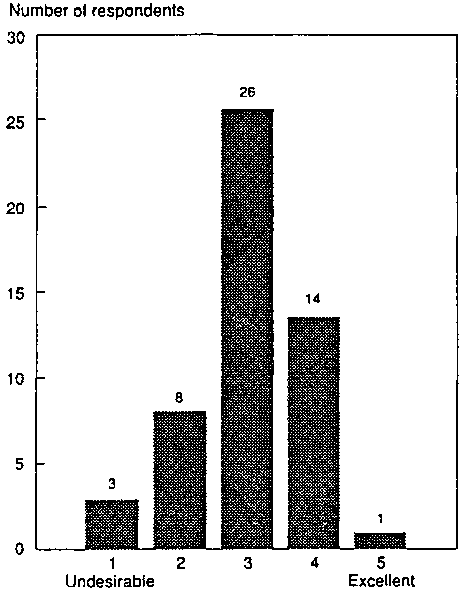
During the main phase of our review, the Panel conducted a confidential questionnaire survey of internationally recruited research staff to ascertain their views on the advantages and disadvantages of the matrix approach and to obtain a subjective, quantitative estimate of its effectiveness. The measure of effectiveness was based on a five-point scale ranging from 'undesirable' to 'excellent'. A total of 52 responses were received, practically all from staff playing some role in management or implementation of research projects. This reflects an 80 percent response rate.
As Figure 4.1 shows, opinions of IRRI's research staff vary widely about the effectiveness of the matrix approach. Exactly half of the responding IRS give it a ranking at the mid-point between 'undesirable' and 'excellent'. The remaining half are about equally divided between more favourable and unfavourable sentiments about matrix management.
Fig. 4.1 Effectiveness of IRRI's Matrix Approach as seen by Internationally Recruited Staff (n = 52)
This pattern of responses is roughly the same for staff with different lengths of tenure at IRRI, with one slight difference. Staff who have been at IRRI six or more years are slightly more positive about the effectiveness of matrix management than those with a tenure of less than six years.
The scientists at IRRI saw the following to be the key advantages of the matrix approach (listed in order of decreasing frequency of mention):
· fosters interdisciplinary research and promotes research collaboration;
· research directions, priorities, goals and outputs are clear;
· better communication among staff, better flow of information;
· better use of resources;
· greater transparency and participation of staff;
· clear responsibility and accountability of scientists;
· allows research to be directed at the problems of less advantaged ecosystems.
The most frequently mentioned disadvantages were as follows (again, listed in order of decreasing frequency):
· excessive bureaucracy, red tape, paperwork, reporting requirements;
· too many meetings;
· unclear responsibilities, too many bosses;
· too much time spent on management and administration;
· less time for science;
· slow decision-making;
· scientists' time split too many ways;
· exclusion of International Programmes from the matrix;
· decision-making authority too centralized.
The advantages and disadvantages of matrix management mentioned by IRRI scientists are almost identical to those typically given in other organizations using a matrix framework. A matrix organization reflects an overlay of two structures: one based along input lines (in this case, disciplines), and the other along output lines (or programmes). Thus, it has the advantages as well as the disadvantages of both output-and input-based organizations. When one side of the matrix dominates the other (through the way resources flow or decisions are made), many of the disadvantages mentioned by staff reflect the concerns of the weaker dimension.
As a Panel, we applaud IRRI's move to a matrix management system because it has introduced an output-orientation to the research programme that did not exist as strongly in the earlier structure. The matrix system has allowed IRRI to link the outputs of the Centre's work to the needs of its clients, thereby increasing the emphasis on relevance of its efforts. Also, the explicit focus on client needs, goals, strategic directions, and programmes has enabled IRRI to better anticipate and manage change. At the same time, the move to a matrix system has enabled IRRI to maintain some focus on scientific quality and disciplinary aspects of research. Thus, in many ways, the new structure reflects a compromise between IRRI's old input-oriented structure and the new output orientation brought about by the IRRI strategy.
We also applaud IRRI's efforts to make the matrix work. The whole institute has been engaged in an unprecedented team building effort. A clearly visible consequence of this effort is that the staff are now able to communicate with each other more effectively than before. They understand each other better, are more tolerant of each other, and are better able to give and receive feedback. As a result, there is a greater and more visible unity of purpose. The IRRI mission and strategy seem to be well understood by the scientists. Also, staff seem clearer about how their own work fits into the overall IRRI programme.
The unity of purpose we have observed, coupled with the fact that the creators of the IRRI matrix are the IRRI staff themselves, give the Panel hope that IRRI is in a strong position to mend the matrix when it begins to stand in the way of good research. The matrix should be seen for what it is: a tool for accomplishing the IRRI mission in the most efficient way, and subject to modification when the mission is changed or inefficiencies creep in.
In our judgment, it is timely for IRRI to take a close look at ways of improving the functioning of the matrix. The list of disadvantages mentioned by IRRI staff is a good starting point for this examination. We comment below on four aspects that are important: transaction costs of matrix management, disciplinary excellence, project management, and linkages between research and international programmes.
The strong comments made by IRRI staff about the disadvantages of the matrix system suggest that well-organized and equally strong efforts need to be applied in a sustained manner to reduce what economists call the 'transaction costs' of the matrix management system - that is, the time spent in meetings and negotiations and the amount of paperwork necessary to plan, execute, monitor, and evaluate the research programme. There are well-tried methods to reduce such transaction costs, such as providing training to those scientists who lack skills in project management, decentralizing decision-making to the lowest possible level, systematic efforts to organize and run meetings more efficiently (incidentally, one member of our team reported that an organization suffering from similar ills found a short-term solution in banning all morning meetings), and determined measures to improve electronic communication and management information systems. Some of these measures are already being applied at IRRI, but the Panel believes that a sustained, systematic effort, led from the Director General's office and strongly backed by him, could yield considerable gains in reducing the present overload of management burdens on senior scientists.
IRRI's shift to a matrix management system elevated programme needs over disciplinary concerns. All resources devoted to research began to flow through the ecosystem programmes. By and large, disciplinary units became subservient to programmes, projects and their goals. 100 percent of the time of the scientists began to be budgeted to research projects. A scientist's time began to be split among several discrete activities. Shortage of funds and understaffing meant that the few scientists available in some divisions (such as Social Science and Soil Science) were carrying the total burden of servicing all projects requiring inputs from that discipline. Many scientists began to feel they had no 'breathing room' or flexibility to pursue their own scientific or disciplinary interests and needs. Every effort needed to be fitted into a 'propel' project with several stages of approval. In many ways, the scientist's creativity was being locked into producing highly specific programme outputs.
As noted earlier, we applaud IRRI's shift towards a matrix system that has a strong programme orientation. However, we believe that the pendulum has swung too far in the output dimension of the matrix.
It is true that all of IRRI's efforts should be directed towards achieving its mission, programme goals, project objectives, etc. However, this static production-oriented view needs to be balanced against a dynamic 'sustainability' perspective. Most organization theories (like their counterparts in agricultural sciences) argue that increasing or maintaining the productivity of the resource base (in this case, human) is at least as important as the levels of production at a given point in time.
It is for this reason that most successful organizations place highest priority on attracting, retaining and further developing a human resource cadre that would give them a competitive edge over similar organizations. This is particularly important for research organizations which rely almost exclusively on the creativity of individual scientists.
The matrix, by definition, splits the disciplinary effort into many programme-oriented projects. Yet, to serve the organization better in the long-run, disciplinary divisions need to integrate the learning of their members and monitor and reinforce the quality of the scientific effort emanating from them. To help the programmes better, they may need to undertake some exploratory studies, perhaps too small or specific to factor into the programmes. They may also need some single-discipline projects that do not fit into ecosystem programmes (with the possible exception of the Cross-Ecosystem Programme) or that may be more efficient to manage within the division (such as a single discipline research network). Division staff also need to develop or sharpen their disciplinary capabilities to remain up-to-date, and to improve their career prospects.
Recommendation 4.1
The Panel recommends that IRRI adjust the matrix management system to provide the Divisions more authority and means to strengthen disciplinary capabilities and rigour, and to ensure that the emphasis on ecosystem research programmes does not lead to an erosion of disciplinary expertise.
We would like to make four additional comments on furthering scientific excellence at IRRI.
First, we applaud the effort IRRI divisions have initiated to develop clear statements of their missions. This is an excellent way to enhance or develop divisional identities, identify goals and explore ways in which divisions can help further the IRRI mission. Such an effort should undoubtedly focus also on the career development of individual division staff (both IRS and NRS).
Second, we feel that in a premier research institution like IRRI someone within the organization needs to play the role of a 'chief scientific officer', as distinct from 'chief executive officer' or 'chief operations officer'. The primary role of the chief scientific officer is to ensure the quality and integrity of the institute's scientific work. This requires continuous monitoring of scientific quality, awareness of scientist concerns, creation (or protection) of an atmosphere in which good science can be practised, and upholding of values promoting creativity (such as 'freedom from fear of failure'.)6 Although everyone at a scientific institution should be a champion of good science, someone with conviction, a 'feel' for science and the concerns of the scientist, and in a position of authority, should carry the explicit responsibility to protect and advance good science.
6 Philip Roussel, Kamal Saad, Tamara Erickson, Third Generation R & D, Harvard Business School Press, 1991.
At IRRI, the DDG-Research carries the dual responsibility of 'chief scientific officer' and 'chief research programme officer'. Because IRRI's priorities were placed initially on the 'output' side of the matrix, the DDGs-Research have emphasized the programme officer role. It may now be timely to balance both roles.
Third, as we comment in greater detail in Chapter 7, IRRI's internal and external review systems should enable IRRI to receive feedback on disciplinary excellence. Peer reviews of disciplinary activities, with a major focus on scientific quality, and more explicit attention to divisional matters by the Board's Programme Committee are among the ways IRRI could further its scientific excellence.
Fourth, at a more pragmatic level, it appears from the responses of the scientists to the survey questionnaire, and from our face-to-face interviews with them, that the time of an average scientist is being split too many ways in the current matrix system. We understand that IRRI is actively considering some proposals on limiting the number of projects of a scientist to a maximum of three, with a major contribution to only one. There are also other proposals which argue for linking each scientist more closely with a single programme, in order to avoid the bureaucratic and communication requirements of being involved with two or more programmes. These are all sound ideas which, when coupled with the other suggestions made above, could further advance the traditionally high disciplinary excellence of IRRI.
Projects constitute the backbone of a matrix management system. In fact, so long as an institute has the right project portfolio and project staffing, theoretically, its whole research programme can be managed with little attention to the two axes of the matrix. For this to happen, one needs the 'right' projects, good staff, and authority to manage them.
The IRRI research programme is now organized into 22 distinct projects, which are further divided into about 100 activities. The number of projects has been reduced from 49 over the last two years. This in itself is a welcome development, so long as each project in the portfolio has a clear output-oriented identity, unambiguous objectives, measurable milestones and a projected finite life.
Some programmes have very few projects but they are broad in their coverage. For example, the Upland Rice Research Programme has only two projects, one on 'sustainable land and resource management' and the other on 'germplasm improvement and crop management'. The Cross-Ecosystem Research Programme has five projects, but with few apparent substantive links among them. This should perhaps be expected because strategic methodological or substantive concerns cutting across rice ecosystems do not need to be inter-linked. (If they were, they would probably be combined into a single project).
Having the 'right homes' for the projects is extremely important. A strategic research project geared mainly towards the problems of a specific ecosystem should naturally be placed in that ecosystem programme. Having it placed in the Cross-Ecosystem Programme would have the effect of distorting the picture on the Institute's priorities and mask the true allocation of resources to ecosystems. However, IRRI's mandate covers many strategic research concerns which can be handled best through the Cross-Ecosystem Programme. Placing the oversight responsibility for a project in a division could be considered when it is dominated by a single discipline. For programme accounting purposes such projects could be classified in the respective ecosystem programme.
Detailed documentation exists for each project and activity and programme and project managers receive periodic financial reports on the project's progress. Also, the Programme Committee of the Board reviews progress in projects annually.
It is not entirely clear under what circumstances IRRI would terminate a project. Activities within projects do get terminated or reduced in scope because of departures of staff or shortage of funds. Some activities are transferred from one project to another, maybe in a different programme. There has been considerable fine-tuning to define and redefine projects, as illustrated by the reduction and redefinition of projects from 49 to 22 in two years. This accounts for some of the dissatisfaction with the bureaucracy of matrix management expressed by staff.
We would like to make three other comments about project management at IRRI.
First, we are not entirely convinced that each IRRI project has a clear focus that would facilitate monitoring of progress towards well-defined objectives. Some of the projects have a distinct 'sub-programme' flavour because of the breadth of their coverage and the continuing nature of their activities. The activities within projects, perhaps in part because most are built around a single scientist, are more like 'projects' in the classical sense of having clear foci, objectives, timetables, budgets and a finite life. We sympathize with IRRI that it would be extremely inefficient if one tried to manage the research programme in terms of some 100 odd activities, and therefore it is essential to have the activities reflect components of major research thrusts. At the same time, these research thrusts, as reflected by individual projects, should have clear enough objectives and milestones for the Institute management and the Board to decide periodically whether to expand, contract, or end them. Otherwise, projects could continue indefinitely, with occasional modifications, because of the natural tendency of some scientists to perpetuate their favourite activities.
Second, IRRI should examine closely its total 'project portfolio' from time to time. To do this accurately IRRI needs to have a good understanding of the risks as well as the expected payoff associated with each project. These factors change over time. New discoveries (by IRRI or others) could reduce uncertainties associated with a project. Also, expected benefits could change because of external circumstances. Increasing scarcity of unrestricted funds necessitates a bold approach to project selection in order to avoid the temptation to focus on activities that come equipped with ample special project funding but are not sufficiently oriented to IRRI's priorities.
Third, managers of projects (in IRRI's terminology, 'Project Coordinators') should be allowed to manage their projects. As we noted above, projects are the backbone of matrix management and the person closest to the problems of a project is the project manager. Managers on the two axes of the matrix should help in the integration of efforts, but not try to micro-manage projects.
This is why having clear foci and milestones are important. For all intents and purposes, after all approvals, the project manager and her/his team could be left alone to do their job, except for occasional reporting of progress and sharing of ideas, more for mutual learning and help than bureaucratic control.
Like the research programme, IRRI's international programme activities are managed through projects. The Panel's assessment of these projects and activities is covered in the next chapter of the report. Here we focus on the mechanisms for linking IRRI's research programme with its other programme activities.
As they are currently constituted, Research and International Programmes reflect two separate and distinct 'businesses' of IRRI. Research is responsible for generating new knowledge, increasingly in partnership with stakeholders in national programmes, sister IARCs or advanced developing country institutions, and institutions in developed countries. International Programmes is responsible for providing services to IRRI's clients and, to some extent, to IRRI's research arm. The service provided by International Programmes gets its strength from IRRI's competence in research. Most of the services provided are thus in the form of 'research-based services'.
Although some IRRI staff work exclusively in Research Programmes, there are others who both do research and contribute to International Programmes (such as research staff contributing to training or information activities).
That there is need for close links between Research and International Programmes is obvious. Both sides gain from such exchanges, not to mention the clients and partners of IRRI, who would benefit from likely increases in the relevance of IRRI's work resulting from these exchanges.
What is not clear to the Panel is how close or organic these links should be. One option that is now being considered by IRRI is to extend the current Research Programme matrix in both the programme and division dimensions by adding International Programmes and Centres to these dimensions. This would certainly help unify IRRI's work and facilitate closer interaction among staff in these two programmes.
On the other hand, there are several factors which argue for maintaining some distance between Research and International Programmes. First, the two businesses have somewhat different identities, values, ethos and principles. The innovation business and the environment it requires are quite different from those in a service enterprise. Mixing the two may water down, and indeed weaken, both cultural systems. Second, a larger matrix is likely to lead to a geometric increase in the complexity of managing relations. Third, each of the two dimensions or 'axes' of the matrix would lose some of its homogeneity. Disciplinary divisions dealing with knowledge generation do not mix well with International Programme 'centres' which are involved with service delivery, and ecosystem programmes have a character different from International Programmes. Fourth, integration of efforts in a matrix is enhanced when both dimensions report to the same 'boss'. Having two bosses manage a matrix jointly could lead to many unforeseen complications and inefficiencies.
It is obvious from the above that we would urge IRRI to proceed cautiously in any move to expand the research programme matrix. Since, according to conventional wisdom, structure follows strategy, we would ask that IRRI explore carefully the strategic imperatives that lie behind, and call for, such a structural change.
The distinction that should be made is perhaps between 'tight' versus 'loose coupling'. Tight coupling is counterproductive to research and, thus, the research programme matrix requires only a loose coupling of ecosystem programmes and discipline-based divisions, with the research projects as the driving force of the overall research programme. Some of the International Programmes, on the other hand, require tighter coupling, because tighter control and management often leads to greater efficiency in a service organization.
These notions relate to the possible internal coupling patterns in each of the two sides of the IRRI enterprise. If the argument above is correct, linking a loosely-coupled research operation to a tightly-coupled service business needs to be approached with care. To protect the loose-coupling in research, International Programmes needs to be linked with research in a loosely-coupled manner.
One option is to keep the research matrix intact, and assign staff who currently work exclusively in International Programmes to existing disciplinary divisions. If the existing divisions do not cover the disciplinary specializations of these staff, one or two new disciplinary divisions could be added to one side of the matrix (such as information and learning-related disciplines). This would have the effect of providing a disciplinary 'home' to all IRRI programme staff. Core- and complementary-funded staff would have greater opportunity for interaction with each other, as would staff in 'new' and 'old' disciplines. And IRRI would not be mixing inputs with outputs.
Under such a scenario, Research and International Programmes would be linked with each other in a loosely-coupled manner. The 'output' dimensions of both enterprises would be managed by the two DDGs, as at present. If new disciplinary divisions were to be added to the research programme matrix, supervision of scientific and disciplinary interests and excellence of staff in the new divisions would most likely fall under the responsibility of the DDG-Research. Linkage across projects in the two separate enterprises could be achieved through ad hoc coordination devices.
IRRI has recently introduced some new terminology related to agricultural research networks. In a recent paper prepared for the Board distinctions are made among the following:7
· A Research Network involves formally-linked teams of scientists from IRRI and other selected institutions to conduct research that is driven by a predetermined theme and/or a set of research tools.· A Technology Evaluation Network is a voluntary and open, informal association of scientists and/or research organizations with common interests. The members work together to share, exchange and evaluate technology, experiences and information.
· A Research Consortium involves a limited number of national and international institutions formally organized to collaborate in research, training and technology generation activities designed to meet mutually defined objectives.
7 The definitions are excerpts from Networks and Research Consortia: Their Functions and Roles Within IRRI Mandate, Position Paper F, Programme Report to the Programme Committee, 21-23 September 1992.
In terms of more commonly used network typologies (such as that described in Plucknett, Smith and Ozgediz8), IRRI's Research Networks (such as SARP and the planned Asian Rice Biotechnology Network) and Consortia (such as the two on Rainfed Lowland Rice and Upland Rice) fall under the rubric of 'collaborative research networks'. The distinguishing characteristic of such networks is that the main output of the network that is produced collaboratively is research. IRRI's Technology Evaluation Networks (such as INGER), on the other hand, exist primarily for exchange, testing and consultation. Here research is a by-product, but not the main output of these networks.
8 Donald Plucknett, Nigel Smith and Selcuk Ozgediz, Networking in International Agricultural Research, Cornell University Press, 1990.
We applaud the renewed emphasis on collaborative research networks at IRRI. Using IRRI's terminology, research networks focusing on specific researchable problems and providing the network participants a mutual learning experience in relatively new fields are likely to have high payoffs, both in terms of generation of new knowledge and in institution building. Because a true collaborative research network is as strong as the weakest link in the chain, IRRI as the network-coordinating institution, carries important organizational and management responsibility to keep quality high and prevent the network from turning into a one-way exchange mechanism. In this regard, the disciplinary divisions of IRRI are likely to play important roles in ensuring the scientific integrity of the research networks and in linking network findings to IRRI's research programme.
Research consortia are essentially closed-membership collaborative research networks. CIP has considerable experience in facilitating collaborative research initiatives similar to IRRI's consortia. For example, PRECODEPA, a regional cooperative programme for potato research and production involving nine Caribbean countries in which CIP participates, has had long experience that could be valuable to IRRI.
While the concept of a research consortium is very attractive ("interdisciplinary research teams of both IRRI and national institution scientists tackling together the generation of knowledge and development of holistic technology for specific rice ecosystems"), making it a reality is a tall order. Consortia are still in the experimental domain. So far IRRI has gained experience in planning and establishing, but not in generating research results through them.
As IRRI recognizes, the consortium approach relies on true peer relationships among scientists, often in different institutions. If such relationships are weak or are difficult to establish, making the consortia work may take a long time.
While encouraging IRRI to make the consortia a success, we would like to make the following cautionary comments:
· At the moment, the consortia cover very broad, comprehensive mandates. If their foci are not narrowed, such as by partitioning them into a series of more narrowly defined research problems with specific aims or by reducing the scope of the effort in initial years, fully collaborative work may not emerge.· A consortium should not be viewed as or allowed to become an institution. It should remain an organizational mechanism or tool for collaborative research. It should have an uncomplicated structure.
· IRRI needs to remain an equal partner, and not the main driving force, of the consortia. The NARS should be at the forefront of the effort, not just in appearance. Fiscal decisions should be made by the Steering Committees, with IRRI's participation, not by IRRI alone.
· The long-run sustainability of the consortia will depend to a large extent on the participant countries' willingness to contribute their own resources to the effort. This commitment should be sought from the beginning.
· The research effort should be mainly at the strategic level. This requires the involvement of highly competent scientists in all partner institutions. The acid test of the consortia concept will probably be its ability to attract such talent to the solution of strategic research problems, without infusion of massive amounts of outside funds. To the extent that a consortium brings new learning experiences to all participants, such as joint effort to develop new methodologies, its chances of success will be high.
IRRI has collaborative relationships with most CGIAR centres. The nature of these collaborative efforts is described in Chapter 7.
When one looks at the CGIAR System as a whole, it seems that the cases of successful collaboration in research are few and far between, in the sense of two or more parties joining forces to address a research problem jointly (as in true collaborative research networks.) This is an observation about inter-centre collaboration in research in the CGIAR, and not an indictment of IRRI. In fact, IRRI, in our opinion, is one of the most 'open' centres in the System, in the sense of "openness to partnership and collaboration".
In the past, most of the collaborative research efforts between the centres has taken the form of one centre outposting one or more of its staff members in another centre, the arrangement being governed by a memorandum of understanding. In such cases the loyalty of the staff member is to her/his centre, and the relationship is mainly 'additive', instead of 'interactive'. More 'organic' relationships, where the parties to the collaboration feel as 'one', are rare.
Obstacles to forming organic relationships are many: separate mandates, loyalties, accountabilities, funding arrangements, ownership concerns, status/domination concerns, compatibility of partners, etc.
During our final visit to IRRI we were informed of a new approach to inter-centre collaboration which appears to address many of these obstacles. The new model concerns the strengthening of existing collaboration between IRRI and CIMMYT in Rice-Wheat research and reflects the current thinking of the managements of both centres.
Organizationally, the idea centres around creating a project team which would work with a great deal of autonomy in addressing strategic ecoregional research issues in the irrigated rice-wheat production systems in south Asia. The effort would be under the overall supervision of the two DDGs-Research of IRRI and CIMMYT (probably in a rotating fashion). The project would have an institutional identity of its own, with its own full-time staff. The collaborating institutions would pool their funds to provide the financing required and provide scientific backstopping as necessary. One of the centres would provide the legal/institutional umbrella for hiring staff and setting up the team. The team would establish linkages and research networks with NARS and other institutions as necessary.
While the details are still being worked out, including alternative funding mechanisms, it appears to the Panel that organizational models such as this should be encouraged by the CGIAR. Finding workable models to carry out ecoregional research will require tapping fully the ingenuity of the centres. There would be value in orienting the System's incentive structures towards identifying truly collaborative strategic research initiatives among centres, NARS and their research partners.
We applaud IRRI and CIMMYT for their efforts geared towards improving inter-centre collaboration in strategic research.
IRRI deserves full praise for organizing its research programme using a matrix management system. We are very impressed with IRRI's (and its DG's) dogged determination to make the matrix system work. IRRI's is perhaps the most ambitious effort within the CGIAR in matrix management and, as such, offers many lessons to other centres contemplating a change towards this type of research management system.
A matrix organization, by definition, is built on a principle of tension between two competing aims and dimensions: relevance of outputs and quality of inputs. Because of this inherent characteristic, it would have been surprising had the Panel found no problems in the running of IRRI's matrix system. Indeed, this would have been a sign that IRRI, in actuality, was not operating in a matrix mode.
As we had expected, IRRI is an extremely dynamic institution. Staff care about IRRI and the way it functions. The staffs awareness of organizational issues (and possible solutions) is extremely high. These have led to the many healthy debates throughout the Institute for improving the way IRRI is managed.
We have made several organizational suggestions above which IRRI should consider for improving the effectiveness of its research programmes. We should note, however, that these do not imply a radical departures from IRRI's current organizational model.