“If eradicating hunger and extreme poverty is at the core of WFP’s business, then digital payments are too. We have the responsibility to provide that first-time access to a bank, or mobile money account, while also helping governments to do the same in their Government-to-Person payments systems, which we’re increasingly supporting.”Valerie Guarnieri
Assistant Executive Director for Programme Operations, World Food Programme
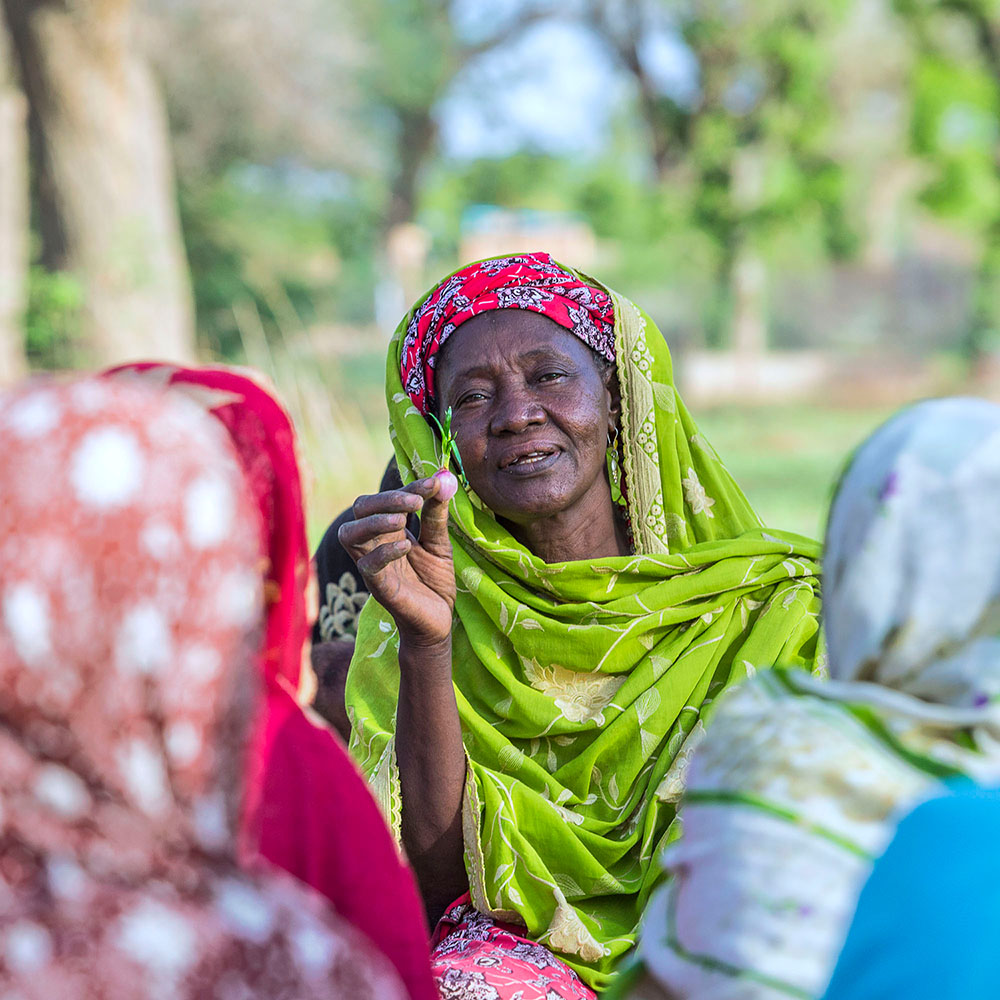

[A3.3] The World Food Programme (WFP) commits to supporting 10 million women and their families through their own financial accounts by 2030. WFP’s commitment to safely prioritizing women as recipients of assistance and sending money to their accounts is a strategic imperative to support women’s economic empowerment journey and secure better food security and nutrition outcomes for them, their families and their communities.
As of 2020, 850 000 women have received money on their own financial accounts.
By 2030, 10 million women will have received money on their own financial accounts.
When women have a financial account in their name, it opens up access to other financial services like loans, credit and insurance, giving them the means to better provide nutritious diets and increasing their opportunities to build a better future for their families. As the world’s largest provider of humanitarian cash transfers globally, the potential for impact is great.
Digital cash not only saves lives but does so efficiently. In Ukraine and Jordan, the World Food Programme (WFP) respectively saved USD 1.2 million and USD 200 000 annually in transfer costs by shifting transfers to people’s own accounts.
In 2024, 2.5 million women (preliminary figures) received cash transfers on their own accounts, with 69 percent of these funds sent via mobile money. Ukraine, Somalia and Jordan lead in sending money to women’s own accounts. Operations are increasingly transferring money in this fashion:
WFP’s efforts over the past years have focused on pioneering countries and learning hubs such as in Ghana, Haiti, Iraq, Jordan, Kenya, Somalia, Uganda and Ukraine, with a focus on advancing work with communities by addressing social norms, building digital financial literacy and engaging men as agents of change. Simultaneously, WFP collaborates with financial providers to expand services for women, and with policymakers to promote inclusive regulations and stronger consumer protections.
Currently, 53 percent of the people receiving money from WFP on their own accounts are women, mostly in female-headed households. WFP is committed to ensuring that in households with men and women, women also receive the transfers on behalf of their families.
In 2025, WFP will continue to support countries that have expressed commitments to prioritizing women to receive money on their account, while also supporting regional efforts. For instance, the Near East and North Africa region is raising funds to support 4 million women in this manner by 2030.
Required citation:
FAO. 2025. Commit to Grow Equality: investing in the future of women in agrifood systems – Progress report 2025. Rome. https://doi.org/10.4060/cd4123en
The designations employed and the presentation of material in this information product do not imply the expression of any opinion whatsoever on the part of the Food and Agriculture Organization of the United Nations (FAO) concerning the legal or development status of any country, territory, city or area or of its authorities, or concerning the delimitation of its frontiers or boundaries. The mention of specific companies or products of manufacturers, whether or not these have been patented, does not imply that these have been endorsed or recommended by FAO in preference to others of a similar nature that are not mentioned.
The views expressed in this information product are those of the author(s) and do not necessarily reflect the views or policies of FAO.
© FAO, 2025
Some rights reserved. This work is made available under the Creative Commons Attribution-NonCommercial-ShareAlike 3.0 IGO licence (CC BY 4.0: https://creativecommons.org/licenses/by/4.0/legalcode.en).
Some rights reserved. This work is made available under the Creative Commons Attribution- 4.0 International licence (CC BY 4.0: https://creativecommons.org/licenses/by/4.0/legalcode.en).
Under the terms of this licence, this work may be copied, redistributed and adapted, provided that the work is appropriately cited. In any use of this work, there should be no suggestion that FAO endorses any specific organization, products or services. The use of the FAO logo is not permitted. If a translation or adaptation of this work is created, it must include the following disclaimer along with the required citation: “This translation [or adaptation] was not created by the Food and Agriculture Organization of the United Nations (FAO). FAO is not responsible for the content or accuracy of this translation [or adaptation]. The original [Language] edition shall be the authoritative edition.”
Any dispute arising under this licence that cannot be settled amicably shall be referred to arbitration in accordance with the Arbitration Rules of the United Nations Commission on International Trade Law (UNCITRAL). The parties shall be bound by any arbitration award rendered as a result of such arbitration as the final adjudication of such a dispute.
Third-party materials. This Creative Commons licence CC BY 4.0 does not apply to non-FAO copyright materials included in this publication. Users wishing to reuse material from this work that is attributed to a third party, such as tables, figures or images, are responsible for determining whether permission is needed for that reuse and for obtaining permission from the copyright holder. The risk of claims resulting from infringement of any third-party-owned component in the work rests solely with the user.
FAO photographs. FAO photographs that may appear in this work are not subject to the above-mentioned Creative Commons licence. Queries for the use of any FAO photographs should be submitted to: photo-library@fao.org.
Sales, rights and licensing. FAO information products are available on the FAO website (www.fao.org/publications) and print copies can be purchased through the distributors listed there. For general enquiries about FAO publications please contact: publications@fao.org. Queries regarding rights and licensing of publications should be submitted to: copyright@fao.org.
Cover photograph: © FAO/Peter Safari; © Patrick Zachmann/Magnum Photo for FAO; © FAO/ Jafaar Al Merei; © FAO/Gilles Sabrie; © FAO/Javid Gurbano