

Introduction
Goals. The report, The future of food and agriculture – Drivers and triggers for transformation, aims at enriching the strategic thinking about, and inspire actions for, the necessary transformation that agrifood systems require, not only to progress towards FAO’s global objectives and SDGs of Agenda 2030, but also, and perhaps more importantly, move agrifood systems towards sustainability and resilience. Indeed, agrifood systems face uncertainties that give rise to serious questions and concerns regarding their current and future performances and sustainability. For this reason, countries, international organizations, civil society and academia are increasingly requesting authoritative foresight exercises that outline alternative scenarios and highlight potential pathways for food and agricultural systems.
Background. This report is grounded on a comprehensive Corporate Strategic Foresight Exercise (CSFE) that benefitted from various consultations, surveys and thematic work, notably: an Internal Expert Consultation (IEC), that engaged more than forty FAO experts at headquarters and in Decentralized Offices; a Staff Sample Survey (SSS) that involved around 300 randomly selected FAO staff, through which visions about possible futures were elicited; a call-for-papers, addressed to FAO’s technical divisions, which deepened the analysis of each of the drivers identified by the IEC; and an External Expert Consultation (EEC), that engaged representatives from civil society, academia, the media, the Informal Strategic Foresight Network of the United Nations High Level Committee on Programmes (UN HLCP), of which FAO is an active member, and the Futures Literacy Team of the United Nations Educational, Scientific and Cultural Organization (UNESCO), which coordinates this UN network. While providing the conceptual and technical backbone of this report, the findings of the above exercises contributed to the preparation of FAO Strategic Framework 2022–31. This report provides a thematic and technical deepening of the analyses of drivers, triggers and challenges provided by the CSFE in the Strategic Framework and proposes pointers on how to achieve the four aspirational “betters” of the Organization: better production, better nutrition, better environment and better life.1
Key drivers of agrifood systems and priority triggers for transformation. It was already clearly stated in the first report of the series, The future of food and agriculture – Trends and challenges, that “business as usual is no longer an option”. If agrifood systems remain on their current paths, the evidence points to a future characterized by persistent food insecurity, degrading resources and unsustainable economic growth. To trigger transformative processes to reverse these negative trends, it is imperative to understand which forces drive the pathways of agrifood systems, the way these forces interact, possible ways to shift their patterns, how to address trade-offs among different objectives that may emerge along transformative processes, and the actions needed to balance them in order to achieve desired objectives.
The CSFE identified 18 interconnected socioeconomic and environmental drivers, and the related trends that can shape the future of agrifood systems (see Figure 1.1, left-hand side part). This report analyses each of these drivers in detail, thanks to the contributions of the relevant FAO Technical Divisions. Throughout the report, the systemic nature of these drivers is underlined by highlighting their mutual linkages and interdependencies. The systemic approach adopted to investigate the future of agrifood systems also justifies the vast scope of the matters covered by the report. Refraining from considering and analysing key socioeconomic and environmental forces that are likely to influence the future patterns of agrifood systems is not advisable. Omitting some of them would have resulted in a simplistic and limited view of the complexity of agrifood systems, their mutual relationships with the broader socioeconomic and environmental systems, their causal linkages and dynamics.
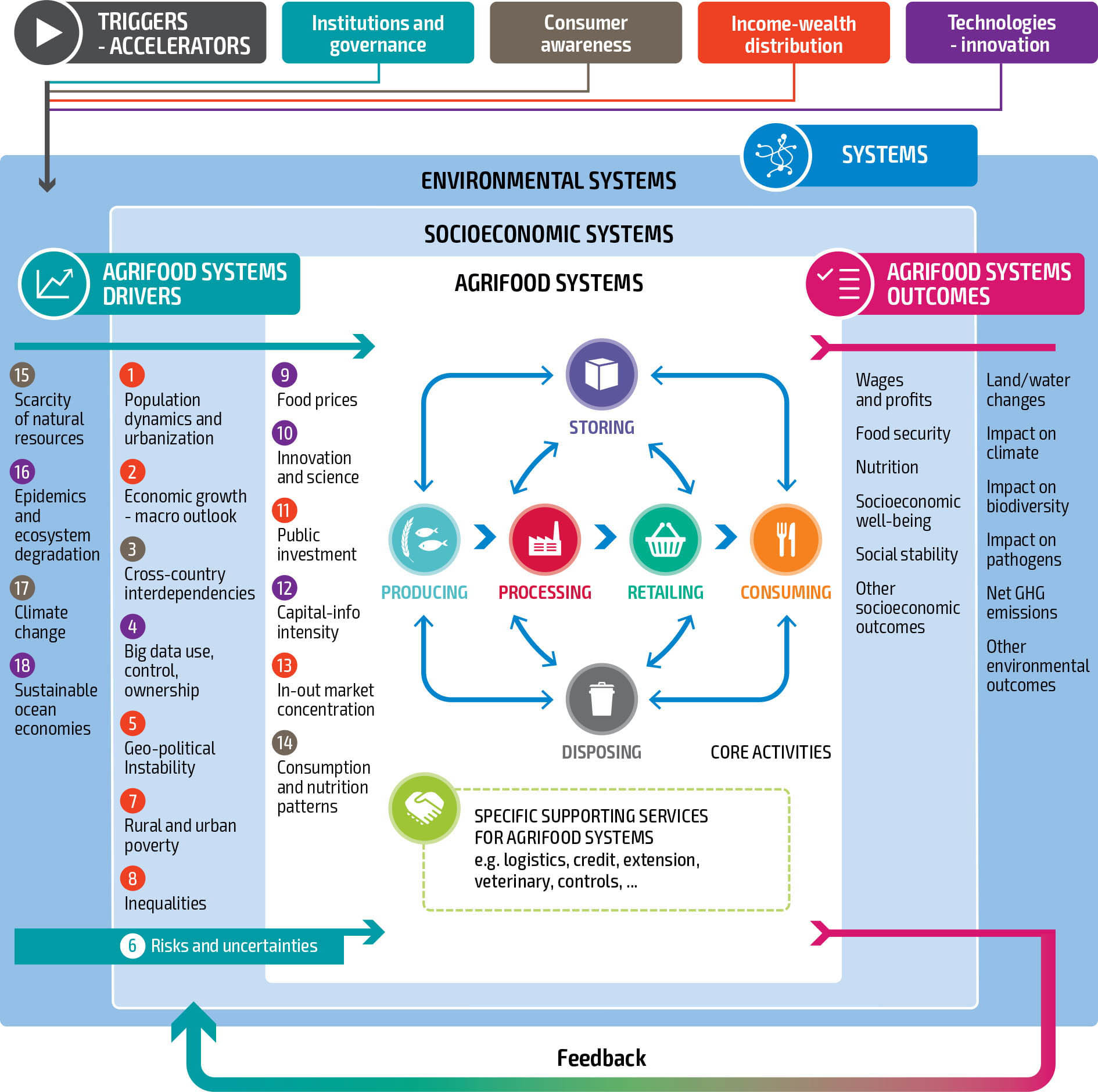
Source: Drivers and triggers based on FAO. 2020. Transforming agri-food systems in an evolving socio-economic, political, and environmental context. Report of the Internal Expert Consultation, June-October 2020. Corporate Strategic foresight exercise. Unpublished. Rome.
The CSFE also identified key families of “triggers of change” to be considered in this process. They are effective starting points or boosters (depending on the context) for transformative processes to move away from “business as usual”. These families of triggers include: i) institutions and governance; ii) consumer awareness; iii) income and wealth distribution; and iv) innovative technologies (see Figure 1.1, top part). These triggers, to be still further articulated, complemented and made context-specific, are expected to influence important drivers of agrifood systems (see Figure 1.1, right hand-side part). Given their potentially high transformative impacts, activating these triggers in the complex multilateral arena can be politically sensitive.