

Globally, evidence for the effectiveness of agri-environmental policies has to date been based primarily on national or subnational analyses, which vary in scope and methodology. To address this gap, a background paper by Wuepper et al. (2025)42 evaluated the impact of over 4 500 policies on cropland, grassland and forest conditions, while maintaining agricultural production across diverse economic and institutional contexts. The policies analysed include mandatory crop rotations, pesticide regulations and subsidies for sustainable land management on croplands; grazing limits and payments for ecosystem services on grasslands; and logging limits, protected areas and carbon credits on forest lands. Given the differences across land cover types in the outcome indicators that need to be measured to assess effectiveness, specific indicators are used (Box 24). These indicators can support the design of cost-effective monitoring frameworks for similar policies as they are publicly available data sources.
Box 24Synthesis overview of policies that improved land conditions
The background paper for this report, authored by Wuepper et al.,42 presents a unique global analysis of agri-environmental policies that have improved land conditions, drawing on empirical evidence combining remote sensing and other geospatial panel data. The findings synthesize research on how policies affect land conditions in cropland,96 grassland97 and forest land,98 while maintaining agricultural production.
Because of inherent differences across land cover types, the analyses adopt unique, albeit related, approaches. First, the land cover is identified spatially, then its condition is analysed through proxies including soil quality for cropland, bird biodiversity and protein production for grassland, and deforestation for forest land (see the table for details on how these were measured).
Policies were analysed using difference-in-difference (DiD) and difference-in-discontinuity (DiDC) methods. The DiD approach estimates changes in land condition trends by comparing countries before and after the introduction of a policy. The DiDC approach is similar, drawing on remote sensing data near international borders to estimate how policy affects border discontinuities in land condition trends over time.99, 100
Contextual factors are also assessed to understand how diverse economic and institutional landscapes hinder or enable policy impact. This includes examining country income, institutional capacity, property rights, enforcement stringency and median farm size to determine how they modify policy effects across contexts.
While filling a gap in the literature, especially for cropland and grassland, this synthesis has certain limitations. Remote sensing data are prone to measurement errors and lack information on many types of biodiversity and pollution. The policy data used in this analysis focus on specific types of policies and outcome indicators, excluding other types of policies (e.g. livestock support or trade policies) that also have an impact on land conditions. Additionally, causal effects from border-level DiD estimates may not be representative of the whole country, and therefore comparisons with other methods have been implemented in the background paper to corroborate findings and ensure robustness.
TABLE SUMMARY OF DATA
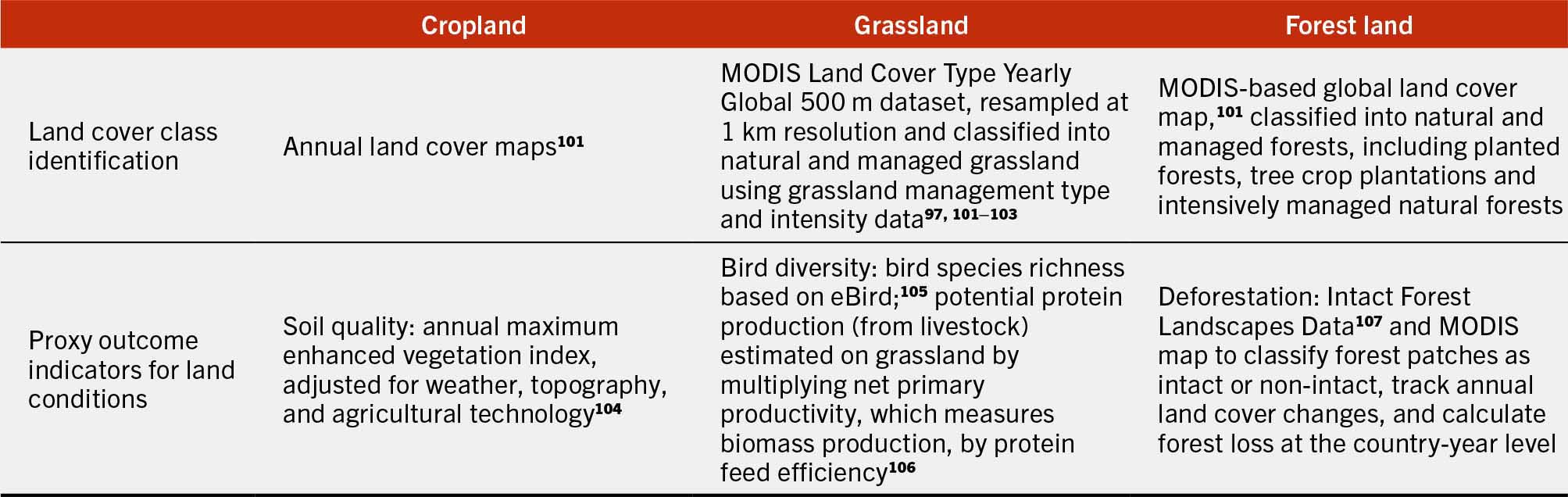
SOURCES: Authors’ own elaboration based on Wuepper, D., Homma, K., Dureti, G., Schioppa, A. & Clemence, S. 2025. Policies that improved land conditions – Background paper for The State of Food and Agriculture 2025. FAO Agricultural Development Economics Working Paper 25-15. Rome, FAO. Findings for cropland draw on Dureti, G., Hadi, H. & Wuepper, D. (forthcoming). Public policies have globally improved cropland condition; findings for grassland draw on Homma, K., Jinfeng, C., Hadi, C.P. & Wuepper, D. (forthcoming). Public land-use policies have improved biodiversity on the world’s grasslands. University of Bonn; findings for forest land draw on Homma, K., Hadi, C.P., Jäger, N., Driscoll, A., Mueller, N., Koch, N. & Wuepper, D. (forthcoming). Does public policy mitigate land conversion and therefore reduce carbon emissions globally? University of Bonn.
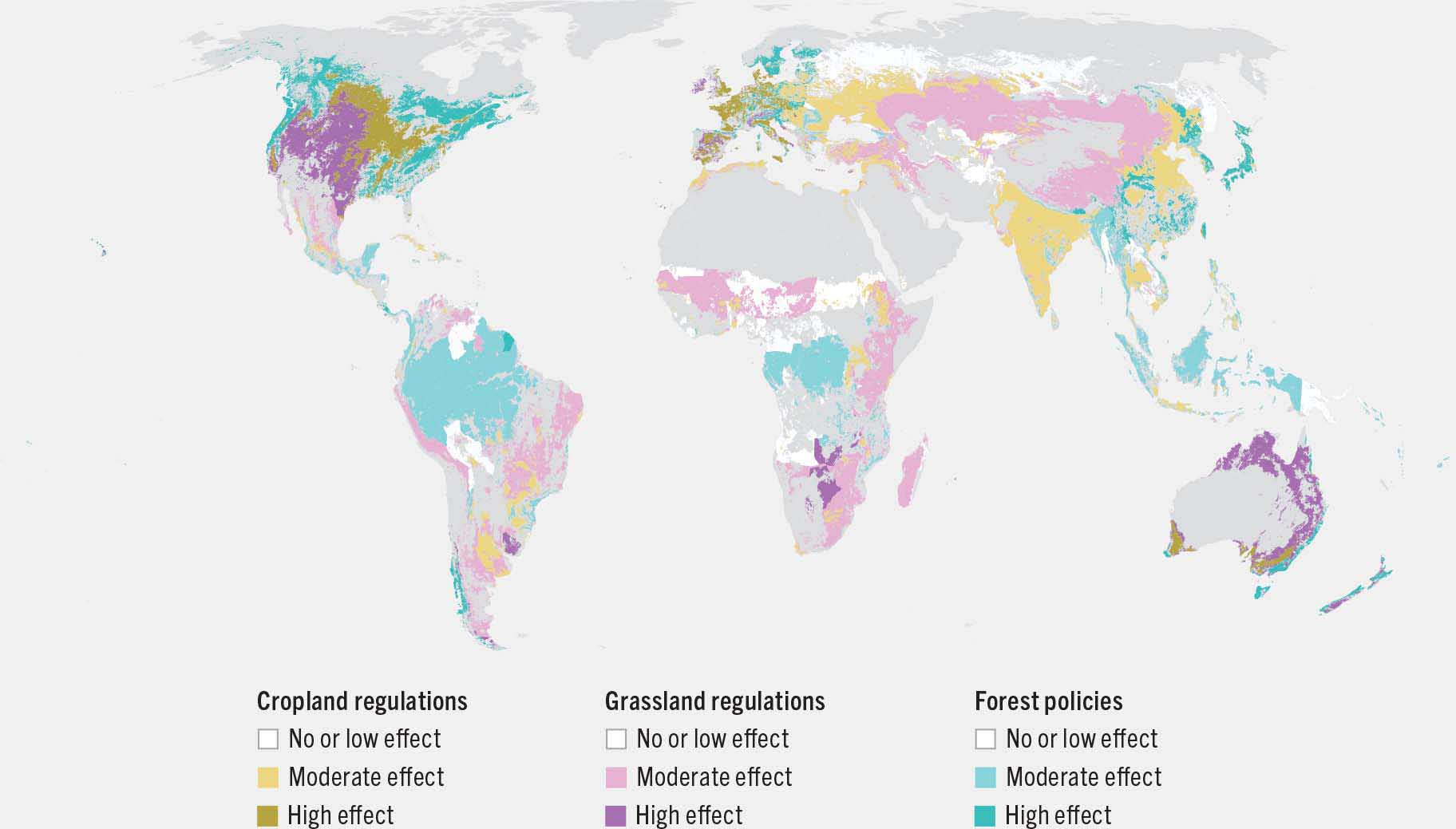
Figure 26 summarizes the results of this global analysis. Land-use regulations consistently emerge as effective instruments for improving land conditions. On average, each additional land-use regulation improved cropland soil conditions by about 2 percent, increased the species richness of threatened birds by about 6 percent, and reduced forest loss by about 10 percent.42 These findings align with broader evidence showing that regulations often improve land conditions by promoting sustainable land management practices, including forest conservation,35, 108 reduced grassland use intensity,97, 109 and the adoption of conservation agriculture techniques such as low or no tillage, crop rotation and soil cover.103, 110, 111 The trade-offs, however, need to be carefully managed. For example, while land-use regulations may be very effective in conserving biodiversity in grassland ecosystems, they may decrease potential protein production,97, 109 underlining the need to carefully balance conservation and production needs.
Figure 26 Potential effects of additional policymaking across countries and land cover types
SOURCE: Figure 16 in Wuepper, D., Homma, K., Dureti, G., Schioppa, A. & Clemence, S. 2025. Policies that improved land conditions – Background paper for The State of Food and Agriculture 2025. FAO Agricultural Development Economics Working Paper 25-15. Rome, FAO.
Agri-environmental payments also show positive impacts, though with greater variability. They are particularly effective in forest conservation35, 97, 108 and contribute to improved cropland conditions at the global level.96 However, they have on average proven ineffective for grassland biodiversity.97 Globally, payment schemes are estimated to be as effective as regulations for forest conservation, and about half as effective for croplands. In some contexts, combining payments with regulations yields better outcomes. For example, in Switzerland, payments linked to management extensification have improved biodiversity in grasslands.41, 68 In China, reductions in sheep numbers under payment schemes have improved grassland quality, particularly on large farms in Inner Mongolia.86, 87 A key challenge, however, is that payments are often voluntary and, if monitoring frameworks are weak, they may be disbursed even without substantial management change.
Policies targeting use of inputs (e.g. fertilizers, pesticides) and broad regulations on habitat or biodiversity showed the least impact on soil quality measured by the enhanced vegetation index in the global analysis.42 However, this finding should be interpreted with caution, as an important goal of such regulations is to address environmental pollution externalities beyond croplands, and these were not assessed in this study. Agricultural inputs are also often less relevant for other land cover types.96 For instance, an action plan in northeast China reduced fertilizer use intensity by nearly 12 percent and improved soil conditions.112 The limited effectiveness of habitat and biodiversity regulations may reflect their broad scope and lack of targeting.
Overall, approaches that combine regulatory and incentive-based instruments offer strong potential to improve land conditions. Their effectiveness depends on careful tailoring to land cover types and local contexts. In croplands, for example, regulations can be complemented by payments supporting biodiversity in non-productive landscape features such as hedgerows or stone walls. In forests, combining legal protections with recognition of Indigenous Peoples’ land rights and enforcement mechanisms has proven effective.35, 108 Ultimately, a context-specific approach that combines policy instruments – tailored to local economic and institutional realities – is essential for improving land conditions.


