

Land degradation is one of three interconnected global challenges cited by the United Nations Rio Conventions, but it is less well understood than both climate change and biodiversity loss.22 This is due in part to its multiple definitions, as well as to the many different approaches to measurement. For example, there are disagreements over how to define baselines, which makes it challenging to agree on the extent of global land degradation across different biomes.5 This complexity is compounded by the use of varying indicators to measure land degradation by different working groups and intergovernmental panels within the United Nations system.23
Despite these challenges, the critical importance of addressing land degradation is widely recognized. It forms the basis of SDG Target 15.3, which aims to “combat desertification, restore degraded land and soil, including land affected by desertification, drought and floods, and strive to achieve a land degradation-neutral world”. Furthermore, there is clear consensus that avoiding, reducing and reversing land degradation all play a highly synergistic role in achieving the majority of the SDGs.5
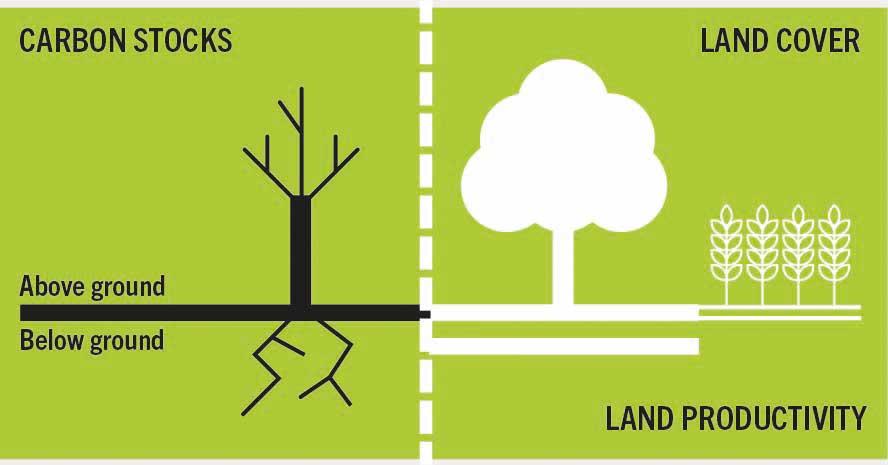
Three specific sub-indicators are used for the purposes of reporting on SDG Indicator 15.3.1 (Proportion of land that is degraded over total land area): 1) trends in carbon stocks (above and below ground); 2) trends in land cover; and 3) trends in productivity (Figure 6). A significant negative change detected in any one of the three sub-indicators – using a specific threshold or statistical decreasing trend – is used to define land as degraded.24 Trends in carbon stocks (identified by measuring soil organic carbon [SOC] above and below ground) reflect slower changes that suggest a trajectory over time; trends in land cover address land conversion; and trends in productivity capture relatively fast changes in land-based natural capital.25 In recognition of the difficulty in measuring these biogeochemical processes, which are largely context-specific, the SDG reporting guidelines provide a wide variety of options for locally calibrated measurements.24
Figure 6 Key indicators of land degradation tracked by SDG Target 15.3
A truly holistic approach to assessing global trends in land degradation would capture all physical, chemical and biological processes that lead to degradation. One way to express land degradation in a globally consistent way is in terms ofland degradation debt.23 A debt-based approach is based on the difference between each land degradation indicator’s current value and the conditions that would be observed without human activity. It is thus possible to distinguish between human-induced degradation and natural degradation and quantify the former. While reversing all human activity is neither feasible nor preferable, the quantification of the global total cost of human-induced land degradation is a first step to identifying and prioritizing activities that can move the needle towards land degradation neutrality objectives.
The choice of baseline is crucial, as it determines whether a specific piece of land is classified as degraded. United Nations Convention to Combat Desertification reporting guidelines for SDG Target 15.3 require the use of a baseline period that covers the years from 2000 to 2015, against which reporting periods are compared.24 However, the use of native/natural conditions as the baseline provides a more long-term understanding of global historical land degradation and highlights the importance of more ambitious goals for restoration.23 Areas where land has been degraded for a long time, due to unsustainable agriculture or other human activity, would otherwise remain undetected, introducing bias into global efforts to achieve land degradation neutrality. Furthermore, using the native/natural state as a baseline is also perceived to be fairer, as countries where the ecosystems were transformed centuries ago can be identified and incentivized to set more ambitious restoration goals, which would not be possible with a recent baseline.5 Figure 7 illustrates the concept of baselines in relation to agricultural history.
Figure 7 Agricultural history in relation to options of land degradation baselines



