

The socioeconomic impacts of yield gaps will likely be concentrated in poor and food-insecure regions of the world, heightening the implications of documented losses for global food security.62, 63 Strategies to address the interconnected drivers of land degradation would benefit from a better understanding of these socioeconomic vulnerability hotspots, where DIYL and ACYG overlap with poverty and food insecurity. The increasing availability of global geospatial data on population structures and socioeconomic indicators facilitates the assessment of such hotspots to identify potential policy entry points.
Populations exposed to degradation-induced yield losses and all-cause yield gaps
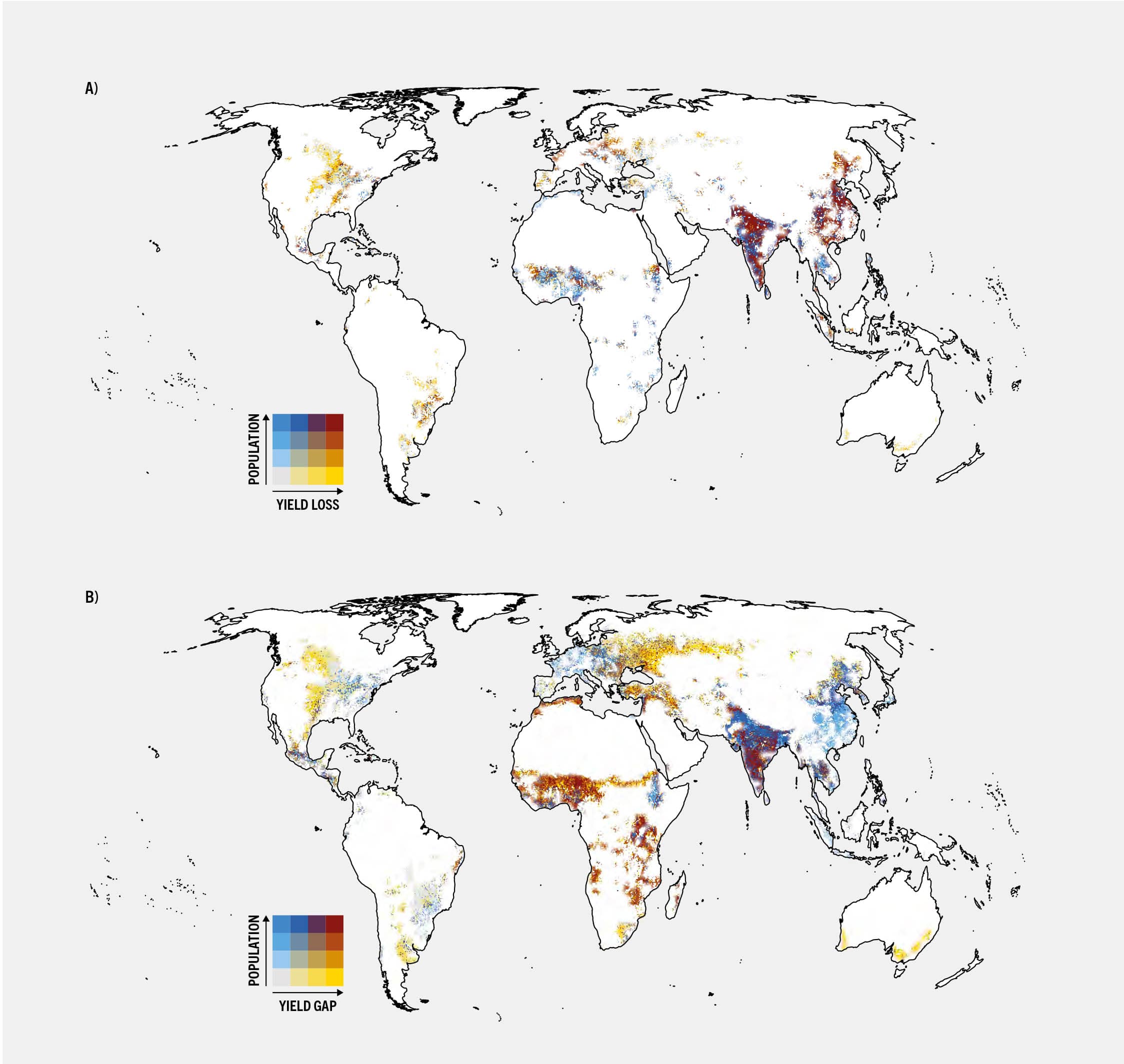
Population hotspots exposed to DIYL and ACYG are shown in Figure 10. Panel A indicates the global distribution of the 1.7 billion people living on land presenting a strong causal link between human-induced cropland degradation and yield loss. The largest affected populations are in Eastern and Southern Asia. Directly addressing the causes of degradation indicators measured here (increases in SOC, erosion and water debts) would decrease yield losses for 1.1 billion people, even if other drivers of yield gaps (e.g. inputs, technology) remain unchanged. Where food insecurity is high, interventions to close yield gaps to increase local food availability and to address other pillars of food security are of particular importance.
Figure 10 Population hotspots exposed to degradation-induced yield losses and all-cause yield gaps
SOURCE: Hadi, H. & Wuepper, D. 2025. A global yield gap assessment to link land degradation to socioeconomic risks – Background paper for The State of Food and Agriculture 2025. FAO Agricultural Development Economics Working Paper 25-16. Rome, FAO.
The relatively small yield gaps observed in parts of Asia reflect a partial masking of the impacts of land degradation linked to the widespread implementation of intensive agricultural practices. The most important of these practices is excessive use of chemical fertilizers – a key driver of soil degradation. Application rates in many cropping systems significantly exceed the recommended sustainable amounts. While it may make perfect economic sense for private landholders to overapply fertilizers (especially in cases where affordability is not an issue or input subsidies are in place), this practice leadsto serious soil health issues, including deep cumulative acidification, salt buildup, poor nutrient use efficiency (often just 30–40 percent), and diffuse pollution from nitrogen and phosphorus runoff.64, 65 These types of degradation outcomes are not measured herein; however, if addressed, they would bring private long-term benefits. The exception is pollution, which constitutes an environmental externality, hence mostly public benefits if addressed.
Smallholders that have access to fertilizers are likely to disproportionately overapply them. This tendency is a result of limited access to complementary fixed inputs (e.g. quality seed, machinery), but it is also a risk-averse strategy adopted to safeguard yields in the face of limited capacity to absorb economic or climatic shocks.64, 66, 67 Such unsustainable intensification can be addressed by optimizing fertilizer types and amounts, improving nutrient use efficiency, and shifting to precision or integrated nutrient management. Adoption of these approaches would reduce yield gaps and improve resilience, while simultaneously reducing the environmental burden of degraded soils.
Panel B of Figure 10 shows the population exposed to all-cause yield gaps. The difference between the two panels is particularly notable in sub-Saharan Africa, due to the region’s very high exposure to ACYG. However, in most cases, cropland degradation is not the underlying driver of yield gaps. As discussed above, a variety of factors – including limited use of modern inputs and mechanization, lack of locally adapted agricultural technologies, and market imperfections impeding adoption – drive yield gaps in the region.58–61 To close yield gaps in sub-Saharan Africa and in other regions facing similar challenges, it is necessary to address these issues while ensuring no worsening of land degradation. For example, fertilizer subsidies should be designed so as to avoid overuse.66
Poverty and stunting under yield gaps
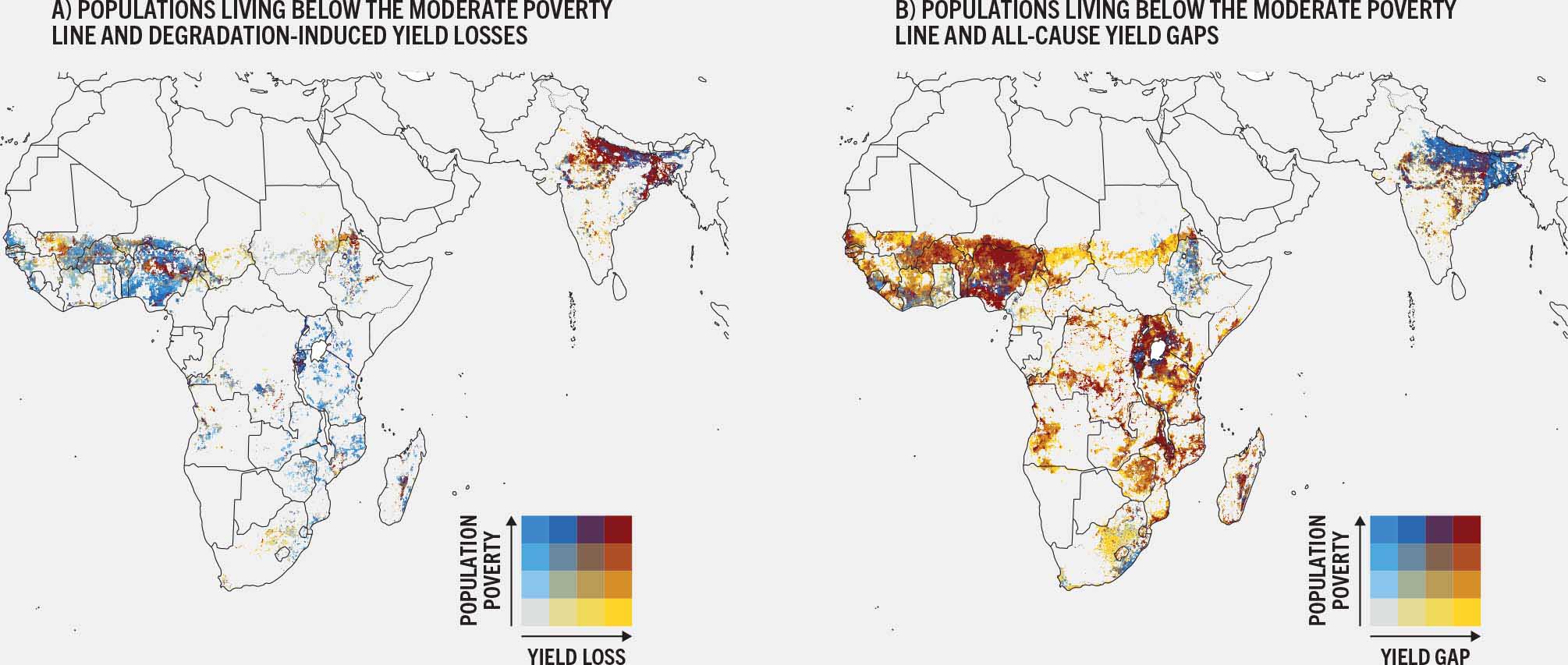
In the absence of high-resolution global poverty maps, the background paper for this report uses georeferenced well-being indicators, drawn from Atlas AI, for 40 countries of sub-Saharan Africa and Southern Asia.a, 68 Figure 11 shows the overlap between populations living below the moderate poverty line (3.20 purchasing power parity dollars, 2011) and DIYL (Panel A) and ACYG (Panel B). The most significant situations of DIYL overlap strongly with poverty in the Indo-Gangetic Plain, making this region a primary hotspot for prioritizing land degradation interventions as part of combined efforts to achieve SDGs 1, 2 and 15. In sub-Saharan Africa, such hotspots include parts of Eastern and Western Africa.
Figure 11 Poverty, degradation-induced yield losses and all-cause yield gaps for sub-Saharan Africa and Southern Asia
SOURCE: Hadi, H. & Wuepper, D. 2025. A global yield gap assessment to link land degradation to socioeconomic risks – Background paper for The State of Food and Agriculture 2025. FAO Agricultural Development Economics Working Paper 25-16. Rome, FAO.
The significant overlap between poverty and all-cause yield gaps, documented in Panel B of Figure 11, once again highlights the importance of primary drivers of low yields other than cropland degradation debts in sub-Saharan Africa.
Hadi and Wuepper (2025)39 also identify that among the 1.7 billion people living on land with significant DIYL, 47 million are children under 5 years of age suffering from stunting – a key indicator of SDG 2 to end all forms of malnutrition. Overlaying land degradation-related yield losses with gridded stunting data reveals yet another type of socioeconomic vulnerability hotspot. Populations most affected by stunting in these hotspots are concentrated in Southern and South-eastern Asia, and in North-East Africa.39


