

As human-induced land degradation is a consequence of decisions regarding land use and land management, it can be helpful to deconstruct the numerous drivers that influence these decisions at local, national and global levels. Agricultural land use refers to whether a piece of land is used for crops, pastures or forests. Land management, on the other hand, refers to how the activity within a given land-use category will be implemented (e.g. through adoption of sustainable practices or otherwise).
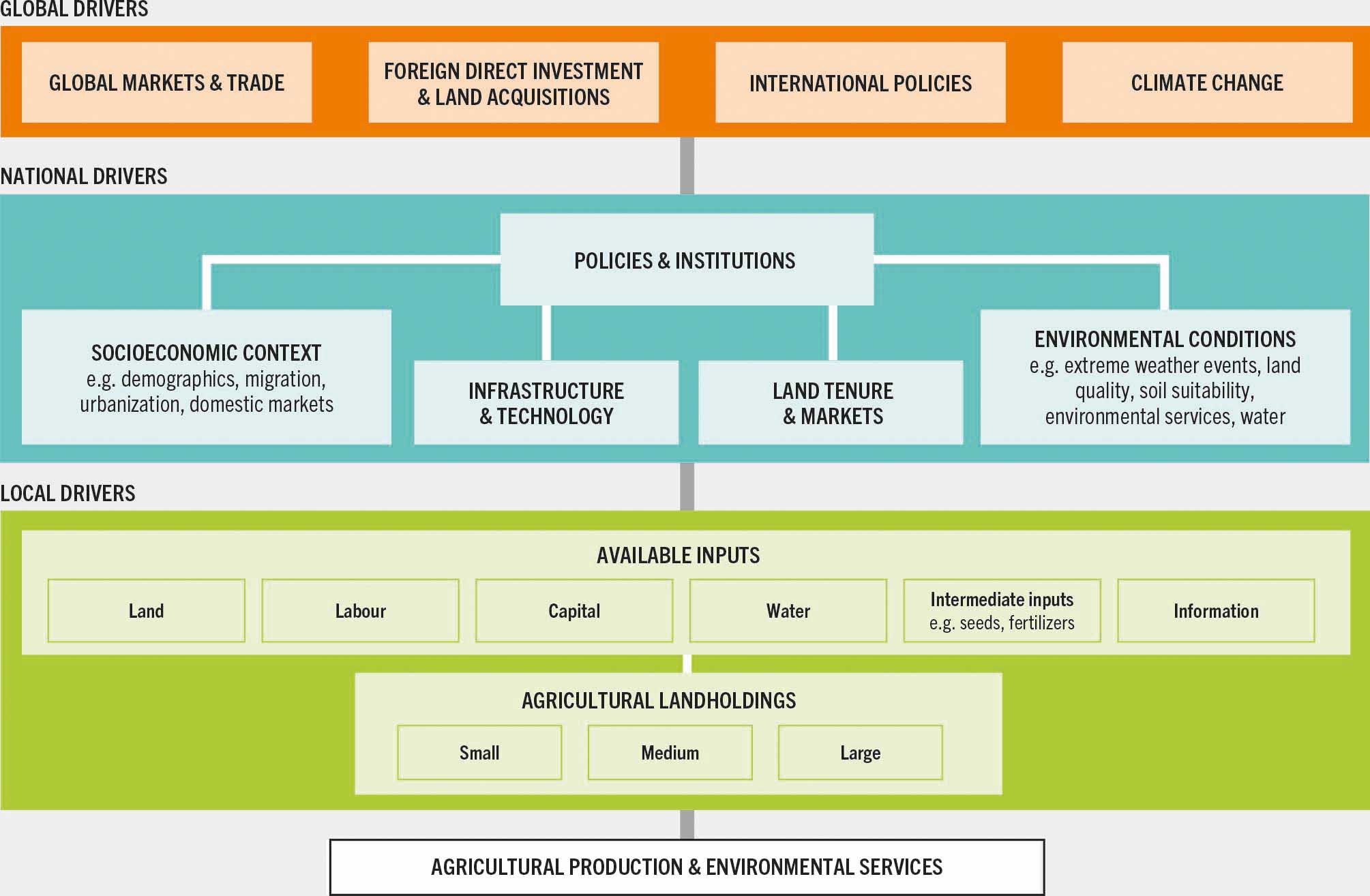
Figure 5 shows the web of drivers that can incentivize or constrain sustainable land use and management decisions. These drivers are grouped at global, national and local levels for the sake of simplification, although they interact dynamically. For example, climate change – a global driver – interacts with national and local drivers to influence both land-use and land management decisions. When yields on existing croplands decrease due to higher temperatures or erratic rainfall, farmers may resort to converting forests or grasslands into cropland, contributing to degradation due to land-use change; alternatively, they can decide to use sustainable land management technologies such as agroforestry to maintain soil moisture and fix nitrogen to boost yields despite climate change. Conversely, unsustainable forms of land use and management at local or national level can increase carbon emissions, further exacerbating climate change globally.
Figure 5 Drivers of agricultural land use and management
SOURCE: Authors’ own elaboration.
Global influences on local decisions
Global drivers of land use and management are felt locally, influencing the agricultural context in which farmers make their decisions through several mechanisms. Global markets and trade comprise one such mechanism: they allow countries to draw on the land and other resources of exporting nations to meet their food needs, acting as a virtual land trade. Many countries depend on trade because of natural resource constraints.73 Trade also expands the impacts of national dietary transitions, as changing consumption patterns in one region influence production systems in another.6, 74
Foreign direct investment and land acquisitions also influence decisions on how land is used and managed. Foreign direct investment involves companies establishing or acquiring operations abroad to expand long-term business interests. Land acquisitions refer specifically to the purchase or long-term lease of land for agricultural, commercial or industrial purposes, often leading to shifts in land use. Both mechanisms can lead to significant shifts in land-use patterns.
International policies and agreements shape land use by promoting shared goals and coordinated action. For instance, under the United Nations Convention to Combat Desertification (UNCCD), 131 countries are working towards achieving land degradation neutrality by 2030 – some through formal commitments with national targets, others by developing strategies and assessing their land conditions.75
Climate change is another global driver that alters weather patterns, growing seasons and land suitability, often leading to land degradation.2 In response, farmers adapt by changing production practices, crops and inputs, as well as increasing area planted.76 Innovations for adaptation (e.g. climate-resilient crops) and mitigation (e.g. improved livestock management) shape decisions across the globe. Beyond impacts on how land used for food production is managed, climate change increases demand for land for biofuels, renewable energy and carbon capture sequestration affecting land use.
Although these global drivers may appear a long way from farm-level decisions, they can result in locally experienced sustainability stressors including land degradation.77 For example, international trade is estimated to account for 21–37 percent of global land use and 17–30 percent of biodiversity loss.78 While trade enhances global resource use efficiency, rising demand for resource-intensive exports (e.g. oilseeds, beef)6 may lead to local resource depletion.79 The growing disconnect between the consumption of food and the land from which it comes, exacerbated by global trade, presents a new challenge to the sustainable management of land systems.80
National contexts shape farmers’ options
At the national level, policies and institutions – or the absence thereof – shape the overall context in which land use and management decisions are made. Government agencies such as ministries of agriculture, environment and forestry, land registration offices, urban planning authorities and enforcement bodies (for land inheritance and environmental regulations) play key roles, with often overlapping mandates. These institutions shape the overall socioeconomic context of land use and condition access to infrastructure and technology. They implement policies that can directly influence land use (e.g. conservation programmes, urban development), land management (e.g. input subsidies, extension) and land distribution (e.g. land titling, tenure reforms), or indirectly affect investment incentives through land, credit and insurance markets. Furthermore, they influence the response to extreme environmental conditions.
Socioeconomic context
The socioeconomic conditions of a country play a critical role in shaping land-use decisions. Demographic trends, including population size, age and gender distribution, migration, and urbanization, influence both labour availability and land pressure. Global population growth rates have shown a sharp decline – albeit with significant regional variation – which may reshape pressure on natural resources.65
Recent socioeconomic trends represent a departure from historical patterns. While population growth has long been a key driver of global food demand and land pressure, economic development and rising per capita incomes are now the main drivers.6, 74, 81 Slowing global population growth, combined with rising economic growth, incomes and urbanization, is shifting food demand towards more resource-intensive foods such as meat, dairy and processed foods.6, 7, 74
In particular, urbanization affects land-use decisions through multiple pathways. There are both indirect impacts through changing diets (mentioned above) and direct impacts through demand for land with implications for land availability, prices and land-use dynamics along the urban–rural continuum. Box 3 presents evidence from France that proximity to intermediate and large cities is associated with higher agricultural land prices.
Box 3Influence of urban proximity on agricultural land prices in France
Land prices are a critical factor in land-use decisions, reflecting both expected returns from land-based activity and underlying land scarcity. Yet, due to limited data availability, these prices are often represented by proxies such as market accessibility or are omitted entirely from analyses.82 Reliable, spatially explicit farmland price data remain rare, especially in rural and low-income regions. Even in high-income countries, research typically focuses on either urban or rural land markets, overlooking transitional zones such as city fringes where both markets interact. Public land transaction data, when available, are often aggregated or commercialized.83
France stands out as a rare exception. Its Land Development and Rural Settlement Agency (SAFER) publishes the Les Prix des Terres map, providing open access, spatially explicit farmland price data at the subnational level, disaggregated by land use (e.g. arable, pasture, vineyard).84 It also reports the number of land acquisitions at the commune level, enhancing transparency on both prices and market activity.
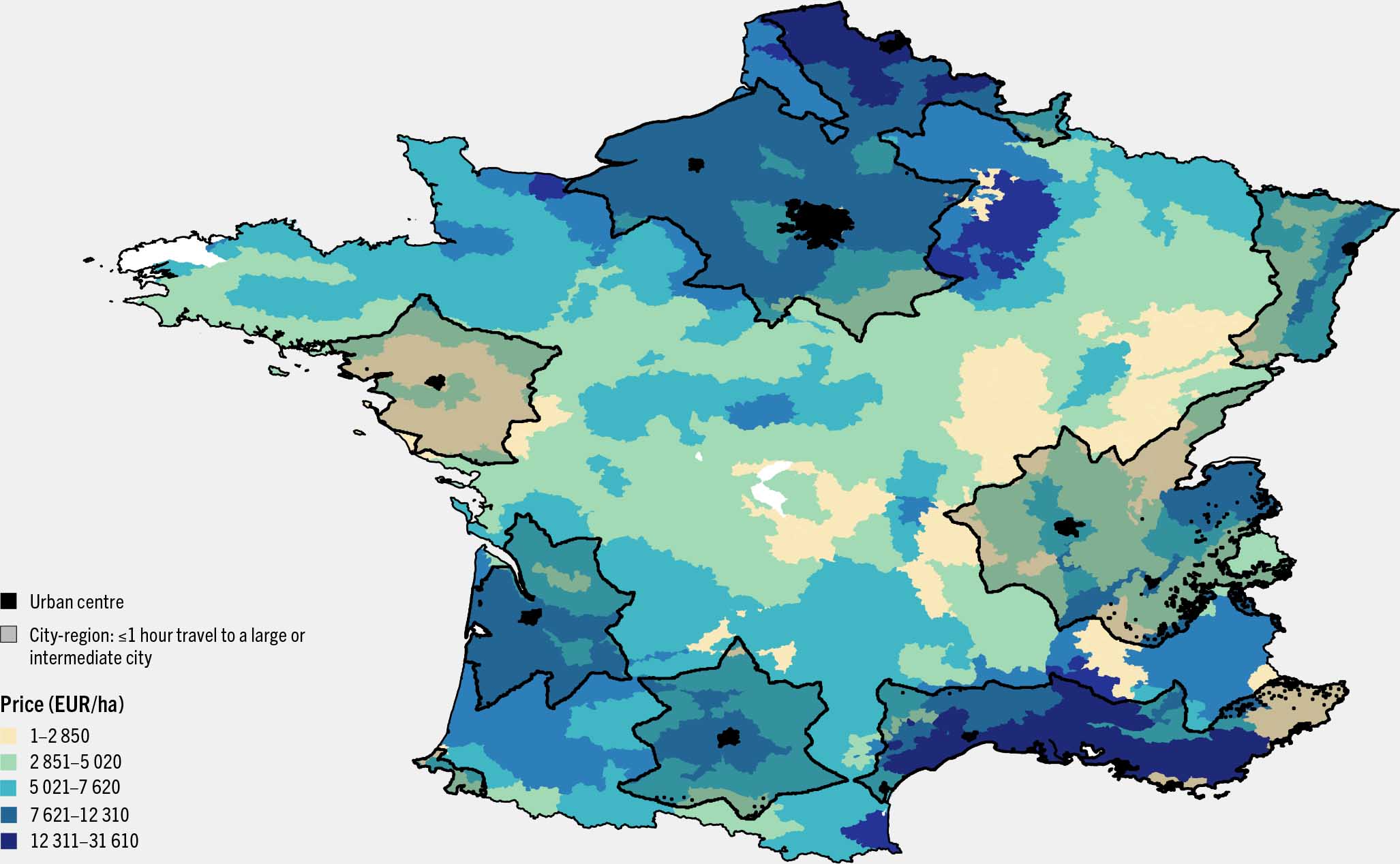
Overlaying such price data with a spatial dataset that defines city-regions, particularly the framework developed by Cattaneo et al.,85 can shed light on how proximity to urban areas of different sizes affects farmland prices. Research suggests that farmland near cities tends to be more expensive due to improved market access, healthy soils and the potential of land conversion for high-value residential or commercial uses.86, 87
Exploratory regression analysis at the agricultural region level controlling for departmental fixed effects* finds that farmland closer to intermediate and large cities is, on average, EUR 1 230 more expensive per hectare.** This is a meaningful increase when compared with departmental averages, which range from EUR 2 370 to EUR 15 590 per hectare. Furthermore, half of all departments have prices below EUR 6 000 per hectare, making a EUR 1 230 difference equivalent to an increase of more than 20 percent.
While many factors influence land values, ranging from land quality, local market and economic conditions to regional land-use regulations, the analysis suggests a correlation between urban proximity and higher farmland prices. Future research can build upon this analysis by incorporating place-specific data and narratives to provide more grounded geographic insights into city-regions and land prices.
FIGURE AGRICULTURAL LAND PRICES AND PROXIMITY TO CITY-REGIONS
SOURCES: SAFER. 2025. Le prix des terres [Farmland prices]. [Cited 22 April 2025]. https://www.le-prix-des-terres.fr; Cattaneo, A., Girgin, S., de By, R., McMenomy, T., Nelson, A. & Vaz, S. 2024. Worldwide delineation of multi-tier city-regions. Nature Cities,1(7): 469–479. https://doi.org/10.1038/s44284-024-00083-z
Domestic markets, such as those for food, agricultural inputs, credit and insurance, also shape land-use decisions by creating incentives or disincentives for producers. When markets are imperfect or missing, decision-makers face constraints that reduce production efficiency.88–91 Moreover, producers are less likely to adopt sustainable land management technologies that can maintain or improve soil health, creating a vicious cycle of low yields, land degradation and agricultural expansion.
Infrastructure and technology access
Infrastructure plays a foundational role in supporting agriculture by providing essential services such as roads, irrigation systems, storage facilities and internet connectivity. These elements improve farmers’ access to markets, reduce production and transaction costs, and contribute to greater productivity and sustainability.14, 92 However, the expansion of infrastructure can also have unintended consequences: in some cases, it may encourage unsustainable intensification and lead to land degradation.
Similarly, access to technology offers significant potential to optimize land management. Innovative tools and practices can enhance input use efficiency and boost productivity, helping to make agriculture more sustainable. For technology to be effective in this role, it must be accessible, inclusive, and adapted to local conditions, in addition to suitable for farms of all sizes.25
Policies and institutions play a crucial role in enabling these advancements. By supporting investments in agricultural research and development, and by ensuring that technologies are widely available and beneficial to diverse stakeholders, they help lay the groundwork for agricultural growth and structural transformation.67
Land tenure and land markets
Land tenure, encompassing both formal regulations and informal rules, defines how individuals and groups access, use and control land.93 Secure land tenure reduces risk and uncertainty, encouraging investment in land productivity and the adoption of sustainable practices.35, 94–96 In some contexts, informal and customary tenure arrangements, particularly over communal lands, can also support the protection of ecosystem services; this is especially so where Indigenous Peoples and other traditional communities have a long-established relationship with land and place a high value on its sustainable use and preservation.97 However, when such tenure is not formally recognized, it can expose communities to socioeconomic and environmental risks, and lead to conflict.98, 99 Box 4 describes the importance of land tenure and governance for sustainable land management and food security.
Box 4Land tenure enables land stewardship and food security
Tenure rights shape access to land, investment choices and agricultural productivity. Secure tenure rights – whether of individual holdings or community-held areas – can play a key role in stimulating investment in adoption of sustainable land management practices, while maintaining the collective resource management systems that underpin food production. Conversely, when land rights are unclear or contested, holdings and communities may face restrictions on land use, displacement, or reduced long-term planning capacity, all of which can negatively affect food security. While tenure security alone does not guarantee food security, it is an essential enabler, especially when combined with broader supportive economic, infrastructural and environmental conditions.113, 114
Globally, pressures on land resources are estimated to undermine the well-being of over 3.2 billion people.115 Land consolidation and fragmentation are placing particular strain on the rural poor in low- and middle-income countries, threatening their access to land and livelihoods. In this context, secure tenure rights play a crucial role in protecting farmers from displacement and ensuring continued access to productive land, thereby bolstering food security.97 Research also shows that secure tenure can contribute to dietary diversity and improved nutrition. In Uganda, for example, the dietary diversity of women of reproductive age was positively correlated with tenure security.116 Secure land tenure is also linked to greater private investment and can facilitate access to credit and insurance, though this also depends on broader institutional capacity.117
Global governance of land tenure is evolving to address these challenges. The Voluntary Guidelines on the Responsible Governance of Tenure of Land, Fisheries and Forests (VGGT), adopted by the Committee on World Food Security in 2012, offer a widely recognized framework for improving tenure governance, focusing on transparency, equity and the protection of vulnerable groups.93 However, implementation remains uneven. Encouragingly, integration of the VGGT into the United Nations Convention to Combat Desertification (UNCCD) and its Land Degradation Neutrality (LDN) targets in 2012 marked a critical step in embedding tenure into land degradation policy. This process has been advanced by a joint FAO-UNCCD initiative which produced a technical guide to support application of the VGGT in the context of LDN implementation, promoting tenure-responsive land restoration and sustainable land governance.115, 118 In 2024, land tenure was further adopted as a headline indicator under Target 22 on traditional knowledge at the Sixteenth meeting of the Conference of the Parties to the Convention on Biological Diversity, institutionalizing land tenure within biodiversity strategies and monitoring frameworks.
Building on this momentum, FAO is preparing a new report, The status of land tenure and governance,119 which will synthesize current evidence, identify key trends and challenges, and outline strategies to strengthen governance and secure tenure rights. The report will highlight the role of collectively managed lands held by Indigenous Peoples and other communities with customary tenure, which cover vast amounts of land. Despite their social and ecological importance, most of these lands remain without legal recognition. Protecting these rights is essential not only to preserving biodiversity and mitigating climate change, but also to ensuring food security and livelihoods.
Closely linked to tenure systems are land markets, which influence how land is allocated and used. Both rental and sales markets shape the type and intensity of agricultural management practices, as well as the conversion of agricultural land to other uses (see Box 16 in Chapter 4). Transparency in land rights and markets conveys clear price signals, facilitates the efficient allocation of land to more productive users, and encourages investment in sustainable land management. Conversely, poorly functioning or opaque land markets can hinder these transfers, weaken credit and insurance systems, and ultimately erode incentives for sustainable land management.88, 100, 101 Thus, the structure and accessibility of land markets are integral to the broader dynamics of land governance and sustainability.
Collective and customary land rights are essential for Indigenous Peoples as they reflect deeply rooted cultural, spiritual and biocentric relationships with land and ecosystems. These customary systems, often operating through collective tenure arrangements, enable Indigenous Peoples to contribute to “overcoming the combined challenges of climate change, food security, biodiversity conservation, and combating desertification and land degradation”.2 When customary rights are not formally recognized, displacement and dispossession can lead to environmental degradation.
Gender inequalities in land rights, access to resources, and decision-making further complicate these dynamics. Women often face weaker tenure security than men, limiting their ability to invest in long-term land improvements. In Malawi, for example, short-term informal tenancy contracts and gender-biased customary inheritance practices have reduced investments in soil conservation.102 Similarly, in Ghana, complex land tenure arrangements tend to increase women’s tenure insecurity, undermining women’s ability to adopt both short- and long-term land conservation practices.103
These challenges are reflected in global data. Women are less likely than men to own land, particularly agricultural land. In 43 out of 49 countries with data on SDG Indicator 5.a.1, men in agricultural households are more likely than women to own or have secure rights to land. In nearly half of these countries, the gender gap in landownership exceeds 20 percentage points. Surveys on tenure insecurity perceptions consistently show that women report higher levels of tenure insecurity in cases of divorce or death of a spouse.104 Although sex-disaggregated data on the share of land owned by women (jointly or individually) compared to men are limited, evidence from six sub-Saharan African countries shows that women own less land and are less likely to be sole owners.105 Furthermore, case studies also show that female farmers tend to access lower-quality land than their male counterparts.106
Despite these disparities, evidence from several countries indicates that strengthening women’s land rights can lead to more sustainable land management. In Benin, for example, land formalization increased long-term investments and decreased the difference between male- and female-headed households’ use of fallowing to restore soil fertility.107 An impact evaluation of Rwanda’s pilot land regularization programme revealed a significant improvement in women’s land access, including inheritance rights; the programme also boosted soil conservation investments, especially among female-headed households previously subject to greater tenure insecurity.108
Beyond legal access, women’s ability to manage land sustainability is shaped by structural inequalities that limit their decision-making power, increase their labour burdens, and influence their knowledge and preferences. These challenges can undermine soil health.109 Yet, when women own land, crop diversity and household food security improve significantly, as demonstrated by evidence from Ecuador and Peru.110, 111 These benefits are even more pronounced when women from low-income farming households are actively involved in decision-making, as observed in Burkina Faso, India, Malawi and the United Republic of Tanzania.112
Nevertheless, women’s land rights remain weak in many countries, despite their recognition in international frameworks such as the Convention on the Elimination of All Forms of Discrimination against Women (CEDAW) and the SDGs (Targets 5.a and 1.4). Box 5 examines the legal barriers that continue to restrict women’s land rights and limit their ability to benefit from land-based opportunities.
Box 5Legal barriers to women’s land rights: gaps, implications and opportunities for reform
Despite growing recognition of the importance of equality between men and women for land governance, legal protections for women’s land rights remain limited and uneven across countries. SDG Indicator 5.a.2 evaluates whether laws guarantee women’s rights to own, use, inherit and register land, and whether they ensure women’s participation in land-related decision-making. Among 91 reporting countries, only 26 percent score high on legal protections, while 49 percent have few or no measures aligned with international standards.
Legal gaps are widespread across all components of the indicator, underscored by a clear lack of enabling provisions – such as those supporting positive measures to promote gender equality in land rights – or provisions that strengthen women’s rights and participation in family and customary land matters (see figure). Thirty-eight percent of countries lack adequate legal provisions to ensure equal inheritance rights for men and women, and boys and girls, with many of these gaps rooted in religious or customary laws.
In many contexts, discriminatory practices persist despite formal legal recognition of women’s rights. For example, in 44 percent of countries, husbands can sell jointly owned land without consent, and only 31 percent of countries require joint registration of land. Among the countries recognizing customary tenure, 44 percent do not prioritize gender equality when customary law conflicts with women’s rights. For instance, in Iraq, traditional community tenure systems typically allocate land rights to male relatives, excluding women without male advocates.120, 121 In Indonesia, young women are not only ineligible for customary land allocations, they are also often barred from inheriting land from their parents despite being more active in farming.122
Although measures such as quotas, tax incentives for joint land registration, and access to finance and extension services can strengthen women’s land rights,123 they are rarely adopted. Only 29 percent of countries have quotas, and few allocate funding to support women’s landownership.
Implications for policy
Closing legal gaps is only the first step. More and better data are needed to support legal reforms and inform the design and implementation of policies and programmes seeking to advance women’s land rights. This is particularly important given the rapid transformation in land tenure systems, as well as gender roles and responsibilities within the family unit, underway in many regions.124 A more detailed and comprehensive review of relevant policies and programmes will be available in FAO's forthcoming report, The status of land tenure and governance.119
Legal protections must be backed by financial resources, strong enforcement mechanisms and efforts to shift discriminatory norms and practices.125 Raising awareness of legal land rights is a critical complement to gender-responsive land reforms, with evidence demonstrating that it can directly influence sustainable land use. In Ethiopia, awareness of tenure security, transfer rights and gender equality significantly boosted the adoption of soil conservation, tree crops and legumes.126 Similarly, a study from Uganda found that land rights awareness had a strong effect on tree planting and soil conservation, especially among female-headed households.127
FIGURE Share of SDG 5.a.2-reporting countries with legal provisions aligned with the indicator’s methodology and CEDAW standards

SOURCE: FAO unpublished data based on officially submitted SDG Indicator 5.a.2 assessment as of 30 July 2025.

Environmental conditions
Farmers’ land management decisions are strongly shaped by local environmental conditions. Factors such as climate, land quality, soil suitability, ecosystem services and water availability play a fundamental role in determining agricultural productivity. In response to increasingly frequent extreme weather events and slow onset changes, many farmers are in need of adaptation strategies, barriers to which may exacerbate land degradation.2
National agri-environmental policies and regulations can support land-based adaptation by promoting sustainable land management practices. These policies not only influence domestic agricultural outcomes but can also have cross-border effects through international trade. However, if trade-offs are not carefully evaluated, such policies may inadvertently encourage unsustainable intensification, leading to maladaptation and long-term environmental degradation including through land-use change.
Local drivers reflect farmers’ resources
At the local level, farmers make decisions based on the available resources synthesized in Figure 5 (green rectangle). Landholding size is not only an indicator of resource endowment; it also shapes access to and use of agricultural inputs such as labour, water, seed and information. These determine farmers' capacity to adopt sustainable practices or, conversely, the likelihood of resorting to methods that may lead to land degradation. In many low-income countries, limited access to fertilizers, irrigation, improved seed varieties and mechanization further constrains these decisions. While land management is a local activity, the availability of these inputs is heavily influenced by national and international contexts.
The interplay between global, national and local drivers creates a complex web of influences on land use and management decisions made by farmers. National policies and institutions shape the availability of resources and incentives, while international agreements and global markets establish broader frameworks and trends. Climate change and markets traverse these levels, impacting land management practices and sustainability. Ultimately, farmers navigate these multifaceted influences to make decisions that balance productivity and socioeconomic needs, but which may fail to capture the full benefits to society of environmental stewardship.


