

Agrifood systems – the production, distribution and consumption of food – are a major contributor to global warming and are responsible for one-third of total GHG emissions (FAO, 2023a). Direct emissions from manure and nitrogen applications to agricultural soils constitute the largest single source of nitrous oxide – a potent greenhouse gas and nowadays the first stratospheric ozone-depleting substance (UNEP and FAO, 2024).
At the same time, climate change affects all dimensions of food security, namely availability, access, utilization and stability, by disrupting food production, quality, storage, transport and retail activities. These effects exacerbate competition for land, soil and water resources (Bezner Kerr et al., 2023).
Climate change contributes to land degradation through increases in rainfall intensity, flooding, drought frequency and severity (IPCC, 2019). It also affects soil carbon levels through warmer temperatures (Ren et al., 2024) and altered precipitation patterns. In subtropical and tropical zones, climate-induced hazards such as floods and droughts negatively impact agricultural production. Vulnerable groups, including Indigenous Peoples, are disproportionally affected. They often rely on rainfed agriculture in marginal areas with high exposure and high vulnerability to water-related stress and low adaptive capacity (Caretta et al., 2022).
FAO has estimated that in 2024, 5.4 billion people lived in countries experiencing temperatures that exceeded 1.5 °C above their baseline, and that 3.5 billion ha, corresponding to 73 percent of global agricultural area, were exposed to this warming (FAO, 2025c, 2025d). Figure 5 shows average temperature change by country in 2024 compared with the baseline of 1951–1980. The growing frequency and intensity of disasters caused by extreme weather events are taking an unprecedented toll on food production, with annual losses estimated at USD 123 billion, equivalent to 5 percent of global agricultural gross domestic product (GDP) (FAO, 2023d).
Figure 5 Average annual temperature change by country, 2024
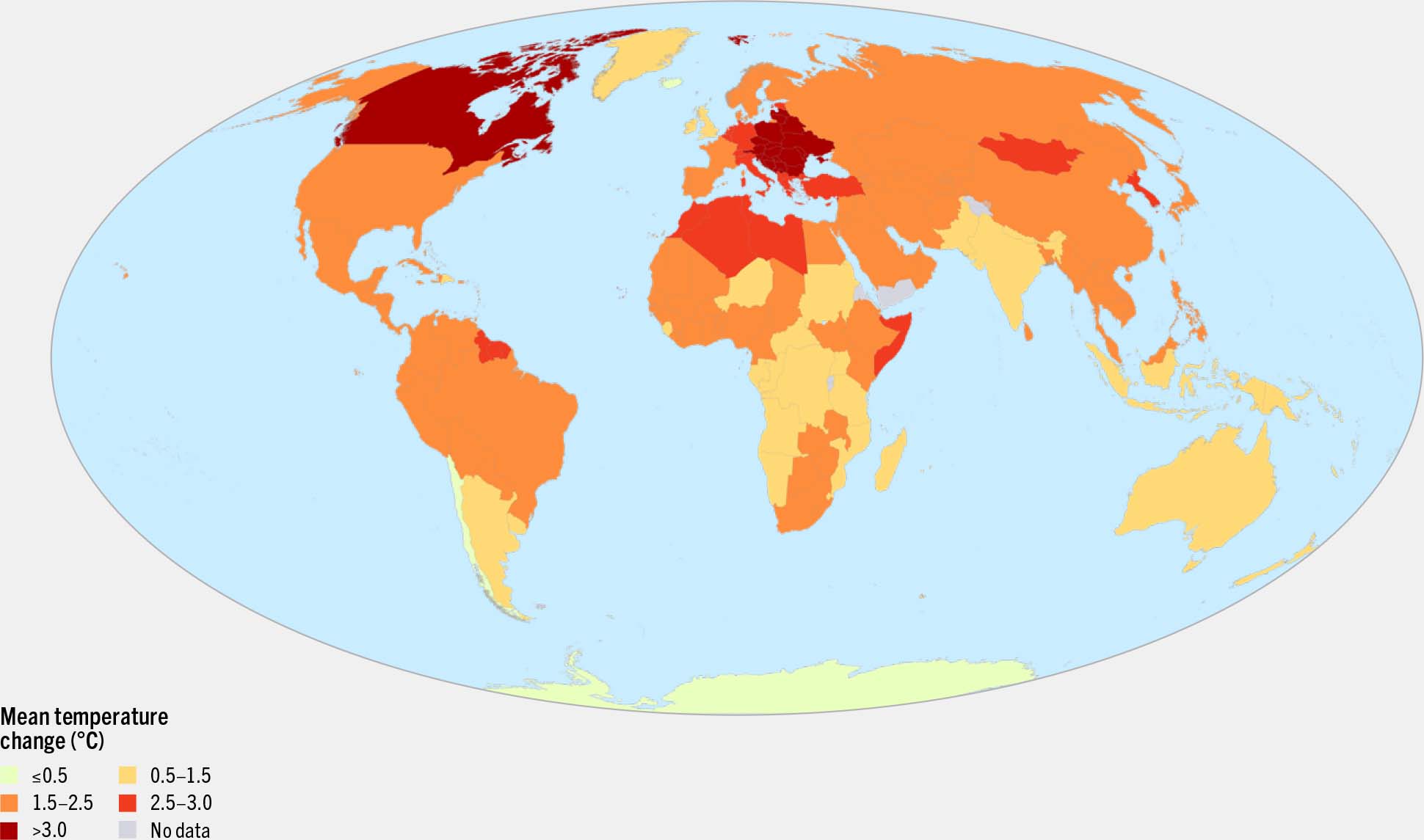
NOTE: Temperature changes are measured on land, excluding ocean data, with reference to a climatology baseline 1951–1980.
SOURCES: Authors’ own elaboration based on FAO. 2025. FAOSTAT: Temperature changes on land. [Accessed on 24 April 2025]. https://www.fao.org/faostat/en/#data/ET. Licence: CC-BY-4.0.

Hazardous weather events, including droughts, floods and heatwaves, disproportionately affect people living in low- and middle-income countries whose livelihoods closely depend on climate-exposed sectors such as agriculture (crop and livestock), forestry, fisheries and tourism (FAO, 2023d; IPCC, 2023). Land degradation exacerbates this situation by reducing the soil’s capacity to retain water. Rural people living in poverty, women and the elderly are more severely affected (FAO, 2024d). Drought has been singled out as a major driver of crop yield reductions globally. Data drawn from reporting to the UNCCD by more than 100 countries have indicated that 1.84 billion people were drought-stricken in the biennium 2022–2023 (UNCCD, 2023). Since 2012, nearly 500 Mha of land have been affected by flood events each year and fires have burned a cumulative area of more than 24 Mha of land and vegetation (EM-DAT, 2024).
Climate change is intensifying the increasingly erratic water cycle, posing serious challenges to agriculture. As part of the contribution of Working Group II to the Intergovernmental Panel on Climate Change (IPCC) Sixth Assessment Report, Caretta et al. (2022) assessed, observed and projected climate-induced changes in the water cycle. The key findings can be summarized as follows:
- Extreme weather events causing highly impactful floods and droughts have become more likely and/or more severe due to climate change. Climate change has contributed to the increased likelihood and severity of the impact of droughts (especially agricultural and hydrological droughts) in many regions, and drought risks are projected to increase over the twenty-first century in many regions, increasing economy-wide risks.
- A large share of climate adaptation interventions (~60 percent) are shaped in response to water-related hazards and involve water interventions (irrigation, rainwater harvesting, soil moisture conservation). Irrigation helps stabilize and increase crop yields and is often a preferred strategy for risk reduction, but irrigation is also associated with a range of adverse outcomes, including groundwater overextraction and additional pressure on already scarce water resources. If not planned carefully, adaptation can transform into maladaptation. For example, efficient irrigation technologies like drip irrigation, while reducing water application rates per unit of land, can increase overall water extraction by increasing total land under irrigation.
- Several mitigation measures, such as carbon capture and storage, bioenergy and afforestation and reforestation, can have a high water footprint.
- Globally, 10 percent of the most water-stressed basins account for 35 percent of global irrigated calorie production. Food production is at risk in these basins and beyond, due to changes in the hydrological components of climate change (i.e. rainfall patterns and evapotranspiration requirements).
- Climate change also affects freshwater ecosystems, fish and other aquatic populations that have low buffering capacity and are sensitive to climate-related shocks and variability.


