


- ➔ Land, soil and water form the foundations of agricultural production. Progress in agricultural production and productivity has made it possible to keep up with increasing demand from a rapidly growing population, but this has been achieved at a substantial environmental and social cost.
- ➔ Land productivity has increased substantially to respond to increasing demand. However, this has often had a negative effect on the environment, in particular on biodiversity, other ecosystem functions and services, and the quality and quantity of land and water resources.
- ➔ Human-induced land degradation affects cropland, pastures and forested land and the people depending on land for their livelihoods. Intensive agricultural practices and unsustainable use of chemicals increasingly lead to pollution and the depletion of land, soil and water resources.
- ➔ Unprecedented pressure on land, soil and water resources and competition between sectors are increasingly affecting agriculture, resulting in loss of productive land and reduced water availability for agriculture. As the main sector for freshwater withdrawals, agriculture contributes to and is increasingly affected by water scarcity. Overexploitation of groundwater and seawater intrusion in coastal aquifers are widespread.
- ➔ Social and gender inequalities persist in access to and governance and control of land and water resources, and undermine food security, especially for the most vulnerable groups.
- ➔ Climate change affects all components of agrifood systems, including land, soil and water resources, with impacts already observed in many areas, including the increasing occurrence of extreme events such as droughts and floods. In some areas, climate change exacerbates already problematic water scarcity.
- ➔ Sustainable management of land, soil and water resources can play a key role in both mitigation of and adaptation to climate change. However, investments and climate finance continue to be scarce and inadequate.
- ➔ Further, climate mitigation and adaptation measures need to be carefully planned to avoid maladaptation or unintended consequences, including additional pressure on scarce water resources or further degradation of land resources.
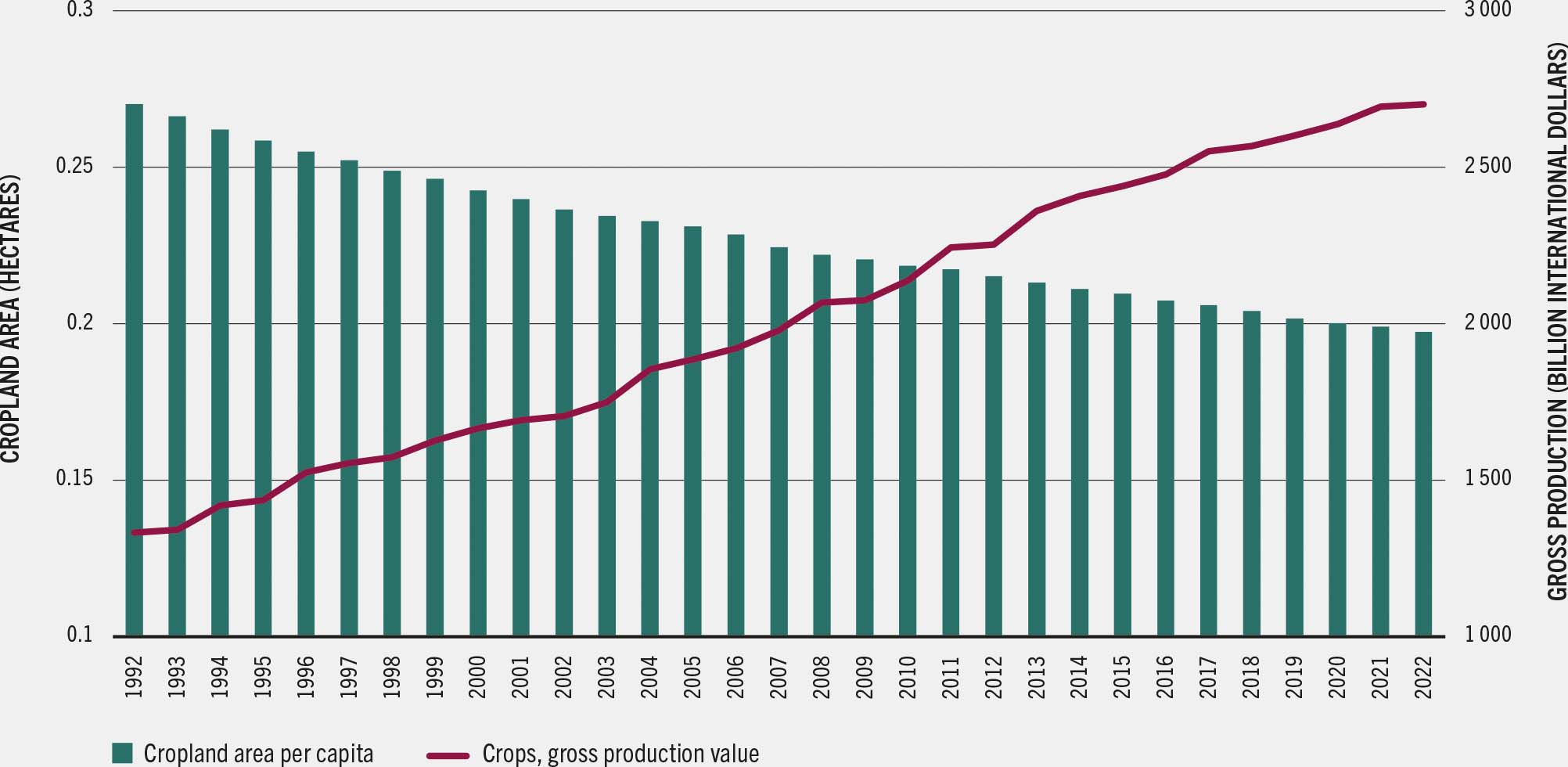
According to estimates by the Food and Agriculture Organization of the United Nations (FAO), on average, global agriculture needs to produce about 50 percent more food, feed and fibre by 2050 compared with 2012 (FAO, 2017, 2022a), with important differences between regions. In 2022, the global value of crop production reached 2.7 trillion international dollars,b nearly double its value in 1992. During the same period, per capita cropland area decreased by 27 percent globally, from 0.27 hectares (ha) in 1992 to less than 0.2 ha in 2022. In contrast, a progressive increase in land productivity was observed over the same period (see Figure 1).
Figure 1 Global trends in cropland area per capita and gross production value of crops, 1992–2022

However, in an increasing number of regions, food security and the agrifood systems on which it is based are at risk from unsustainable natural resource management practices, urban expansion, higher demand for food, water, energy and biomaterials, and persisting social and gender inequalities in access to and governance and control of resources (FAO, 2022a). Climate change is increasingly affecting food security through higher air temperatures, changing precipitation patterns and greater frequency of extreme events – all factors that affect food production. This trend is projected to create additional stress on land and water resources, exacerbating existing risks to livelihoods, biodiversity and food systems. (IPCC, 2019, 2023).
Lately, such land-use challenges have been aggravated by an increase in social instability and conflicts in many countries and regions of the world, affecting an estimated 1.9 billion ha or nearly 40 percent of agricultural land in 2023 (Raleigh, Kishi and Linke, 2023).
This chapter reviews some of the challenges that most directly affect the productive and sustainable management of land, soil and water resources for food and agriculture.
Human-induced land degradation and deforestation
The United Nations Convention to Combat Desertification (UNCCD) estimates that 52 percent of global agricultural land is degraded (UNCCD, 2022a). According to FAO, unsustainable land-use management and practices affect 1 660 million ha (Mha) of land globally (FAO, 2022a). Conservative estimates of the impact of soil erosion and salinization indicate that 82 Mha of rainfed cropland and 24 Mha of irrigated cropland are degraded from salinization processes alone (FAO, 2024a). Importantly, land degradation leads to a loss of habitat and a decline in species diversity, negatively impacting ecosystems and their ability to provide essential services and making them more vulnerable to drought (Rackelmann et al., 2024).
Land degradation increases flood and drought hazards. These events are not just caused by the excess or deficit of precipitation. They also depend on how the land surface receives, stores, transmits and releases water. When soils are healthy, porous, well graded, and rich in organic matter and biodiversity, they can readily absorb excess precipitation, attenuate peak flows and recharge the root-zone storage. Conversely, soils damaged by erosion, compaction, crusting or the exposure of dense clay layers can see their infiltration capacities reduced by 90 percent or more. Under such conditions, even moderate storms can cause flash floods, while dry spells can translate into agricultural droughts since the degraded root-zone storage cannot hold the required moisture to sustain crops until the next precipitation event. Seo et al. (2025) noted that regions experiencing the most severe soil structure loss from intensive cultivation, deforestation or overgrazing exhibit the steepest decline in root-zone moisture and the highest flood peaks for comparable rainfall events. This dual impact of flood amplification and drought intensification is largely attributed to degraded land.
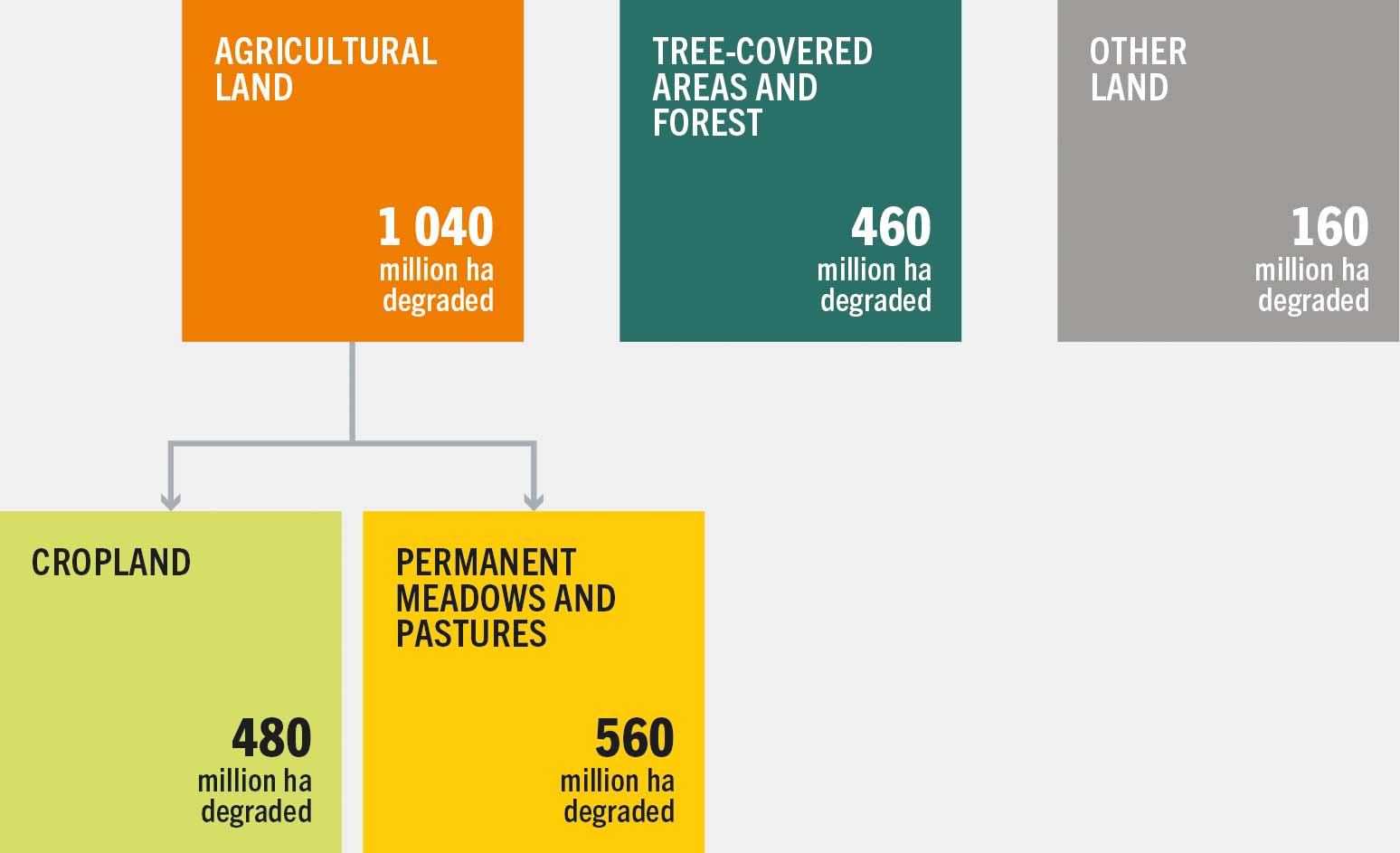
Some 480 Mha of human-induced land degradation occur in croplands where nutrient depletion, loss of soil organic carbon and biodiversity, soil erosion and high concentrations of salts constitute the main symptoms of land degradation (Ziadat et al., 2025). Around 560 Mha of human-induced degraded land are estimated to be in pastures and land used for animal husbandry, where the degradation is driven by unsustainable grazing practices and the invasion of alien species. In other words, more than 60 percent of human-induced land degradation is occurring in agricultural land (croplands and pasturelands), creating unprecedented pressure on the world’s agricultural systems.
Agricultural expansion drives nearly 90 percent of global deforestation (FAO, 2022b) and is a primary cause of the degradation of carbon-rich ecosystems such as peatlands (UNEP, 2022). The practice of burning vegetation for land clearance to sow crops is also one of the main triggers of degradation, as it contributes to loss of soil biodiversity and soil organic carbon and can affect the physical properties of soil such as aggregate stability, water repellency and retention capacity, increasing erodibility (Agbeshie et al., 2022).
Human-induced land degradation also affects the 460 Mha of global surface area that are covered with trees, including forests (see Figure 2). Forest fires, although a natural process, are becoming more frequent, aggressive and widespread across the globe due to human activities, and land-use and management practices, as well as climate change. Every year, an estimated 340 to 370 Mha of the Earth’s land surface are affected by fire (Giglio et al., 2010), including approximately 67 Mha of forested areas (van Lierop et al., 2015). There has been an increasing trend in global burnt area since 2021, with a peak recorded in 2023 (JRC, 2018). Forest fires and wildfires not only cause a loss of above ground biodiversity, but also alter soil biodiversity and functioning (Barreiro and Díaz-Raviña, 2021), contribute to the rapid evaporation of water, and increase the risk of erosion in affected areas (Doerr, Santín and Mataix-Solera, 2023). When wildfires affect carbon-rich soils and peatlands, massive greenhouse gas (GHG) emissions occur. It is estimated that the draining and burning of peatlands to make way for agricultural activities is responsible for nearly 1 gigatonne of carbon dioxide equivalent (CO2eq) every year or about 6 percent of the carbon emissions from global agrifood systems (FAO, 2023a).
Figure 2 Human-induced land degradation, 2020
Nutrient imbalances, including negative balances and overloads, contribute to cropland degradation (FAO, 2024b; Figure 3). A positive balance indicates excess application of nitrogen compared with the part that is extracted from the soil by crops (overload). Excessive use of nitrogen fertilizers in most regions leads to soil and water pollution. Conversely, a negative balance indicates a situation where crops extract more nutrients from the ground than those contributed by fertilizers. Soil nutrient depletion is aggravated by removals of crop residues or their burning, a practice widely adopted across the world (Lin and Begho, 2022). In 2022, the overall agricultural use of chemical fertilizers was 35 percent higher than in 2001, but declining rates have been observed since 2020 (FAO, 2025a). Rising prices, market constraints and geopolitical conflicts contribute to limiting the availability of fertilizers to farmers, leading to additional nutrient mining in already depleted soils (Smith et al., 2024).
Figure 3 Nitrogen nutrient balances per unit area of cropland, 2022
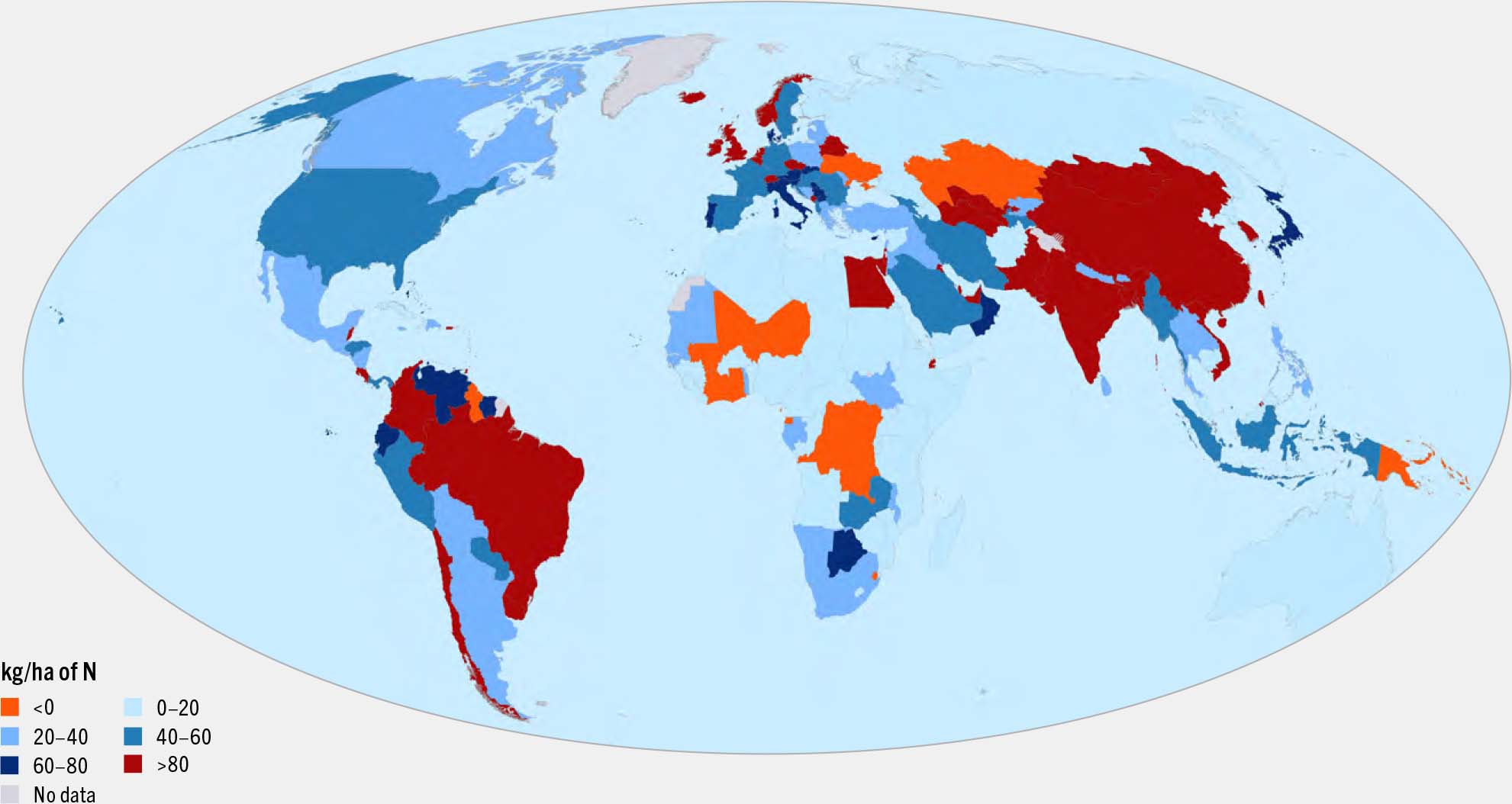
NOTE: Nitrogen (N) nutrient balances are calculated as the difference between inputs (synthetic fertilizers, manure, biological fixation, atmospheric deposition and seeds) and outputs (removal through harvest). Values below zero indicate soil nutrient impoverishment whereas positive balances above 80 kg/ha of N per ha suggest excessive applications.
SOURCE: Authors’ own elaboration based on FAO. 2025. FAOSTAT: Cropland nutrient balance. [Accessed on 13 February 2025]. https://www.fao.org/faostat/en/#data/ESB. Licence: CC-BY-4.0.
The inappropriate use of pesticides poses a serious threat to food safety and contributes to the decline in biodiversity by harming soil microbiota, causing the loss of pollinators and making agrifood systems less resilient to pests, pathogens and climate change (FAO, 2019, 2022c). Since 2001, agricultural use of pesticides has increased by 60 percent, reaching a global average of 2.4 kg per hectare of cropland, with several countries using up to six times the world average (FAO, 2024c), constituting hotspots of environmental concern (Maggi, Tang and Tubiello, 2023). It is estimated that 64 percent of agricultural land is at risk of pesticide pollution (Tang et al., 2021). Of particular concern are pesticides whose ingredients include perfluoroalkyl and polyfluoroalkyl substances (PFAS), known as “forever chemicals”. The presence of these high-risk contaminants can lead to significant economic losses in the event of contaminated food recalls and health hazards (Donley et al., 2024).


