

Irrigation plays a critical role in agricultural production. It ensures that crops benefit from adequate levels of soil moisture throughout the growing season. In so doing, it protects crops from the vagaries of climate, in particular the uncertainty associated with the volume and distribution of precipitations. In dry climates, irrigation is often an essential prerequisite for crop production (see Box 1).
Box 1How irrigation contributes to crop production
- Higher yields. Irrigated crops often yield more than rainfed ones, depending on crop type, region and water management. Estimates range from 30 to 300 percent more yield with irrigation than with rainfed cultivation. There is no real upper limit, as irrigation is often practised in arid areas where rainfed production would not be possible.
- Crop diversification and risk management. Irrigation enables farmers to grow high-value crops such as fruits, vegetables and spices while protecting them from excessive variations in precipitation. In particular, most vegetables require constant soil moisture, a situation that cannot be guaranteed in rainfed conditions.
- Double/triple cropping. Climatic conditions in many areas restrict cropping to part of the year, when rainfall is abundant. Irrigation allows farmers to boost production by using their land even during dry periods, thereby increasing cropping intensity.
- Stability, resilience and climate adaptation. Irrigation reduces the risk of crop failure due to drought or erratic rainfall. As such, it provides more predictability regarding production and incentivizes producers to invest in inputs such as nutrients or protection against pests and diseases, thus indirectly increasing yields. As rainfall patterns become more erratic due to climate change, the stabilizing role of irrigation is increasingly important.
Irrigation has substantial costs. Financially, the infrastructure and equipment needed to take water to fields represent a significant investment. Operation and maintenance costs are also relatively high compared with rainfed agriculture. In environment terms, irrigation is one of the main causes of water scarcity in many regions; given that agriculture accounts for about 72 percent of global freshwater withdrawals, it represents a substantial challenge to sustainable water management.
Assessing the costs and benefits of irrigation is therefore critical. In terms of benefits, the parameter often used is the contribution of irrigation to crop production. Whether this assessment is conducted at local, country or global level, the contribution of irrigation to crop production, and therefore to agriculture, is a key element to consider in agricultural policies.
Global statistics on irrigated production are scarce. FAO’s statistical database FAOSTAT offers a range of data on agricultural land and agricultural production by country, including the value of main agricultural commodities. FAO’s Global Information System on Water and Agriculture (AQUASTAT) offers a combination of data and information on irrigated agriculture for developing countries, as well as regional overviews. Country and regional profiles include data on the extent of irrigated crops.
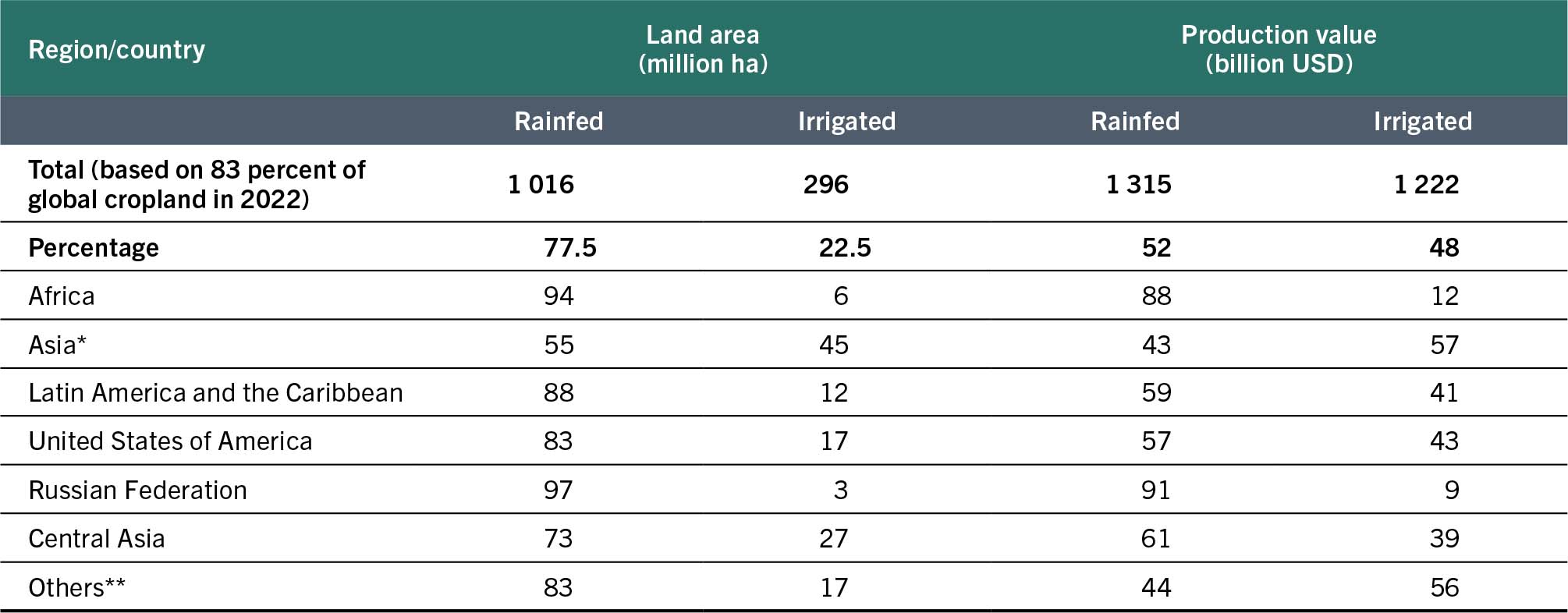
For this report, FAOSTAT and AQUASTAT data were used to estimate the contribution of irrigation to global crop production for the reference year 2022. A combination of regions and major agricultural countries were studied, representing 83 percent of the world’s cropland. The results of this analysis are presented in Table 7.
TABLE 7 IRRIGATED AND RAINFED LAND BY REGION, AND THE RELATIVE PRODUCTION VALUE
SOURCES: Authors’ own elaboration based on FAO. 2025. FAOSTAT: Land use. [Accessed on 13 February 2025]. https://www.fao.org/faostat/en/#data/RL. Licence: CC-BY-4.0; FAO. 2025. AQUASTAT. [Accessed on April 2025]. https://www.fao.org/aquastat/en/databases. Licence: CC-BY-4.0.
In 2022, 22.5 percent of all croplands were equipped for irrigation. These irrigated croplands produced 48 percent of all crops in value terms. This indicates that irrigated land is 3.2 times more productive than rainfed land. As previously mentioned, there are various factors that explain this difference, in particular: higher yields, the potential for increasing cropping intensity, and the fact that irrigation is systematically used to grow high-value crops. The study on irrigated and rainfed croplands conducted for this report estimates that, on average, the yield of irrigated production is 76 percent more than that of rainfed production. Cropping intensity in irrigated agriculture is estimated to be 25 percent higher than in rainfed agriculture. Finally, the value of irrigated production is 45 percent higher on average than the value of rainfed production. These figures are global estimates. Large differences are noted between countries and regions, according to the climatic conditions and the relative expansion of irrigation in agriculture.


