


- ➔ Sustainable and integrated solutions are required to face the food, climate, land, soil, water and biodiversity crises. The need for these solutions has been confirmed in recent international processes, with various calls for action and the setting of targets and commitments aimed at accelerating the achievement of the Sustainable Development Goals. Integrated land, soil and water solutions offer an enabling framework for countries to enhance their efforts towards addressing these intertwined crises in a holistic manner.
- ➔ The three Rio Conventions (Convention on Biological Diversity, United Nations Convention to Combat Desertification and United Nations Framework Convention on Climate Change [UNFCCC]) and their resolutions and decisions highlight the role of agrifood systems in tackling the interconnected triple challenges: ensuring food security and nutrition for a growing global population; supporting the livelihoods of hundreds of millions of farmers and others in the food supply chain; and achieving these goals while supporting sustainable management of the natural resources (land, soil and water) on which sustainable and diversified food production and livelihoods depend.
- ➔ An agrifood systems approach is essential, as reflected in various methodologies and tools. The agroecological approach focuses on protecting the ecosystem base on which agriculture depends, and the agrifoods systems approach aims to achieve all the SDGs.
- ➔ Coherence between sectoral policies is needed to maximize the gains associated with land and water management and address overlaps and trade-offs between competing or conflicting objectives.
- ➔ Integrated land-use planning is key to translate the systemic and integrated approaches on the ground. Moreover, it is necessary to strengthen institutions and regulatory frameworks, and ensure sustainable investment and financing.
- ➔ Integrated land-use planning enables informed decision-making at different levels to address challenges and competing demands. An evidence-based integrated planning process is essential to incorporate the needs and views of different sectors and stakeholders, considering emerging opportunities to enhance production in a sustainable manner. The nine-step FAO guidelines for integrated land-use planning aim to facilitate this process (FAO, forthcoming).
- ➔ An integrated landscape approach to land-use planning is vital. Field interventions can be defined together with those stakeholders who benefit from or are affected by the use of land and water resources. This will ensure that land users’ and stakeholders’ needs are fully reflected and that tools are in place to support land-use decisions from national to local level, while addressing power asymmetries and inclusivity by promoting responsible governance.
- ➔ Integrated water resources management (IWRM) is recommended to optimize the spatial and temporal allocation and use of water resources. This is crucial given that agriculture accounts for more than 70 percent of global freshwater withdrawals. Different needs must be met, taking into consideration quantity, quality and adequate timing. Furthermore, IWRM should go hand in hand with integrated land-use planning. The necessary trade-offs will be addressed by relevant institutions and stakeholders at relevant scales, such as at catchment or river basin, national, regional or international levels.
- ➔ The Water–Energy–Food–Ecosystems (WEFE) nexus approach acknowledges the interconnectedness between water, energy and food systems and their impact on ecosystems. The WEFE nexus enhances resilience, maximizes synergies and promotes the participation of stakeholders and the sustainability of agrifood systems.
- ➔ Institutional capacities and integrated systems of data, information, science and technologies must be set in place and strengthened to enable sustainable and integrated land, soil and water resources management and inform supportive and coherent policies.
- ➔ Rural development policies need to consider efficient and sustainable natural resources management, building resilience and diversifying production systems. A resilient rural economy is vital, and policies must aim to reconcile different land uses, demands and objectives.
- ➔ Tenure arrangements for land and water management often ignore smallholders and vulnerable groups and their legitimate claim to access these resources. Securing access for smallholders and vulnerable groups offers the potential to enhance productivity, protect resources and contribute to inclusive rural development.
- ➔ Data and information are key to ensuring the sustainable and productive management of land and water. The rapid development of information and communication technologies, including remote sensing, offers new opportunities for supporting land and water management. Efforts should be made to ensure that the right type of information reaches the different decision-makers at all levels, and on time.
- ➔ Regulatory frameworks are essential to create a more conducive environment for clarifying land and water rights, and supporting the sustainable management of natural resources and, in turn, public and private sector investment. Too often, unclear environmental regulations, compounded by weak enforcement, exacerbate existing challenges. Stronger policies to promote sustainable land, soil and water management should include clear land and water rights, incentives for sustainable practices and disincentives for unsustainable ones.
- ➔ Most traditional agricultural investment fails to capture the environmental and social costs and benefits associated with agricultural production. Public and private investment instruments that increase agricultural productivity, contribute to inclusive development and preserve natural resources need to be developed and put in practice; at the same time, harmful incentives and subsidies should be reduced and repurposed. Sustainable investments require coordinated collaboration between the public sector and the financial and private sectors.
- ➔ Farmers, especially in developing regions, often lack access to the necessary technologies, information and skills required to implement sustainable practices. This knowledge gap hinders the adoption of innovative and sustainable land and water management approaches and techniques. Farmer-centred training and extension programmes should be institutionalized and use modern communication technologies to promote the adoption of sustainable practices that strengthen resilience, while ensuring the overall improvement of farmers’ socioeconomic status.
- ➔ Farmers need to be recognized as agents of change. Their participation must be strengthened, ensuring that they are involved in the design of local solutions, and supporting their meaningful contribution in policy dialogue at all levels.
- ➔ Partnerships should be forged at different levels, from local to national, regional and international, to avoid duplication and enhance synergies and complementarities.
The previous chapters provide information about the potential to increase production and call for an enabling environment that should be enhanced to realize these options in practice. Thus far, the report has shown how, over the past decades, agriculture has responded to the rapidly increasing demand for food and other agricultural products. It has also stressed how these achievements have come at a heavy cost, both environmentally and in terms of resilience and inclusiveness. Land degradation, loss of biodiversity, increasing water stress and agriculture’s contribution to GHG emissions are putting production systems at risk, while competition for increasingly scarce land and water resources have disproportionally affected the most vulnerable populations who depend on them for their food security and livelihoods (Meybeck et al., 2024).
Chapter 4 showcased some examples of technical solutions, demonstrating how they are implemented in different contexts for more sustainable and inclusive management of land and water resources, while ensuring sufficient food production. If such solutions are to be adopted in the long term by billions of land and water users around the world, including farmers, herders, fisherfolk and forest dwellers, a series of enabling conditions must be put in place and made operational.
The transition to sustainable land and water management requires coordinated efforts by governments, financial institutions and the private sector to provide the necessary support to farmers. By leveraging key drivers in order to address the constraints to implementation, it is possible to scale up interventions that can not only enhance agricultural productivity but also preserve the natural resources on which future generations depend. The pathway to a sustainable future lies in fostering an enabling environment that supports integrated, inclusive and forward-looking action for land, soil and water resources.
The following sections discuss some of the most important drivers to make this happen. They are grouped into levers (the integrated approaches that provide the technical background for developing and managing agrifood systems) and enablers (for scaling up sustainable land and water resources management).
Levers: integrated approaches
Integrated approaches provide guidance for the effective, practical and coherent management of the interactions between different components of a system. They offer processes that seek to minimize any negative impact and maximize the expected benefits from social, economic and environmental perspectives. In agrifood systems, integrated approaches take into account the different facets of agriculture, since they are interrelated. The value of a system’s approach is explained in the following sections, which cover the interactions related to land, soil, water, agroecology and energy, among others, highlighting the importance of taking into account the needs of farmers and other stakeholders.
Lever 1: Integrated land-use planning
The ever-rising demand for food, feed and fibre, as well as competing demands from urbanization and other economic sectors, place increasing pressure on land and water resources. Land use is a function of four interrelated thematic spheres: landscape, markets, social norms and legislation. Each of the four spheres interacts with the others to generate a particular land-use pattern in a given territory or landscape. This implies that in order to enact necessary or desirable changes in land use, planning must anticipate the consequent changes that will be needed in one or more of the spheres that work together to form the land-use pattern. An evidence-based integrated planning process is essential, supported by suitable tools and practices that incorporate the needs and views of different sectors and stakeholders, emerging opportunities and challenges.
Land evaluation systems and tools help to better match land use with its sustainable potential in order to reduce the amount of land required to meet human needs, minimize land degradation and cost-effectively restore already degraded lands (UNEP, 2016).
Integrated land-use planning and territorial planning offer a suite of tools to balance competing land-use demands and allocate resources across multiple users, sectors and jurisdictions along an urban–rural continuum (UNCCD, 2023). The term “integrated” refers to recent trends in land-use planning: optimization of land and water use across different planning scales, participation by and consultation with stakeholders, multidisciplinary technical support, coordination with multiple sectors at different decision-making levels and the use of multiple tools. Modern approaches to ILUP are based on the principles of decentralization and participation, whereby the primary land users such as farmers, herders, fisherfolk or forest dwellers have a legitimate stake in the planning process, along with the actors who use the land for different purposes (e.g. settlements, sources of energy, industry, mineral resources, recreation and tourism). Increasing recognition is given to inclusiveness, taking account of the specific needs of men and women, and vulnerable and marginalized persons from different socioeconomic and ethnic groups (see Box 18).
Box 18Main features of integrated land-use planning (ILUP)
- Aims to enhance the sustainability of land use and management with the full participation of stakeholders.
- Assesses the prevailing biophysical, socioeconomic and legal conditions, drawing on multidisciplinary, multisectoral and local expertise to optimize land use across different parts of the landscape.
- Offers an approach to planning, taking into account that each situation is unique and demands its own solutions.
- Results in a negotiated outcome that needs to be implemented, evaluated and monitored.
Integrated land-use planning uses participatory approaches that empower stakeholders to analyse an existing situation and enable them to propose the necessary changes and develop an agreed plan. This calls for land users to be given a central role, since their intimate knowledge and experience of their own territory places them in the best position to articulate their needs and desires for change (see Box 19) (Ziadat et al., 2022).
Box 19Morocco: developing a Territorial Planning Pact in the Souss-Massa region
In Morocco, analyses were carried out to assess the types, degree and severity of land degradation “hotspots”, as well as “bright spots”, using FAO’s Land Degradation Assessment in Drylands (LADA) and World Overview of Conservation Approaches and Technologies (WOCAT) tools. The analyses helped to identify appropriate technological solutions for sustainable land management (SLM). Results from local assessments were used to implement a process of participatory land-use planning in selected communities of the Souss-Massa region. The process led to the development of a Territorial Planning Pact for land-use planning and a three-year action plan to help implement and mainstream SLM in selected communities. The pact forms a base for the planning development programme in the region, with the involvement of key stakeholders. This example highlights the importance of integrating biophysical and socioeconomic information as part of a participatory process to identify the actions and responsibilities of various stakeholders and ensure both the sustainable management of scarce natural resources and improved livelihoods.
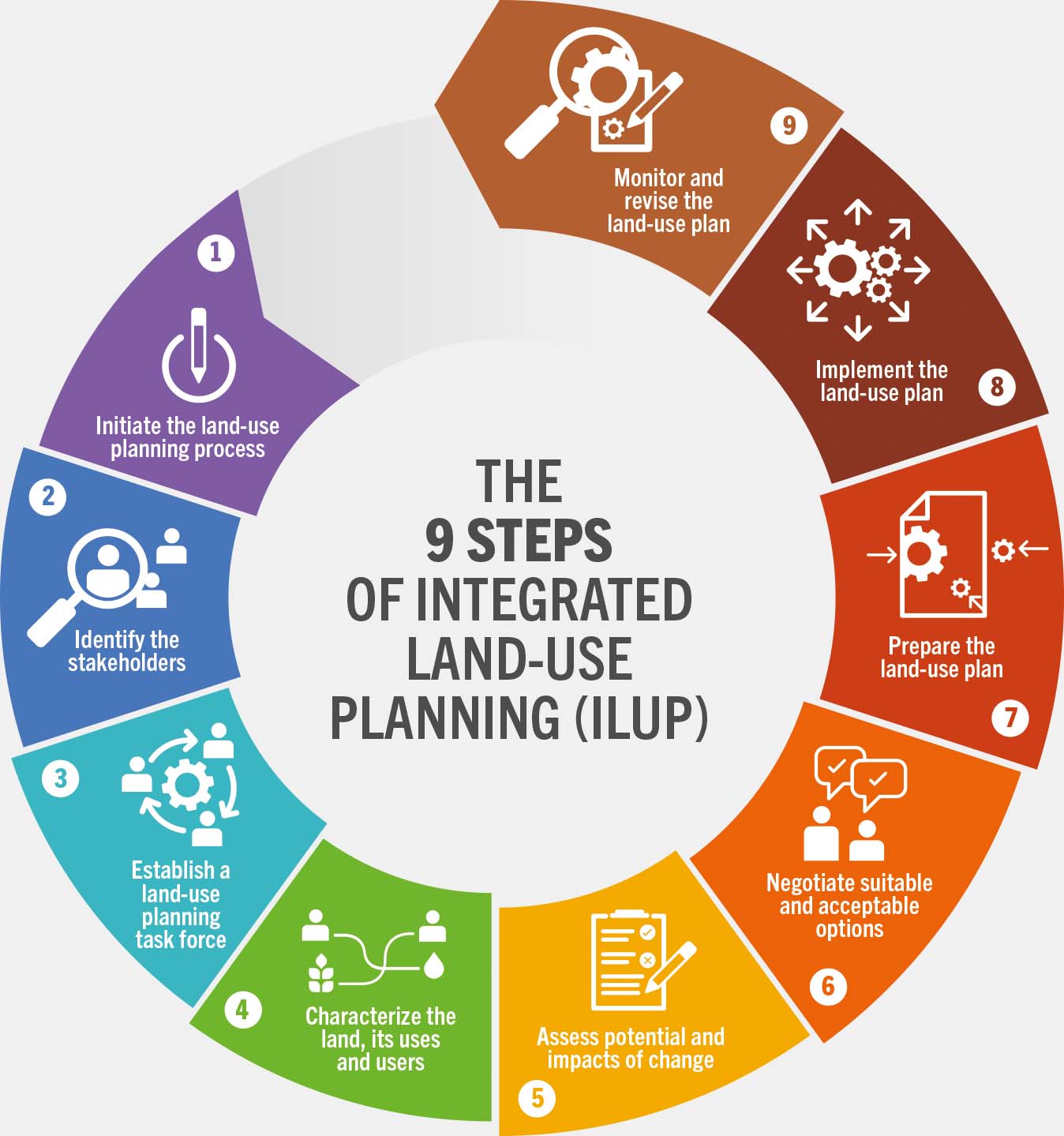
Integrated land-use planning considers the following issues: climate change, land degradation neutrality (LDN) and restoration, conservation and sustainable use of biodiversity, urbanization, peri-urban and urban agriculture, governance, land and water tenure, and the rights of women and Indigenous Peoples. FAO is in the process of updating the guidelines on ILUP based on nine steps (see Table 11 and Figure 27).
TABLE 11 NINE STEPS IN THE FAO GUIDELINES FOR INTEGRATED LAND-USE PLANNING
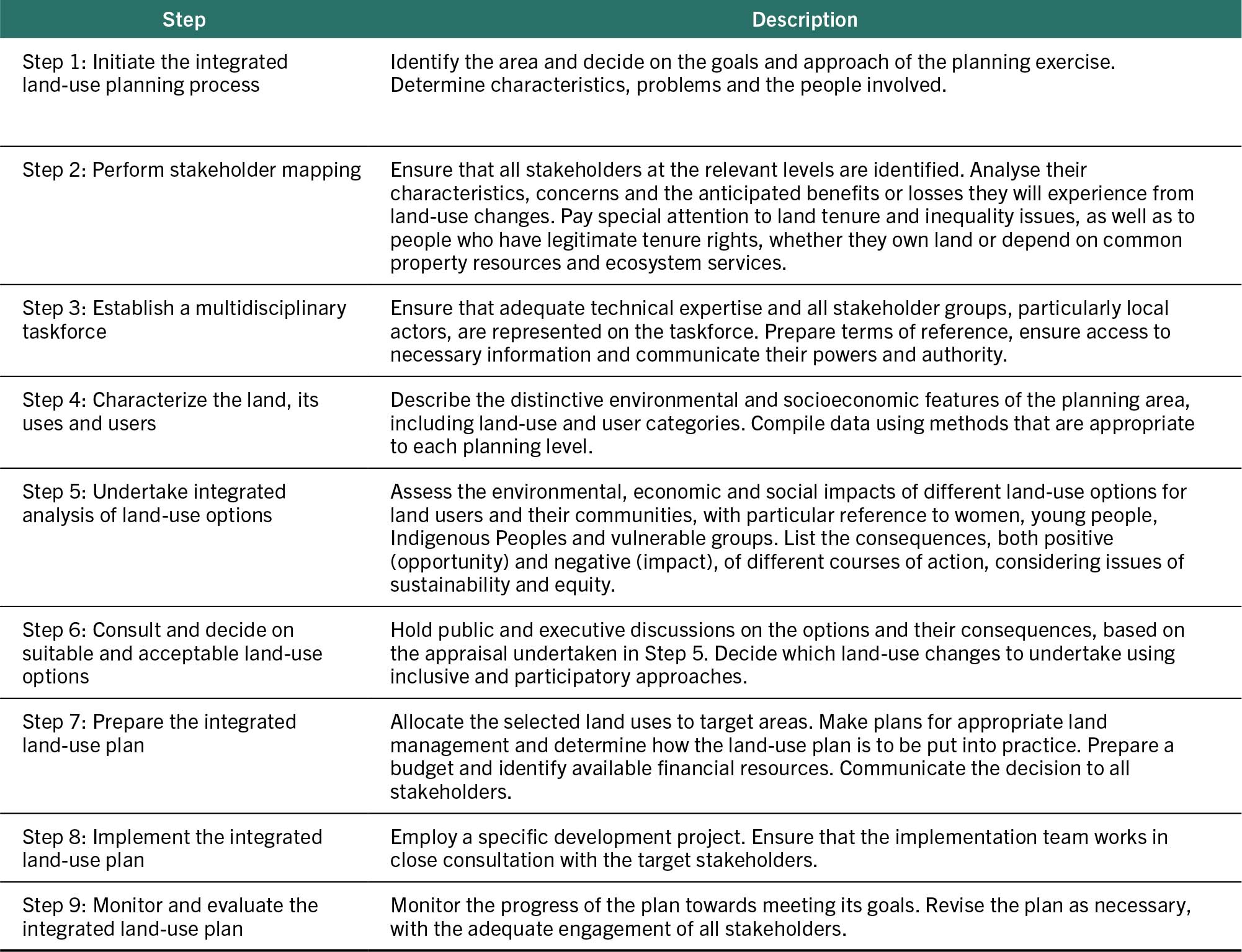
Figure 27 The nine steps of the FAO guidelines for integrated land-use planning
Lever 2: Integrated landscape management
Integrated landscape management is the basis of natural resource management; it ensures that, by managing the natural resource base and ecosystem services through a coordinated process across sectors and stakeholders, the full range of societal needs can be met in the short and long term (FAO, 2017a).
Diverse landscape management approaches have been developed from different entry points but aim at realizing multiple outcomes simultaneously. Commonalities include generating an agreed vision among stakeholders of long-term and wide-scale landscape goals; adopting a mosaic of practices that achieve multiple objectives; devising strategies to manage spatial interactions across different land uses and users; establishing institutions for stakeholder dialogue, negotiation and action; and shaping markets and policies to support desired outcomes. These processes cover the technical, socioeconomic, market and policy dimensions and are mutually reinforcing (LPFN, 2015).
Up-to-date land-use planning tools have strong potential to support integrated landscape management and land restoration processes. Field programmes should be designed and implemented in a range of countries to validate the utility of updated tools and to fine-tune them to ensure that user needs are fully reflected and that tools are in place to support land-use decisions at national to local scales (FAO, 2017a).
Lever 3: Integrated water resources management
Integrated water resources management (IWRM) is defined as ‘’a process that promotes the coordinated development and management of water, land and related resources in order to maximise the resultant economic and social welfare in an equitable manner without compromising the sustainability of vital ecosystems” (Agarwal et al., 2000, p. 6).
Adopting an IWRM approach is recommended to optimize the spatial and temporal allocation of water resources for different water quantity and quality needs. Such needs may be, for example, for crop varieties with their own cyclical – mostly seasonal – requirements, fisheries and aquaculture, livestock, and other non-agricultural sectors such as domestic water supply, energy, industry and recreation.
Given that agriculture accounts for more than 70 percent or freshwater abstractions, the sector plays a critical role in IWRM. Reducing inefficiencies makes it possible to produce more food (more crops per drop) and free more water for subsectors within agriculture and for other sectors; in addition, it ensures a more equitable sharing of water between different users, correcting past inequities in some instances. Integrated water resources management can also ensure the allocation of water for crops that are more nutritious and, where relevant, crops that give a higher economic return.
Integrated water resources management should be implemented hand in hand and in complementarity with integrated land-use planning. It fosters the establishment of institutional arrangements that will oversee equitable sharing of the socioeconomic and environmental benefits, taking into account upstream and downstream water demands at the scale of a catchment at local, national, regional or international levels, such as in shared river basins (see Box 20).
Box 20Making integrated water resources management work for fisheries
To reconcile the needs of inland fisheries with agricultural demands, adopting integrated water resources management (IWRM) is essential, as it facilitates cross-sector collaboration among fisheries managers, farmers and other water resource planners, ensuring that fisheries are considered part of the broader basin planning and management.
Assessing inland fisheries at basin scale is critical for understanding and managing the threats that they face. Basin-level assessments offer a comprehensive view of various factors impacting fisheries, such as habitat degradation, water pollution and overfishing (FAO and AfDB, 2024). Basin assessments can therefore play a crucial role in promoting IWRM by providing valuable insights into the productivity and health of inland fisheries, helping stakeholders to make informed decisions regarding water use and allocation.
Inland aquaculture presents another opportunity for integrated food production. Rice–fish farming systems are a prime example, where fish raised in flooded rice fields contribute both to farm incomes and nutrition, while simultaneously utilizing water more efficiently. Additionally, using nutrient-rich aquaculture water to irrigate crops can improve overall ecosystem productivity.
Finally, effective governance is critical to achieving sustainable outcomes in land and water management. Various policy frameworks (such as the Guidelines for Sustainable Aquaculture, the Voluntary Guidelines for Securing Sustainable Small-Scale Fisheries in the Context of Food Security and Poverty Eradication, and the Voluntary Guidelines on the Responsible Governance of Tenure of Land, Fisheries and Forests) emphasize the need for participatory governance, where small-scale fishers and aquaculture producers are actively involved in managing the resources on which they depend. Co-management approaches, which empower local communities to participate in decision-making processes, can help to balance the needs of different sectors and promote the sustainable use of aquatic ecosystems.
Lever 4: Water–Energy–Food–Ecosystems nexus
The Water–Energy–Food–Ecosystems (WEFE) nexus approach acknowledges the interconnection between water, energy, food and ecosystems. Water is essential for the production of energy such as hydropower and the cooling of coal-fired or nuclear power stations; energy is critical for accessing and distributing water; both water and energy are important in food systems, at different levels of the value chain, from production, transformation and commercialization to consumption. Food systems also have an impact on water and energy in different ways. For example, water used for agriculture may not be available for energy or other sectors and may result in water pollution.
Ultimately, any development linked to water, energy and food systems will have an impact on the ecosystems that provide the natural resource base on which it relies. A WEFE nexus approach therefore stresses the critical importance of ecosystems and includes: i) assessment of opportunities for maximizing synergies between the three components, achieving efficiencies and reducing any risk; ii) development of appropriate responses; and iii) implementation of the required practical solutions on the ground, in a participatory manner.
Understanding these key interactions, and the potential synergies and trade-offs between water resources, energy generation, food production and ecosystems, is critical to addressing growing societal demands in a context of climate change, increasing biodiversity loss and pollution.
The WEFE nexus is an efficient approach that enhances the resilience and sustainability of agrifood systems. It advances policy coherence and supports an integrated and coordinated approach across the four sectors, with a view to reconciling conflicting interests. FAO’s mandate to achieve food security serves as an entry point for its work on the WEFE nexus.
Lever 5: Agroecology
Agroecology has been defined as “the integration of research, education, action and change that brings sustainability to all parts of the food system: ecological, economic, and social” (Gliessman, 2007). Agroecology is transdisciplinary, in that it values all forms of knowledge and experience in food systems change. It is participatory, in that it requires the involvement of all stakeholders from the farm to the table and everyone in between. And it is action-oriented, because it confronts the economic and political power structures of the current industrial food system with alternative social structures and policy action. The approach is grounded in ecological thinking, where a holistic, systems-level understanding of food systems sustainability is required (Gliessman, 2018).
As in the definition, agroecology seeks to achieve a balance between three dimensions (ecological, economic and social) by integrating various disciplines that have an impact on food systems in a participatory manner, leading to the required actions in the face of competing pressures from economic and political structures, with the underlying prioritization of ecological integrity and sustainability (Tittonell, 2023).
While agroecology might not meet with a general consensus, it emphasizes that all stakeholders share the responsibility of ensuring that the integrity of ecosystems is not compromised by agriculture, highlighting the importance of locally driven solutions for sustainable agrifood systems.
Lever 6: Agrifood systems approach
Agrifood systems encompass the entire range of actors and their interlinked value-adding activities in the production, aggregation, processing, distribution, consumption and disposal of food products that originate from agriculture, forestry or fisheries, and parts of the broader economic, societal and natural environments in which they are embedded. Agrifood systems are composed of subsystems (e.g. farming, waste management and input supply systems) and interact with other key systems (e.g. energy, trade and health systems); they also interact with and depend on other interrelated systems such as water and land systems (FAO, 2025a). Therefore, a structural change in a food system may originate from a change in another system; for example, a policy promoting more biofuel in the energy system will have a significant impact on food systems (FAO, 2018).
Thus, in an agrifood systems approach, the interaction of each agricultural commodity with all other systems at the various steps in the value chain is considered with the aim of achieving food security and nutrition without compromising the economic, social and environmental bases on which it depends, for the needs of present and future generations. With the objective of contributing to the achievement of the Sustainable Development Goals, a sustainable food system may need to be assessed and redesigned in order to contribute to sustainable production, inclusivity, sustainability, resilience, nutrition and healthy diets, requiring different kinds of interventions (from policy to field actions) at different levels and from different role players.


